Factorials - Math
Card 1 of 324
Find the value of:

Find the value of:
Tap to reveal answer
The factorial sign (!) just tells us to multiply that number by every integer that leads up to it. So,  can also be written as:
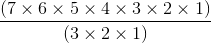
To make this easier for ourselves, we can cancel out the numbers that appear on both the top and bottom:

The factorial sign (!) just tells us to multiply that number by every integer that leads up to it. So,
To make this easier for ourselves, we can cancel out the numbers that appear on both the top and bottom:
← Didn't Know|Knew It →
What is the value of  ?
?
What is the value of
Tap to reveal answer
! is the symbol for factorial, which means the product of the whole numbers less than the given number.
Thus,  .
.
! is the symbol for factorial, which means the product of the whole numbers less than the given number.
Thus,
← Didn't Know|Knew It →
What is the value of  ?
?
What is the value of
Tap to reveal answer
By definition,  .
.
By definition,
← Didn't Know|Knew It →
Stewie has  marbles in a bag. How many marbles does Stewie have?
Stewie has
Tap to reveal answer

Simplifying this equation we notice that the 3's, 2's, and 1's cancel so

Alternative Solution

Simplifying this equation we notice that the 3's, 2's, and 1's cancel so
Alternative Solution
← Didn't Know|Knew It →
Which of the following is equivalent to  ?
?
Which of the following is equivalent to
Tap to reveal answer
This is a factorial question. The formula for factorials is  .
.

This is a factorial question. The formula for factorials is
← Didn't Know|Knew It →
Which of the following is NOT the same as  ?
?
Which of the following is NOT the same as
Tap to reveal answer
The  cancels out all of
  except for the parts higher than 4, this leaves a 6 and a 5 left to multilpy
The
← Didn't Know|Knew It →
Find the value of:
Find the value of:
Tap to reveal answer
The factorial sign (!) just tells us to multiply that number by every integer that leads up to it. So, can also be written as:
To make this easier for ourselves, we can cancel out the numbers that appear on both the top and bottom:
The factorial sign (!) just tells us to multiply that number by every integer that leads up to it. So,
To make this easier for ourselves, we can cancel out the numbers that appear on both the top and bottom:
← Didn't Know|Knew It →
Simplify the following expression:

Simplify the following expression:
Tap to reveal answer
Recall that  .
.
Likewise,  .
.
Thus, the expression  can be simplified in two parts:

and

The product of these two expressions is the final answer: 
Recall that
Likewise,
Thus, the expression
and
The product of these two expressions is the final answer:
← Didn't Know|Knew It →

Tap to reveal answer
To simplify this, just write out each factorial:

To simplify this, just write out each factorial:
← Didn't Know|Knew It →

If  is a postive integer, which of the following answer choices is a possible value for the expression.
If
Tap to reveal answer
This expression of factorials reduces to (n+1)(n+2). Therefore, the solution must be a number that multiplies to 2 consecutive integers. Only 30 is a product of 2 consecutive integers. 
So n would have to be 4 in this problem.
This expression of factorials reduces to (n+1)(n+2). Therefore, the solution must be a number that multiplies to 2 consecutive integers. Only 30 is a product of 2 consecutive integers.
So n would have to be 4 in this problem.
← Didn't Know|Knew It →
Divide  by
by 
Divide
Tap to reveal answer
A factorial is a number which is the product of itself and all integers before it. For example 
In our case we are asked to divide  by
by  . To do this we will set up the following:

We know that  can be rewritten as the product of itself and all integers before it or:

Substituting this equivalency in and simplifying the term, we get:

A factorial is a number which is the product of itself and all integers before it. For example
In our case we are asked to divide
We know that
Substituting this equivalency in and simplifying the term, we get:
← Didn't Know|Knew It →
Simplify:

Simplify:
Tap to reveal answer
Remember what a factorial is, and first write out what the original equation means. A factorial is a number that you multiply by all whole numbers that come before it until you reach one.
You can simplify because all terms in the expression 17! are found in 20!.
Thus:


Remember what a factorial is, and first write out what the original equation means. A factorial is a number that you multiply by all whole numbers that come before it until you reach one.
You can simplify because all terms in the expression 17! are found in 20!.
Thus:
← Didn't Know|Knew It →
Simplify: 
Simplify:
Tap to reveal answer
Rewrite the factorials in multiplicative order.

In this scenario, the numbers of the factorial in the numerator and denominator CANNOT cancel. Simplify by multiplying out the factorials.

Rewrite the factorials in multiplicative order.
In this scenario, the numbers of the factorial in the numerator and denominator CANNOT cancel. Simplify by multiplying out the factorials.
← Didn't Know|Knew It →
Simplify the following expression:

Simplify the following expression:
Tap to reveal answer
n! indicates a factorial, which means the products of numbers from 1 to n.



n! indicates a factorial, which means the products of numbers from 1 to n.
← Didn't Know|Knew It →
Divide: 
Divide:
Tap to reveal answer
Write out the terms for the factorial.
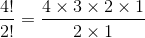
Cancel out the common numbers in the numerator and denominator.

The answer is  .
.
Write out the terms for the factorial.
Cancel out the common numbers in the numerator and denominator.
The answer is
← Didn't Know|Knew It →
Multiply: 
Multiply:
Tap to reveal answer
To evaluate the product of these factorials, we will need to expand the factorials.

Multiply all the values.

The answer is: 
To evaluate the product of these factorials, we will need to expand the factorials.
Multiply all the values.
The answer is:
← Didn't Know|Knew It →
Divide: 
Divide:
Tap to reveal answer
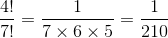
Expand the factorials in the numerator and denominator.

The terms 1, 2, 3, and 4 can be eliminated from the numerator and denominator. The simplification becomes:
Expand the factorials in the numerator and denominator.
The terms 1, 2, 3, and 4 can be eliminated from the numerator and denominator. The simplification becomes:
← Didn't Know|Knew It →
Solve: 
Solve:
Tap to reveal answer
Evaluate the factorials first.


Substitute the values back into the expression.

Simplify the numerator.

Evaluate the factorials first.
Substitute the values back into the expression.
Simplify the numerator.
← Didn't Know|Knew It →
Solve the factorial: 
Solve the factorial:
Tap to reveal answer
Evaluate each factorial inside the parentheses.
Zero factorial is equal to  . Simplify by order of operations.

The answer is  .
.
Evaluate each factorial inside the parentheses.
Zero factorial is equal to
The answer is
← Didn't Know|Knew It →
Simplify the following factorial:

Simplify the following factorial:
Tap to reveal answer
Simplify the following factorial:

To solve this, we need to understand factorials. Factorials are denoted by a number followed by the ! sign. What a factorial is, is a given number multiplied by each positive integer leading up to the given number. Stated differently...

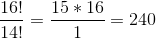
So what we have above is really:

Now, because numbers 1 through 14 are in the numerator and the denominator, they will cancel and we will be left with:
Simplify the following factorial:
To solve this, we need to understand factorials. Factorials are denoted by a number followed by the ! sign. What a factorial is, is a given number multiplied by each positive integer leading up to the given number. Stated differently...
So what we have above is really:
Now, because numbers 1 through 14 are in the numerator and the denominator, they will cancel and we will be left with:
← Didn't Know|Knew It →