How to find the volume of a pyramid - Math
Card 1 of 40
An architect wants to make a square pyramid and fill it with 12,000 cubic feet of sand. If the base of the pyramid is 30 feet on each side, how tall does he need to make it?
An architect wants to make a square pyramid and fill it with 12,000 cubic feet of sand. If the base of the pyramid is 30 feet on each side, how tall does he need to make it?
Tap to reveal answer
Volume of Pyramid = 1/3 * Area of Base * Height
12,000 ft3 = 1/3 * 30ft * 30ft * H
12,000 = 300 * H
H = 12,000 / 300 = 40
H = 40 ft
Volume of Pyramid = 1/3 * Area of Base * Height
12,000 ft3 = 1/3 * 30ft * 30ft * H
12,000 = 300 * H
H = 12,000 / 300 = 40
H = 40 ft
← Didn't Know|Knew It →
The volume of a 6-foot-tall square pyramid is 8 cubic feet. How long are the sides of the base?
The volume of a 6-foot-tall square pyramid is 8 cubic feet. How long are the sides of the base?
Tap to reveal answer
Volume of a pyramid is

Thus:


Area of the base is  .
.
Therefore, each side is  .
.
Volume of a pyramid is
Thus:
Area of the base is
Therefore, each side is
← Didn't Know|Knew It →
What is the sum of the number of vertices, edges, and faces of a square pyramid?
What is the sum of the number of vertices, edges, and faces of a square pyramid?
Tap to reveal answer
A square pyramid has one square base and four triangular sides.
Vertices (where two or more edges come together): 5. There are four vertices on the base (one at each corner of the square) and a fifth at the top of the pyramid.
Edges (where two faces come together): 8. There are four edges on the base (one along each side) and four more along the sides of the triangular faces extending from the corners of the base to the top vertex.
Faces (planar surfaces): 5. The base is one face, and there are four triangular faces that form the top of the pyramid.
Total 
A square pyramid has one square base and four triangular sides.
Vertices (where two or more edges come together): 5. There are four vertices on the base (one at each corner of the square) and a fifth at the top of the pyramid.
Edges (where two faces come together): 8. There are four edges on the base (one along each side) and four more along the sides of the triangular faces extending from the corners of the base to the top vertex.
Faces (planar surfaces): 5. The base is one face, and there are four triangular faces that form the top of the pyramid.
Total
← Didn't Know|Knew It →
What is the volume of a pyramid with a height of  and a square base with a side length of
  ?
?
What is the volume of a pyramid with a height of
Tap to reveal answer
To find the volume of a pyramid we must use the equation

We must first solve for the area of the square using

We plug in  and square it to get
We then plug our answer into the equation for the pyramid with the height to get
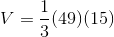
We multiply the result to get our final answer for the volume of the pyramid
 .
.
To find the volume of a pyramid we must use the equation
We must first solve for the area of the square using
We plug in
We then plug our answer into the equation for the pyramid with the height to get
We multiply the result to get our final answer for the volume of the pyramid
← Didn't Know|Knew It →
Find the volume of the following pyramid. Round the answer to the nearest integer.
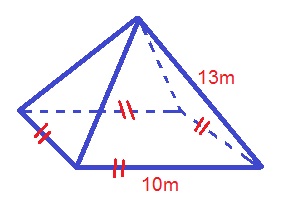
Find the volume of the following pyramid. Round the answer to the nearest integer.
Tap to reveal answer
The formula for the volume of a pyramid is:

where  is the width of the base,
  is the length of the base, and
  is the height of the pyramid.
In order to determine the height of the pyramid, you will need to use the Pythagoream Theorem to find the slant height:




Now we can use the slant height to find the pyramid height, once again using the Pythagoream Theorem:




Plugging in our values, we get:



The formula for the volume of a pyramid is:
where
In order to determine the height of the pyramid, you will need to use the Pythagoream Theorem to find the slant height:
Now we can use the slant height to find the pyramid height, once again using the Pythagoream Theorem:
Plugging in our values, we get:
← Didn't Know|Knew It →
Find the volume of the following pyramid.
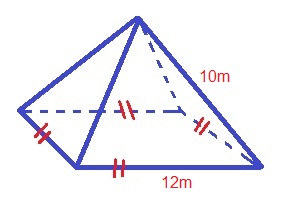
Find the volume of the following pyramid.
Tap to reveal answer
The formula for the volume of a pyramid is:
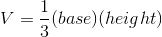
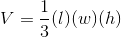
Where  is the length of the base,
  is the width of the base, and
  is the height of the pyramid
Use the Pythagorean Theorem to find the length of the slant height:



Now, use the Pythagorean Theorem again to find the length of the height:



Plugging in our values, we get:


The formula for the volume of a pyramid is:
Where
Use the Pythagorean Theorem to find the length of the slant height:
Now, use the Pythagorean Theorem again to find the length of the height:
Plugging in our values, we get:
← Didn't Know|Knew It →
An architect wants to make a square pyramid and fill it with 12,000 cubic feet of sand. If the base of the pyramid is 30 feet on each side, how tall does he need to make it?
An architect wants to make a square pyramid and fill it with 12,000 cubic feet of sand. If the base of the pyramid is 30 feet on each side, how tall does he need to make it?
Tap to reveal answer
Volume of Pyramid = 1/3 * Area of Base * Height
12,000 ft3 = 1/3 * 30ft * 30ft * H
12,000 = 300 * H
H = 12,000 / 300 = 40
H = 40 ft
Volume of Pyramid = 1/3 * Area of Base * Height
12,000 ft3 = 1/3 * 30ft * 30ft * H
12,000 = 300 * H
H = 12,000 / 300 = 40
H = 40 ft
← Didn't Know|Knew It →
The volume of a 6-foot-tall square pyramid is 8 cubic feet. How long are the sides of the base?
The volume of a 6-foot-tall square pyramid is 8 cubic feet. How long are the sides of the base?
Tap to reveal answer
Volume of a pyramid is
Thus:
Area of the base is .
Therefore, each side is .
Volume of a pyramid is
Thus:
Area of the base is
Therefore, each side is
← Didn't Know|Knew It →
What is the sum of the number of vertices, edges, and faces of a square pyramid?
What is the sum of the number of vertices, edges, and faces of a square pyramid?
Tap to reveal answer
A square pyramid has one square base and four triangular sides.
Vertices (where two or more edges come together): 5. There are four vertices on the base (one at each corner of the square) and a fifth at the top of the pyramid.
Edges (where two faces come together): 8. There are four edges on the base (one along each side) and four more along the sides of the triangular faces extending from the corners of the base to the top vertex.
Faces (planar surfaces): 5. The base is one face, and there are four triangular faces that form the top of the pyramid.
Total
A square pyramid has one square base and four triangular sides.
Vertices (where two or more edges come together): 5. There are four vertices on the base (one at each corner of the square) and a fifth at the top of the pyramid.
Edges (where two faces come together): 8. There are four edges on the base (one along each side) and four more along the sides of the triangular faces extending from the corners of the base to the top vertex.
Faces (planar surfaces): 5. The base is one face, and there are four triangular faces that form the top of the pyramid.
Total
← Didn't Know|Knew It →
What is the volume of a pyramid with a height of and a square base with a side length of ?
What is the volume of a pyramid with a height of
Tap to reveal answer
To find the volume of a pyramid we must use the equation
We must first solve for the area of the square using
We plug in and square it to get
We then plug our answer into the equation for the pyramid with the height to get
We multiply the result to get our final answer for the volume of the pyramid
.
To find the volume of a pyramid we must use the equation
We must first solve for the area of the square using
We plug in
We then plug our answer into the equation for the pyramid with the height to get
We multiply the result to get our final answer for the volume of the pyramid
← Didn't Know|Knew It →
Find the volume of the following pyramid. Round the answer to the nearest integer.
Find the volume of the following pyramid. Round the answer to the nearest integer.
Tap to reveal answer
The formula for the volume of a pyramid is:
where is the width of the base, is the length of the base, and is the height of the pyramid.
In order to determine the height of the pyramid, you will need to use the Pythagoream Theorem to find the slant height:
Now we can use the slant height to find the pyramid height, once again using the Pythagoream Theorem:
Plugging in our values, we get:
The formula for the volume of a pyramid is:
where
In order to determine the height of the pyramid, you will need to use the Pythagoream Theorem to find the slant height:
Now we can use the slant height to find the pyramid height, once again using the Pythagoream Theorem:
Plugging in our values, we get:
← Didn't Know|Knew It →
Find the volume of the following pyramid.
Find the volume of the following pyramid.
Tap to reveal answer
The formula for the volume of a pyramid is:
Where is the length of the base, is the width of the base, and is the height of the pyramid
Use the Pythagorean Theorem to find the length of the slant height:
Now, use the Pythagorean Theorem again to find the length of the height:
Plugging in our values, we get:
The formula for the volume of a pyramid is:
Where
Use the Pythagorean Theorem to find the length of the slant height:
Now, use the Pythagorean Theorem again to find the length of the height:
Plugging in our values, we get:
← Didn't Know|Knew It →
Pyramid 1 has a square base with sidelength  ; its height is
  .
.
Pyramid 2 has a square base with sidelength  ; its height is
  .
.
Which is the greater quantity?
(a) The volume of Pyramid 1
(b) The volume of Pyramid 2
Pyramid 1 has a square base with sidelength
Pyramid 2 has a square base with sidelength
Which is the greater quantity?
(a) The volume of Pyramid 1
(b) The volume of Pyramid 2
Tap to reveal answer
Use the formula  on each pyramid.
(a) 

(b) 

Regardless of  , (b) is the greater quantity.
Use the formula
(a)
(b)
Regardless of
← Didn't Know|Knew It →
Which is the greater quantity?
(a) The volume of a pyramid with height 4, the base of which has sidelength 1
(b) The volume of a pyramid with height 1, the base of which has sidelength 2
Which is the greater quantity?
(a) The volume of a pyramid with height 4, the base of which has sidelength 1
(b) The volume of a pyramid with height 1, the base of which has sidelength 2
Tap to reveal answer
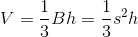
The volume of a pyramid with height  and a square base with sidelength
  is
is
 .
.
(a) Substitute  :
: 
(b) Substitute  :
: 
The two pyramids have equal volume.
The volume of a pyramid with height
(a) Substitute
(b) Substitute
The two pyramids have equal volume.
← Didn't Know|Knew It →
Which is the greater quantity?
(a) The volume of a pyramid whose base is a square with sidelength 8 inches
(b) The volume of a pyramid whose base is an equilateral triangle with sidelength one foot
Which is the greater quantity?
(a) The volume of a pyramid whose base is a square with sidelength 8 inches
(b) The volume of a pyramid whose base is an equilateral triangle with sidelength one foot
Tap to reveal answer
The volume of a pyramid is one-third of the product of the height and the area of the base. The areas of the bases can be calculated, but no information is given about the heights of the pyramids. There is not enough information to determine which one has the greater volume.
The volume of a pyramid is one-third of the product of the height and the area of the base. The areas of the bases can be calculated, but no information is given about the heights of the pyramids. There is not enough information to determine which one has the greater volume.
← Didn't Know|Knew It →
A pyramid with a square base has height equal to the perimeter of its base. Its volume is  . In terms of
  , what is the length of each side of its base?
A pyramid with a square base has height equal to the perimeter of its base. Its volume is
Tap to reveal answer
The volume of a pyramid is given by the formula

where  is the area of its base and
  is its height.
Let  be the length of one side of the square base. Then the height is equal to the perimeter of that square, so

and the area of the base is

So the volume formula becomes
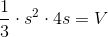
Solve for  :
:

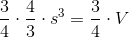


The volume of a pyramid is given by the formula
where
Let
and the area of the base is
So the volume formula becomes
Solve for
← Didn't Know|Knew It →
Pyramid 1 has a square base with sidelength ; its height is .
Pyramid 2 has a square base with sidelength ; its height is .
Which is the greater quantity?
(a) The volume of Pyramid 1
(b) The volume of Pyramid 2
Pyramid 1 has a square base with sidelength
Pyramid 2 has a square base with sidelength
Which is the greater quantity?
(a) The volume of Pyramid 1
(b) The volume of Pyramid 2
Tap to reveal answer
Use the formula on each pyramid.
(a)
(b)
Regardless of , (b) is the greater quantity.
Use the formula
(a)
(b)
Regardless of
← Didn't Know|Knew It →
Which is the greater quantity?
(a) The volume of a pyramid with height 4, the base of which has sidelength 1
(b) The volume of a pyramid with height 1, the base of which has sidelength 2
Which is the greater quantity?
(a) The volume of a pyramid with height 4, the base of which has sidelength 1
(b) The volume of a pyramid with height 1, the base of which has sidelength 2
Tap to reveal answer
The volume of a pyramid with height and a square base with sidelength is
.
(a) Substitute :
(b) Substitute :
The two pyramids have equal volume.
The volume of a pyramid with height
(a) Substitute
(b) Substitute
The two pyramids have equal volume.
← Didn't Know|Knew It →
Which is the greater quantity?
(a) The volume of a pyramid whose base is a square with sidelength 8 inches
(b) The volume of a pyramid whose base is an equilateral triangle with sidelength one foot
Which is the greater quantity?
(a) The volume of a pyramid whose base is a square with sidelength 8 inches
(b) The volume of a pyramid whose base is an equilateral triangle with sidelength one foot
Tap to reveal answer
The volume of a pyramid is one-third of the product of the height and the area of the base. The areas of the bases can be calculated, but no information is given about the heights of the pyramids. There is not enough information to determine which one has the greater volume.
The volume of a pyramid is one-third of the product of the height and the area of the base. The areas of the bases can be calculated, but no information is given about the heights of the pyramids. There is not enough information to determine which one has the greater volume.
← Didn't Know|Knew It →
A pyramid with a square base has height equal to the perimeter of its base. Its volume is . In terms of , what is the length of each side of its base?
A pyramid with a square base has height equal to the perimeter of its base. Its volume is
Tap to reveal answer
The volume of a pyramid is given by the formula
where is the area of its base and is its height.
Let be the length of one side of the square base. Then the height is equal to the perimeter of that square, so
and the area of the base is
So the volume formula becomes
Solve for :
The volume of a pyramid is given by the formula
where
Let
and the area of the base is
So the volume formula becomes
Solve for
← Didn't Know|Knew It →