How to find the perimeter of an acute / obtuse triangle - Math
Card 1 of 108
Two similiar triangles exist where the ratio of perimeters is 4:5 for the smaller to the larger triangle. If the larger triangle has sides of 6, 7, and 12 inches, what is the perimeter, in inches, of the smaller triangle?
Two similiar triangles exist where the ratio of perimeters is 4:5 for the smaller to the larger triangle. If the larger triangle has sides of 6, 7, and 12 inches, what is the perimeter, in inches, of the smaller triangle?
Tap to reveal answer
The larger triangle has a perimeter of 25 inches. Therefore, using a 4:5 ratio, the smaller triangle's perimeter will be 20 inches.
The larger triangle has a perimeter of 25 inches. Therefore, using a 4:5 ratio, the smaller triangle's perimeter will be 20 inches.
← Didn't Know|Knew It →
If a = 7 and b = 4, which of the following could be the perimeter of the triangle?
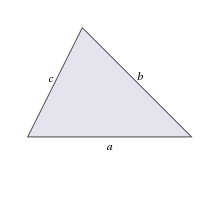
I. 11
II. 15
III. 25
If a = 7 and b = 4, which of the following could be the perimeter of the triangle?
I. 11
II. 15
III. 25
Tap to reveal answer
Consider the perimeter of a triangle:
P = a + b + c
Since we know a and b, we can find c.
In I:
11 = 7 + 4 + c
11 = 11 + c
c = 0
Note that if c = 0, the shape is no longer a trial. Thus, we can eliminate I.
In II:
15 = 7 + 4 + c
15 = 11 + c
c = 4.
This is plausible given that the other sides are 7 and 4.
In III:
25 = 7 + 4 + c
25 = 11 + c
c = 14.
It is not possible for one side of a triangle to be greater than the sum of both of the other sides, so eliminate III.
Thus we are left with only II.
Consider the perimeter of a triangle:
P = a + b + c
Since we know a and b, we can find c.
In I:
11 = 7 + 4 + c
11 = 11 + c
c = 0
Note that if c = 0, the shape is no longer a trial. Thus, we can eliminate I.
In II:
15 = 7 + 4 + c
15 = 11 + c
c = 4.
This is plausible given that the other sides are 7 and 4.
In III:
25 = 7 + 4 + c
25 = 11 + c
c = 14.
It is not possible for one side of a triangle to be greater than the sum of both of the other sides, so eliminate III.
Thus we are left with only II.
← Didn't Know|Knew It →
Two sides of an isosceles triangle are 20 and 30. What is the difference of the largest and the smallest possible perimeters?
Two sides of an isosceles triangle are 20 and 30. What is the difference of the largest and the smallest possible perimeters?
Tap to reveal answer
The trick here is that we don't know which is the repeated side. Our possible triangles are therefore 20 + 20 + 30 = 70 or 30 + 30 + 20 = 80. The difference is therefore 80 – 70 or 10.
The trick here is that we don't know which is the repeated side. Our possible triangles are therefore 20 + 20 + 30 = 70 or 30 + 30 + 20 = 80. The difference is therefore 80 – 70 or 10.
← Didn't Know|Knew It →
Two similiar triangles have a ratio of perimeters of 7:2.
If the smaller triangle has sides of 3, 7, and 5, what is the perimeter of the larger triangle.
Two similiar triangles have a ratio of perimeters of 7:2.
If the smaller triangle has sides of 3, 7, and 5, what is the perimeter of the larger triangle.
Tap to reveal answer
Adding the sides gives a perimeter of 15 for the smaller triangle. Multipying by the given ratio of $\frac{7}{2}$, yields 52.5.
Adding the sides gives a perimeter of 15 for the smaller triangle. Multipying by the given ratio of $\frac{7}{2}$, yields 52.5.
← Didn't Know|Knew It →
Two similiar triangles exist where the ratio of perimeters is 4:5 for the smaller to the larger triangle. If the larger triangle has sides of 6, 7, and 12 inches, what is the perimeter, in inches, of the smaller triangle?
Two similiar triangles exist where the ratio of perimeters is 4:5 for the smaller to the larger triangle. If the larger triangle has sides of 6, 7, and 12 inches, what is the perimeter, in inches, of the smaller triangle?
Tap to reveal answer
The larger triangle has a perimeter of 25 inches. Therefore, using a 4:5 ratio, the smaller triangle's perimeter will be 20 inches.
The larger triangle has a perimeter of 25 inches. Therefore, using a 4:5 ratio, the smaller triangle's perimeter will be 20 inches.
← Didn't Know|Knew It →
If a = 7 and b = 4, which of the following could be the perimeter of the triangle?
I. 11
II. 15
III. 25
If a = 7 and b = 4, which of the following could be the perimeter of the triangle?
I. 11
II. 15
III. 25
Tap to reveal answer
Consider the perimeter of a triangle:
P = a + b + c
Since we know a and b, we can find c.
In I:
11 = 7 + 4 + c
11 = 11 + c
c = 0
Note that if c = 0, the shape is no longer a trial. Thus, we can eliminate I.
In II:
15 = 7 + 4 + c
15 = 11 + c
c = 4.
This is plausible given that the other sides are 7 and 4.
In III:
25 = 7 + 4 + c
25 = 11 + c
c = 14.
It is not possible for one side of a triangle to be greater than the sum of both of the other sides, so eliminate III.
Thus we are left with only II.
Consider the perimeter of a triangle:
P = a + b + c
Since we know a and b, we can find c.
In I:
11 = 7 + 4 + c
11 = 11 + c
c = 0
Note that if c = 0, the shape is no longer a trial. Thus, we can eliminate I.
In II:
15 = 7 + 4 + c
15 = 11 + c
c = 4.
This is plausible given that the other sides are 7 and 4.
In III:
25 = 7 + 4 + c
25 = 11 + c
c = 14.
It is not possible for one side of a triangle to be greater than the sum of both of the other sides, so eliminate III.
Thus we are left with only II.
← Didn't Know|Knew It →
Two sides of an isosceles triangle are 20 and 30. What is the difference of the largest and the smallest possible perimeters?
Two sides of an isosceles triangle are 20 and 30. What is the difference of the largest and the smallest possible perimeters?
Tap to reveal answer
The trick here is that we don't know which is the repeated side. Our possible triangles are therefore 20 + 20 + 30 = 70 or 30 + 30 + 20 = 80. The difference is therefore 80 – 70 or 10.
The trick here is that we don't know which is the repeated side. Our possible triangles are therefore 20 + 20 + 30 = 70 or 30 + 30 + 20 = 80. The difference is therefore 80 – 70 or 10.
← Didn't Know|Knew It →
Two similiar triangles have a ratio of perimeters of 7:2.
If the smaller triangle has sides of 3, 7, and 5, what is the perimeter of the larger triangle.
Two similiar triangles have a ratio of perimeters of 7:2.
If the smaller triangle has sides of 3, 7, and 5, what is the perimeter of the larger triangle.
Tap to reveal answer
Adding the sides gives a perimeter of 15 for the smaller triangle. Multipying by the given ratio of $\frac{7}{2}$, yields 52.5.
Adding the sides gives a perimeter of 15 for the smaller triangle. Multipying by the given ratio of $\frac{7}{2}$, yields 52.5.
← Didn't Know|Knew It →
Two similiar triangles exist where the ratio of perimeters is 4:5 for the smaller to the larger triangle. If the larger triangle has sides of 6, 7, and 12 inches, what is the perimeter, in inches, of the smaller triangle?
Two similiar triangles exist where the ratio of perimeters is 4:5 for the smaller to the larger triangle. If the larger triangle has sides of 6, 7, and 12 inches, what is the perimeter, in inches, of the smaller triangle?
Tap to reveal answer
The larger triangle has a perimeter of 25 inches. Therefore, using a 4:5 ratio, the smaller triangle's perimeter will be 20 inches.
The larger triangle has a perimeter of 25 inches. Therefore, using a 4:5 ratio, the smaller triangle's perimeter will be 20 inches.
← Didn't Know|Knew It →
If a = 7 and b = 4, which of the following could be the perimeter of the triangle?
I. 11
II. 15
III. 25
If a = 7 and b = 4, which of the following could be the perimeter of the triangle?
I. 11
II. 15
III. 25
Tap to reveal answer
Consider the perimeter of a triangle:
P = a + b + c
Since we know a and b, we can find c.
In I:
11 = 7 + 4 + c
11 = 11 + c
c = 0
Note that if c = 0, the shape is no longer a trial. Thus, we can eliminate I.
In II:
15 = 7 + 4 + c
15 = 11 + c
c = 4.
This is plausible given that the other sides are 7 and 4.
In III:
25 = 7 + 4 + c
25 = 11 + c
c = 14.
It is not possible for one side of a triangle to be greater than the sum of both of the other sides, so eliminate III.
Thus we are left with only II.
Consider the perimeter of a triangle:
P = a + b + c
Since we know a and b, we can find c.
In I:
11 = 7 + 4 + c
11 = 11 + c
c = 0
Note that if c = 0, the shape is no longer a trial. Thus, we can eliminate I.
In II:
15 = 7 + 4 + c
15 = 11 + c
c = 4.
This is plausible given that the other sides are 7 and 4.
In III:
25 = 7 + 4 + c
25 = 11 + c
c = 14.
It is not possible for one side of a triangle to be greater than the sum of both of the other sides, so eliminate III.
Thus we are left with only II.
← Didn't Know|Knew It →
Two sides of an isosceles triangle are 20 and 30. What is the difference of the largest and the smallest possible perimeters?
Two sides of an isosceles triangle are 20 and 30. What is the difference of the largest and the smallest possible perimeters?
Tap to reveal answer
The trick here is that we don't know which is the repeated side. Our possible triangles are therefore 20 + 20 + 30 = 70 or 30 + 30 + 20 = 80. The difference is therefore 80 – 70 or 10.
The trick here is that we don't know which is the repeated side. Our possible triangles are therefore 20 + 20 + 30 = 70 or 30 + 30 + 20 = 80. The difference is therefore 80 – 70 or 10.
← Didn't Know|Knew It →
Two similiar triangles have a ratio of perimeters of 7:2.
If the smaller triangle has sides of 3, 7, and 5, what is the perimeter of the larger triangle.
Two similiar triangles have a ratio of perimeters of 7:2.
If the smaller triangle has sides of 3, 7, and 5, what is the perimeter of the larger triangle.
Tap to reveal answer
Adding the sides gives a perimeter of 15 for the smaller triangle. Multipying by the given ratio of $\frac{7}{2}$, yields 52.5.
Adding the sides gives a perimeter of 15 for the smaller triangle. Multipying by the given ratio of $\frac{7}{2}$, yields 52.5.
← Didn't Know|Knew It →
An acute isosceles triangle has an area of  square units and a base with length
  . Find the perimeter of this triangle.
An acute isosceles triangle has an area of
Tap to reveal answer
To solve this problem, first work backwards using the formula:

Plugging in the given information and solving for height.


Now that you've found the height of the triangle, use the Pythagorean Theorem to find the length of one of the equivalent sides of the triangle.
(Note, when applying the formula divide the measurement of the base in half--so the triangle will have sides of  and
and  .
.
Thus, the solution is:


In this problem, the isosceles triangle will have two sides with the length of  and one side length of
  . Therefore, the perimeter is:
To solve this problem, first work backwards using the formula:
Plugging in the given information and solving for height.
Now that you've found the height of the triangle, use the Pythagorean Theorem to find the length of one of the equivalent sides of the triangle.
(Note, when applying the formula divide the measurement of the base in half--so the triangle will have sides of
Thus, the solution is:
In this problem, the isosceles triangle will have two sides with the length of
← Didn't Know|Knew It →
A scalene triangle has sides with lengths of  foot,
foot,  foot, and
  foot. Find the perimeter of the the triangle (in inches).
A scalene triangle has sides with lengths of
Tap to reveal answer
To solve this problem, first convert each of the fractions from feet to inches.
 inches
 inches
 inches
The perimeter of the triangle must equal 
To solve this problem, first convert each of the fractions from feet to inches.
The perimeter of the triangle must equal
← Didn't Know|Knew It →
An acute triangle has side lengths of  and
and  . The hypotenuse of the triangle is not
  . Find the perimeter of this triangle.
An acute triangle has side lengths of
Tap to reveal answer
Since the two side lengths provided in the question are not the hypotenuse, first use the Pythagorean Theorem to find the length of the third side.


The perimeter is equal to  .
.


Since the two side lengths provided in the question are not the hypotenuse, first use the Pythagorean Theorem to find the length of the third side.
The perimeter is equal to
← Didn't Know|Knew It →

Find the perimeter of the triangle shown above.
Find the perimeter of the triangle shown above.
Tap to reveal answer
Since the two side lengths provided in the question are not the hypotenuse, first use the Pythagorean Theorem to find the length of the third side.


Perimeter is equal to  .
.

Since the two side lengths provided in the question are not the hypotenuse, first use the Pythagorean Theorem to find the length of the third side.
Perimeter is equal to
← Didn't Know|Knew It →
An obtuse Isosceles triangle has an area of  square units and a base with length
  . Find the perimeter of this triangle.
An obtuse Isosceles triangle has an area of
Tap to reveal answer
To solve this solution, first work backwards using the formula: 


Now that you've found the height of the triangle, use the Pythagorean Theorem to find the length of one of the equivalent sides of the triangle.
(Note, when applying the formula divide the measurement of the base in half--so the triangle will have sides of  and .
and .
Thus, the solution is:


In this problem, the isosceles triangle will have two sides with the length of  and one side length of
  . Therefore, the perimeter is:
  .
.
To solve this solution, first work backwards using the formula:
Now that you've found the height of the triangle, use the Pythagorean Theorem to find the length of one of the equivalent sides of the triangle.
(Note, when applying the formula divide the measurement of the base in half--so the triangle will have sides of
Thus, the solution is:
In this problem, the isosceles triangle will have two sides with the length of
← Didn't Know|Knew It →

Find the perimeter of the acute isosceles triangle shown above. Note, the triangle has a base of  and height of
  .
.
Find the perimeter of the acute isosceles triangle shown above. Note, the triangle has a base of
Tap to reveal answer
Use the Pythagorean Theorem to find the length of one of the equivalent sides of the triangle.
(Note, when applying the formula divide the measurement of the base in half--so the triangle will have sides of  and .
and .
Thus, the solution is:


In this problem, the isosceles triangle will have two sides with the length of  and one side length of
  . Therefore, the perimeter is:
  .
.
Use the Pythagorean Theorem to find the length of one of the equivalent sides of the triangle.
(Note, when applying the formula divide the measurement of the base in half--so the triangle will have sides of
Thus, the solution is:
In this problem, the isosceles triangle will have two sides with the length of
← Didn't Know|Knew It →
For the triangle below, the perimeter is  . Find the value of
  .
.

For the triangle below, the perimeter is
Tap to reveal answer
The dashes on the two sides of the triangle indicate that those two sides are congruent. Thus, the length of the missing side is  also.
also.
Now, use the information given about the perimeter to set up an equation to solve for  . The sum of all the sides will give the perimeter.


The dashes on the two sides of the triangle indicate that those two sides are congruent. Thus, the length of the missing side is
Now, use the information given about the perimeter to set up an equation to solve for
← Didn't Know|Knew It →
Find the value of  if the perimeter is
  .
.

Find the value of
Tap to reveal answer
The dashes on the two sides of the triangle indicate that those two sides are congruent. Thus, the length of the missing side is  also.
also.
Now, use the information given about the perimeter to set up an equation to solve for  . The sum of all the sides will give the perimeter.


The dashes on the two sides of the triangle indicate that those two sides are congruent. Thus, the length of the missing side is
Now, use the information given about the perimeter to set up an equation to solve for
← Didn't Know|Knew It →