How to find the perimeter of a parallelogram - Math
Card 1 of 96
Find the perimeter (in inches) of a parallelogram that has a base of  and a side length of
  .
.
Find the perimeter (in inches) of a parallelogram that has a base of
Tap to reveal answer
To find the perimeter of the parallelogram apply the formula:  . However, to find the solution with the correct unit, convert
  and
and  . We can convert feet into inches because
  .
.
Thus, the solution is:


To find the perimeter of the parallelogram apply the formula:
Thus, the solution is:
← Didn't Know|Knew It →
A parallelogram has a base length of  and a side length of
  . Find the perimeter of the parallelogram.
A parallelogram has a base length of
Tap to reveal answer
To solve this problem, apply the formula:  .
.
Since, the side length is equal to  , the solution is:


To solve this problem, apply the formula:
Since, the side length is equal to
← Didn't Know|Knew It →

Find the perimeter of the parallelogram shown above.
Find the perimeter of the parallelogram shown above.
Tap to reveal answer
In order to find the perimeter of this parallelogram, apply the formula:
 .
.
The solution is:


In order to find the perimeter of this parallelogram, apply the formula:
The solution is:
← Didn't Know|Knew It →
If a parallelogram has a base that is three times the length of the side, and the side length is equal to  , what is the perimeter of the parallelogram in inches?
If a parallelogram has a base that is three times the length of the side, and the side length is equal to
Tap to reveal answer
The side length of this parallelogram is  foot, which is equivalent to
  inches because
  .
.
Thus, the base must be  .
.
Then, apply the formula 


The side length of this parallelogram is
Thus, the base must be
Then, apply the formula
← Didn't Know|Knew It →

Find the perimeter of the parallelogram shown above.
Find the perimeter of the parallelogram shown above.
Tap to reveal answer
To find the perimeter of this parallelogram, first find the length of the side:  .
.
Since,  , the side must be
  .
.
Then apply the formula:


To find the perimeter of this parallelogram, first find the length of the side:
Since,
Then apply the formula:
← Didn't Know|Knew It →
A parallelogram has a side length  that of the length of the base. If the length of the base is
  , find the perimeter of the parallelogram.
A parallelogram has a side length
Tap to reveal answer
Since the side is  the length of the base, the side is equal to
  .
.
Then apply the formula  .
.
The solution is:


Since the side is
Then apply the formula
The solution is:
← Didn't Know|Knew It →
If a parallelogram has a base of  and a side length of
  , find the perimeter of the parallelogram.
If a parallelogram has a base of
Tap to reveal answer
To solve this problem, apply the formula:  .
.
Thus, the solution is:


To solve this problem, apply the formula:
Thus, the solution is:
← Didn't Know|Knew It →

Find the perimeter of the parallelogram shown above.
Find the perimeter of the parallelogram shown above.
Tap to reveal answer
To solve this problem, apply the formula  .
.
Since the length of the side is not provided in the figure, apply the formula  , where
  ,
,  and
and  the side of the parallelogram.
The solution is:


Thus,

To solve this problem, apply the formula
Since the length of the side is not provided in the figure, apply the formula
The solution is:
Thus,
← Didn't Know|Knew It →
A parallelogram has a base that is  times greater than the length of the side of the parallelogram. If the length of the side is
  , what is the perimeter of the parallelogram?
A parallelogram has a base that is
Tap to reveal answer
To solve this problem, first find the  . Then to find the length of the base:
Then apply the formula:
 .
.


To solve this problem, first find the
Then apply the formula:
← Didn't Know|Knew It →
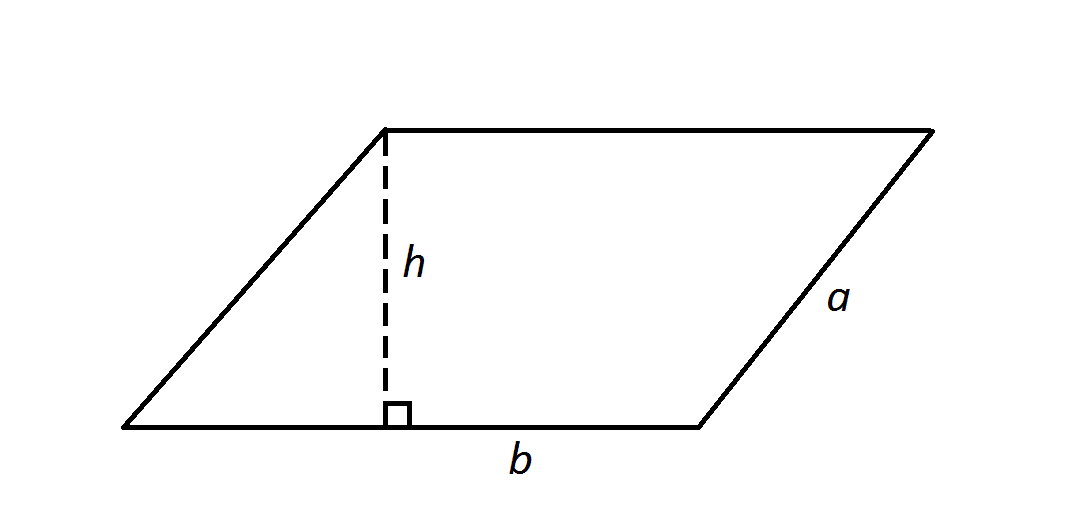
Note: Figure NOT drawn to scale.
 , where
  and
and  represent side lengths of the parallelogram and
  represents the height.
Find the perimeter of the parallelogram in the diagram.
Note: Figure NOT drawn to scale.


Find the perimeter of the parallelogram in the diagram.
Tap to reveal answer
The perimeter of the parallelogram is the sum of the four side lengths - here, that formula becomes
 .
.
Note that the height  is irrelevant to the answer.
The perimeter of the parallelogram is the sum of the four side lengths - here, that formula becomes
Note that the height
← Didn't Know|Knew It →
Find the perimeter of the parallelogram.
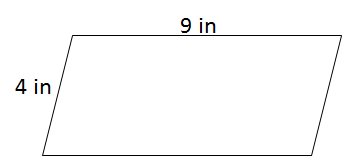
Find the perimeter of the parallelogram.
Tap to reveal answer
To find the perimeter of a parallelogram, add the lengths of the sides. Opposite sides of a parallelogram are equivalent.

To find the perimeter of a parallelogram, add the lengths of the sides. Opposite sides of a parallelogram are equivalent.
← Didn't Know|Knew It →
If the perimter of a parallelogram is  and one of the sides is
  , what is the other side length?
If the perimter of a parallelogram is
Tap to reveal answer
The perimeter of a parallelogram is found by adding up all four sides.
Since there are two pairs of side with equal lengths, two sides must have a length of  .
.
So the perimeter would be
 or
or  .
.
To find the value of the other side length, you would divide the remaining perimeter not include in the other sides by  .
.
So  .
.
That means the other side length would be  .
.
The perimeter of a parallelogram is found by adding up all four sides.
Since there are two pairs of side with equal lengths, two sides must have a length of
So the perimeter would be
To find the value of the other side length, you would divide the remaining perimeter not include in the other sides by
So
That means the other side length would be
← Didn't Know|Knew It →
If a parallelogram has side lengths of  and
and  , what is the perimeter?
If a parallelogram has side lengths of
Tap to reveal answer
The perimeter of a parallelogram is two times the two side lengths and add them together.
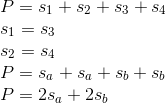
Therefore, this particular problem becomes as follows.

and

so
 .
.
The perimeter of a parallelogram is two times the two side lengths and add them together.
Therefore, this particular problem becomes as follows.
and
so
← Didn't Know|Knew It →
Find the perimeter (in inches) of a parallelogram that has a base of and a side length of .
Find the perimeter (in inches) of a parallelogram that has a base of
Tap to reveal answer
To find the perimeter of the parallelogram apply the formula: . However, to find the solution with the correct unit, convert and . We can convert feet into inches because .
Thus, the solution is:
To find the perimeter of the parallelogram apply the formula:
Thus, the solution is:
← Didn't Know|Knew It →
A parallelogram has a base length of and a side length of . Find the perimeter of the parallelogram.
A parallelogram has a base length of
Tap to reveal answer
To solve this problem, apply the formula: .
Since, the side length is equal to , the solution is:
To solve this problem, apply the formula:
Since, the side length is equal to
← Didn't Know|Knew It →
Find the perimeter of the parallelogram shown above.
Find the perimeter of the parallelogram shown above.
Tap to reveal answer
In order to find the perimeter of this parallelogram, apply the formula:
.
The solution is:
In order to find the perimeter of this parallelogram, apply the formula:
The solution is:
← Didn't Know|Knew It →
If a parallelogram has a base that is three times the length of the side, and the side length is equal to , what is the perimeter of the parallelogram in inches?
If a parallelogram has a base that is three times the length of the side, and the side length is equal to
Tap to reveal answer
The side length of this parallelogram is foot, which is equivalent to inches because .
Thus, the base must be .
Then, apply the formula
The side length of this parallelogram is
Thus, the base must be
Then, apply the formula
← Didn't Know|Knew It →
Find the perimeter of the parallelogram shown above.
Find the perimeter of the parallelogram shown above.
Tap to reveal answer
To find the perimeter of this parallelogram, first find the length of the side: .
Since, , the side must be .
Then apply the formula:
To find the perimeter of this parallelogram, first find the length of the side:
Since,
Then apply the formula:
← Didn't Know|Knew It →
A parallelogram has a side length that of the length of the base. If the length of the base is , find the perimeter of the parallelogram.
A parallelogram has a side length
Tap to reveal answer
Since the side is the length of the base, the side is equal to .
Then apply the formula .
The solution is:
Since the side is
Then apply the formula
The solution is:
← Didn't Know|Knew It →
If a parallelogram has a base of and a side length of , find the perimeter of the parallelogram.
If a parallelogram has a base of
Tap to reveal answer
To solve this problem, apply the formula: .
Thus, the solution is:
To solve this problem, apply the formula:
Thus, the solution is:
← Didn't Know|Knew It →