How to find the length of the side of a square - Math
Card 1 of 268
The area of square R is 12 times the area of square T. If the area of square R is 48, what is the length of one side of square T?
The area of square R is 12 times the area of square T. If the area of square R is 48, what is the length of one side of square T?
Tap to reveal answer
We start by dividing the area of square R (48) by 12, to come up with the area of square T, 4. Then take the square root of the area to get the length of one side, giving us 2.
We start by dividing the area of square R (48) by 12, to come up with the area of square T, 4. Then take the square root of the area to get the length of one side, giving us 2.
← Didn't Know|Knew It →
When the side of a certain square is increased by 2 inches, the area of the resulting square is 64 sq. inches greater than the original square. What is the length of the side of the original square, in inches?
When the side of a certain square is increased by 2 inches, the area of the resulting square is 64 sq. inches greater than the original square. What is the length of the side of the original square, in inches?
Tap to reveal answer
Let x represent the length of the original square in inches. Thus the area of the original square is x2. Two inches are added to x, which is represented by x+2. The area of the resulting square is (x+2)2. We are given that the new square is 64 sq. inches greater than the original. Therefore we can write the algebraic expression:
x2 + 64 = (x+2)2
FOIL the right side of the equation.
x2 + 64 = x2 + 4x + 4
Subtract x2 from both sides and then continue with the alegbra.
64 = 4x + 4
64 = 4(x + 1)
16 = x + 1
15 = x
Therefore, the length of the original square is 15 inches.
If you plug in the answer choices, you would need to add 2 inches to the value of the answer choice and then take the difference of two squares. The choice with 15 would be correct because 172 -152 = 64.
Let x represent the length of the original square in inches. Thus the area of the original square is x2. Two inches are added to x, which is represented by x+2. The area of the resulting square is (x+2)2. We are given that the new square is 64 sq. inches greater than the original. Therefore we can write the algebraic expression:
x2 + 64 = (x+2)2
FOIL the right side of the equation.
x2 + 64 = x2 + 4x + 4
Subtract x2 from both sides and then continue with the alegbra.
64 = 4x + 4
64 = 4(x + 1)
16 = x + 1
15 = x
Therefore, the length of the original square is 15 inches.
If you plug in the answer choices, you would need to add 2 inches to the value of the answer choice and then take the difference of two squares. The choice with 15 would be correct because 172 -152 = 64.
← Didn't Know|Knew It →
If the area of a square is 25 inches squared, what is the perimeter?
If the area of a square is 25 inches squared, what is the perimeter?
Tap to reveal answer
The area of a square is equal to length times width or length squared (since length and width are equal on a square). Therefore, the length of one side is l = $$\sqrt{25in^{2}$$} or l=5 in. The perimeter of a square is the sum of the length of all 4 sides or 4 times 5 in. =20 in.
The area of a square is equal to length times width or length squared (since length and width are equal on a square). Therefore, the length of one side is l = $$\sqrt{25in^{2}$$} or l=5 in. The perimeter of a square is the sum of the length of all 4 sides or 4 times 5 in. =20 in.
← Didn't Know|Knew It →
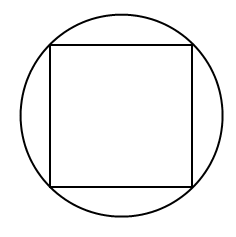
A square is inscribed inside a circle, as illustrated above. The radius of the circle is  units. If all of the square's diagonals pass through the circle's center, what is the area of the square?
A square is inscribed inside a circle, as illustrated above. The radius of the circle is
Tap to reveal answer
Given that the square's diagonals pass through the circle's center, those diagonals must each form a diameter of the circle. The circle's diameter is twice its radius, i.e.  , which is
  . Since this diameter (i.e., the square's diagonal) is the hypotenuse of a right triangle formed by two sides of the square, the length of one of the square's sides can be calculated with the Pythagorean Theorem.
  replace
  and
and  because the sides of the square must be equal in length. Since the objective is to solve for the square's area, solve for
  since one side squared will be the square's area.


 units squared
Given that the square's diagonals pass through the circle's center, those diagonals must each form a diameter of the circle. The circle's diameter is twice its radius, i.e.
← Didn't Know|Knew It →
The area of square R is 12 times the area of square T. If the area of square R is 48, what is the length of one side of square T?
The area of square R is 12 times the area of square T. If the area of square R is 48, what is the length of one side of square T?
Tap to reveal answer
We start by dividing the area of square R (48) by 12, to come up with the area of square T, 4. Then take the square root of the area to get the length of one side, giving us 2.
We start by dividing the area of square R (48) by 12, to come up with the area of square T, 4. Then take the square root of the area to get the length of one side, giving us 2.
← Didn't Know|Knew It →
When the side of a certain square is increased by 2 inches, the area of the resulting square is 64 sq. inches greater than the original square. What is the length of the side of the original square, in inches?
When the side of a certain square is increased by 2 inches, the area of the resulting square is 64 sq. inches greater than the original square. What is the length of the side of the original square, in inches?
Tap to reveal answer
Let x represent the length of the original square in inches. Thus the area of the original square is x2. Two inches are added to x, which is represented by x+2. The area of the resulting square is (x+2)2. We are given that the new square is 64 sq. inches greater than the original. Therefore we can write the algebraic expression:
x2 + 64 = (x+2)2
FOIL the right side of the equation.
x2 + 64 = x2 + 4x + 4
Subtract x2 from both sides and then continue with the alegbra.
64 = 4x + 4
64 = 4(x + 1)
16 = x + 1
15 = x
Therefore, the length of the original square is 15 inches.
If you plug in the answer choices, you would need to add 2 inches to the value of the answer choice and then take the difference of two squares. The choice with 15 would be correct because 172 -152 = 64.
Let x represent the length of the original square in inches. Thus the area of the original square is x2. Two inches are added to x, which is represented by x+2. The area of the resulting square is (x+2)2. We are given that the new square is 64 sq. inches greater than the original. Therefore we can write the algebraic expression:
x2 + 64 = (x+2)2
FOIL the right side of the equation.
x2 + 64 = x2 + 4x + 4
Subtract x2 from both sides and then continue with the alegbra.
64 = 4x + 4
64 = 4(x + 1)
16 = x + 1
15 = x
Therefore, the length of the original square is 15 inches.
If you plug in the answer choices, you would need to add 2 inches to the value of the answer choice and then take the difference of two squares. The choice with 15 would be correct because 172 -152 = 64.
← Didn't Know|Knew It →
If the area of a square is 25 inches squared, what is the perimeter?
If the area of a square is 25 inches squared, what is the perimeter?
Tap to reveal answer
The area of a square is equal to length times width or length squared (since length and width are equal on a square). Therefore, the length of one side is l = $$\sqrt{25in^{2}$$} or l=5 in. The perimeter of a square is the sum of the length of all 4 sides or 4 times 5 in. =20 in.
The area of a square is equal to length times width or length squared (since length and width are equal on a square). Therefore, the length of one side is l = $$\sqrt{25in^{2}$$} or l=5 in. The perimeter of a square is the sum of the length of all 4 sides or 4 times 5 in. =20 in.
← Didn't Know|Knew It →
A square is inscribed inside a circle, as illustrated above. The radius of the circle is units. If all of the square's diagonals pass through the circle's center, what is the area of the square?
A square is inscribed inside a circle, as illustrated above. The radius of the circle is
Tap to reveal answer
Given that the square's diagonals pass through the circle's center, those diagonals must each form a diameter of the circle. The circle's diameter is twice its radius, i.e. , which is . Since this diameter (i.e., the square's diagonal) is the hypotenuse of a right triangle formed by two sides of the square, the length of one of the square's sides can be calculated with the Pythagorean Theorem. replace and because the sides of the square must be equal in length. Since the objective is to solve for the square's area, solve for since one side squared will be the square's area.
units squared
Given that the square's diagonals pass through the circle's center, those diagonals must each form a diameter of the circle. The circle's diameter is twice its radius, i.e.
← Didn't Know|Knew It →

A square has an area of  , what is the length of its side?
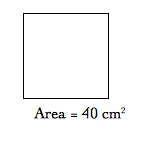
A square has an area of
Tap to reveal answer
The sides can be found by taking the square root of the area.
 , where
  = side.
 .
.
So the length of a side is 6.3 cm.
The sides can be found by taking the square root of the area.
So the length of a side is 6.3 cm.
← Didn't Know|Knew It →
The perimeter of a square is 16. Find the length of each side of this square.
The perimeter of a square is 16. Find the length of each side of this square.
Tap to reveal answer
First, know that all the side lengths of a square are equal. Second, know that the sum of all 4 side lengths gives us the perimeter. Thus, the square perimeter of 16 is written as


where S is the side length of a square. Solve for this S

So the length of each side of this square is 4.
First, know that all the side lengths of a square are equal. Second, know that the sum of all 4 side lengths gives us the perimeter. Thus, the square perimeter of 16 is written as
where S is the side length of a square. Solve for this S
So the length of each side of this square is 4.
← Didn't Know|Knew It →
The area of the square shown below is 36 square inches. What is the length of one of the sides?

The area of the square shown below is 36 square inches. What is the length of one of the sides?
Tap to reveal answer
The area of any quadrilateral can be determined by multiplying the length of its base by its height.
Since we know the shape here is square, we know that all sides are of equal length. From this we can work backwards by taking the square root of the area to find the length of one side.

The length of one (and each) side of this square is 6 inches.
The area of any quadrilateral can be determined by multiplying the length of its base by its height.
Since we know the shape here is square, we know that all sides are of equal length. From this we can work backwards by taking the square root of the area to find the length of one side.
The length of one (and each) side of this square is 6 inches.
← Didn't Know|Knew It →
A playground is enclosed by a square fence. The area of the playground is 
 . The perimeter of the fence is
 . What is the length of one side of the fence?
A playground is enclosed by a square fence. The area of the playground is
Tap to reveal answer
We will have two formulas to help us solve this problem, the area and perimeter of a square.
The area of a square is:


 ,
,
where  length of the square and
  width of the square.
The perimeter of a square is:


Plugging in our values, we have:


Since all sides of a square have the same value, we can replace all  and
and  with
with  (side). Our equations become:


Therefore, 

 .
.
We will have two formulas to help us solve this problem, the area and perimeter of a square.
The area of a square is:
where
The perimeter of a square is:
Plugging in our values, we have:
Since all sides of a square have the same value, we can replace all
Therefore,
← Didn't Know|Knew It →
A square has one side of length  , what is the length of the opposite side?
A square has one side of length
Tap to reveal answer
One of the necessary conditions of a square is that all sides be of equal length. Therefore, because we are given the length of one side we know the length of all sides and that includes the length of the opposite side. Since the length of one of the sides is 4 we can conclude that all of the sides are 4, meaning the opposite side has a length of 4.
One of the necessary conditions of a square is that all sides be of equal length. Therefore, because we are given the length of one side we know the length of all sides and that includes the length of the opposite side. Since the length of one of the sides is 4 we can conclude that all of the sides are 4, meaning the opposite side has a length of 4.
← Didn't Know|Knew It →
If the area of the square is 100 square units, what is, in units, the length of one side of the square?
If the area of the square is 100 square units, what is, in units, the length of one side of the square?
Tap to reveal answer


← Didn't Know|Knew It →
The perimeter of a square is half its area. What is the length of one side of the square?
The perimeter of a square is half its area. What is the length of one side of the square?
Tap to reveal answer
We begin by recalling the formulas for the perimeter and area of a square respectively.


Using these formulas and the fact that the perimeter is half the area, we can create an equation.

We can multiply both sides by 2 to eliminate the fraction.

To get one side of the equation equal to zero, we will move everything to the right side.

Next we can factor.

Setting each factor equal to zero provides two potential solutions.
 or
or 

However, since a square cannot have a side of length 0, 8 is our only answer.
We begin by recalling the formulas for the perimeter and area of a square respectively.
Using these formulas and the fact that the perimeter is half the area, we can create an equation.
We can multiply both sides by 2 to eliminate the fraction.
To get one side of the equation equal to zero, we will move everything to the right side.
Next we can factor.
Setting each factor equal to zero provides two potential solutions.
However, since a square cannot have a side of length 0, 8 is our only answer.
← Didn't Know|Knew It →
In Square  ,
,  . Evaluate
  in terms of
  .
.
In Square
Tap to reveal answer
If diagonal  of Square
  is constructed, then
  is a 45-45-90 triangle with hypotenuse
  . By the 45-45-90 Theorem, the sidelength
  can be calculated as follows:
 .
.
If diagonal
← Didn't Know|Knew It →
The circle that circumscribes Square  has circumference 20. To the nearest tenth, evaluate
  .
.
The circle that circumscribes Square
Tap to reveal answer
The diameter of a circle with circumference 20 is

The diameter of a circle that circumscribes a square is equal to the length of the diagonals of the square.
If diagonal  of Square
  is constructed, then
  is a 45-45-90 triangle with hypotenuse approximately 6.3662. By the 45-45-90 Theorem, divide this by
  to get the sidelength of the square:

The diameter of a circle with circumference 20 is
The diameter of a circle that circumscribes a square is equal to the length of the diagonals of the square.
If diagonal
← Didn't Know|Knew It →
The circle inscribed inside Square  has circumference 16. To the nearest tenth, evaluate
  .
.
The circle inscribed inside Square
Tap to reveal answer
The diameter of a circle that is inscribed inside a square is equal to its sidelength  , so all we need to do is find the diameter of the circle - which is circumference 16 divided by
  :
:
 .
.
The diameter of a circle that is inscribed inside a square is equal to its sidelength
← Didn't Know|Knew It →

Refer to the above figure, which shows equilateral triangle  inside Square
  . Also,
  .
.
Quadrilateral  has area 100. Which of these choices comes closest to
  ?
?
Refer to the above figure, which shows equilateral triangle
Quadrilateral
Tap to reveal answer
Let  , the sidelength shared by the square and the equilateral triangle.
The area of  is
is

The area of Square  is
is  .
.
By symmetry,  bisects the portion of the square not in the triangle, so the area of Quadrilateral
  is half the difference of those of the square and the triangle. Since the area of Quadrilateral
  is 100, we can set up an equation:


Of the five choices, 20 comes closest.
Let
The area of
The area of Square
By symmetry,
Of the five choices, 20 comes closest.
← Didn't Know|Knew It →
Rectangle  has area 90% of that of Square
  , and
, and  is 80% of
  . What percent of
  is
is  ?
?
Rectangle
Tap to reveal answer
The area of Square  is the square of sidelength
  , or
, or  .
.
The area of Rectangle  is
is  . Rectangle
  has area 90% of that of Square
  , which is
  ;
;  is 80% of
  , so
, so  . We can set up the following equation:


As a percent,  of
of  is
is 
The area of Square
The area of Rectangle
As a percent,
← Didn't Know|Knew It →