How to find the length of the diagonal of a rectangle - Math
Card 1 of 184
Which is the greater quantity?
(a) The length of a diagonal of a square with sidelength 20 inches
(b) The length of a diagonal of a rectangle with length 25 inches and width less than 10 inches
Which is the greater quantity?
(a) The length of a diagonal of a square with sidelength 20 inches
(b) The length of a diagonal of a rectangle with length 25 inches and width less than 10 inches
Tap to reveal answer
The lengths of the diagonals of these rectangles can be computed using the Pythagorean Theorem:
(a) 
(b) 
 so
so  . Since the diagonal of the rectangle in (b) measures less than
  , it must also measure less than that of the square in (a)
The lengths of the diagonals of these rectangles can be computed using the Pythagorean Theorem:
(a)
(b)
← Didn't Know|Knew It →
In Rectangle  ,
,  , the diagonals intersect at a point
  .
.
Which is the greater quantity?
(a) 
(b) 
In Rectangle
Which is the greater quantity?
(a)
(b)
Tap to reveal answer
The diagonals of a rectangle are congruent and bisect each other. Therefore,  is equidistant from all four vertices, making
  . The relationship between the sides is not relevant here.
The diagonals of a rectangle are congruent and bisect each other. Therefore,
← Didn't Know|Knew It →
Rectangle  has length 60 inches and width 80 inches. The two diagonals of the rectangle intersect at point
  . Which is the greater quantity?
(a) 
(b) 
Rectangle
(a)
(b)
Tap to reveal answer
Two consecutive sides of a rectangle and a diagonal form a right triangle, so the length of any diagonal can be determined using the Pythagorean Theorem, substituting  :
:





The diagonals of a rectangle bisect each other. Therefore, the distance from a vertex to the point of intersection is half this, and  .
.
Two consecutive sides of a rectangle and a diagonal form a right triangle, so the length of any diagonal can be determined using the Pythagorean Theorem, substituting
The diagonals of a rectangle bisect each other. Therefore, the distance from a vertex to the point of intersection is half this, and
← Didn't Know|Knew It →
A rectangle has perimeter 140 inches and area 1,200 square inches. Which is the greater quantity?
(A) The length of a diagonal of the rectangle.
(B) 4 feet
A rectangle has perimeter 140 inches and area 1,200 square inches. Which is the greater quantity?
(A) The length of a diagonal of the rectangle.
(B) 4 feet
Tap to reveal answer
Let  and
and  be the dimensions of the rectangle. Then
 and, subsequently,

Since the product of the length and width is the area, we are looking for two numbers whose sum is 70 and whose product is 1,200; through trial and error, they are found to be 30 and 40. We can assign either to be  and the other to be
  since the result is the same.
The length of a diagonal of the rectangle  can be found by applying the Pythagorean Theorem:


A diagonal is 50 inches long; since 4 feet are equivalent to 48 inches, (A) is the greater quantity.
Let
Since the product of the length and width is the area, we are looking for two numbers whose sum is 70 and whose product is 1,200; through trial and error, they are found to be 30 and 40. We can assign either to be
The length of a diagonal of the rectangle
A diagonal is 50 inches long; since 4 feet are equivalent to 48 inches, (A) is the greater quantity.
← Didn't Know|Knew It →
The length and width of a rectangle are in the ratio of 3:4. If the rectangle has an area of 108 square centimeters, what is the length of the diagonal?
The length and width of a rectangle are in the ratio of 3:4. If the rectangle has an area of 108 square centimeters, what is the length of the diagonal?
Tap to reveal answer
The length and width of the rectangle are in a ratio of 3:4, so the sides can be written as 3_x_ and 4_x_.
We also know the area, so we write an equation and solve for x:
(3_x_)(4_x_) = 12_x_2 = 108.
x2 = 9
x = 3
Now we can recalculate the length and the width:
length = 3x = 3(3) = 9 centimeters
width = 4x = 4(3) = 12 centimeters
Using the Pythagorean Theorem we can find the diagonal, c:
length2 + width2 = c2
92 + 122 = _c_2
81 + 144 = c2
225 = c2
c = 15 centimeters
The length and width of the rectangle are in a ratio of 3:4, so the sides can be written as 3_x_ and 4_x_.
We also know the area, so we write an equation and solve for x:
(3_x_)(4_x_) = 12_x_2 = 108.
x2 = 9
x = 3
Now we can recalculate the length and the width:
length = 3x = 3(3) = 9 centimeters
width = 4x = 4(3) = 12 centimeters
Using the Pythagorean Theorem we can find the diagonal, c:
length2 + width2 = c2
92 + 122 = _c_2
81 + 144 = c2
225 = c2
c = 15 centimeters
← Didn't Know|Knew It →
What is the length of the diagonal of a rectangle that is 3 feet long and 4 feet wide?
What is the length of the diagonal of a rectangle that is 3 feet long and 4 feet wide?
Tap to reveal answer
The diagonal of the rectangle is equivalent to finding the length of the hypotenuse of a right triangle with sides 3 and 4. Using the Pythagorean Theorem:
$3^{2}$$+4^{2}$ = $hypotenuse^{2}$
25 = $hypotenuse^{2}$
hypotenuse = 5
Therefore the diagonal of the rectangle is 5 feet.
The diagonal of the rectangle is equivalent to finding the length of the hypotenuse of a right triangle with sides 3 and 4. Using the Pythagorean Theorem:
$3^{2}$$+4^{2}$ = $hypotenuse^{2}$
25 = $hypotenuse^{2}$
hypotenuse = 5
Therefore the diagonal of the rectangle is 5 feet.
← Didn't Know|Knew It →
What is the diagonal of a rectangle with a side length of 5 and a base of 8? (Round to the nearest tenth)
What is the diagonal of a rectangle with a side length of 5 and a base of 8? (Round to the nearest tenth)
Tap to reveal answer
To find the diagonal of a rectangle we must use the side lengths to create a 90 degree triangle with side lengths of 5, 8, and a hypotenuse which is equal to the diagonal.
If we have a right angle triangle and a value for two of the three side lengths, we use the Pythagorean Theorem to solve for the length of the third side.
The two side lengths that meet to form the right angle are labeled  and
and  which are interchangeable for each side length.
The long length connecting them is labeled  and is known as the hypotenuse.
The Pythagorean Theorem states 
Take 5 and 8 and plug them into the equation as  and
and  to yield
First square the numbers 
After squaring the numbers add them together 
Once you have the sum, square root both sides 
After calculating our answer for the diagonal is  .
.
To find the diagonal of a rectangle we must use the side lengths to create a 90 degree triangle with side lengths of 5, 8, and a hypotenuse which is equal to the diagonal.
If we have a right angle triangle and a value for two of the three side lengths, we use the Pythagorean Theorem to solve for the length of the third side.
The two side lengths that meet to form the right angle are labeled
The long length connecting them is labeled
The Pythagorean Theorem states
Take 5 and 8 and plug them into the equation as
First square the numbers
After squaring the numbers add them together
Once you have the sum, square root both sides
After calculating our answer for the diagonal is
← Didn't Know|Knew It →
A rectangle has a width of  and a length that is
  shorter than twice the width. What is the length of the diagonal rounded to the nearest tenth?
A rectangle has a width of
Tap to reveal answer
First we must find the length of the rectangle before we can solve for the diagonal. With a length  shorter than twice the width, we can solve for length by drafting an algebraic equation:

Now that we know the values for length and width, we can use the Pythagorean Theorem to solve for the diagonal:

First we must find the length of the rectangle before we can solve for the diagonal. With a length
Now that we know the values for length and width, we can use the Pythagorean Theorem to solve for the diagonal:
← Didn't Know|Knew It →
Find the length of the diagonal of a rectangle with side lengths 6 and 7.
Find the length of the diagonal of a rectangle with side lengths 6 and 7.
Tap to reveal answer
To find the diagonal of a rectangle recall that the diagonal will create a triangle where the width and length are legs of the triangle and the diagonal is the hypotenuse.
To solve, simple use the Pythagorean Theorem and solve for the hypotenuse, which will be the diagonal of the rectangle.
Thus,

To find the diagonal of a rectangle recall that the diagonal will create a triangle where the width and length are legs of the triangle and the diagonal is the hypotenuse.
To solve, simple use the Pythagorean Theorem and solve for the hypotenuse, which will be the diagonal of the rectangle.
Thus,
← Didn't Know|Knew It →
Find the length of the diagonal of a rectangle with length 7 and width 2.
Find the length of the diagonal of a rectangle with length 7 and width 2.
Tap to reveal answer
To solve, simply use the Pythagorean Theorem. Thus,


To solve, simply use the Pythagorean Theorem. Thus,
← Didn't Know|Knew It →
A rectangle has a length of 12 in and a width of 5 in. What is the diagonal of the rectangle?
A rectangle has a length of 12 in and a width of 5 in. What is the diagonal of the rectangle?
Tap to reveal answer
To find the diagonal we use the Pythagorean Theorem:
 where
where  = hypotenuse
 or
or 
To find the diagonal we use the Pythagorean Theorem:
← Didn't Know|Knew It →
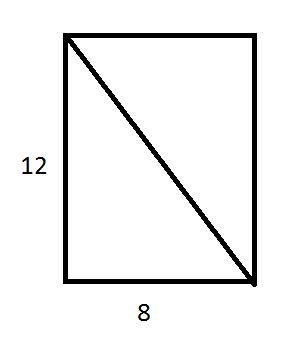
Find the length of the diagonal.
Find the length of the diagonal.
Tap to reveal answer
The rectangle can be cut into two equal right triangles, where the hypotenuse of both is the rectangle's diagonal.
Use the Pythagorean Theorem to find the hypotenuse:
 , where a and b are the legs and c is the hypotenuse


The rectangle can be cut into two equal right triangles, where the hypotenuse of both is the rectangle's diagonal.
Use the Pythagorean Theorem to find the hypotenuse:
← Didn't Know|Knew It →
One side of a rectangle is 7 inches and another is 9 inches. How many inches long is the rectangle's diagonal?
One side of a rectangle is 7 inches and another is 9 inches. How many inches long is the rectangle's diagonal?
Tap to reveal answer
You can find the diagonal of a rectangle if you have the width and the height. The diagonal equals the square root of the width squared plus the height squared.

You can find the diagonal of a rectangle if you have the width and the height. The diagonal equals the square root of the width squared plus the height squared.
← Didn't Know|Knew It →
A rectangle has a height of  and a base of
  . What is the length of its diagonal rounded to the nearest tenth?
A rectangle has a height of
Tap to reveal answer
1. Use Pythagorean Theorem with  and
and  .
.


2. Solve for  , the length of the diagonal:




This rounds down to  because the hundredth's place (
 ) is less than
  .
.
1. Use Pythagorean Theorem with
2. Solve for
This rounds down to
← Didn't Know|Knew It →
The sides of rectangle ABCD are 4 in and 13 in.
How long is the diagonal of rectangle ABCD?
The sides of rectangle ABCD are 4 in and 13 in.
How long is the diagonal of rectangle ABCD?
Tap to reveal answer
A diagonal of a rectangle cuts the rectangle into 2 right triangles with sides equal to the sides of the rectangle and with a hypotenuse that is the diagonal. All you need to do is use the pythagorean theorem:
 where a and b are the sides of the rectangle and c is the length of the diagonal.

A diagonal of a rectangle cuts the rectangle into 2 right triangles with sides equal to the sides of the rectangle and with a hypotenuse that is the diagonal. All you need to do is use the pythagorean theorem:
← Didn't Know|Knew It →
A standard high school basketball court is 84 feet long and 50 feet wide. During practice, Coach K has Kyrie run from one the right corner on one end of the court to the left corner at the other end of the court. To the nearest foot, how far did Kyrie run?
A standard high school basketball court is 84 feet long and 50 feet wide. During practice, Coach K has Kyrie run from one the right corner on one end of the court to the left corner at the other end of the court. To the nearest foot, how far did Kyrie run?
Tap to reveal answer
A picture helps greatly with this problem, so we begin with a rectangular basketball court.
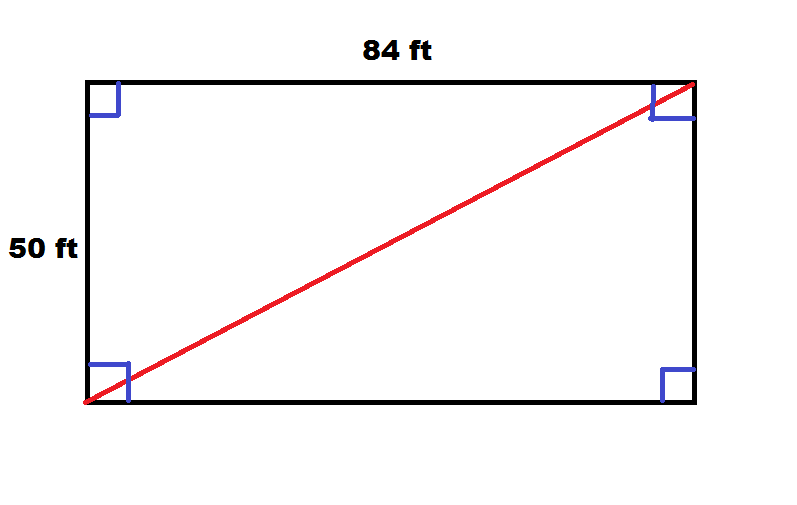
We note that the distance run by Kyrie (drawn in red) is the diagonal of our rectangle, which we will call  . We should also not that this diagonal divides our rectangle into two congruent right triangles. We can therefore find the length of our diagonal by focusing on one of these triangles and determining the hypotenuse. This can be done with the Pythagorean Theorem, which gives us:


Taking the square root gives us

Rounding to the nearest foot gives an answer of 98.
A picture helps greatly with this problem, so we begin with a rectangular basketball court.
We note that the distance run by Kyrie (drawn in red) is the diagonal of our rectangle, which we will call
Taking the square root gives us
Rounding to the nearest foot gives an answer of 98.
← Didn't Know|Knew It →
Find the length of the diagonal of a rectangle that has a length of  and a width of
  .
.
Find the length of the diagonal of a rectangle that has a length of
Tap to reveal answer
The diagonal of a rectangle is also the hypotenuse of a right triangle that has the length and the width of the rectangle as its legs.

We can then use the Pythgorean Theorem to find the diagonal.

For the given rectangle,

The diagonal of a rectangle is also the hypotenuse of a right triangle that has the length and the width of the rectangle as its legs.
We can then use the Pythgorean Theorem to find the diagonal.
For the given rectangle,
← Didn't Know|Knew It →
Find the length of the diagonal of a rectangle that has a length of  and a width of
  .
.
Find the length of the diagonal of a rectangle that has a length of
Tap to reveal answer
The diagonal of a rectangle is also the hypotenuse of a right triangle that has the length and the width of the rectangle as its legs.
We can then use the Pythgorean Theorem to find the diagonal.

For the given rectangle,

The diagonal of a rectangle is also the hypotenuse of a right triangle that has the length and the width of the rectangle as its legs.
We can then use the Pythgorean Theorem to find the diagonal.
For the given rectangle,
← Didn't Know|Knew It →
Find the length of the diagonal of a rectangle that has a length of  and a width of
  .
.
Find the length of the diagonal of a rectangle that has a length of
Tap to reveal answer
The diagonal of a rectangle is also the hypotenuse of a right triangle that has the length and the width of the rectangle as its legs.
We can then use the Pythgorean Theorem to find the diagonal.

For the given rectangle,

The diagonal of a rectangle is also the hypotenuse of a right triangle that has the length and the width of the rectangle as its legs.
We can then use the Pythgorean Theorem to find the diagonal.
For the given rectangle,
← Didn't Know|Knew It →
Find the length of the diagonal of a rectangle that has a length of  and a width of
  .
.
Find the length of the diagonal of a rectangle that has a length of
Tap to reveal answer
The diagonal of a rectangle is also the hypotenuse of a right triangle that has the length and the width of the rectangle as its legs.
We can then use the Pythgorean Theorem to find the diagonal.

For the given rectangle,

The diagonal of a rectangle is also the hypotenuse of a right triangle that has the length and the width of the rectangle as its legs.
We can then use the Pythgorean Theorem to find the diagonal.
For the given rectangle,
← Didn't Know|Knew It →