How to find the length of an edge of a cube - Math
Card 1 of 108
Our backyard pool holds 10,000 gallons. Its average depth is 4 feet deep and it is 10 feet long. If there are 7.48 gallons in a cubic foot, how wide is the pool?
Our backyard pool holds 10,000 gallons. Its average depth is 4 feet deep and it is 10 feet long. If there are 7.48 gallons in a cubic foot, how wide is the pool?
Tap to reveal answer
There are 7.48 gallons in cubic foot. Set up a ratio:
1 ft3 / 7.48 gallons = x cubic feet / 10,000 gallons
Pool Volume = 10,000 gallons = 10,000 gallons * (1 ft3/ 7.48 gallons) = 1336.9 ft3
Pool Volume = 4ft x 10 ft x WIDTH = 1336.9 cubic feet
Solve for WIDTH:
4 ft x 10 ft x WIDTH = 1336.9 cubic feet
WIDTH = 1336.9 / (4 x 10) = 33.4 ft
There are 7.48 gallons in cubic foot. Set up a ratio:
1 ft3 / 7.48 gallons = x cubic feet / 10,000 gallons
Pool Volume = 10,000 gallons = 10,000 gallons * (1 ft3/ 7.48 gallons) = 1336.9 ft3
Pool Volume = 4ft x 10 ft x WIDTH = 1336.9 cubic feet
Solve for WIDTH:
4 ft x 10 ft x WIDTH = 1336.9 cubic feet
WIDTH = 1336.9 / (4 x 10) = 33.4 ft
← Didn't Know|Knew It →
A cube has a volume of 64cm3. What is the area of one side of the cube?
A cube has a volume of 64cm3. What is the area of one side of the cube?
Tap to reveal answer
The cube has a volume of 64cm3, making the length of one edge 4cm (4 * 4 * 4 = 64).
So the area of one side is 4 * 4 = 16cm2
The cube has a volume of 64cm3, making the length of one edge 4cm (4 * 4 * 4 = 64).
So the area of one side is 4 * 4 = 16cm2
← Didn't Know|Knew It →
Given that the suface area of a cube is 72, find the length of one of its sides.
Given that the suface area of a cube is 72, find the length of one of its sides.
Tap to reveal answer
The standard equation for surface area is

where  denotes side length. Rearrange the equation in terms of
  to find the length of a side with the given surface area:

The standard equation for surface area is
where
← Didn't Know|Knew It →
Find the length of an edge of the following cube:
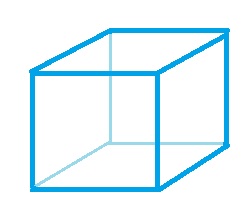
The volume of the cube is  .
.
Find the length of an edge of the following cube:
The volume of the cube is
Tap to reveal answer
The formula for the volume of a cube is
 ,
,
where  is the length of the edge of a cube.
Plugging in our values, we get:


The formula for the volume of a cube is
where
Plugging in our values, we get:
← Didn't Know|Knew It →
Find the length of an edge of the following cube:
The volume of the cube is  .
.
Find the length of an edge of the following cube:
The volume of the cube is
Tap to reveal answer
The formula for the volume of a cube is
,
where is the length of the edge of a cube.
Plugging in our values, we get:


The formula for the volume of a cube is
where
Plugging in our values, we get:
← Didn't Know|Knew It →
What is the length of an edge of a cube that has a surface area of 54?
What is the length of an edge of a cube that has a surface area of 54?
Tap to reveal answer
The surface area of a cube can be determined using the following equation:


The surface area of a cube can be determined using the following equation:
← Didn't Know|Knew It →
If the surface area of a cube is  , what is the length of one side of the cube?
If the surface area of a cube is
Tap to reveal answer
Recall how to find the surface area of a cube:

Since the question asks you to find the length of a side of this cube, rearrange the equation.


Substitute in the given surface area to find the side length.

Simplify.

Reduce.

Recall how to find the surface area of a cube:
Since the question asks you to find the length of a side of this cube, rearrange the equation.
Substitute in the given surface area to find the side length.
Simplify.
Reduce.
← Didn't Know|Knew It →
If the surface area of a cube is  , find the length of one side of the cube.
If the surface area of a cube is
Tap to reveal answer
Recall how to find the surface area of a cube:
Since the question asks you to find the length of a side of this cube, rearrange the equation.


Substitute in the given surface area to find the side length.

Simplify.

Reduce.

Recall how to find the surface area of a cube:
Since the question asks you to find the length of a side of this cube, rearrange the equation.
Substitute in the given surface area to find the side length.
Simplify.
Reduce.
← Didn't Know|Knew It →
If the surface area of a cube is  , find the length of a side of the cube.
If the surface area of a cube is
Tap to reveal answer
Recall how to find the surface area of a cube:
Since the question asks you to find the length of a side of this cube, rearrange the equation.


Substitute in the given surface area to find the side length.

Simplify.

Reduce.

Recall how to find the surface area of a cube:
Since the question asks you to find the length of a side of this cube, rearrange the equation.
Substitute in the given surface area to find the side length.
Simplify.
Reduce.
← Didn't Know|Knew It →
Given that the volume of a cube is  , what is the length of any one of its sides?
Given that the volume of a cube is
Tap to reveal answer

The formula for the volume is given by

Since we have the volume, we must take the cube root of the volume to find the length of any one side (since it is a cube, all of the sides are equal).

Plugging in 216 for the volume, we end up with

The formula for the volume is given by
Since we have the volume, we must take the cube root of the volume to find the length of any one side (since it is a cube, all of the sides are equal).
Plugging in 216 for the volume, we end up with
← Didn't Know|Knew It →
A face of a cube has a diagonal with a length of  . What is the length of one of the edges of the cube?

A face of a cube has a diagonal with a length of
Tap to reveal answer
Because this is a cube, it's helpful to remember that the value of the diagonal of one face is the same length for the other five faces. Additionally, the length of one edge will be the same length of all the cube's other edges. This helps relieve the stress of there being more than one possible right answer.
To find the edge, we're looking for the length of one of the sides of the square's faces. The problem can be seen in a simplified square convention:

The diagonal merely splits a square into two right 45-45-90 triangles. Finding the length of one the sides of the squares can be solved either through trigonometric functions or the rules for 45-45-90 triangles.
Using the rules for 45-45-90 triangles:

The hypotenuse of the created triangle is  , which can be set equal to
  to solve for
  , which in this case will give us the length of one of the cube's edges.


Therefore, the edge length of the cube is  .
.
Because this is a cube, it's helpful to remember that the value of the diagonal of one face is the same length for the other five faces. Additionally, the length of one edge will be the same length of all the cube's other edges. This helps relieve the stress of there being more than one possible right answer.
To find the edge, we're looking for the length of one of the sides of the square's faces. The problem can be seen in a simplified square convention:
The diagonal merely splits a square into two right 45-45-90 triangles. Finding the length of one the sides of the squares can be solved either through trigonometric functions or the rules for 45-45-90 triangles.
Using the rules for 45-45-90 triangles:
The hypotenuse of the created triangle is
Therefore, the edge length of the cube is
← Didn't Know|Knew It →
If the surface area of a cube is equal to  , what is the length of one of the cube's sides?
If the surface area of a cube is equal to
Tap to reveal answer
The surface area of a cube can be represented as  , since a cube has six sides and the surface area of each side is represented by its length multiplied by its width, which for a cube is
  , since all of its edges are the same length.
We can substitute  into this equation and then solve for
  :
:


So, one edge of this cube is  in length.
The surface area of a cube can be represented as
We can substitute
So, one edge of this cube is
← Didn't Know|Knew It →
Find the length of one of the cube's sides:

Find the length of one of the cube's sides:
Tap to reveal answer
The only information that is given is that the diagonal of one of the faces of the cube is  . Because this is a cube, this is true for the rest of the five faces. All the edges will also be the same length, meaning this eliminates the possibility of more than one correct answer.
The edge of the cube can be solved for using the Pythagorean Theorem because the diagonal creates two right triangles. Or, if you're comfortable with it, you can remember that the diagonal creates two  special right triangles that have their own rules with respect to solving for sides.
Using the Pythagorean Theorem,  , we can simplify the equation according to information we have and can deduce the correct answer.
The variables  and
and  refer to the legs of the right triangles. Because this is a cube, we can deduce that the length of the legs will be the same. Therefore,
  . That means the Pythagorean Theorem (for this case) can be rewritten as
Looking back at the problem, the only information given is the hypotenuse for one of the two triangles. This value can be substituted in for  . Then, as we solve for
  , we will obtain the answer for the question: the length of the edge.


Therefore, the edge of the cube is  .
.
The only information that is given is that the diagonal of one of the faces of the cube is
The edge of the cube can be solved for using the Pythagorean Theorem because the diagonal creates two right triangles. Or, if you're comfortable with it, you can remember that the diagonal creates two
Using the Pythagorean Theorem,
The variables
Looking back at the problem, the only information given is the hypotenuse for one of the two triangles. This value can be substituted in for
Therefore, the edge of the cube is
← Didn't Know|Knew It →
The volume of a cube is  .
.
Find the length of the cube to the nearest tenth of a foot.
The volume of a cube is
Find the length of the cube to the nearest tenth of a foot.
Tap to reveal answer
Since the volume of a cube is length times width times height, with every measurement being the same, we just need to take the cube root of the volume:
 .
.
Rounded to the nearest tenth, the length is 3.5 feet.
Since the volume of a cube is length times width times height, with every measurement being the same, we just need to take the cube root of the volume:
Rounded to the nearest tenth, the length is 3.5 feet.
← Didn't Know|Knew It →
A cube has a volume of  . What is the lengh of one of the edges of this cube?
A cube has a volume of
Tap to reveal answer
Since cubes have side lengths that are equal and we find the volume by  , then the side length of a cube with a volume of
  is simply
  . In other words what number multiplied three times gives 512? Take the cube root of 512 to get
  .
.
Since cubes have side lengths that are equal and we find the volume by
← Didn't Know|Knew It →
If a cube has a volume of  , what would be the length of the sides of the cube?
If a cube has a volume of
Tap to reveal answer
A geometric cube has  edges, all of equal length and the formula to solve for volume is:

And since all edges are of equal length, we can use this formula to solve for length of sides:

A geometric cube has
And since all edges are of equal length, we can use this formula to solve for length of sides:
← Didn't Know|Knew It →
A geometric cube has a volume of  . Solve for the length of the edge.
A geometric cube has a volume of
Tap to reveal answer
The formula for volume of a perfect sphere is represented in this formula, with  representing length of sides:

Since we know the volume, we can use the formula for volume to determine length of edges:
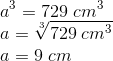
The formula for volume of a perfect sphere is represented in this formula, with
Since we know the volume, we can use the formula for volume to determine length of edges:
← Didn't Know|Knew It →
If the surface area of a cube is  , what is the length of one side of the cube?
If the surface area of a cube is
Tap to reveal answer
Recall how to find the surface area of a cube:
Since the question asks you to find the length of a side of this cube, rearrange the equation.


Substitute in the given surface area to find the side length.

Simplify.

Reduce.

Recall how to find the surface area of a cube:
Since the question asks you to find the length of a side of this cube, rearrange the equation.
Substitute in the given surface area to find the side length.
Simplify.
Reduce.
← Didn't Know|Knew It →
If the surface area of a cube is  , find the length of one side of the cube.
If the surface area of a cube is
Tap to reveal answer
Recall how to find the surface area of a cube:
Since the question asks you to find the length of a side of this cube, rearrange the equation.


Substitute in the given surface area to find the side length.

Simplify.

Reduce.

Recall how to find the surface area of a cube:
Since the question asks you to find the length of a side of this cube, rearrange the equation.
Substitute in the given surface area to find the side length.
Simplify.
Reduce.
← Didn't Know|Knew It →
If the surface area of a cube is  , find the length of a side of the cube.
If the surface area of a cube is
Tap to reveal answer
Recall how to find the surface area of a cube:
Since the question asks you to find the length of a side of this cube, rearrange the equation.


Substitute in the given surface area to find the side length.

Simplify.

Reduce.

Recall how to find the surface area of a cube:
Since the question asks you to find the length of a side of this cube, rearrange the equation.
Substitute in the given surface area to find the side length.
Simplify.
Reduce.
← Didn't Know|Knew It →