How to find the area of an acute / obtuse triangle - Math
Card 1 of 164
If triangle ABC has vertices (0, 0), (6, 0), and (2, 3) in the xy-plane, what is the area of ABC?
If triangle ABC has vertices (0, 0), (6, 0), and (2, 3) in the xy-plane, what is the area of ABC?
Tap to reveal answer
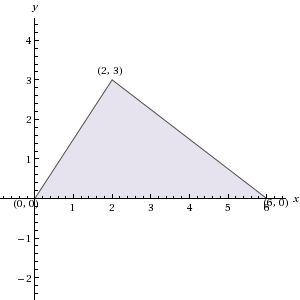
Sketching ABC in the xy-plane, as pictured here, we see that it has base 6 and height 3. Since the formula for the area of a triangle is 1/2 * base * height, the area of ABC is 1/2 * 6 * 3 = 9.
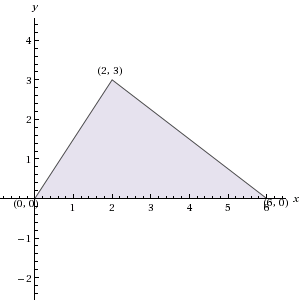
Sketching ABC in the xy-plane, as pictured here, we see that it has base 6 and height 3. Since the formula for the area of a triangle is 1/2 * base * height, the area of ABC is 1/2 * 6 * 3 = 9.
← Didn't Know|Knew It →
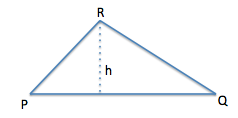
The height,  , of triangle
  in the figure is one-fourth the length of
  . In terms of h, what is the area of triangle
  ?
?
The height, 


Tap to reveal answer
If h=\frac{1}{4}$ *$\overline{PQ}$, then the length of $\overline{PQ}$ must be 4h.
Using the formula for the area of a triangle ($\frac{1}{2}$bh), with b=4h, the area of the triangle must be $2h^{2}$.
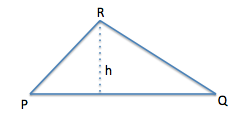
If h=\frac{1}{4}$ *$\overline{PQ}$, then the length of $\overline{PQ}$ must be 4h.
Using the formula for the area of a triangle ($\frac{1}{2}$bh), with b=4h, the area of the triangle must be $2h^{2}$.
← Didn't Know|Knew It →
Find the area of a triangle whose base is  and whose height is
  .
.
Find the area of a triangle whose base is
Tap to reveal answer
This problem is solved using the geometric formula for the area of a triangle.

Convert feet to inches.
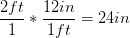
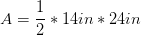

This problem is solved using the geometric formula for the area of a triangle.
Convert feet to inches.
← Didn't Know|Knew It →
What is the area of a triangle with a height of  and a base of
  ?
?
What is the area of a triangle with a height of
Tap to reveal answer
When searching for the area of a triangle we are looking for the amount of the space enclosed by the triangle.
The equation for area of a triangle is

Plug the values for base and height into the equation yielding
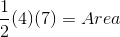
Then multiply the numbers together to arrive at the answer  .
.
When searching for the area of a triangle we are looking for the amount of the space enclosed by the triangle.
The equation for area of a triangle is
Plug the values for base and height into the equation yielding
Then multiply the numbers together to arrive at the answer
← Didn't Know|Knew It →
In ΔABC: a = 8, b = 13, c = 9.
Find the area of ΔABC (to the nearest tenth).
In ΔABC: a = 8, b = 13, c = 9.
Find the area of ΔABC (to the nearest tenth).
Tap to reveal answer
In order to determine the area of a non-right triangle, we can use Heron's formula:


Using the information from the question, we obtain:


In order to determine the area of a non-right triangle, we can use Heron's formula:
Using the information from the question, we obtain:
← Didn't Know|Knew It →
In ΔABC: a = 16, b = 11, c = 19.
Find the area of ΔABC (to the nearest tenth).
In ΔABC: a = 16, b = 11, c = 19.
Find the area of ΔABC (to the nearest tenth).
Tap to reveal answer
In order to determine the area of a non-right triangle, we can use Heron's formula:


Using the information from the question, we obtain:


In order to determine the area of a non-right triangle, we can use Heron's formula:
Using the information from the question, we obtain:
← Didn't Know|Knew It →
Find the height of a triangle if its base is  long and its area is
  .
.
Find the height of a triangle if its base is
Tap to reveal answer
The formula to find the area of a triangle is

Substitute in the given values for area and base to solve for the height,  :
:


The formula to find the area of a triangle is
Substitute in the given values for area and base to solve for the height,
← Didn't Know|Knew It →
In terms of  , what is the area of a triangle with a height of
  and a base of
  ?
?
In terms of
Tap to reveal answer
The formula to find the area of a triangle is

Substitute in the given values for the base and the height to find the area.

The formula to find the area of a triangle is
Substitute in the given values for the base and the height to find the area.
← Didn't Know|Knew It →
Find the area of the triangle below. Round to the nearest tenths place.

Find the area of the triangle below. Round to the nearest tenths place.
Tap to reveal answer
The formula used to find the area of the triangle is

Now, we will need to use a trigonometric ratio to find the length of the height. Because of the angle given, we will need to use  , because we are looking for the length of the adjacent side, the triangle's height, and we know the length of the hypotenuse of the smaller triangle formed by the height.
Remember that 

Now, solve for the height.

Now you can find the area of the triangle:

The formula used to find the area of the triangle is
Now, we will need to use a trigonometric ratio to find the length of the height. Because of the angle given, we will need to use
Remember that
Now, solve for the height.
Now you can find the area of the triangle:
← Didn't Know|Knew It →
Find the area of the triangle below. Round to the nearest tenths place.

Find the area of the triangle below. Round to the nearest tenths place.
Tap to reveal answer
The formula used to find the area of the triangle is

Now, we will need to use a trigonometric ratio to find the length of the height. Because of the angle given, we will need to use  , because we are looking for the length of the adjacent side, the triangle's height, and we know the length of the hypotenuse of the smaller triangle formed by the height.
Remember that 

Now, solve for the height.

Now you can find the area.

The formula used to find the area of the triangle is
Now, we will need to use a trigonometric ratio to find the length of the height. Because of the angle given, we will need to use
Remember that
Now, solve for the height.
Now you can find the area.
← Didn't Know|Knew It →
Find the area of the triangle below. Round to the nearest tenths place.

Find the area of the triangle below. Round to the nearest tenths place.
Tap to reveal answer
The formula used to find the area of the triangle is

Now, we will need to use a trigonometric ratio to find the length of the height. Because of the angle given, we will need to use  , because we are looking for the length of the adjacent side—the triangle's height—and we know the length of the hypotenuse of the smaller triangle formed by the height.
Remember that 

Now, solve for the height.

Now you can find the area.

The formula used to find the area of the triangle is
Now, we will need to use a trigonometric ratio to find the length of the height. Because of the angle given, we will need to use
Remember that
Now, solve for the height.
Now you can find the area.
← Didn't Know|Knew It →
Find the area of the triangle below. Round to the nearest tenths place.

Find the area of the triangle below. Round to the nearest tenths place.
Tap to reveal answer
The formula used to find the area of the triangle is

Now, we will need to use a trigonometric ratio to find the length of the height. Because of the angle given, we will need to use  , because we are looking for the length of the adjacent side—the triangle's height—and we know the length of the hypotenuse of the smaller triangle formed by the height.
Remember that 

Now, solve for the height.

Now you can find the area.

The formula used to find the area of the triangle is
Now, we will need to use a trigonometric ratio to find the length of the height. Because of the angle given, we will need to use
Remember that
Now, solve for the height.
Now you can find the area.
← Didn't Know|Knew It →
Find the area of the triangle below. Round to the nearest tenths place.

Find the area of the triangle below. Round to the nearest tenths place.
Tap to reveal answer
The formula used to find the area of the triangle is

Now, we will need to use a trigonometric ratio to find the length of the height. Because of the angle given, we will need to use  , because we are looking for the length of the adjacent side—the triangle's height—and we know the length of the hypotenuse of the smaller triangle formed by the height.
Remember that 

Now, solve for the height.

Now you can find the area.

The formula used to find the area of the triangle is
Now, we will need to use a trigonometric ratio to find the length of the height. Because of the angle given, we will need to use
Remember that
Now, solve for the height.
Now you can find the area.
← Didn't Know|Knew It →
Find the area of the triangle below. Round to the nearest tenths place.

Find the area of the triangle below. Round to the nearest tenths place.
Tap to reveal answer
The formula used to find the area of the triangle is

Now, we will need to use a trigonometric ratio to find the length of the height. Because of the angle given, we will need to use  , because we are looking for the height of the triangle, which in this case is the side opposite to the known angle, and we also know the length of the hypotenuse of the smaller triangle formed by the height.
Remember that 

Now, solve for the height.

Now you can find the area.

The formula used to find the area of the triangle is
Now, we will need to use a trigonometric ratio to find the length of the height. Because of the angle given, we will need to use
Remember that
Now, solve for the height.
Now you can find the area.
← Didn't Know|Knew It →
Find the area of the triangle. Round to the nearest tenths.

Find the area of the triangle. Round to the nearest tenths.
Tap to reveal answer
The formula used to find the area of the triangle is

Now, we will need to use a trigonometric ratio to find the length of the height. Because of the angle given, we will need to use  , because we are looking for the height of the triangle, which in this case is the side opposite to the known angle, and we also know the length of the hypotenuse of the smaller triangle formed by the height.
Remember that 

Now, solve for the height.

Now you can find the area.

The formula used to find the area of the triangle is
Now, we will need to use a trigonometric ratio to find the length of the height. Because of the angle given, we will need to use
Remember that
Now, solve for the height.
Now you can find the area.
← Didn't Know|Knew It →
Find the area of the triangle below. Round to the nearest tenths place.

Find the area of the triangle below. Round to the nearest tenths place.
Tap to reveal answer
The formula used to find the area of the triangle is

Now, we will need to use a trigonometric ratio to find the length of the height. Because of the angle given, we will need to use  , because we are looking for the height of the triangle, which in this case is the side opposite to the known angle, and we also know the length of the hypotenuse of the smaller triangle formed by the height.
Remember that 

Now, solve for the height.

Now you can find the area.

The formula used to find the area of the triangle is
Now, we will need to use a trigonometric ratio to find the length of the height. Because of the angle given, we will need to use
Remember that
Now, solve for the height.
Now you can find the area.
← Didn't Know|Knew It →
Find the area of the triangle below. Round to the nearest tenths place.

Find the area of the triangle below. Round to the nearest tenths place.
Tap to reveal answer
The formula used to find the area of the triangle is

Now, we will need to use a trigonometric ratio to find the length of the height. Because of the angle given, we will need to use  , because we are looking for the height of the triangle, which in this case is the side opposite to the known angle, and we also know the length of the hypotenuse of the smaller triangle formed by the height.
Remember that 

Now, solve for the height.

Now you can find the area.

The formula used to find the area of the triangle is
Now, we will need to use a trigonometric ratio to find the length of the height. Because of the angle given, we will need to use
Remember that
Now, solve for the height.
Now you can find the area.
← Didn't Know|Knew It →
Find the area of the triangle below. Round to the nearest tenths place.

Find the area of the triangle below. Round to the nearest tenths place.
Tap to reveal answer
The formula used to find the area of the triangle is

Now, we will need to use a trigonometric ratio to find the length of the height. Because of the angle given, we will need to use  , because we are looking for the height of the triangle, which in this case is the side opposite to the known angle, and we also know the length of the hypotenuse of the smaller triangle formed by the height.
Remember that 

Now, solve for the height.

Now you can find the area.

The formula used to find the area of the triangle is
Now, we will need to use a trigonometric ratio to find the length of the height. Because of the angle given, we will need to use
Remember that
Now, solve for the height.
Now you can find the area.
← Didn't Know|Knew It →
In the figure, a triangle that shares its base with the width of the rectangle has a height that is half the length of the rectangle. Find the area of the shaded region.

In the figure, a triangle that shares its base with the width of the rectangle has a height that is half the length of the rectangle. Find the area of the shaded region.
Tap to reveal answer

In order to find the area of the shaded region, we must first find the areas of the triangle and the rectangle.
Recall how to find the area of a rectangle:

Substitute in the given length and width to find the area.


Next, recall how to find the area of a triangle:

From the question, we know that the height of the triangle is half the length of the rectangle. Use the length of the rectangle to find the height of the triangle:


Since the base of the triangle and the width of the rectangle are the same, we can find the area of the triangle:


To find the area of the shaded region, subtract the area of the triangle from the area of the rectangle.


Solve.

In order to find the area of the shaded region, we must first find the areas of the triangle and the rectangle.
Recall how to find the area of a rectangle:
Substitute in the given length and width to find the area.
Next, recall how to find the area of a triangle:
From the question, we know that the height of the triangle is half the length of the rectangle. Use the length of the rectangle to find the height of the triangle:
Since the base of the triangle and the width of the rectangle are the same, we can find the area of the triangle:
To find the area of the shaded region, subtract the area of the triangle from the area of the rectangle.
Solve.
← Didn't Know|Knew It →
In the figure, a triangle that shares its base with the width of the rectangle has a height that is half the length of the rectangle. Find the area of the shaded region.

In the figure, a triangle that shares its base with the width of the rectangle has a height that is half the length of the rectangle. Find the area of the shaded region.
Tap to reveal answer
In order to find the area of the shaded region, we must first find the areas of the triangle and the rectangle.
Recall how to find the area of a rectangle:

Substitute in the given length and width to find the area.


Next, recall how to find the area of a triangle:

From the question, we know that the height of the triangle is half the length of the rectangle. Use the length of the rectangle to find the height of the triangle:


Since the base of the triangle and the width of the rectangle are the same, we can find the area of the triangle:


To find the area of the shaded region, subtract the area of the triangle from the area of the rectangle.


Solve.

In order to find the area of the shaded region, we must first find the areas of the triangle and the rectangle.
Recall how to find the area of a rectangle:
Substitute in the given length and width to find the area.
Next, recall how to find the area of a triangle:
From the question, we know that the height of the triangle is half the length of the rectangle. Use the length of the rectangle to find the height of the triangle:
Since the base of the triangle and the width of the rectangle are the same, we can find the area of the triangle:
To find the area of the shaded region, subtract the area of the triangle from the area of the rectangle.
Solve.
← Didn't Know|Knew It →