How to find the area of a trapezoid - Math
Card 1 of 374
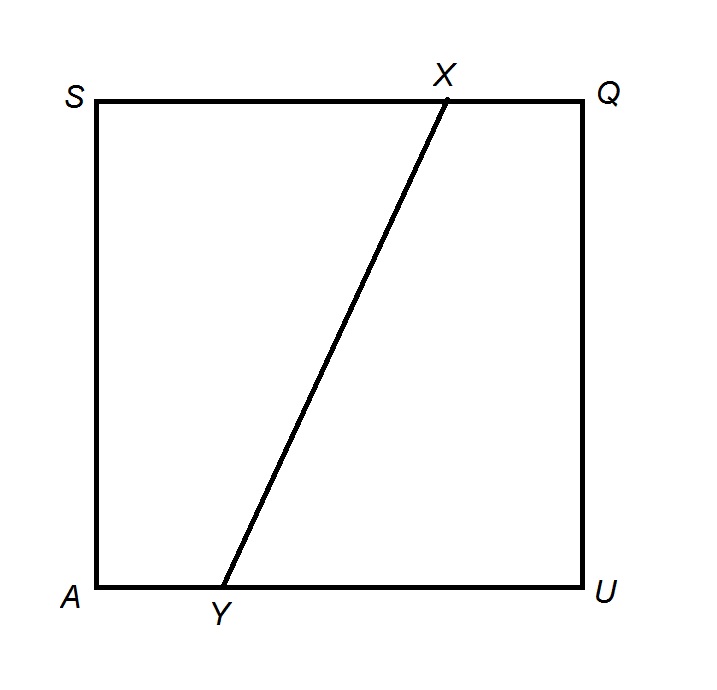
Note: Figure NOT drawn to scale
The above figure shows Square  .
.

Which is the greater quantity?
(a) The area of Trapezoid 
(b) The area of Trapezoid 
Note: Figure NOT drawn to scale
The above figure shows Square
Which is the greater quantity?
(a) The area of Trapezoid
(b) The area of Trapezoid
Tap to reveal answer
The easiest way to answer the question is to locate  on
on  such that
  :
:
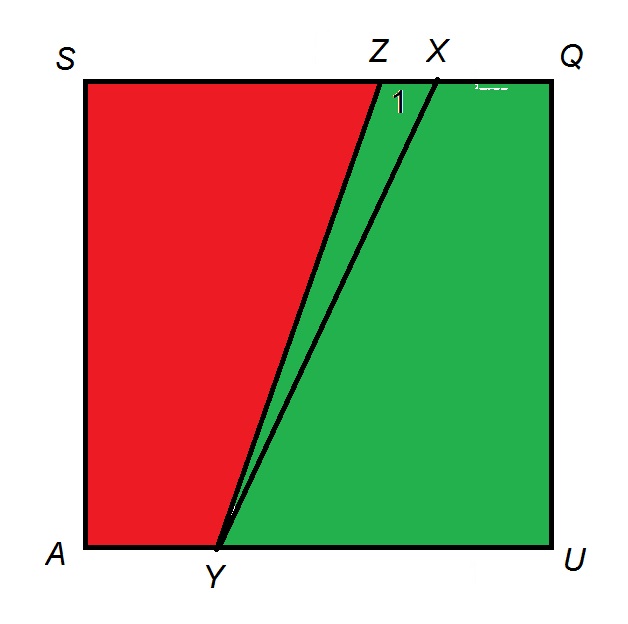
Trapezoids  and
and  have the same height, which is
  . Their bases, by construction, have the same lengths -
  and
and  . Therefore, Trapezoids
  and
and  have the same area.
Since , it follows that  , and
, and  . It follows that Trapezoid
  is greater in area than Trapezoids
  and
and  , and Trapezoid is less in area.
The easiest way to answer the question is to locate
Trapezoids
Since
← Didn't Know|Knew It →
What is the area of this regular trapezoid?
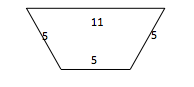
What is the area of this regular trapezoid?
Tap to reveal answer
To solve this question, you must divide the trapezoid into a rectangle and two right triangles. Using the Pythagorean Theorem, you would calculate the height of the triangle which is 4. The dimensions of the rectangle are 5 and 4, hence the area will be 20. The base of the triangle is 3 and the height of the triangle is 4. The area of one triangle is 6. Hence the total area will be 20+6+6=32. If you forget to split the shape into a rectangle and TWO triangles, or if you add the dimensions of the trapezoid, you could arrive at 26 as your answer.
To solve this question, you must divide the trapezoid into a rectangle and two right triangles. Using the Pythagorean Theorem, you would calculate the height of the triangle which is 4. The dimensions of the rectangle are 5 and 4, hence the area will be 20. The base of the triangle is 3 and the height of the triangle is 4. The area of one triangle is 6. Hence the total area will be 20+6+6=32. If you forget to split the shape into a rectangle and TWO triangles, or if you add the dimensions of the trapezoid, you could arrive at 26 as your answer.
← Didn't Know|Knew It →
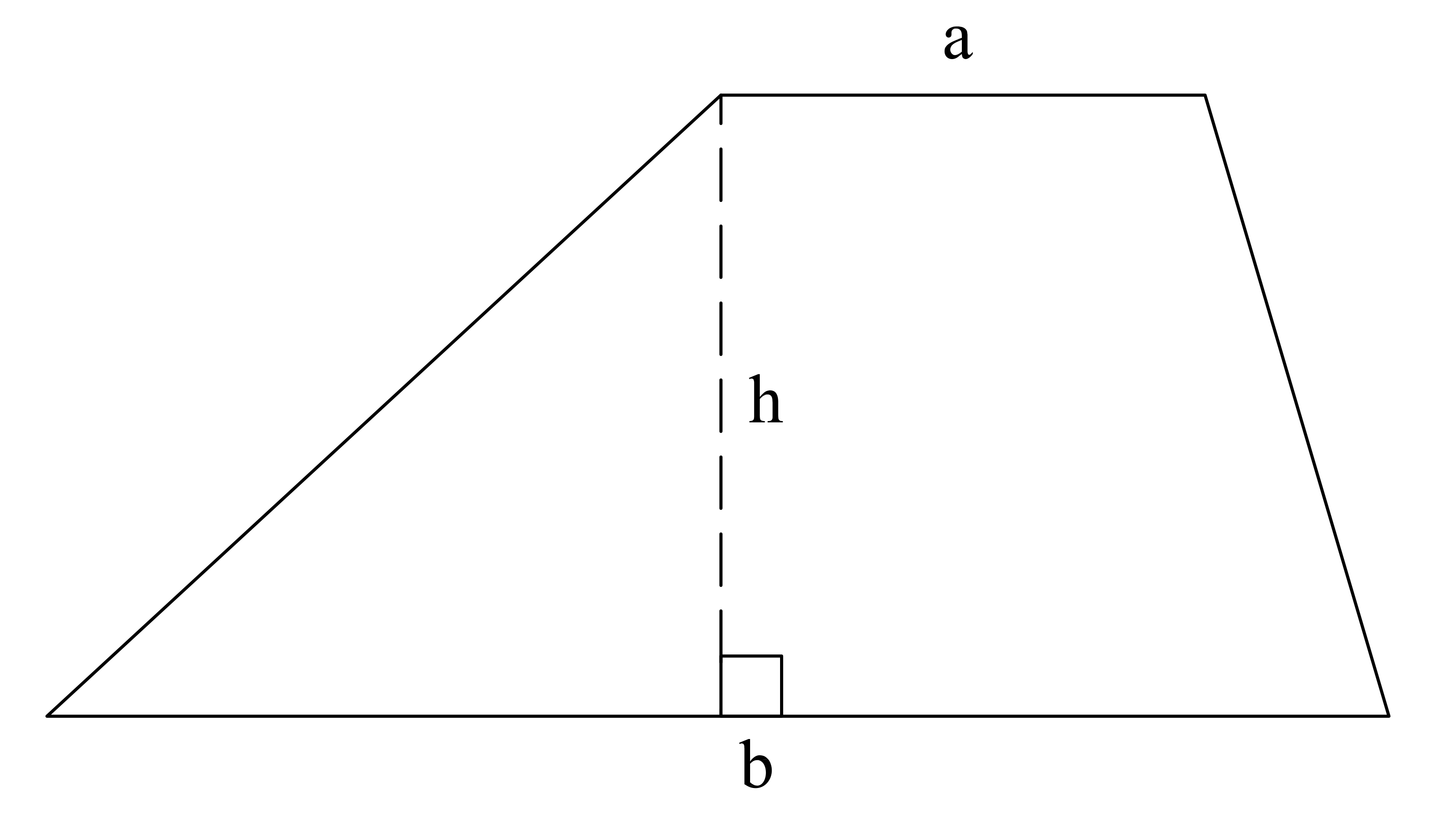
What is the area of the trapezoid above if a = 2, b = 6, and h = 4?
What is the area of the trapezoid above if a = 2, b = 6, and h = 4?
Tap to reveal answer
Area of a Trapezoid = ½(a+b)*h
= ½ (2+6) * 4
= ½ (8) * 4
= 4 * 4 = 16
Area of a Trapezoid = ½(a+b)*h
= ½ (2+6) * 4
= ½ (8) * 4
= 4 * 4 = 16
← Didn't Know|Knew It →
A trapezoid has a base of length 4, another base of length s, and a height of length s. A square has sides of length s. What is the value of s such that the area of the trapezoid and the area of the square are equal?
A trapezoid has a base of length 4, another base of length s, and a height of length s. A square has sides of length s. What is the value of s such that the area of the trapezoid and the area of the square are equal?
Tap to reveal answer
In general, the formula for the area of a trapezoid is (1/2)(a + b)(h), where a and b are the lengths of the bases, and h is the length of the height. Thus, we can write the area for the trapezoid given in the problem as follows:
area of trapezoid = (1/2)(4 + s)(s)
Similarly, the area of a square with sides of length a is given by _a_2. Thus, the area of the square given in the problem is _s_2.
We now can set the area of the trapezoid equal to the area of the square and solve for s.
(1/2)(4 + s)(s) = _s_2
Multiply both sides by 2 to eliminate the 1/2.
(4 + s)(s) = 2_s_2
Distribute the s on the left.
4_s_ + _s_2 = 2_s_2
Subtract _s_2 from both sides.
4_s_ = _s_2
Because s must be a positive number, we can divide both sides by s.
4 = s
This means the value of s must be 4.
The answer is 4.
In general, the formula for the area of a trapezoid is (1/2)(a + b)(h), where a and b are the lengths of the bases, and h is the length of the height. Thus, we can write the area for the trapezoid given in the problem as follows:
area of trapezoid = (1/2)(4 + s)(s)
Similarly, the area of a square with sides of length a is given by _a_2. Thus, the area of the square given in the problem is _s_2.
We now can set the area of the trapezoid equal to the area of the square and solve for s.
(1/2)(4 + s)(s) = _s_2
Multiply both sides by 2 to eliminate the 1/2.
(4 + s)(s) = 2_s_2
Distribute the s on the left.
4_s_ + _s_2 = 2_s_2
Subtract _s_2 from both sides.
4_s_ = _s_2
Because s must be a positive number, we can divide both sides by s.
4 = s
This means the value of s must be 4.
The answer is 4.
← Didn't Know|Knew It →
This figure is an isosceles trapezoid with bases of 6 in and 18 in and a side of 10 in.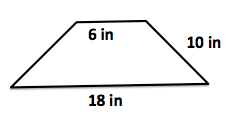
What is the area of the isoceles trapezoid?
This figure is an isosceles trapezoid with bases of 6 in and 18 in and a side of 10 in.
What is the area of the isoceles trapezoid?
Tap to reveal answer
In order to find the area of an isoceles trapezoid, you must average the bases and multiply by the height.
The average of the bases is straight forward:

In order to find the height, you must draw an altitude. This creates a right triangle in which one of the legs is also the height of the trapezoid. You may recognize the Pythagorean triple (6-8-10) and easily identify the height as 8. Otherwise, use  .
.


Multiply the average of the bases (12) by the height (8) to get an area of 96.

In order to find the area of an isoceles trapezoid, you must average the bases and multiply by the height.
The average of the bases is straight forward:
In order to find the height, you must draw an altitude. This creates a right triangle in which one of the legs is also the height of the trapezoid. You may recognize the Pythagorean triple (6-8-10) and easily identify the height as 8. Otherwise, use
Multiply the average of the bases (12) by the height (8) to get an area of 96.
← Didn't Know|Knew It →
Find the area of the following trapezoid:
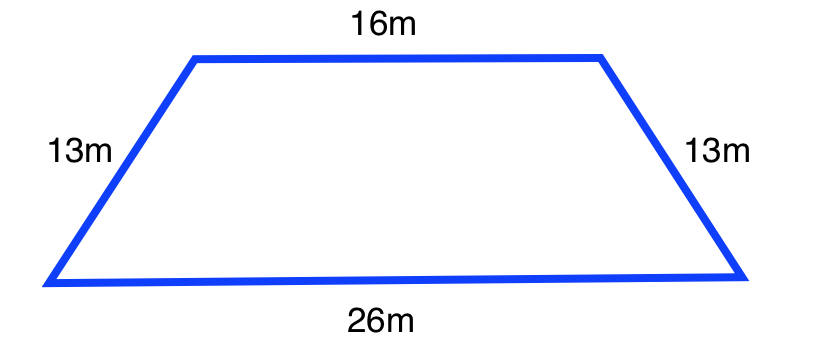
Find the area of the following trapezoid:
Tap to reveal answer
The formula for the area of a trapezoid is:

Where  is the length of one base,
  is the length of the other base, and
  is the height.
To find the height of the trapezoid, use a Pythagorean triple:


Plugging in our values, we get:


The formula for the area of a trapezoid is:
Where
To find the height of the trapezoid, use a Pythagorean triple:
Plugging in our values, we get:
← Didn't Know|Knew It →
Find the area of the following trapezoid:
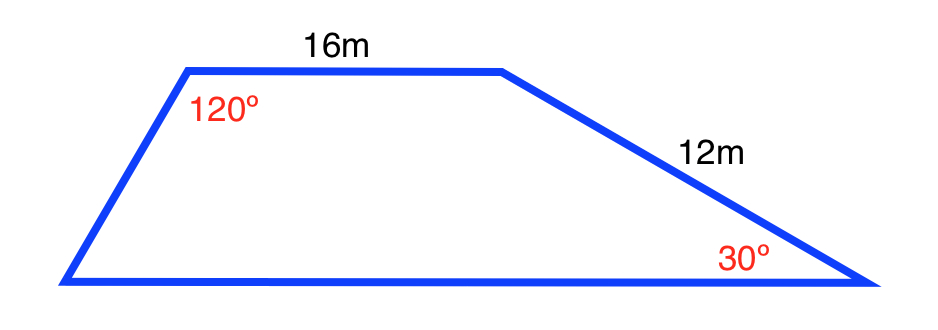
Find the area of the following trapezoid:
Tap to reveal answer
Use the formula for  triangles in order to find the length of the bottom base and the height.
The formula is:

Where  is the length of the side opposite the
  .
.
Beginning with the  side, if we were to create a
  triangle, the length of the base is
  , and the height is
  .
.
Creating another triangle on the left, we find the height is , the length of the base is  , and the side is
  .
.
The formula for the area of a trapezoid is:
Where is the length of one base, is the length of the other base, and is the height.
Plugging in our values, we get:


Use the formula for
The formula is:
Where
Beginning with the
Creating another
The formula for the area of a trapezoid is:
Where
Plugging in our values, we get:
← Didn't Know|Knew It →
Determine the area of the following trapezoid:
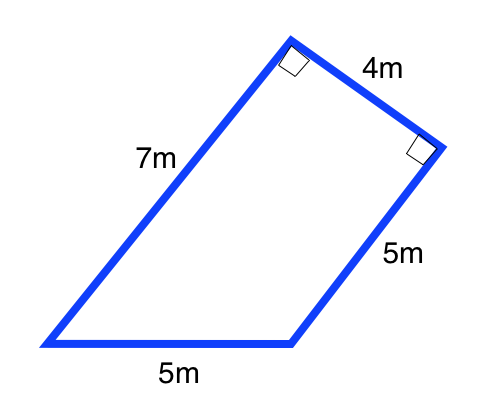
Determine the area of the following trapezoid:
Tap to reveal answer
The formula for the area of a trapezoid is:
 ,
,
where  is the length of one base,
  is the length of another base, and
  is the length of the height.
Plugging in our values, we get:

The formula for the area of a trapezoid is:
where
Plugging in our values, we get:
← Didn't Know|Knew It →
Find the area of the following trapezoid:
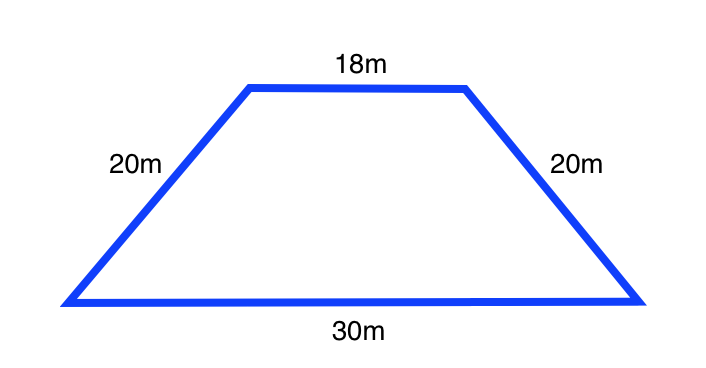
Find the area of the following trapezoid:
Tap to reveal answer
The formula for the area of a trapezoid is:
,
where is the length of one base, is the length of another base, and is the length of the height.
Use the Pythagorean Theorem to find the height of the trapezoid:


Plugging in our values, we get:

The formula for the area of a trapezoid is:
where
Use the Pythagorean Theorem to find the height of the trapezoid:
Plugging in our values, we get:
← Didn't Know|Knew It →
Find the area of the following trapezoid:
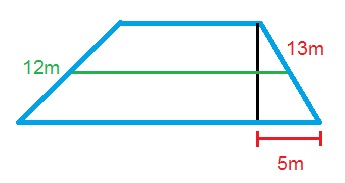
Find the area of the following trapezoid:
Tap to reveal answer
The formula for the area of a trapezoid is
 .
.
Use the Pythagorean Theorem to find the length of the height:


Plugging in our values, we get:


The formula for the area of a trapezoid is
Use the Pythagorean Theorem to find the length of the height:
Plugging in our values, we get:
← Didn't Know|Knew It →
Find the area of the following trapezoid:
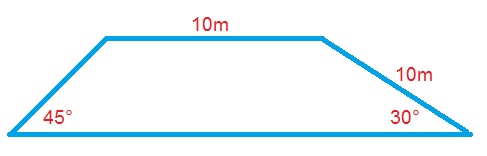
Find the area of the following trapezoid:
Tap to reveal answer
The formula for the area of a trapezoid is
 ,
,
where  is the base of the trapezoid and
  is the height of the trapezoid.
Use the formula for a  triangle to find the length of the base and height:


Use the formula for a  triangle to find the length of the base and height:


Plugging in our values, we get:


The formula for the area of a trapezoid is
where
Use the formula for a
Use the formula for a
Plugging in our values, we get:
← Didn't Know|Knew It →
Find the area of the trapezoid.
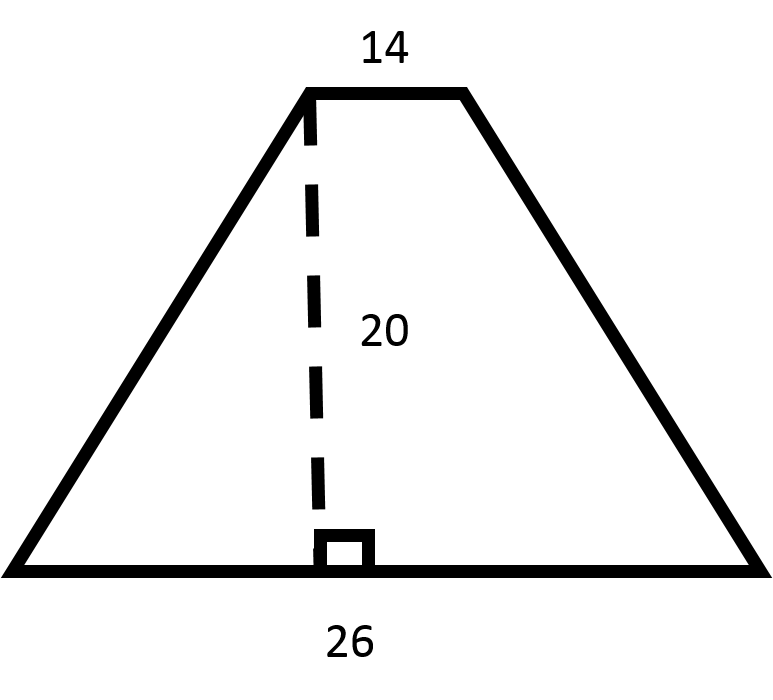
Find the area of the trapezoid.
Tap to reveal answer
Recall the formula for finding the area of a trapezoid:

Now, plug in the values for the bases and the height to find the area.

Recall the formula for finding the area of a trapezoid:
Now, plug in the values for the bases and the height to find the area.
← Didn't Know|Knew It →
Find the area of the trapezoid.
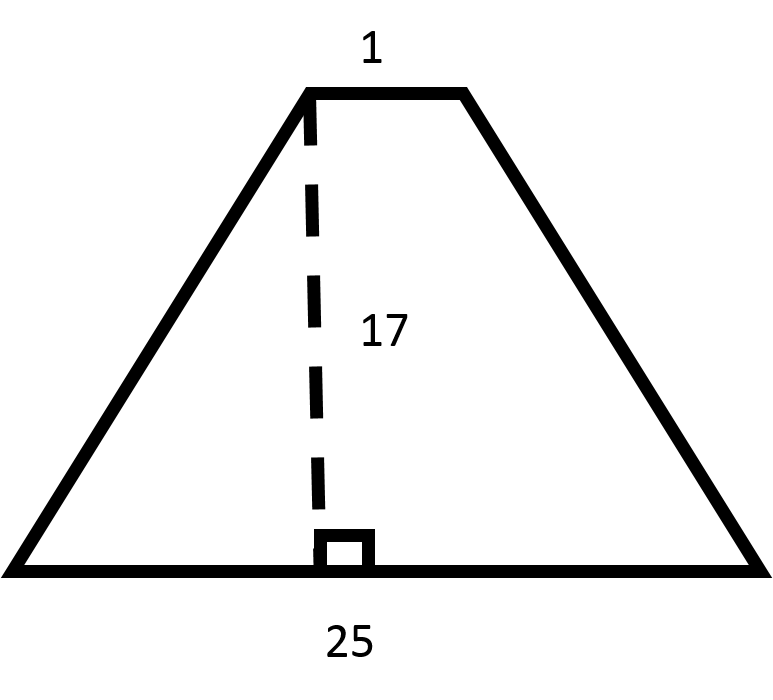
Find the area of the trapezoid.
Tap to reveal answer
Recall the formula for finding the area of a trapezoid:
Now, plug in the values for the bases and the height to find the area.

Recall the formula for finding the area of a trapezoid:
Now, plug in the values for the bases and the height to find the area.
← Didn't Know|Knew It →
A trapezoid has two bases measuring  and
and  , and a height measuring
What is its area?
A trapezoid has two bases measuring
What is its area?
Tap to reveal answer
To find the area of a trapezoid, use this formula:  .
.
Use the information from the question to solve.


The area is  .
.
To find the area of a trapezoid, use this formula:
Use the information from the question to solve.
The area is
← Didn't Know|Knew It →
Calculate the area of the trapezoid:

Calculate the area of the trapezoid:
Tap to reveal answer
Break the figure into a rectangle and a triangle. Use the dotted line as a guide. The rectangle has a length of 8 and a width of 6. The triangle has a base of 6 and width of 6.
Area of the rectangle:


Area of the triangle:


Add them together:

Break the figure into a rectangle and a triangle. Use the dotted line as a guide. The rectangle has a length of 8 and a width of 6. The triangle has a base of 6 and width of 6.
Area of the rectangle:
Area of the triangle:
Add them together:
← Didn't Know|Knew It →

Figure not drawn to scale
Find the area of the trapezoid.
Figure not drawn to scale
Find the area of the trapezoid.
Tap to reveal answer
In order to find the area of the trapezoid, we must follow the formula below:

 One of the bases of the trapezoid
 The other base of the trapezoid
 The height of the trapezoid
In this question,  ,
,  , and
, and 


By following the formula and order of operations, we are able to solve the problem. The area of the trapezoid is 72 in.2
In order to find the area of the trapezoid, we must follow the formula below:
In this question,
By following the formula and order of operations, we are able to solve the problem. The area of the trapezoid is 72 in.2
← Didn't Know|Knew It →
Find the area of the trapezoid:

Find the area of the trapezoid:
Tap to reveal answer


← Didn't Know|Knew It →
In a trapezoid, the top base is equal to 5 and the bottom base is equal to 11. It has a height of 6. What is the area?
In a trapezoid, the top base is equal to 5 and the bottom base is equal to 11. It has a height of 6. What is the area?
Tap to reveal answer
The area of a trapezoid is equal to the sum of the bases, divided by 2, and then multiplied by the height:


The area of a trapezoid is equal to the sum of the bases, divided by 2, and then multiplied by the height:
← Didn't Know|Knew It →
A trapezoid's bases are  and
and  long. It's height is
  . What is the area of this trapezoid?
A trapezoid's bases are
Tap to reveal answer
The formula to calculate the area of a trapezoid is:


The formula to calculate the area of a trapezoid is:
← Didn't Know|Knew It →
Find the area of a trapezoid whose bases are  and
and  and height is
  .
.
Find the area of a trapezoid whose bases are
Tap to reveal answer
To solve, simply use the formula for the area of a trapezoid. Thus,

To solve, simply use the formula for the area of a trapezoid. Thus,
← Didn't Know|Knew It →