How to find the area of a square - Math
Card 1 of 1247
Calvin is remodeling his room. He used  feet of molding to put molding around all four walls. Now he wants to paint three of the walls. Each wall is the same width and is
  feet tall. If one can of paint covers
  square feet, how many cans of paint will he need to paint three walls.
Calvin is remodeling his room. He used
Tap to reveal answer
When Calvin put up  feet of molding, he figured out the perimeter of the room was
  feet. Since he knows that all four walls are the same width, he can use the equation
  to determine the length of each side by plugging
  in for
  and solving for
  .
.

In order to solve for  , Calvin must divide both sides by four.
The left-hand side simplifies to:

The right-hand side simplifies to:

Now, Calvin knows the width of each room is  feet. Next he must find the area of each wall. To do this, he must multiply the width by the height because the area of a rectangle is found using the equation
  . Since Calvin now knows that the width of each wall is
  feet and that the height of each wall is also
  feet, he can multiply the two together to find the area.

Since Calvin wants to find how much paint he needs to cover three walls, he must first find out how many square feet he is covering. If one wall is  square feet, he must multiply that by
  .
.

Calvin is painting  square feet. If one can of paint covers 24 square feet, he must divide the total space (
 square feet) by
  .
.

Calvin will need  cans of paint.
When Calvin put up
In order to solve for
The left-hand side simplifies to:
The right-hand side simplifies to:
Now, Calvin knows the width of each room is
Since Calvin wants to find how much paint he needs to cover three walls, he must first find out how many square feet he is covering. If one wall is
Calvin is painting
Calvin will need
← Didn't Know|Knew It →
Which is the greater quantity?
(a) The surface area of a cube with volume 
(b) The surface area of a cube with sidelength 
Which is the greater quantity?
(a) The surface area of a cube with volume
(b) The surface area of a cube with sidelength
Tap to reveal answer
We can actually solve this by comparing volumes; the cube with the greater volume has the greater sidelength and, subsequently, the greater surface area.
The volume of the cube in (b) is the cube of 90 millimeters, or 9 centimeters. This is  , which is greater than
  . The cube in (b) has the greater volume, sidelength, and, most importantly, surface area.
We can actually solve this by comparing volumes; the cube with the greater volume has the greater sidelength and, subsequently, the greater surface area.
The volume of the cube in (b) is the cube of 90 millimeters, or 9 centimeters. This is
← Didn't Know|Knew It →
Each side of a square is  units long. Which is the greater quantity?
(A) The area of the square
(B) 
Each side of a square is
(A) The area of the square
(B)
Tap to reveal answer
The area of a square is the square of its side length:

Using the side length from the question:

However, it is impossible to tell with certainty which of  and
and  is greater.
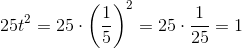
For example, if  ,
,

and

so  if .
if .
But if  ,
,
and
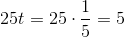
so  if .
if .
The area of a square is the square of its side length:
Using the side length from the question:
However, it is impossible to tell with certainty which of
For example, if
and
so
But if
and
so
← Didn't Know|Knew It →
The sum of the lengths of three sides of a square is one yard. Give its area in square inches.
The sum of the lengths of three sides of a square is one yard. Give its area in square inches.
Tap to reveal answer
A square has four sides of the same length.
One yard is equal to 36 inches, so each side of the square has length
 inches.
Its area is the square of the sidelength, or
 square inches.
A square has four sides of the same length.
One yard is equal to 36 inches, so each side of the square has length
Its area is the square of the sidelength, or
← Didn't Know|Knew It →
The sum of the lengths of three sides of a square is 3,900 centimeters. Give its area in square meters.
The sum of the lengths of three sides of a square is 3,900 centimeters. Give its area in square meters.
Tap to reveal answer
100 centimeters are equal to one meter, so 3,900 centimeters are equal to
 meters.
A square has four sides of the same length. Since the sum of the lengths of three of the congruent sides is 3,900 centimeters, or 39 meters, each side measures
 meters.
The area of the square is the square of the sidelength, or
 square meters.
100 centimeters are equal to one meter, so 3,900 centimeters are equal to
A square has four sides of the same length. Since the sum of the lengths of three of the congruent sides is 3,900 centimeters, or 39 meters, each side measures
The area of the square is the square of the sidelength, or
← Didn't Know|Knew It →
A square has a side with a length of 5. What is the area of the square?
A square has a side with a length of 5. What is the area of the square?
Tap to reveal answer
The area formula for a square is length times width. Keep in mind that all of a square's sides are equal.

So, if one side of a square equals 5, all of the other sides must also equal 5. You will find the area of the square by multiplying two of its sides:


The area formula for a square is length times width. Keep in mind that all of a square's sides are equal.
So, if one side of a square equals 5, all of the other sides must also equal 5. You will find the area of the square by multiplying two of its sides:
← Didn't Know|Knew It →
One square mile is equivalent to 640 acres. Which of the following is the greater quantity?
(a) The area of a square plot of land whose perimeter measures one mile
(b) 160 acres
One square mile is equivalent to 640 acres. Which of the following is the greater quantity?
(a) The area of a square plot of land whose perimeter measures one mile
(b) 160 acres
Tap to reveal answer
A square plot of land with perimeter one mile has as its sidelength one fourth of this, or  mile; its area is the square of this, or
 square miles.
One square mile is equivalent to 640 acres, so  square miles is equivalent to
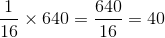 acres.
This makes (b) greater.
A square plot of land with perimeter one mile has as its sidelength one fourth of this, or
One square mile is equivalent to 640 acres, so
This makes (b) greater.
← Didn't Know|Knew It →
One square kilometer is equal to 100 hectares.
Which is the greater quantity?
(a) The area of a rectangular plot of land 500 meters in length and 200 meters in width
(b) One hectare
One square kilometer is equal to 100 hectares.
Which is the greater quantity?
(a) The area of a rectangular plot of land 500 meters in length and 200 meters in width
(b) One hectare
Tap to reveal answer
One kilometer is equal to 1,000 meters, so divide each dimension of the plot in meters by 1,000 to convert to kilometers:
 kilometers
 kilometers
Multiply the dimensions to get the area in square kilometers:
 square kilometers
Since one square kilometer is equal to 100 hectares, multiply this by 100 to convert to hectares:
 hectares
This makes (a) the greater.
One kilometer is equal to 1,000 meters, so divide each dimension of the plot in meters by 1,000 to convert to kilometers:
Multiply the dimensions to get the area in square kilometers:
Since one square kilometer is equal to 100 hectares, multiply this by 100 to convert to hectares:
This makes (a) the greater.
← Didn't Know|Knew It →
Freddie is building a square pen for his pig. He plans to buy x feet of fencing to build the pen. This will result in a pen with an area of p square feet. Unfortunately, he only has enough money to buy one third of the planned amount of fencing. Which expression represents the area of the pen he can build with this limited amount of fencing?
Freddie is building a square pen for his pig. He plans to buy x feet of fencing to build the pen. This will result in a pen with an area of p square feet. Unfortunately, he only has enough money to buy one third of the planned amount of fencing. Which expression represents the area of the pen he can build with this limited amount of fencing?
Tap to reveal answer
If Freddie uses x feet of fencing makes a square, each side must be x/4 feet long. The area of this square is (x/4)2 = _x_2/16 = p square feet.
If Freddie uses one third of x feet of fencing makes a square, each side must be x/12 feet long. The area of this square is (x/12)2 = _x_2/144 = 1/9(_x_2/16) = 1/9(p) = p/9 square feet.
Alternate method:
The scale factor between the small perimeter and the larger perimeter = 1 : 3. Since we're comparing area, a two-dimensional measurement, we can square the scale factor and see that the ratio of the areas is 12 : 32 = 1 : 9.
If Freddie uses x feet of fencing makes a square, each side must be x/4 feet long. The area of this square is (x/4)2 = _x_2/16 = p square feet.
If Freddie uses one third of x feet of fencing makes a square, each side must be x/12 feet long. The area of this square is (x/12)2 = _x_2/144 = 1/9(_x_2/16) = 1/9(p) = p/9 square feet.
Alternate method:
The scale factor between the small perimeter and the larger perimeter = 1 : 3. Since we're comparing area, a two-dimensional measurement, we can square the scale factor and see that the ratio of the areas is 12 : 32 = 1 : 9.
← Didn't Know|Knew It →
How much more area does a square with a side of 2r have than a circle with a radius r? Approximate π by using 22/7.
How much more area does a square with a side of 2r have than a circle with a radius r? Approximate π by using 22/7.
Tap to reveal answer
The area of a circle is given by A = πr2 or 22/7r2
The area of a square is given by A = s2 or (2r)2 = 4r2
Then subtract the area of the circle from the area of the square and get 6/7 square units.
The area of a circle is given by A = πr2 or 22/7r2
The area of a square is given by A = s2 or (2r)2 = 4r2
Then subtract the area of the circle from the area of the square and get 6/7 square units.
← Didn't Know|Knew It →
ABCD and EFGH are squares such that the perimeter of ABCD is 3 times that of EFGH. If the area of EFGH is 25, what is the area of ABCD?
ABCD and EFGH are squares such that the perimeter of ABCD is 3 times that of EFGH. If the area of EFGH is 25, what is the area of ABCD?
Tap to reveal answer
Assign variables such that
One side of ABCD = a
and One side of EFGH = e
Note that all sides are the same in a square. Since the perimeter is the sum of all sides, according to the question:
4a = 3 x 4e = 12e or a = 3e
From that area of EFGH is 25,
e x e = 25 so e = 5
Substitute a = 3e so a = 15
We aren’t done. Since we were asked for the area of ABCD, this is a x a = 225.
Assign variables such that
One side of ABCD = a
and One side of EFGH = e
Note that all sides are the same in a square. Since the perimeter is the sum of all sides, according to the question:
4a = 3 x 4e = 12e or a = 3e
From that area of EFGH is 25,
e x e = 25 so e = 5
Substitute a = 3e so a = 15
We aren’t done. Since we were asked for the area of ABCD, this is a x a = 225.
← Didn't Know|Knew It →
A half circle has an area of  . What is the area of a square with sides that measure the same length as the diameter of the half circle?
A half circle has an area of
Tap to reveal answer
If the area of the half circle is  , then the area of a full circle is twice that, or
  .
.
Use the formula for the area of a circle to solve for the radius:
36π = πr2
r = 6
If the radius is 6, then the diameter is 12. We know that the sides of the square are the same length as the diameter, so each side has length 12.
Therefore the area of the square is 12 x 12 = 144.
If the area of the half circle is
Use the formula for the area of a circle to solve for the radius:
36π = πr2
r = 6
If the radius is 6, then the diameter is 12. We know that the sides of the square are the same length as the diameter, so each side has length 12.
Therefore the area of the square is 12 x 12 = 144.
← Didn't Know|Knew It →
If a completely fenced-in square-shaped yard requires 140 feet of fence, what is the area, in square feet, of the lot?
If a completely fenced-in square-shaped yard requires 140 feet of fence, what is the area, in square feet, of the lot?
Tap to reveal answer
Since the yard is square in shape, we can divide the perimeter(140ft) by 4, giving us 35ft for each side. We then square 35 to give us the area, 1225 feet.
Since the yard is square in shape, we can divide the perimeter(140ft) by 4, giving us 35ft for each side. We then square 35 to give us the area, 1225 feet.
← Didn't Know|Knew It →
A square has an area of 36. If all sides are doubled in value, what is the new area?
A square has an area of 36. If all sides are doubled in value, what is the new area?
Tap to reveal answer
Let S be the original side length. S*S would represent the original area. Doubling the side length would give you 2S*2S, simplifying to 4*(S*S), giving a new area of 4x the original, or 144.
Let S be the original side length. S*S would represent the original area. Doubling the side length would give you 2S*2S, simplifying to 4*(S*S), giving a new area of 4x the original, or 144.
← Didn't Know|Knew It →
If the perimeter of a square is equal to twice its area, what is the length of one of its sides?
If the perimeter of a square is equal to twice its area, what is the length of one of its sides?
Tap to reveal answer
Area of a square in terms of each of its sides:
Area = S x S
Perimeter of a square:
Perimeter = 4S
So if 'the perimeter of a square is equal to twice its area':
2 x Area = Perimeter
2 x \[S x S\] = \[4S\]; divide by 2:
S x S = 2S; divide by S:
S = 2
Area of a square in terms of each of its sides:
Area = S x S
Perimeter of a square:
Perimeter = 4S
So if 'the perimeter of a square is equal to twice its area':
2 x Area = Perimeter
2 x \[S x S\] = \[4S\]; divide by 2:
S x S = 2S; divide by S:
S = 2
← Didn't Know|Knew It →
If the diagonal of a square measures 16$\sqrt{2}$ cm, what is the area of the square?
If the diagonal of a square measures 16$\sqrt{2}$ cm, what is the area of the square?
Tap to reveal answer
This is an isosceles right triangle, so the diagonal must equal $\sqrt{2}$ times the length of a side. Thus, one side of the square measures 16 cm, and the area is equal to (16 $cm)^{2}$ = 256 $cm^{2}$
This is an isosceles right triangle, so the diagonal must equal $\sqrt{2}$ times the length of a side. Thus, one side of the square measures 16 cm, and the area is equal to (16 $cm)^{2}$ = 256 $cm^{2}$
← Didn't Know|Knew It →
If the perimeter of a square is 44 centimeters, what is the area of the square in square centimeters?
If the perimeter of a square is 44 centimeters, what is the area of the square in square centimeters?
Tap to reveal answer
Since the square's perimeter is 44, then each side is $\frac{44}{4}$=11.
Then in order to find the area, use the definition that the
$Area=side^{2}$
$11^{2}$=121
Since the square's perimeter is 44, then each side is $\frac{44}{4}$=11.
Then in order to find the area, use the definition that the
$Area=side^{2}$
$11^{2}$=121
← Didn't Know|Knew It →
A square A has side lengths of z. A second square B has side lengths of 2.25z. How many A's can you fit in a single B?
A square A has side lengths of z. A second square B has side lengths of 2.25z. How many A's can you fit in a single B?
Tap to reveal answer
The area of A is n, the area of B is 5.0625n. Therefore, you can fit 5.06 A's in B.
The area of A is n, the area of B is 5.0625n. Therefore, you can fit 5.06 A's in B.
← Didn't Know|Knew It →
The perimeter of a square is 12 in. If the square is enlarged by a factor of three, what is the new area?
The perimeter of a square is 12 in. If the square is enlarged by a factor of three, what is the new area?
Tap to reveal answer
The perimeter of a square is given by P=4s=12 so the side length of the original square is 3 in. The side of the new square is enlarged by a factor of 3 to give s=9 in.
So the area of the new square is given by A = $s^{2}$ = $(9)^{2}$ = 81 $in^{2}$.
The perimeter of a square is given by P=4s=12 so the side length of the original square is 3 in. The side of the new square is enlarged by a factor of 3 to give s=9 in.
So the area of the new square is given by A = $s^{2}$ = $(9)^{2}$ = 81 $in^{2}$.
← Didn't Know|Knew It →
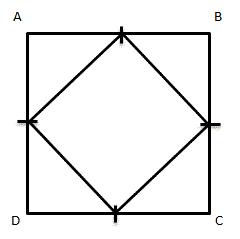
Given square  , with midpoints on each side connected to form a new, smaller square. How many times bigger is the area of the larger square than the smaller square?
Given square
Tap to reveal answer
Assume that the length of each midpoint is 1. This means that the length of each side of the large square is 2, so the area of the larger square is 4 square $units.A=s^{2}$
To find the area of the smaller square, first find the length of each side. Because the length of each midpoint is 1, each side of the smaller square is $\sqrt{2}$ (use either the Pythagorean Theorem or notice that these right trianges are isoceles right trianges, so s, s, s$\sqrt{2}$ can be used).
The area then of the smaller square is 2 square units.
Comparing the area of the two squares, the larger square is 2 times larger than the smaller square.
Assume that the length of each midpoint is 1. This means that the length of each side of the large square is 2, so the area of the larger square is 4 square $units.A=s^{2}$
To find the area of the smaller square, first find the length of each side. Because the length of each midpoint is 1, each side of the smaller square is $\sqrt{2}$ (use either the Pythagorean Theorem or notice that these right trianges are isoceles right trianges, so s, s, s$\sqrt{2}$ can be used).
The area then of the smaller square is 2 square units.
Comparing the area of the two squares, the larger square is 2 times larger than the smaller square.
← Didn't Know|Knew It →