How to find the angle of a sector - Math
Card 1 of 240
Which is the greater quantity?
(a) The degree measure of a 10-inch-long arc on a circle with radius 8 inches.
(b) The degree measure of a 12-inch-long arc on a circle with radius 10 inches.
Which is the greater quantity?
(a) The degree measure of a 10-inch-long arc on a circle with radius 8 inches.
(b) The degree measure of a 12-inch-long arc on a circle with radius 10 inches.
Tap to reveal answer
(a) A circle with radius 8 inches has crircumference  inches. An arc 10 inches long is
  of that circle.
  , the degree measure of this arc.
(b) A circle with radius 10 inches has crircumference  inches. An arc 12 inches long is
  of that circle.
  , the degree measure of this arc.
(a) is the greater quantity.
(a) A circle with radius 8 inches has crircumference
(b) A circle with radius 10 inches has crircumference
(a) is the greater quantity.
← Didn't Know|Knew It →

Note: figure NOT drawn to scale
Refer to the above figure. Which is the greater quantity?
(a) 
(b) 
Note: figure NOT drawn to scale
Refer to the above figure. Which is the greater quantity?
(a)
(b)
Tap to reveal answer
Since
 ,
,
the triangle is a right triangle with right angle  .
.
 is an inscribed angle on the circle, so the arc it intercepts is a semicricle. Therefore,
  is also a semicircle, and it measures
  .
.
Since
the triangle is a right triangle with right angle
← Didn't Know|Knew It →

Refer to the above figure. Which is the greater quantity?
(a) 
(b) 55
Refer to the above figure. Which is the greater quantity?
(a)
(b) 55
Tap to reveal answer
The measure of an inscribed angle of a circle is one-half that of the arc it intercepts. Therefore,  .
.
The measure of an inscribed angle of a circle is one-half that of the arc it intercepts. Therefore,
← Didn't Know|Knew It →

Note: Figure NOT drawn to scale
Refer to the above figure. Which is the greater quantity?
(a) 
(b) 90
Note: Figure NOT drawn to scale
Refer to the above figure. Which is the greater quantity?
(a)
(b) 90
Tap to reveal answer
The measure of an arc intercepted by an inscribed angle of a circle is twice that of the angle. Therefore, 
The measure of an arc intercepted by an inscribed angle of a circle is twice that of the angle. Therefore,
← Didn't Know|Knew It →
 has twice the radius of
  . Sector 1 is part of
  ; Sector 2 is part of
  ; the two sectors are equal in area.
Which is the greater quantity?
(a) Twice the degree measure of the central angle of Sector 1
(b) The degree measure of the central angle of Sector 2
Which is the greater quantity?
(a) Twice the degree measure of the central angle of Sector 1
(b) The degree measure of the central angle of Sector 2
Tap to reveal answer
 has twice the radius of
  , so
, so  has four times the area of
  . This means that for a sector of
  to have the same area as a sector of
  , the central angle of the latter sector must be four times that of the former sector. This makes (b) greater than (a), which is only twice that of the former sector.
← Didn't Know|Knew It →

The area of the shaded sector in circle O is  . What is the angle measure
  ?
?
The area of the shaded sector in circle O is
Tap to reveal answer
Remember that the angle for a sector or arc is found as a percentage of the total  degrees of the circle. The proportion of
  to
to  is the same as
  to the total area of the circle.
The area of a circle is found by:

For our data, this means:

Now we can solve for  using the proportions:

Cross multiply:

Divide both sides by  :
:

Therefore,  is
is  ˚.
˚.
Remember that the angle for a sector or arc is found as a percentage of the total
The area of a circle is found by:
For our data, this means:
Now we can solve for
Cross multiply:
Divide both sides by
Therefore,
← Didn't Know|Knew It →

The area of the shaded sector in circle O is  . What is the angle measure
  , rounded to the nearest hundredth?
The area of the shaded sector in circle O is
Tap to reveal answer
Remember that the angle for a sector or arc is found as a percentage of the total  degrees of the circle. The proportion of
  to
to  is the same as
  to the total area of the circle.
The area of a circle is found by:

For our data, this means:

Now we can solve for  using the proportions:

Cross multiply:

Divide both sides by  :
:

Therefore,  is
is  ˚.
˚.
Remember that the angle for a sector or arc is found as a percentage of the total
The area of a circle is found by:
For our data, this means:
Now we can solve for
Cross multiply:
Divide both sides by
Therefore,
← Didn't Know|Knew It →

The arc-length for the shaded sector is  . What is the value of
  , rounded to the nearest hundredth?
The arc-length for the shaded sector is
Tap to reveal answer
Remember that the angle for a sector or arc is found as a percentage of the total  degrees of the circle. The proportion of
  to
to  is the same as
  to the total circumference of the circle.
The circumference of a circle is found by:

For our data, this means:

Now we can solve for  using the proportions:

Cross multiply:

Divide both sides by  :
:

Therefore,  is
is  ˚.
˚.
Remember that the angle for a sector or arc is found as a percentage of the total
The circumference of a circle is found by:
For our data, this means:
Now we can solve for
Cross multiply:
Divide both sides by
Therefore,
← Didn't Know|Knew It →

The arc-length for the shaded sector is  . What is the value of
  , rounded to the nearest hundredth?
The arc-length for the shaded sector is
Tap to reveal answer
Remember that the angle for a sector or arc is found as a percentage of the total  degrees of the circle. The proportion of
  to
to  is the same as
  to the total circumference of the circle.
The circumference of a circle is found by:

For our data, this means:

Now we can solve for  using the proportions:

Cross multiply:

Divide both sides by  :
:

Therefore,  is
is  ˚.
˚.
Remember that the angle for a sector or arc is found as a percentage of the total
The circumference of a circle is found by:
For our data, this means:
Now we can solve for
Cross multiply:
Divide both sides by
Therefore,
← Didn't Know|Knew It →
 is inscribed in a circle.
  is a semicircle.
  .
.
Which is the greater quantity?
(a) 
(b) 
Which is the greater quantity?
(a)
(b)
Tap to reveal answer
The figure referenced is below:

 is a semicircle, so
  is one as well; as a semicircle, its measure is
  . The inscribed angle that intercepts this semicircle,
  , is a right angle, of measure
  .
.  , and the sum of the measures of the interior angles of a triangle is
  , so
, so


 has greater measure than
  , so the minor arc intercepted by
  , which is
  , has greater measure than that intercepted by
  , which is
  . It follows that the major arc corresponding to the latter, which is
  , has greater measure than that corresponding to the former, which is
  .
.
The figure referenced is below:
← Didn't Know|Knew It →

Refer to the above figure, Which is the greater quantity?
(a) The area of 
(b) The area of the orange semicircle
Refer to the above figure, Which is the greater quantity?
(a) The area of
(b) The area of the orange semicircle
Tap to reveal answer
 has angles of degree measure 30 and 60; the third angle must measure 90 degrees, making a right triangle.
For the sake of simplicity, let  ; the reasoning is independent of the actual length. The smaller leg of a 30-60-90 triangle has length equal to
  times that of the longer leg; this is about

The area of a right triangle is half the product of its legs, so

Also, if  , then the orange semicircle has diameter 1 and radius
  . Its area can be found by substituting
  in the formula:

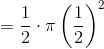
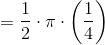



The orange semicircle has a greater area than 
For the sake of simplicity, let
The area of a right triangle is half the product of its legs, so
Also, if
The orange semicircle has a greater area than
← Didn't Know|Knew It →

In the above figure,  is a diameter of the circle.
Which is the greater quantity?
(a) 
(b) 
In the above figure,
Which is the greater quantity?
(a)
(b)
Tap to reveal answer
That  is a diameter of the circle is actually irrelevant to the problem. Two inscribed angles of a circle that both intercept the same arc, as
  and
and  both do here, have the same measure.
That
← Didn't Know|Knew It →
Trapezoid  is inscribed in a circle, with
  a diameter.
Which is the greater quantity?
(a) 
(b) 
Trapezoid
Which is the greater quantity?
(a)
(b)
Tap to reveal answer
Below is the inscribed trapezoid referenced, along with its diagonals.

 , so, by the Alternate Interior Angles Theorem,
 , and their intercepted angles are also congruent - that is,


By the Arc Addition Principle,
 .
.
Below is the inscribed trapezoid referenced, along with its diagonals.
By the Arc Addition Principle,
← Didn't Know|Knew It →

In the above figure,  is the center of the circle, and
  . Which is the greater quantity?
(a) 
(b) 
In the above figure,
(a)
(b)
Tap to reveal answer
Construct  . The new figure is below:

 , so
, so  . It follows that their respective central angles have measures

and
 .
.
Also, since  and
and  -
-  being a semicircle - by the Arc Addition Principle,
  .
.  , an inscribed angle which intercepts this arc, has half this measure, which is
  . The other angle of
  , which is
  , also measures
  , so
, so  is equilateral.
 , since all radii are congruent;
 by reflexivity;

By the Side-Angle-Side Inequality Theorem (or Hinge Theorem), it follows that  . Since
  is equilateral,
  , and since all radii are congruent,
  . Substituting, it follows that
  .
.
Construct
and
Also, since
By the Side-Angle-Side Inequality Theorem (or Hinge Theorem), it follows that
← Didn't Know|Knew It →

In the above figure,  is a diameter of the circle. Which is the greater quantity?
(a) 
(b) 
In the above figure,
(a)
(b)
Tap to reveal answer
Both  and
and  are inscribed angles of the same circle which intercept the same arc; they are therefore of the same measure. The fact that
  is a diameter of the circle is actually irrelevant to the problem.
Both
← Didn't Know|Knew It →

Figure NOT drawn to scale.
Refer to the above diagram.  is the arithmetic mean of
  and
and  .
.
Which is the greater quantity?
(a) 
(b) 
Figure NOT drawn to scale.
Refer to the above diagram.
Which is the greater quantity?
(a)
(b)
Tap to reveal answer
 is the arithmetic mean of
  and
and  , so
, so

By arc addition, this becomes

Also,  , or, equivalently,
 , so
, so

Solving for  :
:


Also,

If two tangents are drawn to a circle, the measure of the angle they form is half the difference of the measures of the arcs they intercept, so

By arc addition, this becomes
Also,
Solving for
Also,
If two tangents are drawn to a circle, the measure of the angle they form is half the difference of the measures of the arcs they intercept, so
← Didn't Know|Knew It →

Figure NOT drawn to scale
In the above diagram,  .
.
Which is the greater quantity?
(a) 
(b) 
Figure NOT drawn to scale
In the above diagram,
Which is the greater quantity?
(a)
(b)
Tap to reveal answer
 is a right triangle whose hypotenuse
  has length
  times that of leg
  . This is characteristic of a triangle whose acute angles both have measure
  -and consequently, whose acute angles are congruent. Therefore,

These inscribed angles being congruent, the arcs they intercept,  and
and  , are also congruent.
These inscribed angles being congruent, the arcs they intercept,
← Didn't Know|Knew It →
Figure NOT drawn to scale
In the above diagram,  .
.
Which is the greater quantity?
(a) 
(b) 
Figure NOT drawn to scale
In the above diagram,
Which is the greater quantity?
(a)
(b)
Tap to reveal answer
 is an inscribed angle, so its degree measure is half that of the arc it intercepts,
  :
:
 .
.
 and
and  are acute angles of right triangle
  . They are therefore complimentary - that is, their degree measures total
  . Consequently,


 .
.
← Didn't Know|Knew It →
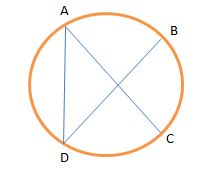
In the circle above, the length of arc BC is 100 degrees, and the segment AC is a diameter. What is the measure of angle ADB in degrees?
In the circle above, the length of arc BC is 100 degrees, and the segment AC is a diameter. What is the measure of angle ADB in degrees?
Tap to reveal answer
Since we know that segment AC is a diameter, this means that the length of the arc ABC must be 180 degrees. This means that the length of the arc AB must be 80 degrees.
Since angle ADB is an inscribed angle, its measure is equal to half of the measure of the angle of the arc that it intercepts. This means that the measure of the angle is half of 80 degrees, or 40 degrees.
Since we know that segment AC is a diameter, this means that the length of the arc ABC must be 180 degrees. This means that the length of the arc AB must be 80 degrees.
Since angle ADB is an inscribed angle, its measure is equal to half of the measure of the angle of the arc that it intercepts. This means that the measure of the angle is half of 80 degrees, or 40 degrees.
← Didn't Know|Knew It →
The length of an arc,  , of a circle is
  and the radius,
  , of the circle is
  . What is the measure in degrees of the central angle,
  , formed by the arc
  ?
?
The length of an arc,
Tap to reveal answer
The circumference of the circle is  .
.

The length of the arc S is  .
.
A ratio can be established:
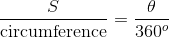

Solving for _ _yields 90o.
Note: This makes sense. Since the arc S was one-fourth the circumference of the circle, the central angle formed by arc S should be one-fourth the total degrees of a circle.
The circumference of the circle is
The length of the arc S is
A ratio can be established:
Solving for _
Note: This makes sense. Since the arc S was one-fourth the circumference of the circle, the central angle formed by arc S should be one-fourth the total degrees of a circle.
← Didn't Know|Knew It →