How to find an angle in a parallelogram - Math
Card 1 of 80
A parallelogram contains 2 angles measuring 135 and 45. What are the measures of the other 2 angles?
A parallelogram contains 2 angles measuring 135 and 45. What are the measures of the other 2 angles?
Tap to reveal answer
Parallelograms have angles totalling 360 degrees, but also have matching pairs of angles at the ends of diagonals. Therefore the 2 additional angles must match the 2 given in the question.
Parallelograms have angles totalling 360 degrees, but also have matching pairs of angles at the ends of diagonals. Therefore the 2 additional angles must match the 2 given in the question.
← Didn't Know|Knew It →

Using the above rhombus, find the measurement of angle 
Using the above rhombus, find the measurement of angle
Tap to reveal answer
A rhombus must have equivalent opposite interior angles. Additionally, the sum of all four interior angles must equal  degrees. And, the adjacent interior angles must be supplementary angles (sum of
  degrees)--i.e. angles
  degrees.
Thus, the solution is:


A rhombus must have equivalent opposite interior angles. Additionally, the sum of all four interior angles must equal
Thus, the solution is:
← Didn't Know|Knew It →
Using the above rhombus, find the measurement of angle  .
.
Using the above rhombus, find the measurement of angle
Tap to reveal answer
A rhombus must have equivalent opposite interior angles. Additionally, the sum of all four interior angles must equal  degrees. And, the adjacent interior angles must be supplementary angles (sum of
  degrees)--i.e. angles
  degrees.
Thus, 

A rhombus must have equivalent opposite interior angles. Additionally, the sum of all four interior angles must equal
Thus,
← Didn't Know|Knew It →

Using the above rhombus, find the measurement of angle 
Using the above rhombus, find the measurement of angle
Tap to reveal answer
A rhombus must have equivalent opposite interior angles. Additionally, the sum of all four interior angles must equal  degrees. And, the adjacent interior angles must be supplementary angles (sum of
  degrees).
Thus, the solution is:


A rhombus must have equivalent opposite interior angles. Additionally, the sum of all four interior angles must equal
Thus, the solution is:
← Didn't Know|Knew It →
Using the above rhombus, find the sum of angle  and angle
  .
.
Using the above rhombus, find the sum of angle
Tap to reveal answer
A rhombus must have equivalent opposite interior angles. Additionally, the sum of all four interior angles must equal  degrees. And, the adjacent interior angles must be supplementary angles (sum of
  degrees).
Thus, the solution is:


A rhombus must have equivalent opposite interior angles. Additionally, the sum of all four interior angles must equal
Thus, the solution is:
← Didn't Know|Knew It →

Given that the measurement of angle  degrees, find the sum of angle
  and angle
Given that the measurement of angle
Tap to reveal answer
A rhombus must have equivalent opposite interior angles. Additionally, the sum of all four interior angles must equal  degrees. And, the adjacent interior angles must be supplementary angles (sum of
  degrees)--i.e. angles
  degrees.
The solution to this problem is:


Therefore,

A rhombus must have equivalent opposite interior angles. Additionally, the sum of all four interior angles must equal
The solution to this problem is:
Therefore,
← Didn't Know|Knew It →
In the above rhombus, angle  has a measurement of
  degrees. Find the sum of angles
  and
and 
In the above rhombus, angle
Tap to reveal answer
A rhombus must have equivalent opposite interior angles. Additionally, the sum of all four interior angles must equal  degrees. And, the adjacent interior angles must be supplementary angles (sum of
  degrees)--i.e. angles
  degrees.
The solution to this problem is:


Thus,

A rhombus must have equivalent opposite interior angles. Additionally, the sum of all four interior angles must equal
The solution to this problem is:
Thus,
← Didn't Know|Knew It →

Using the parallelogram above, find the measurement of angle 
Using the parallelogram above, find the measurement of angle
Tap to reveal answer
A parallelogram must have equivalent opposite interior angles. Additionally, the sum of all four interior angles must equal degrees. And, the adjacent interior angles must be supplementary angles (sum of degrees).
Since, angle  and
and  are supplementary the solution is:

A parallelogram must have equivalent opposite interior angles. Additionally, the sum of all four interior angles must equal
Since, angle
← Didn't Know|Knew It →
Using the parallelogram above, find the sum of angles  and
and  .
.
Using the parallelogram above, find the sum of angles
Tap to reveal answer
A rhombus must have equivalent opposite interior angles. Additionally, the sum of all four interior angles must equal degrees. And, the adjacent interior angles must be supplementary angles (sum of degrees).
The first step to solving this problem is to find the measurement of angle  . Since angle
  is a supplementary angle to angle
  , angle

Since, angle  and
and  are opposite interior angles they must be equivalent.
Thus, the final solution is:

A rhombus must have equivalent opposite interior angles. Additionally, the sum of all four interior angles must equal
The first step to solving this problem is to find the measurement of angle
Since, angle
Thus, the final solution is:
← Didn't Know|Knew It →
Using the parallelogram above, find the sum of angles  and
and  .
.
Using the parallelogram above, find the sum of angles
Tap to reveal answer
A parallelogram must have equivalent opposite interior angles. Additionally, the sum of all four interior angles must equal degrees. And, the adjacent interior angles must be supplementary angles (sum of degrees).
Since, angles  and
and  are opposite interior angles, they must be equivalent.
Therefore, the solution is:

A parallelogram must have equivalent opposite interior angles. Additionally, the sum of all four interior angles must equal
Since, angles
Therefore, the solution is:
← Didn't Know|Knew It →
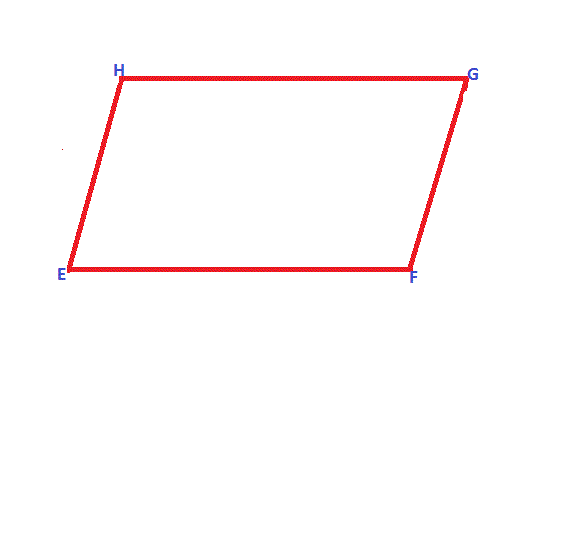
In the parallelogram shown above, angle  is
is  degrees. Find the measure of angle
In the parallelogram shown above, angle
Tap to reveal answer
A parallelogram must have equivalent opposite interior angles. Additionally, the sum of all four interior angles must equal degrees. And, the adjacent interior angles must be supplementary angles (sum of degrees).
Since, angles  and
and  are opposite interior angles, thus they must be equivalent.
 , therefore
A parallelogram must have equivalent opposite interior angles. Additionally, the sum of all four interior angles must equal
Since, angles
← Didn't Know|Knew It →
In the parallelogram shown above, angle  is
is  degrees. Find the sum of angles
  and
and  .
.
In the parallelogram shown above, angle
Tap to reveal answer
A parallelogram must have equivalent opposite interior angles. Additionally, the sum of all four interior angles must equal degrees. And, the adjacent interior angles must be supplementary angles (sum of degrees).
Thus, the solution is:

Since both angles  and
and  equal
equal  There sum must equal
A parallelogram must have equivalent opposite interior angles. Additionally, the sum of all four interior angles must equal
Thus, the solution is:
Since both angles
← Didn't Know|Knew It →
Using the parallelogram above, find the sum of angles  and
and 
Using the parallelogram above, find the sum of angles
Tap to reveal answer
A parallelogram must have equivalent opposite interior angles. Additionally, the sum of all four interior angles must equal degrees.
Also, the adjacent interior angles must be supplementary angles (sum of degrees).
Since, angles  and
and  are adjacent to each other they must be supplementary angles.
Thus, the sum of these two angles must equal  degrees.
A parallelogram must have equivalent opposite interior angles. Additionally, the sum of all four interior angles must equal
Also, the adjacent interior angles must be supplementary angles (sum of
Since, angles
Thus, the sum of these two angles must equal
← Didn't Know|Knew It →
A paralellogram as two angles that are 65 degrees and 115 degrees respectively. What are the other two angles in the paralellogram?
A paralellogram as two angles that are 65 degrees and 115 degrees respectively. What are the other two angles in the paralellogram?
Tap to reveal answer
This question is very simple to answer if you remember that ALL paralellograms have two pairs of equal and opposite angles, and that the four angles in any quadrilateral MUST add up to 360 degrees.
Because the angles given are different, we know that they are supplementary and the other two missing angles MUST be the same.

This question is very simple to answer if you remember that ALL paralellograms have two pairs of equal and opposite angles, and that the four angles in any quadrilateral MUST add up to 360 degrees.
Because the angles given are different, we know that they are supplementary and the other two missing angles MUST be the same.
← Didn't Know|Knew It →
Given: Rectangle  with diagonals
  and
and  intersecting at point
  .
.
True or false:  must be a right angle.
Given: Rectangle
True or false:
Tap to reveal answer
The diagonals of a parallelogram are perpendicular - and, consequently,  is a right angle. - if and only if the parallelogram is a rhombus, a figure with four sides of equal length. Not all rectangles have four congruent sides. Therefore,
  need not be a right angle.
The diagonals of a parallelogram are perpendicular - and, consequently,
← Didn't Know|Knew It →
Given: Regular Pentagon  with center
  . Construct segments
  and
and  to form Quadrilateral
  .
.
True or false: Quadrilateral  is a parallelogram.
Given: Regular Pentagon
True or false: Quadrilateral
Tap to reveal answer
Below is regular Pentagon  with center
  , a segment drawn from
  to each vertex - that is, each of its radii drawn.
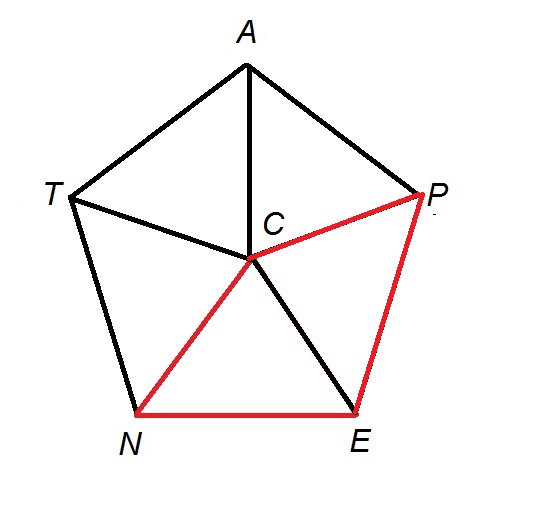
The measure of each angle of a regular pentagon can be calculated by setting  equal to 5 in the formula

and evaluating:

Specifically,

By symmetry, each radius bisects one of these angles. Specifically,

By the Same-Side Interior Angles Theorem, consecutive angles of a parallelogram are supplementary - that is, their measures total  . However,
 ,
,
violating these conditions. Therefore, Quadrilateral  is not a parallelogram.
Below is regular Pentagon
The measure of each angle of a regular pentagon can be calculated by setting
and evaluating:
Specifically,
By symmetry, each radius bisects one of these angles. Specifically,
By the Same-Side Interior Angles Theorem, consecutive angles of a parallelogram are supplementary - that is, their measures total
violating these conditions. Therefore, Quadrilateral
← Didn't Know|Knew It →
Given: Parallelogram  such that
  .
.
True or false: Parallelogram  must be a rectangle.
Given: Parallelogram
True or false: Parallelogram
Tap to reveal answer
A rectangle is a parallelogram with four right angles.
Consecutive angles of a parallelogram are supplementary. If one angle of a parallelogram is given to be right, then its neighboring angles, being supplementary to a right angle, are right as well; also, opposite angles of a parallelogram are congruent, so the opposite angle is also right. All four angles must be right, making the parallelogram a rectangle by definition.
A rectangle is a parallelogram with four right angles.
Consecutive angles of a parallelogram are supplementary. If one angle of a parallelogram is given to be right, then its neighboring angles, being supplementary to a right angle, are right as well; also, opposite angles of a parallelogram are congruent, so the opposite angle is also right. All four angles must be right, making the parallelogram a rectangle by definition.
← Didn't Know|Knew It →
Given: Quadrilateral such that  and
and  .
.
True or false: It follows that Quadrilateral is a parallelogram.
Given: Quadrilateral
True or false: It follows that Quadrilateral
Tap to reveal answer
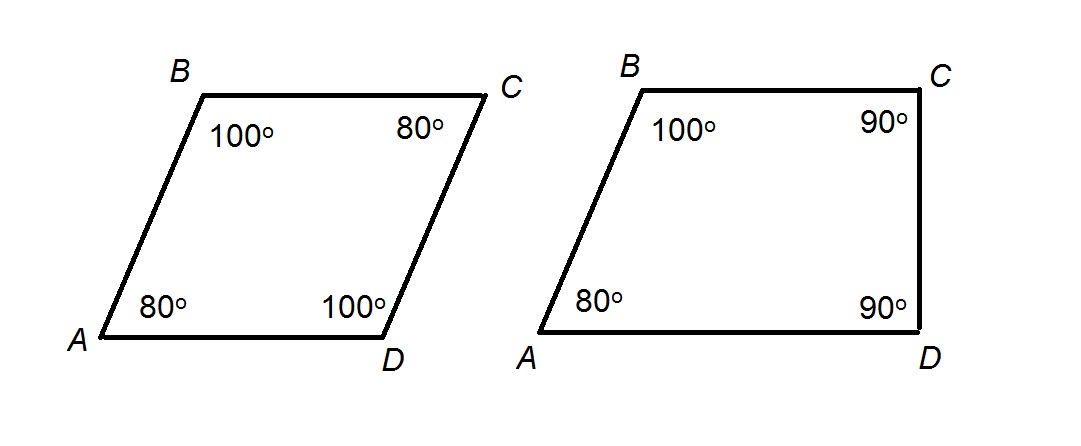
 , making
  and
and  supplementary. By the Converse of the Same Side Interior Angles Theorem, , it does follow that
  . However, without knowing the measures of the other two angles, nothing further can be concluded about Quadrilateral . Below are a parallelogram and a trapezoid, both of which have these two angles of these measures.
← Didn't Know|Knew It →
Given: Parallelogram  such that
  and
and  .
.
True or false: It follows that Parallelogram  is a rectangle.
Given: Parallelogram
True or false: It follows that Parallelogram
Tap to reveal answer
By the Same-Side Interior Angles Theorem, consecutive angles of a parallelogram can be proved to be supplementary - that is, their angle measures total  . Specifically,
  and
and  are a pair of supplementary angles. Since they are also congruent, it follows that both are right angles. For the same reason,
  and
and  are also right angles. The parallelogram, having four right angles, is a rectangle by definition.
By the Same-Side Interior Angles Theorem, consecutive angles of a parallelogram can be proved to be supplementary - that is, their angle measures total
← Didn't Know|Knew It →
In the parallellogram, what is the value of  ?
?
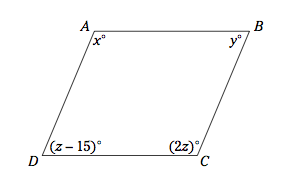
In the parallellogram, what is the value of
Tap to reveal answer
Opposite angles are equal, and adjacent angles must sum to 180.
Therefore, we can set up an equation to solve for z:
(z – 15) + 2z = 180
3z - 15 = 180
3z = 195
z = 65
Now solve for x:
2_z_ = x = 130°
Opposite angles are equal, and adjacent angles must sum to 180.
Therefore, we can set up an equation to solve for z:
(z – 15) + 2z = 180
3z - 15 = 180
3z = 195
z = 65
Now solve for x:
2_z_ = x = 130°
← Didn't Know|Knew It →