Finding Sides - Math
Card 1 of 220
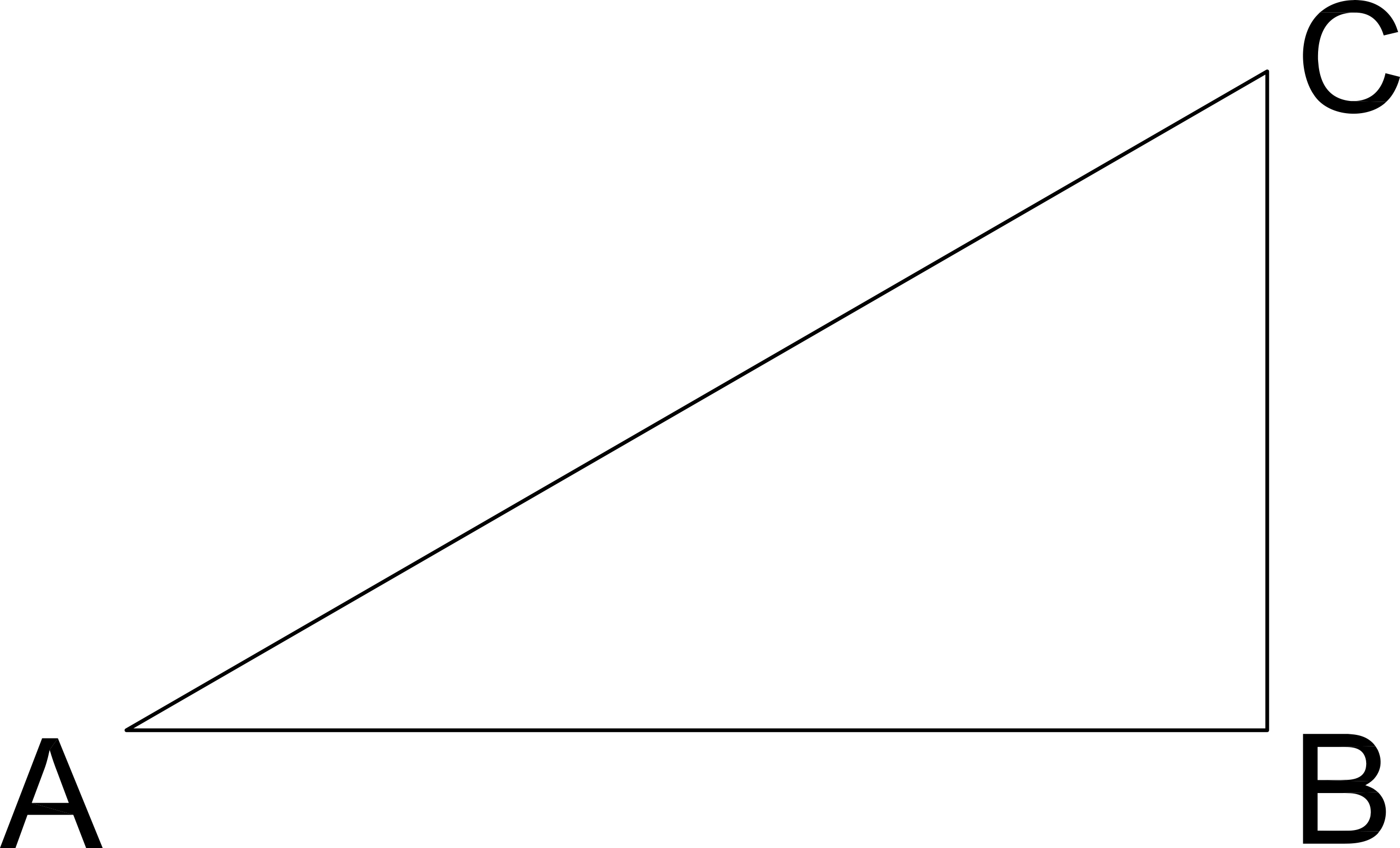
What is the length of CB?
What is the length of CB?
Tap to reveal answer


← Didn't Know|Knew It →
If  equals
  and
and  is
is  , how long is
  ?
?
If
Tap to reveal answer
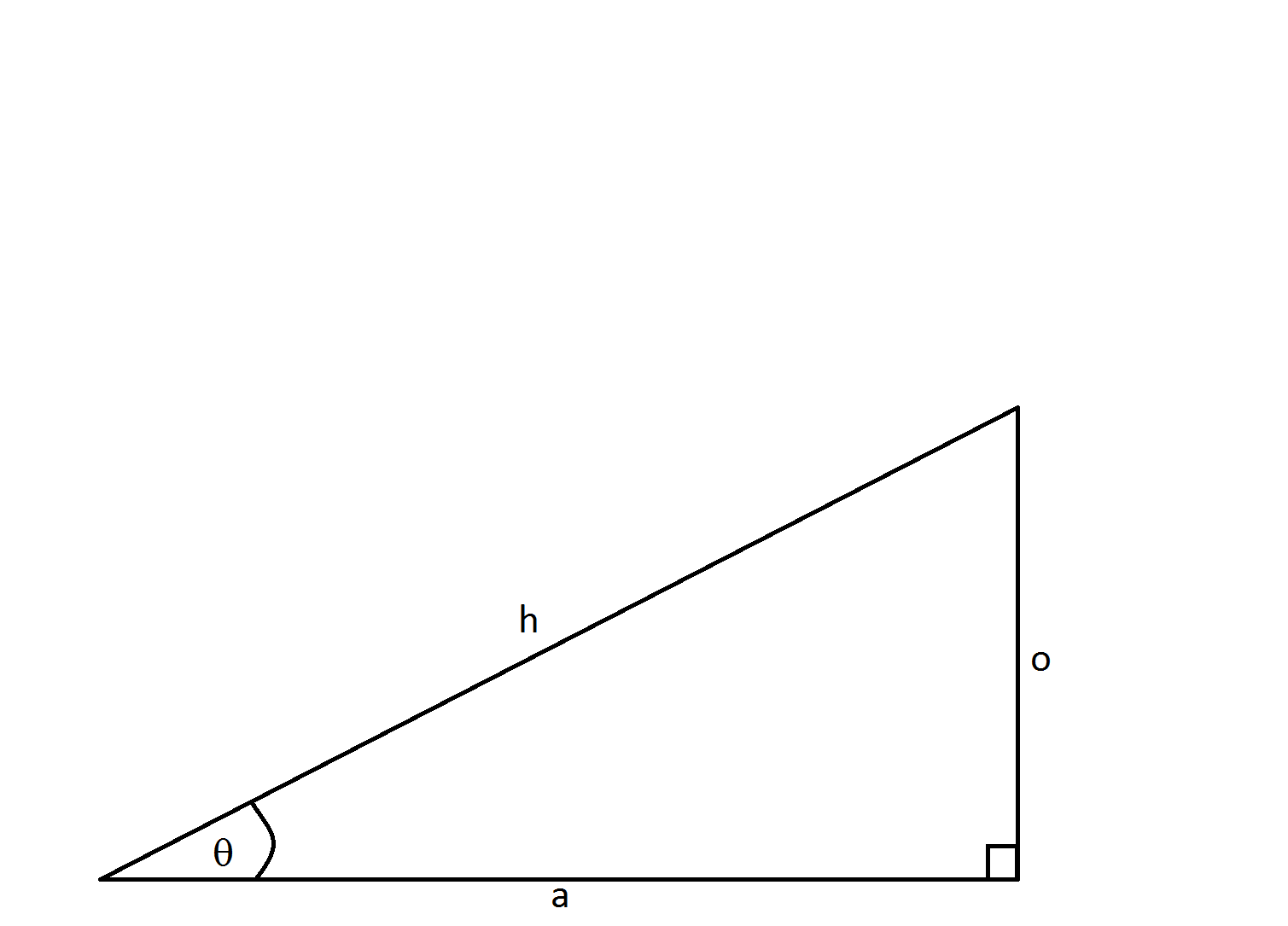
This problem can be easily solved using trig identities. We are given the hypotenuse  and
and  . We can then calculate side
  using the
  .
.
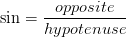
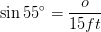
Rearrange to solve for  .
.


If you calculated the side to equal  then you utilized the
  function rather than the
  .
.
This problem can be easily solved using trig identities. We are given the hypotenuse
Rearrange to solve for
If you calculated the side to equal
← Didn't Know|Knew It →
Solve for  .
.
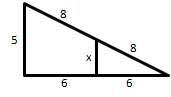
(Figure not drawn to scale).
Solve for
(Figure not drawn to scale).
Tap to reveal answer
The side-angle-side (SAS) postulate can be used to determine that the triangles are similar. Both triangles share the angle farthest to the right. In the smaller triangle, the upper edge has a length of  , and in the larger triangle is has a length of
  . In the smaller triangle, the bottom edge has a length of
  , and in the larger triangle is has a length of
  . We can test for comparison.

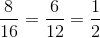
The statement is true, so the triangles must be similar.
We can use this ratio to solve for the missing side length.

To simplify, we will only use the lower edge and left edge comparison.

Cross multiply.

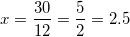
The side-angle-side (SAS) postulate can be used to determine that the triangles are similar. Both triangles share the angle farthest to the right. In the smaller triangle, the upper edge has a length of
The statement is true, so the triangles must be similar.
We can use this ratio to solve for the missing side length.
To simplify, we will only use the lower edge and left edge comparison.
Cross multiply.
← Didn't Know|Knew It →
Solve for  .
.
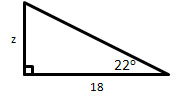
(Figure not drawn to scale).
Solve for
(Figure not drawn to scale).
Tap to reveal answer
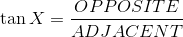
We can solve using the trigonometric definition of tangent.

We are given the angle and the adjacent side.
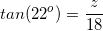
We can find  with a calculator.



We can solve using the trigonometric definition of tangent.
We are given the angle and the adjacent side.
We can find
← Didn't Know|Knew It →
What is the length of CB?
What is the length of CB?
Tap to reveal answer
← Didn't Know|Knew It →
If equals and is , how long is ?
If
Tap to reveal answer
This problem can be easily solved using trig identities. We are given the hypotenuse and . We can then calculate side using the .
Rearrange to solve for .
If you calculated the side to equal then you utilized the function rather than the .
This problem can be easily solved using trig identities. We are given the hypotenuse
Rearrange to solve for
If you calculated the side to equal
← Didn't Know|Knew It →
Solve for .
(Figure not drawn to scale).
Solve for
(Figure not drawn to scale).
Tap to reveal answer
The side-angle-side (SAS) postulate can be used to determine that the triangles are similar. Both triangles share the angle farthest to the right. In the smaller triangle, the upper edge has a length of , and in the larger triangle is has a length of . In the smaller triangle, the bottom edge has a length of , and in the larger triangle is has a length of . We can test for comparison.
The statement is true, so the triangles must be similar.
We can use this ratio to solve for the missing side length.
To simplify, we will only use the lower edge and left edge comparison.
Cross multiply.
The side-angle-side (SAS) postulate can be used to determine that the triangles are similar. Both triangles share the angle farthest to the right. In the smaller triangle, the upper edge has a length of
The statement is true, so the triangles must be similar.
We can use this ratio to solve for the missing side length.
To simplify, we will only use the lower edge and left edge comparison.
Cross multiply.
← Didn't Know|Knew It →
Solve for .
(Figure not drawn to scale).
Solve for
(Figure not drawn to scale).
Tap to reveal answer
We can solve using the trigonometric definition of tangent.
We are given the angle and the adjacent side.
We can find with a calculator.
We can solve using the trigonometric definition of tangent.
We are given the angle and the adjacent side.
We can find
← Didn't Know|Knew It →

Note: Figure NOT drawn to scale.
Refer to the above diagram. Evaluate  .
.
Note: Figure NOT drawn to scale.
Refer to the above diagram. Evaluate
Tap to reveal answer
The altitude perpendicular to the hypotenuse of a right triangle divides that triangle into two smaller triangles similar to each other and the large triangle. Therefore, the sides are in proportion. The hypotenuse of the triangle is equal to

Therefore, we can set up, and solve for  in, a proportion statement involving the shorter side and hypotenuse of the large triangle and the larger of the two smaller triangles:


This is not one of the choices.
The altitude perpendicular to the hypotenuse of a right triangle divides that triangle into two smaller triangles similar to each other and the large triangle. Therefore, the sides are in proportion. The hypotenuse of the triangle is equal to
Therefore, we can set up, and solve for
This is not one of the choices.
← Didn't Know|Knew It →
What is the length of the diagonals of trapezoid  ? Assume the figure is an isoceles trapezoid.

What is the length of the diagonals of trapezoid
Tap to reveal answer
To find the length of the diagonal, we need to use the Pythagorean Theorem. Therefore, we need to sketch the following triangle within trapezoid  :
:

We know that the base of the triangle has length  . By subtracting the top of the trapezoid from the bottom of the trapezoid, we get:

Dividing by two, we have the length of each additional side on the bottom of the trapezoid:

Adding these two values together, we get  .
.
The formula for the length of diagonal  uses the Pythagoreon Theorem:
 , where
  is the point between
  and
and  representing the base of the triangle.
Plugging in our values, we get:


To find the length of the diagonal, we need to use the Pythagorean Theorem. Therefore, we need to sketch the following triangle within trapezoid
We know that the base of the triangle has length
Dividing by two, we have the length of each additional side on the bottom of the trapezoid:
Adding these two values together, we get
The formula for the length of diagonal
Plugging in our values, we get:
← Didn't Know|Knew It →
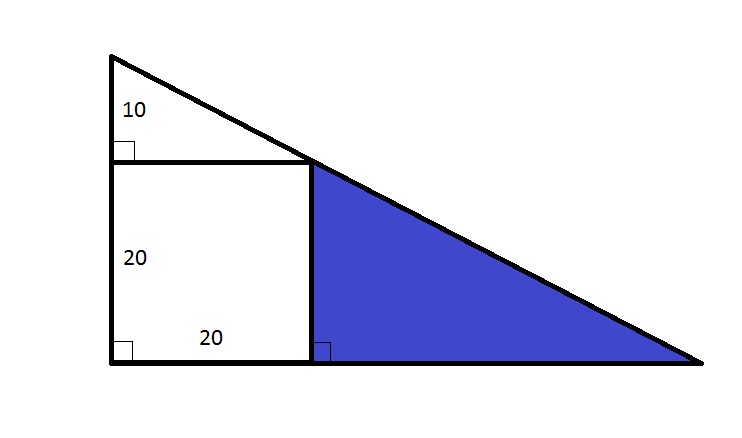
Note: Figure NOT drawn to scale.
Refer to the above diagram. Evaluate the length of the hypotenuse of the blue triangle.
Note: Figure NOT drawn to scale.
Refer to the above diagram. Evaluate the length of the hypotenuse of the blue triangle.
Tap to reveal answer
The inscribed rectangle is a 20 by 20 square. Since opposite sides of the square are parallel, the corresponding angles of the two smaller right triangles are congruent; therefore, the two triangles are similar and, by definition, their sides are in proportion.
The small top triangle has legs 10 and 20. Therefore, the length of its hypotenuse can be determined using the Pythagorean Theorem:

The small top triangle has short leg 10 and hypotenuse  . The blue triangle has short leg 20 and unknown hypotenuse
  , where
  can be calculated with the proportion statement


The inscribed rectangle is a 20 by 20 square. Since opposite sides of the square are parallel, the corresponding angles of the two smaller right triangles are congruent; therefore, the two triangles are similar and, by definition, their sides are in proportion.
The small top triangle has legs 10 and 20. Therefore, the length of its hypotenuse can be determined using the Pythagorean Theorem:
The small top triangle has short leg 10 and hypotenuse
← Didn't Know|Knew It →
Which of the following describes a triangle with sides one kilometer, 100 meters, and 100 meters?
Which of the following describes a triangle with sides one kilometer, 100 meters, and 100 meters?
Tap to reveal answer
One kilometer is equal to 1,000 meters, so the triangle has sides of length 100, 100, and 1,000. However,

That is, the sum of the least two sidelengths is not greater than the third. This violates the Triangle Inequality, and this triangle cannot exist.
One kilometer is equal to 1,000 meters, so the triangle has sides of length 100, 100, and 1,000. However,
That is, the sum of the least two sidelengths is not greater than the third. This violates the Triangle Inequality, and this triangle cannot exist.
← Didn't Know|Knew It →

Note: figure NOT drawn to scale.
Refer to the triangle in the above diagram.
 .
.
Evaluate  .
.
Note: figure NOT drawn to scale.
Refer to the triangle in the above diagram.
Evaluate
Tap to reveal answer
By the Law of Sines,

Substitute  and solve for
  :
:


By the Law of Sines,
Substitute
← Didn't Know|Knew It →
Note: figure NOT drawn to scale.
Refer to the triangle in the above diagram.

Evaluate  . Round to the nearest tenth, if applicable.
Note: figure NOT drawn to scale.
Refer to the triangle in the above diagram.
Evaluate
Tap to reveal answer
By the Law of Cosines,

Substitute  :
:


By the Law of Cosines,
Substitute
← Didn't Know|Knew It →

The above figure is a regular pentagon. Evaluate  to the nearest tenth.
The above figure is a regular pentagon. Evaluate
Tap to reveal answer
Two sides of the triangle formed measure 4 each; the included angle is one angle of the regular pentagon, which measures

The length of the third side can be found by applying the Law of Cosines:

where  :
:


Two sides of the triangle formed measure 4 each; the included angle is one angle of the regular pentagon, which measures
The length of the third side can be found by applying the Law of Cosines:
where
← Didn't Know|Knew It →
In triangle  ,
,  and
and  .
.
Which of the following statements is true about the lengths of the sides of  ?
?
In triangle
Which of the following statements is true about the lengths of the sides of
Tap to reveal answer
In a triangle, the shortest side is opposite the angle of least measure; the longest side is opposite the angle of greatest measure. Therefore, if we order the angles, we can order their opposite sides similarly.
Since the measures of the three interior angles of a triangle must total  ,
,


 has the least degree measure, so its opposite side,
  , is the shortest.
  , so by the Isosceles Triangle Theorem, their opposite sides
  and
and  are congruent. Therefore, the correct choice is
 .
.
In a triangle, the shortest side is opposite the angle of least measure; the longest side is opposite the angle of greatest measure. Therefore, if we order the angles, we can order their opposite sides similarly.
Since the measures of the three interior angles of a triangle must total
← Didn't Know|Knew It →
Assume quadrilateral  is a rhombus. The perimeter of
  is
is  , and the length of one of its diagonals is
  . What is the area of
  ?
?
Assume quadrilateral
Tap to reveal answer
To solve for the area of the rhombus  , we must use the equation
  , where
  and
and  are the diagonals of the rhombus. Since the perimeter of the rhombus is
  , and by definition all 4 sides of a rhombus have the same length, we know that the length of each side is
  . We can find the length of the other diagonal if we recognize that the two diagonals combined with a side edge form a right triangle. The length of the hypotenuse is
  , and each leg of the triangle is equal to one-half of each diagonal. We can therefore set up an equation involving Pythagorean's Theorem as follows:
 , where
  is equal to one-half the length of the unknown diagonal.
We can therefore solve for  as follows:

 is therefore equal to 8, and our other diagonal is 16. We can now use both diagonals to solve for the area of the rhombus:

The area of rhombus  is therefore equal to
To solve for the area of the rhombus
We can therefore solve for
The area of rhombus
← Didn't Know|Knew It →
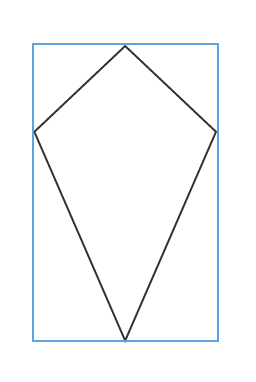
The area of the rectangle is  , what is the area of the kite?
The area of the rectangle is
Tap to reveal answer
The area of a kite is half the product of the diagonals.

The diagonals of the kite are the height and width of the rectangle it is superimposed in, and we know that because the area of a rectangle is base times height.
Therefore our equation becomes:
 .
.
We also know the area of the rectangle is  . Substituting this value in we get the following:

Thus,, the area of the kite is  .
.
The area of a kite is half the product of the diagonals.
The diagonals of the kite are the height and width of the rectangle it is superimposed in, and we know that because the area of a rectangle is base times height.
Therefore our equation becomes:
We also know the area of the rectangle is
Thus,, the area of the kite is
← Didn't Know|Knew It →

 is a rhombus with side length
  . Diagonal
  has a length of
  . Find the length of diagonal
  .
.
Tap to reveal answer
A rhombus is a quadrilateral with four sides of equal length. Rhombuses have diagonals that bisect each other at right angles.

Thus, we can consider the right triangle  to find the length of diagonal
  . From the problem, we are given that the sides are
  and
and  . Because the diagonals bisect each other, we know:


Using the Pythagorean Theorem,


A rhombus is a quadrilateral with four sides of equal length. Rhombuses have diagonals that bisect each other at right angles.
Thus, we can consider the right triangle
Using the Pythagorean Theorem,
← Didn't Know|Knew It →

 is a rhombus.
 and
and  . Find
  .
.
Tap to reveal answer
A rhombus is a quadrilateral with four sides of equal length. Rhombuses have diagonals that bisect each other at right angles.
Thus, we can consider the right triangle  to find the length of diagonal
  . From the problem, we are given that the sides are
  and
and  . Because the diagonals bisect each other, we know:


Using the Pythagorean Theorem,


A rhombus is a quadrilateral with four sides of equal length. Rhombuses have diagonals that bisect each other at right angles.
Thus, we can consider the right triangle
Using the Pythagorean Theorem,
← Didn't Know|Knew It →