Expressing Radicals as Exponents - Math
Card 1 of 56
Express the following radical in rational (exponential) form:

Express the following radical in rational (exponential) form:
Tap to reveal answer
To convert the radical to exponent form, begin by converting the integer:

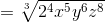
Now, divide each exponent by  to remove the radical:

Finally, simplify the exponents:

To convert the radical to exponent form, begin by converting the integer:
Now, divide each exponent by
Finally, simplify the exponents:
← Didn't Know|Knew It →
Convert the radical to exponential notation.

Convert the radical to exponential notation.
Tap to reveal answer
Remember that any term outside the radical will be in the denominator of the exponent.

Since  does not have any roots, we are simply raising it to the one-fourth power.

Remember that any term outside the radical will be in the denominator of the exponent.
Since
← Didn't Know|Knew It →
What is the value of  ?
?
What is the value of
Tap to reveal answer
An exponent written as a fraction can be rewritten using roots.  can be reqritten as
  . The bottom number on the fraction becomes the root, and the top becomes the exponent you raise the number to.
  is the same as
  . This will give us the answer of 243.
An exponent written as a fraction can be rewritten using roots.
← Didn't Know|Knew It →
Express the following radical in rational (exponential) form:

Express the following radical in rational (exponential) form:
Tap to reveal answer
To convert the radical to exponent form, begin by converting the integer:


Now, divide each exponent by  to clear the square root:
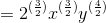
Finally, simplify the exponents:

To convert the radical to exponent form, begin by converting the integer:
Now, divide each exponent by
Finally, simplify the exponents:
← Didn't Know|Knew It →
Express the following radical in rational (exponential) form:

Express the following radical in rational (exponential) form:
Tap to reveal answer
To convert the radical to exponent form, begin by converting the integer:


Now, divide each exponent by  to cancel the radical:

Finally, simplify the exponents:

To convert the radical to exponent form, begin by converting the integer:
Now, divide each exponent by
Finally, simplify the exponents:
← Didn't Know|Knew It →
Which fraction is equivalent to  ?
?
Which fraction is equivalent to
Tap to reveal answer
Multiply the numerator and denominator by the compliment of the denominator:
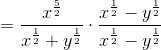
Simplify the expression:
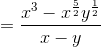
Multiply the numerator and denominator by the compliment of the denominator:
Simplify the expression:
← Didn't Know|Knew It →
Simplify the following radical. Express in rational (exponential) form.

Simplify the following radical. Express in rational (exponential) form.
Tap to reveal answer
Multiply the numerator and denominator by the compliment of the denominator:
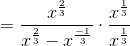
Simplify the expression:

Multiply the numerator and denominator by the compliment of the denominator:
Simplify the expression:
← Didn't Know|Knew It →
Choose the fraction equivalent to  .
.
Choose the fraction equivalent to
Tap to reveal answer
Multiply the numerator and denominator by the compliment of the denominator:


Simplify the expression:
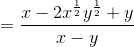
Multiply the numerator and denominator by the compliment of the denominator:
Simplify the expression:
← Didn't Know|Knew It →
Simplify the following radical. Express in rational (exponential) form.

Simplify the following radical. Express in rational (exponential) form.
Tap to reveal answer
Multiply the numerator and denominator to the exponent:

Simplify the expression by combining like terms:

Multiply the numerator and denominator to the exponent:
Simplify the expression by combining like terms:
← Didn't Know|Knew It →
Simplify: 
Simplify:
Tap to reveal answer
Multiply the numerator and denominator to the exponent:

Simplify the expression by combining like terms:

Multiply the numerator and denominator to the exponent:
Simplify the expression by combining like terms:
← Didn't Know|Knew It →
Express the following exponent in radical form:

Express the following exponent in radical form:
Tap to reveal answer
Begin by converting each exponent to have a denominator of  :
:

Now, rearrange into radical form:

Finally, simplify:

Begin by converting each exponent to have a denominator of
Now, rearrange into radical form:
Finally, simplify:
← Didn't Know|Knew It →
Express the following exponent in radical form:

Express the following exponent in radical form:
Tap to reveal answer
Begin by converting each exponent to have a denominator of :

Now, put this in radical form:

Finally, simplify:

Begin by converting each exponent to have a denominator of
Now, put this in radical form:
Finally, simplify:
← Didn't Know|Knew It →
Express the following exponent in radical form:

Express the following exponent in radical form:
Tap to reveal answer
Begin by changing the fractional exponents so that they both have a common denominator of  :
:

Now, put this in radical form and simplify:


Begin by changing the fractional exponents so that they both have a common denominator of
Now, put this in radical form and simplify:
← Didn't Know|Knew It →
Simplify the following radical expression using exponents. Express the final answer in radical form.

Simplify the following radical expression using exponents. Express the final answer in radical form.
Tap to reveal answer
Begin by converting the radical into exponent form:

Simplify the exponent and multiply:


Convert into radical form:

Simplify:

Begin by converting the radical into exponent form:
Simplify the exponent and multiply:
Convert into radical form:
Simplify:
← Didn't Know|Knew It →
Convert the radical to exponential notation.
Convert the radical to exponential notation.
Tap to reveal answer
Remember that any term outside the radical will be in the denominator of the exponent.
Since does not have any roots, we are simply raising it to the one-fourth power.
Remember that any term outside the radical will be in the denominator of the exponent.
Since
← Didn't Know|Knew It →
What is the value of ?
What is the value of
Tap to reveal answer
An exponent written as a fraction can be rewritten using roots. can be reqritten as . The bottom number on the fraction becomes the root, and the top becomes the exponent you raise the number to. is the same as . This will give us the answer of 243.
An exponent written as a fraction can be rewritten using roots.
← Didn't Know|Knew It →
Express the following radical in rational (exponential) form:
Express the following radical in rational (exponential) form:
Tap to reveal answer
To convert the radical to exponent form, begin by converting the integer:
Now, divide each exponent by to clear the square root:
Finally, simplify the exponents:
To convert the radical to exponent form, begin by converting the integer:
Now, divide each exponent by
Finally, simplify the exponents:
← Didn't Know|Knew It →
Express the following radical in rational (exponential) form:
Express the following radical in rational (exponential) form:
Tap to reveal answer
To convert the radical to exponent form, begin by converting the integer:
Now, divide each exponent by to remove the radical:
Finally, simplify the exponents:
To convert the radical to exponent form, begin by converting the integer:
Now, divide each exponent by
Finally, simplify the exponents:
← Didn't Know|Knew It →
Express the following radical in rational (exponential) form:
Express the following radical in rational (exponential) form:
Tap to reveal answer
To convert the radical to exponent form, begin by converting the integer:
Now, divide each exponent by to cancel the radical:
Finally, simplify the exponents:
To convert the radical to exponent form, begin by converting the integer:
Now, divide each exponent by
Finally, simplify the exponents:
← Didn't Know|Knew It →
Which fraction is equivalent to ?
Which fraction is equivalent to
Tap to reveal answer
Multiply the numerator and denominator by the compliment of the denominator:
Simplify the expression:
Multiply the numerator and denominator by the compliment of the denominator:
Simplify the expression:
← Didn't Know|Knew It →