Clock Math - Math
Card 1 of 120
The clock in the classroom reads 5:00pm. What is the angle that the hands are forming?
The clock in the classroom reads 5:00pm. What is the angle that the hands are forming?
Tap to reveal answer
Since the clock is a circle, you can determine that the total number of degrees inside the circle is 360. Since a clock has 12 numbers, we can divide 360 by 12 to see what the angle is between two numbers that are right next to each other. Thus, we can see that the angle between two numbers right next to each other is  . However, the clock is reading 5:00, so there are five numbers we have to take in to account. Therefore, we multiply 30 by 5, which gives us
  as our answer.
Since the clock is a circle, you can determine that the total number of degrees inside the circle is 360. Since a clock has 12 numbers, we can divide 360 by 12 to see what the angle is between two numbers that are right next to each other. Thus, we can see that the angle between two numbers right next to each other is
← Didn't Know|Knew It →
The time on a clock reads 5:00. What is the measure of the central angle formed by the hands of the clock?
The time on a clock reads 5:00. What is the measure of the central angle formed by the hands of the clock?
Tap to reveal answer
First, remember that the number of degrees in a circle is 360. Then, figure out how many degrees are in between each number on the face of the clock. Since there are 12 numbers, there are  between each number. Since the time reads 5:00, multiply
  , which yields
  .
.
First, remember that the number of degrees in a circle is 360. Then, figure out how many degrees are in between each number on the face of the clock. Since there are 12 numbers, there are
← Didn't Know|Knew It →
What is the measure, in degrees, of the acute angle formed by the hands of a 12-hour clock that reads exactly 3:10?
What is the measure, in degrees, of the acute angle formed by the hands of a 12-hour clock that reads exactly 3:10?
Tap to reveal answer
The entire clock measures 360°. As the clock is divided into 12 sections, the distance between each number is equivalent to 30° (360/12). The distance between the 2 and the 3 on the clock is 30°. One has to account, however, for the 10 minutes that have passed. 10 minutes is 1/6 of an hour so the hour hand has also moved 1/6 of the distance between the 3 and the 4, which adds 5° (1/6 of 30°). The total measure of the angle, therefore, is 35°.
The entire clock measures 360°. As the clock is divided into 12 sections, the distance between each number is equivalent to 30° (360/12). The distance between the 2 and the 3 on the clock is 30°. One has to account, however, for the 10 minutes that have passed. 10 minutes is 1/6 of an hour so the hour hand has also moved 1/6 of the distance between the 3 and the 4, which adds 5° (1/6 of 30°). The total measure of the angle, therefore, is 35°.
← Didn't Know|Knew It →
What is the measure of the smaller angle formed by the hands of an analog watch if the hour hand is on the 10 and the minute hand is on the 2?
What is the measure of the smaller angle formed by the hands of an analog watch if the hour hand is on the 10 and the minute hand is on the 2?
Tap to reveal answer
A analog clock is divided up into 12 sectors, based on the numbers 1–12. One sector represents 30 degrees (360/12 = 30). If the hour hand is directly on the 10, and the minute hand is on the 2, that means there are 4 sectors of 30 degrees between then, thus they are 120 degrees apart (30 * 4 = 120).
A analog clock is divided up into 12 sectors, based on the numbers 1–12. One sector represents 30 degrees (360/12 = 30). If the hour hand is directly on the 10, and the minute hand is on the 2, that means there are 4 sectors of 30 degrees between then, thus they are 120 degrees apart (30 * 4 = 120).
← Didn't Know|Knew It →
If it is 2:00 PM, what is the measure of the angle between the minute and hour hands of the clock?
If it is 2:00 PM, what is the measure of the angle between the minute and hour hands of the clock?
Tap to reveal answer
First note that a clock is a circle made of 360 degrees, and that each number represents an angle and the separation between them is 360/12 = 30. And at 2:00, the minute hand is on the 12 and the hour hand is on the 2. The correct answer is 2 * 30 = 60 degrees.
First note that a clock is a circle made of 360 degrees, and that each number represents an angle and the separation between them is 360/12 = 30. And at 2:00, the minute hand is on the 12 and the hour hand is on the 2. The correct answer is 2 * 30 = 60 degrees.
← Didn't Know|Knew It →
It is 4 o’clock. What is the measure of the angle formed between the hour hand and the minute hand?
It is 4 o’clock. What is the measure of the angle formed between the hour hand and the minute hand?
Tap to reveal answer
At four o’clock the minute hand is on the 12 and the hour hand is on the 4. The angle formed is 4/12 of the total number of degrees in a circle, 360.
4/12 * 360 = 120 degrees
At four o’clock the minute hand is on the 12 and the hour hand is on the 4. The angle formed is 4/12 of the total number of degrees in a circle, 360.
4/12 * 360 = 120 degrees
← Didn't Know|Knew It →
If a clock reads 8:15 PM, what angle do the hands make?
If a clock reads 8:15 PM, what angle do the hands make?
Tap to reveal answer
A clock is a circle, and a circle always contains 360 degrees. Since there are 60 minutes on a clock, each minute mark is 6 degrees.

The minute hand on the clock will point at 15 minutes, allowing us to calculate it's position on the circle.

Since there are 12 hours on the clock, each hour mark is 30 degrees.

We can calculate where the hour hand will be at 8:00.

However, the hour hand will actually be between the 8 and the 9, since we are looking at 8:15 rather than an absolute hour mark. 15 minutes is equal to one-fourth of an hour. Use the same equation to find the additional position of the hour hand.
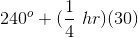


We are looking for the angle between the two hands of the clock. The will be equal to the difference between the two angle measures.

A clock is a circle, and a circle always contains 360 degrees. Since there are 60 minutes on a clock, each minute mark is 6 degrees.
The minute hand on the clock will point at 15 minutes, allowing us to calculate it's position on the circle.
Since there are 12 hours on the clock, each hour mark is 30 degrees.
We can calculate where the hour hand will be at 8:00.
However, the hour hand will actually be between the 8 and the 9, since we are looking at 8:15 rather than an absolute hour mark. 15 minutes is equal to one-fourth of an hour. Use the same equation to find the additional position of the hour hand.
We are looking for the angle between the two hands of the clock. The will be equal to the difference between the two angle measures.
← Didn't Know|Knew It →
Find the angle between the minute and hour hand at 8:20 PM.
Find the angle between the minute and hour hand at 8:20 PM.
Tap to reveal answer
The distance between each notch on the clock is 6 degrees because there are 360 degrees on the clock, and there are 60 notches total. The minute hand is at notch #20, and so it is 120 degrees from the top. The hour hand is a little past notch #40 because the time is a little past hour 8. Thus, the hour hand is a little past 240 degrees from the top, going clockwise ( degrees).
In each hour, the hour hand goes 5 notches, or 30 degrees. Because it is now 20 minutes past the hour, a third of an hour has passed. One third of 30 degrees is 10 degrees. Thus, the hour hand is 10 degrees past notch #40. The hour hand is 250 degrees from the top, going clockwise. The angle between the two hands is thus 130 degrees.
The distance between each notch on the clock is 6 degrees because there are 360 degrees on the clock, and there are 60 notches total. The minute hand is at notch #20, and so it is 120 degrees from the top. The hour hand is a little past notch #40 because the time is a little past hour 8. Thus, the hour hand is a little past 240 degrees from the top, going clockwise (
In each hour, the hour hand goes 5 notches, or 30 degrees. Because it is now 20 minutes past the hour, a third of an hour has passed. One third of 30 degrees is 10 degrees. Thus, the hour hand is 10 degrees past notch #40. The hour hand is 250 degrees from the top, going clockwise. The angle between the two hands is thus 130 degrees.
← Didn't Know|Knew It →
When making a pie chart, how many degrees should be allotted for  percent?
When making a pie chart, how many degrees should be allotted for
Tap to reveal answer
This is a proportion problem
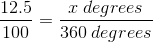 so there are
  in
in  percent of a circle
This is a proportion problem
← Didn't Know|Knew It →
A clock currently reads 2:00. What is the size of the angle formed between the hour and minute hands?
A clock currently reads 2:00. What is the size of the angle formed between the hour and minute hands?
Tap to reveal answer
The interior angle of a sector is equal the the angle of the sector. If the entire circumference was the sector, it would equal  . Additionally, if it were 12:00, the angle would be equal to
  . We can solve the problem by setting up a proportion. 2:00 will be two-twelfths of the circle past the 12:00 mark, and will be at an angle of
  .
.

Cross multiply and solve for  .
.


The interior angle of a sector is equal the the angle of the sector. If the entire circumference was the sector, it would equal
Cross multiply and solve for
← Didn't Know|Knew It →
What is the measure of the smaller angle formed by the hands of an analog watch if the hour hand is on the 10 and the minute hand is on the 2?
What is the measure of the smaller angle formed by the hands of an analog watch if the hour hand is on the 10 and the minute hand is on the 2?
Tap to reveal answer
A analog clock is divided up into 12 sectors, based on the numbers 1–12. One sector represents 30 degrees (360/12 = 30). If the hour hand is directly on the 10, and the minute hand is on the 2, that means there are 4 sectors of 30 degrees between then, thus they are 120 degrees apart (30 * 4 = 120).
A analog clock is divided up into 12 sectors, based on the numbers 1–12. One sector represents 30 degrees (360/12 = 30). If the hour hand is directly on the 10, and the minute hand is on the 2, that means there are 4 sectors of 30 degrees between then, thus they are 120 degrees apart (30 * 4 = 120).
← Didn't Know|Knew It →
If it is 2:00 PM, what is the measure of the angle between the minute and hour hands of the clock?
If it is 2:00 PM, what is the measure of the angle between the minute and hour hands of the clock?
Tap to reveal answer
First note that a clock is a circle made of 360 degrees, and that each number represents an angle and the separation between them is 360/12 = 30. And at 2:00, the minute hand is on the 12 and the hour hand is on the 2. The correct answer is 2 * 30 = 60 degrees.
First note that a clock is a circle made of 360 degrees, and that each number represents an angle and the separation between them is 360/12 = 30. And at 2:00, the minute hand is on the 12 and the hour hand is on the 2. The correct answer is 2 * 30 = 60 degrees.
← Didn't Know|Knew It →
It is 4 o’clock. What is the measure of the angle formed between the hour hand and the minute hand?
It is 4 o’clock. What is the measure of the angle formed between the hour hand and the minute hand?
Tap to reveal answer
At four o’clock the minute hand is on the 12 and the hour hand is on the 4. The angle formed is 4/12 of the total number of degrees in a circle, 360.
4/12 * 360 = 120 degrees
At four o’clock the minute hand is on the 12 and the hour hand is on the 4. The angle formed is 4/12 of the total number of degrees in a circle, 360.
4/12 * 360 = 120 degrees
← Didn't Know|Knew It →
What is the measure, in degrees, of the acute angle formed by the hands of a 12-hour clock that reads exactly 3:10?
What is the measure, in degrees, of the acute angle formed by the hands of a 12-hour clock that reads exactly 3:10?
Tap to reveal answer
The entire clock measures 360°. As the clock is divided into 12 sections, the distance between each number is equivalent to 30° (360/12). The distance between the 2 and the 3 on the clock is 30°. One has to account, however, for the 10 minutes that have passed. 10 minutes is 1/6 of an hour so the hour hand has also moved 1/6 of the distance between the 3 and the 4, which adds 5° (1/6 of 30°). The total measure of the angle, therefore, is 35°.
The entire clock measures 360°. As the clock is divided into 12 sections, the distance between each number is equivalent to 30° (360/12). The distance between the 2 and the 3 on the clock is 30°. One has to account, however, for the 10 minutes that have passed. 10 minutes is 1/6 of an hour so the hour hand has also moved 1/6 of the distance between the 3 and the 4, which adds 5° (1/6 of 30°). The total measure of the angle, therefore, is 35°.
← Didn't Know|Knew It →
If a clock reads 8:15 PM, what angle do the hands make?
If a clock reads 8:15 PM, what angle do the hands make?
Tap to reveal answer
A clock is a circle, and a circle always contains 360 degrees. Since there are 60 minutes on a clock, each minute mark is 6 degrees.
The minute hand on the clock will point at 15 minutes, allowing us to calculate it's position on the circle.
Since there are 12 hours on the clock, each hour mark is 30 degrees.
We can calculate where the hour hand will be at 8:00.
However, the hour hand will actually be between the 8 and the 9, since we are looking at 8:15 rather than an absolute hour mark. 15 minutes is equal to one-fourth of an hour. Use the same equation to find the additional position of the hour hand.
We are looking for the angle between the two hands of the clock. The will be equal to the difference between the two angle measures.
A clock is a circle, and a circle always contains 360 degrees. Since there are 60 minutes on a clock, each minute mark is 6 degrees.
The minute hand on the clock will point at 15 minutes, allowing us to calculate it's position on the circle.
Since there are 12 hours on the clock, each hour mark is 30 degrees.
We can calculate where the hour hand will be at 8:00.
However, the hour hand will actually be between the 8 and the 9, since we are looking at 8:15 rather than an absolute hour mark. 15 minutes is equal to one-fourth of an hour. Use the same equation to find the additional position of the hour hand.
We are looking for the angle between the two hands of the clock. The will be equal to the difference between the two angle measures.
← Didn't Know|Knew It →
Find the angle between the minute and hour hand at 8:20 PM.
Find the angle between the minute and hour hand at 8:20 PM.
Tap to reveal answer
The distance between each notch on the clock is 6 degrees because there are 360 degrees on the clock, and there are 60 notches total. The minute hand is at notch #20, and so it is 120 degrees from the top. The hour hand is a little past notch #40 because the time is a little past hour 8. Thus, the hour hand is a little past 240 degrees from the top, going clockwise ( degrees).
In each hour, the hour hand goes 5 notches, or 30 degrees. Because it is now 20 minutes past the hour, a third of an hour has passed. One third of 30 degrees is 10 degrees. Thus, the hour hand is 10 degrees past notch #40. The hour hand is 250 degrees from the top, going clockwise. The angle between the two hands is thus 130 degrees.
The distance between each notch on the clock is 6 degrees because there are 360 degrees on the clock, and there are 60 notches total. The minute hand is at notch #20, and so it is 120 degrees from the top. The hour hand is a little past notch #40 because the time is a little past hour 8. Thus, the hour hand is a little past 240 degrees from the top, going clockwise (
In each hour, the hour hand goes 5 notches, or 30 degrees. Because it is now 20 minutes past the hour, a third of an hour has passed. One third of 30 degrees is 10 degrees. Thus, the hour hand is 10 degrees past notch #40. The hour hand is 250 degrees from the top, going clockwise. The angle between the two hands is thus 130 degrees.
← Didn't Know|Knew It →
When making a pie chart, how many degrees should be allotted for percent?
When making a pie chart, how many degrees should be allotted for
Tap to reveal answer
This is a proportion problem
so there are in percent of a circle
This is a proportion problem
← Didn't Know|Knew It →
A clock currently reads 2:00. What is the size of the angle formed between the hour and minute hands?
A clock currently reads 2:00. What is the size of the angle formed between the hour and minute hands?
Tap to reveal answer
The interior angle of a sector is equal the the angle of the sector. If the entire circumference was the sector, it would equal . Additionally, if it were 12:00, the angle would be equal to . We can solve the problem by setting up a proportion. 2:00 will be two-twelfths of the circle past the 12:00 mark, and will be at an angle of .
Cross multiply and solve for .
The interior angle of a sector is equal the the angle of the sector. If the entire circumference was the sector, it would equal
Cross multiply and solve for
← Didn't Know|Knew It →
What is the measure, in degrees, of the acute angle formed by the hands of a 12-hour clock that reads exactly 3:10?
What is the measure, in degrees, of the acute angle formed by the hands of a 12-hour clock that reads exactly 3:10?
Tap to reveal answer
The entire clock measures 360°. As the clock is divided into 12 sections, the distance between each number is equivalent to 30° (360/12). The distance between the 2 and the 3 on the clock is 30°. One has to account, however, for the 10 minutes that have passed. 10 minutes is 1/6 of an hour so the hour hand has also moved 1/6 of the distance between the 3 and the 4, which adds 5° (1/6 of 30°). The total measure of the angle, therefore, is 35°.
The entire clock measures 360°. As the clock is divided into 12 sections, the distance between each number is equivalent to 30° (360/12). The distance between the 2 and the 3 on the clock is 30°. One has to account, however, for the 10 minutes that have passed. 10 minutes is 1/6 of an hour so the hour hand has also moved 1/6 of the distance between the 3 and the 4, which adds 5° (1/6 of 30°). The total measure of the angle, therefore, is 35°.
← Didn't Know|Knew It →
What is the measure of the smaller angle formed by the hands of an analog watch if the hour hand is on the 10 and the minute hand is on the 2?
What is the measure of the smaller angle formed by the hands of an analog watch if the hour hand is on the 10 and the minute hand is on the 2?
Tap to reveal answer
A analog clock is divided up into 12 sectors, based on the numbers 1–12. One sector represents 30 degrees (360/12 = 30). If the hour hand is directly on the 10, and the minute hand is on the 2, that means there are 4 sectors of 30 degrees between then, thus they are 120 degrees apart (30 * 4 = 120).
A analog clock is divided up into 12 sectors, based on the numbers 1–12. One sector represents 30 degrees (360/12 = 30). If the hour hand is directly on the 10, and the minute hand is on the 2, that means there are 4 sectors of 30 degrees between then, thus they are 120 degrees apart (30 * 4 = 120).
← Didn't Know|Knew It →