MAP 8th Grade Math
Help Questions
MAP 8th Grade Math › MAP 8th Grade Math
Calculate the volume of the cone provided. Round the answer to the nearest hundredth.


Explanation
In order to solve this problem, we need to recall the formula used to calculate the volume of a cone:

Now that we have this formula, we can substitute in the given values and solve:


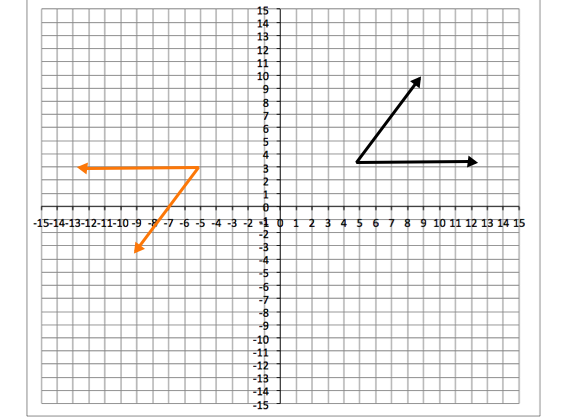
Observe the location of the black and orange angles on the provided coordinate plane and identify which of the following transformations—rotation, translation, or reflection—the black angle has undergone in order to reach the position of the orange angle. Select the answer that provides the correct transformation shown in the provided image.
A 
A reflection over the x-axis
A translation to the left
A translation down
Explanation
First, let's define the possible transformations.
Rotation: A rotation means turning an image, shape, line, etc. around a central point.
Translation: A translation means moving or sliding an image, shape, line, etc. over a plane.
Reflection: A reflection mean flipping an image, shape, line, etc. over a central line.
In the images from the question, notice that the black angle rotates 
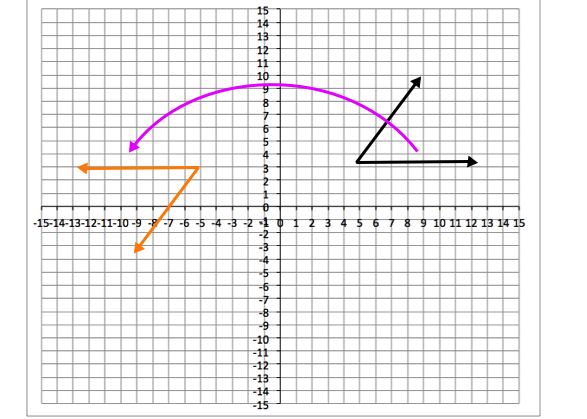
The transformation can't be a reflection over the x-axis because the orange angle didn't flip over the x-axis.
The transformation can't be a translation because the angle changes direction, which does not happened when you simply move or slide an angle or image.
Solve for


Explanation
In order to solve for 

For this problem, the first thing we want to do is distribute the 


Next, we can subtract 

Finally, we divide 


Which of the following answer choices displays an irrational number?


Explanation
Our answer choices consist of two types of numbers: rational numbers and irrational numbers. In order to correctly answer this question, we need to know the difference between the two types of numbers.
Rational numbers are numbers that we use most often, and can be written as a simple fraction.
Irrational numbers cannot be written as fractions, and are numbers that have decimal places that never repeat or end.
In this case, 
Solve for
Explanation
In order to solve for
For this problem, the first thing we want to do is distribute the
Next, we can subtract
Finally, we divide
The scatter plot provided displays a group of students' test scores versus the number of missing assignments the students have. Based on plot, select the best answer that describes the direction of the points.

A negative, linear association
A negative, non linear association
A positive, nonlinear association
A positive, linear association
Explanation
The data points in the scatter plot move up the y-axis as the x-axis decreases; thus the data points show a negative association. Also, the data points do not curve, or go up and down, but gradually decreased; thus the scatter plot shows a linear association. We could even draw a "best fit" line:

Calculate the volume of the cone provided. Round the answer to the nearest hundredth.
Explanation
In order to solve this problem, we need to recall the formula used to calculate the volume of a cone:
Now that we have this formula, we can substitute in the given values and solve:
Observe the location of the black and orange angles on the provided coordinate plane and identify which of the following transformations—rotation, translation, or reflection—the black angle has undergone in order to reach the position of the orange angle. Select the answer that provides the correct transformation shown in the provided image.
A
A reflection over the x-axis
A translation to the left
A translation down
Explanation
First, let's define the possible transformations.
Rotation: A rotation means turning an image, shape, line, etc. around a central point.
Translation: A translation means moving or sliding an image, shape, line, etc. over a plane.
Reflection: A reflection mean flipping an image, shape, line, etc. over a central line.
In the images from the question, notice that the black angle rotates
The transformation can't be a reflection over the x-axis because the orange angle didn't flip over the x-axis.
The transformation can't be a translation because the angle changes direction, which does not happened when you simply move or slide an angle or image.
A middle school teacher conducted a survey of the 


Explanation
To help answer this question, we can construct a two-way table and fill in our known quantities from the question.
The columns of the table will represent the students who are athletes or are not athletes and the rows will contain the students who drink soda or do not drink soda. The first bit of information that we were given from the question was that 


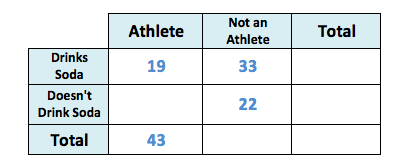
Our question asked how many students don't drink soda. We add up the numbers in the "doesn't drink soda" row to get the total, but first we need to fill in a gap in our table, students who were athletes, but don't drink soda. We can take the total number of students who are athletes, 


This means that 
Now, we add up the numbers in the "doesn't drink soda" row to get the total:

This means that 
Which of the following answer choices displays an irrational number?
Explanation
Our answer choices consist of two types of numbers: rational numbers and irrational numbers. In order to correctly answer this question, we need to know the difference between the two types of numbers.
Rational numbers are numbers that we use most often, and can be written as a simple fraction.
Irrational numbers cannot be written as fractions, and are numbers that have decimal places that never repeat or end.
In this case,