How to find the solution to an equation
Help Questions
ISEE Upper Level: Quantitative Reasoning › How to find the solution to an equation
Solve the equation for 


Explanation
First, simplify the equation as much as possible:

Now we can take the 


Which of the following makes the equation true:


Explanation
To find the answer, we will solve for x. So, we get


A class has 25 students. If 60% of them are boys, how many students are girls?
10
15
20
9
8
Explanation
We know that 40% of the class are girls because 60% are boys. To express 40% as a fraction of the 25 total students, we set up a proportion to find the number of girls in the class.


When solving for 
Adam has 3 siblings. When his mother bakes a cake, each of the 4 children is given ¼ of the cake. Adam only finished 1/3 of his share of cake. If the original cake had 12 slices, how many slices did Adam eat?
1
2
3
4
6
Explanation
Each of the children gets 1/4 of the cake. Taking 1/4 of 12 shows that each child gets 3 slices. If Adam finishes 1/3 of his share, then he has eaten one out of the 3 slices.
A small bakery sells two flavors of muffins: chocolate and banana.
At the end of the day, there are 13 muffins left.
There are 

If
how many banana muffins are left?


Explanation
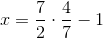
The first step is to solve for x.
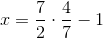


If there are 1x chocolate muffins and 2y banana muffins, for a total of 13 muffins then:



Since the number of banana muffins remaining is 2y, there are 12 banana muffins left.
On average, 1 in 9 peanuts that are harvested will only have one pod instead of two pods. Of those one-pod peanuts, three quarters of them will be smaller than the average peanut.
If 900 peanuts are harvested, how many will be one-pod peanuts that are smaller than average in size?


Explanation
If there are 900 peanuts and 1 in 9 will be one-podded, that means that 100 will be one-podded.
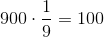
Three quarters of these 100 one-podded peanuts will be of smaller than average size. Three quarters of of 100 is 75. Therefore, 75 is the correct answer.
Julie sells cars. She has a monthly salary of $1000 and a commission of $500 for each car sold. How much money will she make this month if she sells 7 cars?
$4500
$3500
$7000
$8000
$1500
Explanation
To find out how much Julie makes from selling the cars, we first multiply the 7 cars she sells by the $500 that she receives for each car. This gives us $3,500. We now add the $1,000 that she gets for her monthly salary for a total of $4,500.
Fifteen percent of the students in the classroom brought their lunch from home. If 9 students brought their lunch from home, how many students are in the classroom total?
60
6
50
135
Explanation
You can think of the total number of students in the classroom as an unknown variable, 
You can set up an equation that includes 
Total Amount x Percent = Part of Total Amount


You use 
Now you can algebraically solve for 


Therefore there are 60 total students.
Which of the answer choices below has a value that is different from the others?


Explanation


Therefore, 
Machine A can produce 4 books in 2 days. Machine B can produce 20 books in 4 days. How many books can machines A and B, working together, produce in 40 days?
280
200
120
960
10
Explanation
Through simplification, we can see that machine A produces 2 books a day and that machine B produces 5 books a day. If we multily each by 40 days and add them together, we find that together they can produce 280 books in 40 days:
