How to find the area of a circle - ISEE Upper Level: Quantitative Reasoning
Card 1 of 92
What is the area of a circle with a diameter of  , rounded to the nearest whole number?
What is the area of a circle with a diameter of
Tap to reveal answer
The formula for the area of a circle is
pi $r^{2}$
Find the radius by dividing 9 by 2:
$\frac{9}{2}$=4.5
So the formula for area would now be:
pi $r^{2}$=pi $(4.5)^{2}$=20.25pi approx 63.6= 64
The formula for the area of a circle is
pi $r^{2}$
Find the radius by dividing 9 by 2:
$\frac{9}{2}$=4.5
So the formula for area would now be:
pi $r^{2}$=pi $(4.5)^{2}$=20.25pi approx 63.6= 64
← Didn't Know|Knew It →
What is the area of a circle that has a diameter of  inches?
What is the area of a circle that has a diameter of
Tap to reveal answer
The formula for finding the area of a circle is  . In this formula,
  represents the radius of the circle. Since the question only gives us the measurement of the diameter of the circle, we must calculate the radius. In order to do this, we divide the diameter by
  .
.

Now we use  for
for  in our equation.

The formula for finding the area of a circle is
Now we use
← Didn't Know|Knew It →
What is the area of a circle with a diameter equal to 6?
What is the area of a circle with a diameter equal to 6?
Tap to reveal answer
First, solve for radius:

Then, solve for area:

First, solve for radius:
Then, solve for area:
← Didn't Know|Knew It →
The diameter of a circle is  . Give the area of the circle.
The diameter of a circle is
Tap to reveal answer
The area of a circle can be calculated using the formula:
 ,
,
where  is the diameter of the circle, and
  is approximately
  .
.

The area of a circle can be calculated using the formula:
where
← Didn't Know|Knew It →
The diameter of a circle is  . Give the area of the circle in terms of
  .
.
The diameter of a circle is
Tap to reveal answer
The area of a circle can be calculated using the formula:
 ,
,
where  is the diameter of the circle and
  is approximately
  .
.


The area of a circle can be calculated using the formula:
where
← Didn't Know|Knew It →
The radius of a circle is  . Give the area of the circle.
The radius of a circle is
Tap to reveal answer
The area of a circle can be calculated as  , where
  is the radius of the circle, and
  is approximately
  .
.

The area of a circle can be calculated as
← Didn't Know|Knew It →
The circumference of a circle is  inches. Find the area of the circle.
Let  .
.
The circumference of a circle is
Let
Tap to reveal answer
First we need to find the radius of the circle. The circumference of a circle is  , where
  is the radius of the circle.

The area of a circle is  where
where  is the radius of the circle.

First we need to find the radius of the circle. The circumference of a circle is
The area of a circle is
← Didn't Know|Knew It →
The perpendicular distance from the chord to the center of a circle is  , and the chord length is
  . Give the area of the circle in terms of
  .
.
The perpendicular distance from the chord to the center of a circle is
Tap to reveal answer
Chord length =  , where
  is the radius of the circle and
  is the perpendicular distance from the chord to the circle center.
Chord length = 

 , where
  is the radius of the circle and
  is approximately
  .
.

Chord length =
Chord length =
← Didn't Know|Knew It →
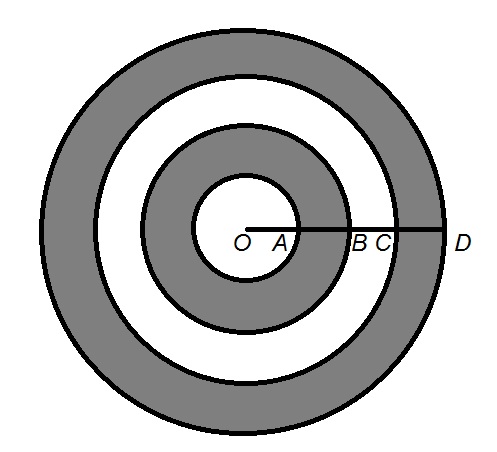
In the above figure,  .
.
What percent of the figure is shaded gray?
In the above figure,
What percent of the figure is shaded gray?
Tap to reveal answer
For the sake of simplicity, we will assume that  ; this reasoning is independent of the actual length.
The four concentric circles have radii 1, 2, 3, and 4, respectively, and their areas can be found by substituting each radius for  in the formula
  :
:




The outer gray ring is the region between the largest and second-largest circles, and has area

The inner gray ring is the region between the second-smallest and smallest circles, and has area

The total area of the gray regions is

Since  out of total area
  is gray, the percent of the figure that is gray is
 .
.
For the sake of simplicity, we will assume that
The four concentric circles have radii 1, 2, 3, and 4, respectively, and their areas can be found by substituting each radius for
The outer gray ring is the region between the largest and second-largest circles, and has area
The inner gray ring is the region between the second-smallest and smallest circles, and has area
The total area of the gray regions is
Since
← Didn't Know|Knew It →
In the above figure, .
Give the ratio of the area of the outer ring to that of the inner circle.
In the above figure,
Give the ratio of the area of the outer ring to that of the inner circle.
Tap to reveal answer
For the sake of simplicity, we will assume that ; this reasoning is independent of the actual length.
The four concentric circles have radii 1, 2, 3, and 4, respectively, and their areas can be found by substituting each radius for in the formula .
The areas of the largest circle and the second-largest circle are, respectively,
The difference of their areas, which is the area of the outer ring, is
.
The inner circle has area
.
The ratio of these areas is therefore
 , or 7 to 1.
For the sake of simplicity, we will assume that
The four concentric circles have radii 1, 2, 3, and 4, respectively, and their areas can be found by substituting each radius for
The areas of the largest circle and the second-largest circle are, respectively,
The difference of their areas, which is the area of the outer ring, is
The inner circle has area
The ratio of these areas is therefore
← Didn't Know|Knew It →
The above figure depicts a dartboard, in which .
A blindfolded man throws a dart at the target. Disregarding any skill factor and assuming he hits the target, what are the odds against his hitting the white inner circle?
The above figure depicts a dartboard, in which
A blindfolded man throws a dart at the target. Disregarding any skill factor and assuming he hits the target, what are the odds against his hitting the white inner circle?
Tap to reveal answer
For the sake of simplicity, we will assume that ; this reasoning is independent of the actual length.
The inner and outer circles have radii 1 and 4, respectively, and their areas can be found by substituting each radius for in the formula :
- this is the white inner circle.
The area of the portion of the target outside the white inner circle is  , so the odds against hitting the inner circle are
 - that is, 15 to 1 odds against.
For the sake of simplicity, we will assume that
The inner and outer circles have radii 1 and 4, respectively, and their areas can be found by substituting each radius for
The area of the portion of the target outside the white inner circle is
← Didn't Know|Knew It →
A circle has a radius of 5 miles, what is its area?
A circle has a radius of 5 miles, what is its area?
Tap to reveal answer
A circle has a radius of 5 miles, what is its area?
Find the area of a circle with the following formula:

We know that r is 5, so we can find our answer with the following:

A circle has a radius of 5 miles, what is its area?
Find the area of a circle with the following formula:
We know that r is 5, so we can find our answer with the following:
← Didn't Know|Knew It →
While mailing some very important letters, you decide to use your circular rubber stamp. If the stamp has a radius of 3.5 cm, what is the area of the stamping surface?
While mailing some very important letters, you decide to use your circular rubber stamp. If the stamp has a radius of 3.5 cm, what is the area of the stamping surface?
Tap to reveal answer
While mailing some very important letters, you decide to use your circular rubber stamp. If the stamp has a radius of 3.5 cm, what is the area of the stamping surface?
Find the area of a circle by using the following formula:

Our radius is 3.5 cm, so plug that in:

While mailing some very important letters, you decide to use your circular rubber stamp. If the stamp has a radius of 3.5 cm, what is the area of the stamping surface?
Find the area of a circle by using the following formula:
Our radius is 3.5 cm, so plug that in:
← Didn't Know|Knew It →
You have a circular window in your vacation room. It has a radius of 9 inches. What is the area of the window?
You have a circular window in your vacation room. It has a radius of 9 inches. What is the area of the window?
Tap to reveal answer
You have a circular window in your vacation room. It has a radius of 9 inches. What is the area of the window?
To find the area of a circle, use the following formula:

Now, we know the radius, so we just need to plug it in and solve.

So, our answer:

You have a circular window in your vacation room. It has a radius of 9 inches. What is the area of the window?
To find the area of a circle, use the following formula:
Now, we know the radius, so we just need to plug it in and solve.
So, our answer:
← Didn't Know|Knew It →
Find the area of a circle with a radius of 6in.
Find the area of a circle with a radius of 6in.
Tap to reveal answer
To find the area of a circle, we will use the following formula:

Now, we know the radius of the circle is 6in.
Knowing this, we can substitute into the formula. We get



To find the area of a circle, we will use the following formula:
Now, we know the radius of the circle is 6in.
Knowing this, we can substitute into the formula. We get
← Didn't Know|Knew It →
Find the area of a circle with a diameter of 10in.
Find the area of a circle with a diameter of 10in.
Tap to reveal answer
To find the area of a circle, we will use the following formula:

where r is the radius of the circle.
Now, we know the diameter of the circle is 10in. We also know the diameter is two times the radius. Therefore, the radius is 5in.
Knowing this, we can substitute into the formula. We get



To find the area of a circle, we will use the following formula:
where r is the radius of the circle.
Now, we know the diameter of the circle is 10in. We also know the diameter is two times the radius. Therefore, the radius is 5in.
Knowing this, we can substitute into the formula. We get
← Didn't Know|Knew It →
Find the area of a circle with a diameter of 14cm.
Find the area of a circle with a diameter of 14cm.
Tap to reveal answer
To find the area of a circle, we will use the following formula:

where r is the radius of the circle.
Now, we know the diameter of the circle is 14cm. We also know the diameter is two times the radius. Therefore, the radius is 7cm.
Knowing this, we can substitute into the formula. We get



To find the area of a circle, we will use the following formula:
where r is the radius of the circle.
Now, we know the diameter of the circle is 14cm. We also know the diameter is two times the radius. Therefore, the radius is 7cm.
Knowing this, we can substitute into the formula. We get
← Didn't Know|Knew It →
You have a tomato plant growing in a pot. If the base of the pot has a radius of 6 inches, find the area of the footprint of the pot.
You have a tomato plant growing in a pot. If the base of the pot has a radius of 6 inches, find the area of the footprint of the pot.
Tap to reveal answer
You have a tomato plant growing in a pot. If the base of the pot has a radius of 6 inches, find the area of the footprint of the pot.
To solve this problem, first recall the formula for area of a circle.

Now, we know our r=6 inches, so we just need to plug in and simplify.

So, our answer is:

You have a tomato plant growing in a pot. If the base of the pot has a radius of 6 inches, find the area of the footprint of the pot.
To solve this problem, first recall the formula for area of a circle.
Now, we know our r=6 inches, so we just need to plug in and simplify.
So, our answer is:
← Didn't Know|Knew It →
Let  .
.
Find the area of a circle with a diameter of 14cm. If necessary, round to the nearest tenths.
Let
Find the area of a circle with a diameter of 14cm. If necessary, round to the nearest tenths.
Tap to reveal answer
To find the area of a circle, we will use the following formula:

where r is the radius of the circle.
Now, we know the diameter of the circle is 14cm. We also know that the diameter is two times the radius. Therefore, the radius is 7cm.
We also know  .
.
Knowing all of this, we can substitute into the formula. We get



We were asked to round to the nearest tenth. So, we get

To find the area of a circle, we will use the following formula:
where r is the radius of the circle.
Now, we know the diameter of the circle is 14cm. We also know that the diameter is two times the radius. Therefore, the radius is 7cm.
We also know
Knowing all of this, we can substitute into the formula. We get
We were asked to round to the nearest tenth. So, we get
← Didn't Know|Knew It →
Find the area of a circle with a radius of 16in.
Find the area of a circle with a radius of 16in.
Tap to reveal answer
To find the area of a circle, we will use the following formula:

where r is the radius of the circle.
Now, we know the radius is 16in. Knowing this, we can substitute into the formula. We get



To find the area of a circle, we will use the following formula:
where r is the radius of the circle.
Now, we know the radius is 16in. Knowing this, we can substitute into the formula. We get
← Didn't Know|Knew It →