Trapezoids - ISEE Upper Level: Quantitative Reasoning
Card 1 of 36
The perimeter of the following trapezoid is  .
.
The following is given:


Find  .
.
Figure not drawn to scale.
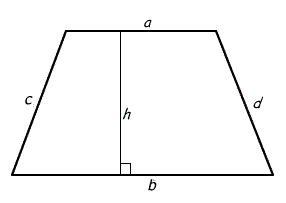
The perimeter of the following trapezoid is
The following is given:
Find
Figure not drawn to scale.
Tap to reveal answer
The perimeter of a trapezoid is equal to the sum of all of the sides, i.e.
 ,
,
where  are the lengths of each side.

The perimeter of a trapezoid is equal to the sum of all of the sides, i.e.
where
← Didn't Know|Knew It →
The bigger base length of a trapezoid is two times bigger than the smaller base length. Legs of the trapezoid have the same length of  . If the perimeter of the trapezoid is
  , give the length of the smaller base.
The bigger base length of a trapezoid is two times bigger than the smaller base length. Legs of the trapezoid have the same length of
Tap to reveal answer
Like any polygon, the perimeter of a trapezoid is the total distance around the outside, i.e.
 ,
,
where  are the lengths of each side.
Let  small base length and
  big base length.

Like any polygon, the perimeter of a trapezoid is the total distance around the outside, i.e.
where
Let
← Didn't Know|Knew It →
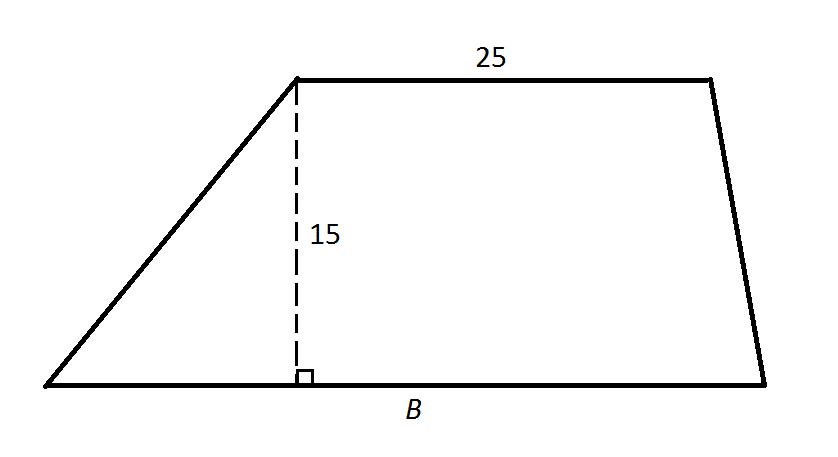
Note: Figure NOT drawn to scale.
The area of the above trapezoid is  . What is
  ?
?
Note: Figure NOT drawn to scale.
The area of the above trapezoid is
Tap to reveal answer
Substitute  into the formula for the area of a trapezoid:
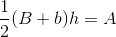
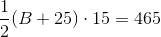







Substitute
← Didn't Know|Knew It →
Find the area of the above trapezoid if  ,
,  , and
, and  .
.
Figure not drawn to scale.
Find the area of the above trapezoid if
Figure not drawn to scale.
Tap to reveal answer
The area of a trapezoid is given by
 ,
,
where  ,
,  are the lengths of each base and
  is the altitude (height) of the trapezoid.


The area of a trapezoid is given by
where
← Didn't Know|Knew It →
A trapezoid has the base lengths of  and
and  . The area of the trapezoid is
  . Give the height of the trapezoid in terms of
  .
.
A trapezoid has the base lengths of
Tap to reveal answer
The area of a trapezoid is given by
 ,
,
where  ,
,  are the lengths of each base and
  is the altitude (height) of the trapezoid.


The area of a trapezoid is given by
where
← Didn't Know|Knew It →
In the following trapezoid  and
and  . The area of the trapezoid is 54 square inches. Give the height of the trapezoid. Figure not drawn to scale.

In the following trapezoid
Tap to reveal answer
The area of a trapezoid is given by
 ,
,
where  ,
,  are the lengths of each base and
  is the altitude (height) of the trapezoid.


Substitute these values into the area formula:

The area of a trapezoid is given by
where
Substitute these values into the area formula:
← Didn't Know|Knew It →

Note: Figure NOT drawn to scale.
The above trapezoid has area  . What is
  ?
?
Note: Figure NOT drawn to scale.
The above trapezoid has area
Tap to reveal answer
Substitute  in the formula for the area of a trapezoid:


Substitute
← Didn't Know|Knew It →
A trapezoid has height 20 inches. Its bases have sum 30 inches, and one base is 6 inches longer than the other. What is the area of this trapezoid?
A trapezoid has height 20 inches. Its bases have sum 30 inches, and one base is 6 inches longer than the other. What is the area of this trapezoid?
Tap to reveal answer
You do not need to find the individual bases; their sum,  , is
, is  . You can substitute
  into the formula for the area of a trapezoid:

 square inches.
Note that the fact that one base is  inches longer is not important here.
You do not need to find the individual bases; their sum,
Note that the fact that one base is
← Didn't Know|Knew It →

What is the area of the shaded portion of the above square?
What is the area of the shaded portion of the above square?
Tap to reveal answer
Quadrilateral  - the shaded region - is a trapezoid with bases
  and
and  , and altitude
  . The area of the trapezoid can be calculated using the formula
 ,
,
where  and
and  , and
, and  .
.
The length of  can be found by setting
  and
and  and applying the Pythagorean Theorem:

Therefore,
 .
.
Substituting:


Quadrilateral
where
The length of
Therefore,
Substituting:
← Didn't Know|Knew It →
Find the area of the above trapezoid if , , and .
Figure not drawn to scale.
Find the area of the above trapezoid if
Figure not drawn to scale.
Tap to reveal answer
The area of a trapezoid is given by
,
where , are the lengths of each base and is the altitude (height) of the trapezoid.
The area of a trapezoid is given by
where
← Didn't Know|Knew It →
A trapezoid has the base lengths of and . The area of the trapezoid is . Give the height of the trapezoid in terms of .
A trapezoid has the base lengths of
Tap to reveal answer
The area of a trapezoid is given by
,
where , are the lengths of each base and is the altitude (height) of the trapezoid.
The area of a trapezoid is given by
where
← Didn't Know|Knew It →
In the following trapezoid and . The area of the trapezoid is 54 square inches. Give the height of the trapezoid. Figure not drawn to scale.
In the following trapezoid
Tap to reveal answer
The area of a trapezoid is given by
,
where , are the lengths of each base and is the altitude (height) of the trapezoid.
Substitute these values into the area formula:
The area of a trapezoid is given by
where
Substitute these values into the area formula:
← Didn't Know|Knew It →
Note: Figure NOT drawn to scale.
The above trapezoid has area . What is ?
Note: Figure NOT drawn to scale.
The above trapezoid has area
Tap to reveal answer
Substitute in the formula for the area of a trapezoid:
Substitute
← Didn't Know|Knew It →
A trapezoid has height 20 inches. Its bases have sum 30 inches, and one base is 6 inches longer than the other. What is the area of this trapezoid?
A trapezoid has height 20 inches. Its bases have sum 30 inches, and one base is 6 inches longer than the other. What is the area of this trapezoid?
Tap to reveal answer
You do not need to find the individual bases; their sum, , is . You can substitute into the formula for the area of a trapezoid:
square inches.
Note that the fact that one base is inches longer is not important here.
You do not need to find the individual bases; their sum,
Note that the fact that one base is
← Didn't Know|Knew It →
What is the area of the shaded portion of the above square?
What is the area of the shaded portion of the above square?
Tap to reveal answer
Quadrilateral - the shaded region - is a trapezoid with bases and , and altitude . The area of the trapezoid can be calculated using the formula
,
where and , and .
The length of can be found by setting and and applying the Pythagorean Theorem:
Therefore,
.
Substituting:
Quadrilateral
where
The length of
Therefore,
Substituting:
← Didn't Know|Knew It →
Find the area of the above trapezoid if , , and .
Figure not drawn to scale.
Find the area of the above trapezoid if
Figure not drawn to scale.
Tap to reveal answer
The area of a trapezoid is given by
,
where , are the lengths of each base and is the altitude (height) of the trapezoid.
The area of a trapezoid is given by
where
← Didn't Know|Knew It →
A trapezoid has the base lengths of and . The area of the trapezoid is . Give the height of the trapezoid in terms of .
A trapezoid has the base lengths of
Tap to reveal answer
The area of a trapezoid is given by
,
where , are the lengths of each base and is the altitude (height) of the trapezoid.
The area of a trapezoid is given by
where
← Didn't Know|Knew It →
In the following trapezoid and . The area of the trapezoid is 54 square inches. Give the height of the trapezoid. Figure not drawn to scale.
In the following trapezoid
Tap to reveal answer
The area of a trapezoid is given by
,
where , are the lengths of each base and is the altitude (height) of the trapezoid.
Substitute these values into the area formula:
The area of a trapezoid is given by
where
Substitute these values into the area formula:
← Didn't Know|Knew It →
Note: Figure NOT drawn to scale.
The above trapezoid has area . What is ?
Note: Figure NOT drawn to scale.
The above trapezoid has area
Tap to reveal answer
Substitute in the formula for the area of a trapezoid:
Substitute
← Didn't Know|Knew It →
A trapezoid has height 20 inches. Its bases have sum 30 inches, and one base is 6 inches longer than the other. What is the area of this trapezoid?
A trapezoid has height 20 inches. Its bases have sum 30 inches, and one base is 6 inches longer than the other. What is the area of this trapezoid?
Tap to reveal answer
You do not need to find the individual bases; their sum, , is . You can substitute into the formula for the area of a trapezoid:
square inches.
Note that the fact that one base is inches longer is not important here.
You do not need to find the individual bases; their sum,
Note that the fact that one base is
← Didn't Know|Knew It →