Rhombuses - ISEE Upper Level Quantitative Reasoning
Card 1 of 36
Consider the rhombus below. Solve for  .
.
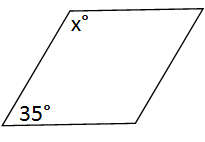
Consider the rhombus below. Solve for
Tap to reveal answer
The total sum of the interior angles of a quadrilateral is  degrees. In this problem, we are only considering half of the interior angles:



The total sum of the interior angles of a quadrilateral is
← Didn't Know|Knew It →
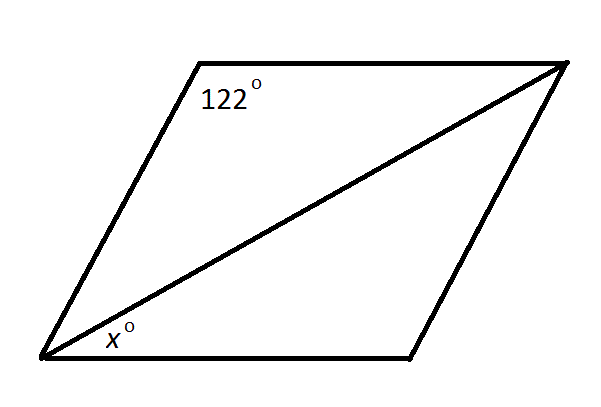
Note: Figure NOT drawn to scale.
The above depicts a rhombus and one of its diagonals. What is  ?
?
Note: Figure NOT drawn to scale.
The above depicts a rhombus and one of its diagonals. What is
Tap to reveal answer
The diagonals of a rhombus bisect the angles.
The angle bisected must be supplementary to the  angle since they are consecutive angles of a parallelogram; therefore, that angle has measure
  , and
, and  is half that, or
  .
.
The diagonals of a rhombus bisect the angles.
The angle bisected must be supplementary to the
← Didn't Know|Knew It →
One side of a rhombus measures 2 yards. Which of the following is equal to the perimeter?
One side of a rhombus measures 2 yards. Which of the following is equal to the perimeter?
Tap to reveal answer
A rhombus has four sides of equal measure, so the perimeter of a rhombus with sidelength 2 yards is  yards.

Also,

The only choice that agrees with any of these measures is 288 inches, the correct choice.
A rhombus has four sides of equal measure, so the perimeter of a rhombus with sidelength 2 yards is
Also,
The only choice that agrees with any of these measures is 288 inches, the correct choice.
← Didn't Know|Knew It →
One side of a rhombus measures  . Give its perimeter in terms of
  .
.
One side of a rhombus measures
Tap to reveal answer
A rhombus has four sides of equal measure, so the perimeter of a rhombus with sidelength  is
is  .
.
A rhombus has four sides of equal measure, so the perimeter of a rhombus with sidelength
← Didn't Know|Knew It →
A rhombus has a perimeter of  . Give the side length of the rhombus.
A rhombus has a perimeter of
Tap to reveal answer
Like any polygon, the perimeter of the rhombus is the total distance around the outside, which can be found by adding together the length of each side. In the case of a rhombus, all four sides have the same length, i.e.
 ,
,
where  is the length of each side.

Like any polygon, the perimeter of the rhombus is the total distance around the outside, which can be found by adding together the length of each side. In the case of a rhombus, all four sides have the same length, i.e.
where
← Didn't Know|Knew It →
A rhombus has the area of  . One of the interior angles is
  . Give the length of each side of the rhombus.
A rhombus has the area of
Tap to reveal answer
The area of a rhombus can be determined by the following formula:
 ,
,
where  is the length of any side and
  is any interior angle.


The area of a rhombus can be determined by the following formula:
where
← Didn't Know|Knew It →
Consider the rhombus below. Solve for .
Consider the rhombus below. Solve for
Tap to reveal answer
The total sum of the interior angles of a quadrilateral is degrees. In this problem, we are only considering half of the interior angles:
The total sum of the interior angles of a quadrilateral is
← Didn't Know|Knew It →
Note: Figure NOT drawn to scale.
The above depicts a rhombus and one of its diagonals. What is ?
Note: Figure NOT drawn to scale.
The above depicts a rhombus and one of its diagonals. What is
Tap to reveal answer
The diagonals of a rhombus bisect the angles.
The angle bisected must be supplementary to the angle since they are consecutive angles of a parallelogram; therefore, that angle has measure , and is half that, or .
The diagonals of a rhombus bisect the angles.
The angle bisected must be supplementary to the
← Didn't Know|Knew It →
Consider the rhombus below. Solve for .
Consider the rhombus below. Solve for
Tap to reveal answer
The total sum of the interior angles of a quadrilateral is degrees. In this problem, we are only considering half of the interior angles:
The total sum of the interior angles of a quadrilateral is
← Didn't Know|Knew It →
Note: Figure NOT drawn to scale.
The above depicts a rhombus and one of its diagonals. What is ?
Note: Figure NOT drawn to scale.
The above depicts a rhombus and one of its diagonals. What is
Tap to reveal answer
The diagonals of a rhombus bisect the angles.
The angle bisected must be supplementary to the angle since they are consecutive angles of a parallelogram; therefore, that angle has measure , and is half that, or .
The diagonals of a rhombus bisect the angles.
The angle bisected must be supplementary to the
← Didn't Know|Knew It →
One side of a rhombus measures 2 yards. Which of the following is equal to the perimeter?
One side of a rhombus measures 2 yards. Which of the following is equal to the perimeter?
Tap to reveal answer
A rhombus has four sides of equal measure, so the perimeter of a rhombus with sidelength 2 yards is yards.
Also,
The only choice that agrees with any of these measures is 288 inches, the correct choice.
A rhombus has four sides of equal measure, so the perimeter of a rhombus with sidelength 2 yards is
Also,
The only choice that agrees with any of these measures is 288 inches, the correct choice.
← Didn't Know|Knew It →
One side of a rhombus measures . Give its perimeter in terms of .
One side of a rhombus measures
Tap to reveal answer
A rhombus has four sides of equal measure, so the perimeter of a rhombus with sidelength is .
A rhombus has four sides of equal measure, so the perimeter of a rhombus with sidelength
← Didn't Know|Knew It →
Two diagonals of a rhombus have lengths of  and
and  . Give the area in terms of
  .
.
Two diagonals of a rhombus have lengths of
Tap to reveal answer
The formula for the area of a rhombus is
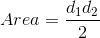 ,
,
where  is the length of one diagonal and
  is the length of the other diagonal.

The formula for the area of a rhombus is
where
← Didn't Know|Knew It →
A rhombus has side length  , and one of the interior angles is
  . Give the area of the rhombus.
A rhombus has side length
Tap to reveal answer
The area of a rhombus can be determined by the following formula:
,
where is the length of any side and is any interior angle.

The area of a rhombus can be determined by the following formula:
where
← Didn't Know|Knew It →
Find the area of a rhombus with one diagonal having a length of 12in and the other having a length two times the first diagonal.
Find the area of a rhombus with one diagonal having a length of 12in and the other having a length two times the first diagonal.
Tap to reveal answer
To find the area of a rhombus, we will use the following formula:

where p and q are the lengths of the diagonals of the rhombus.
Now, we know one diagonal has a length of 12in. We also know the other diagonal is two times the first diagonal. Therefore, the second diagonal is 24in.
Knowing this, we can substitute into the formula. We get
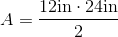


To find the area of a rhombus, we will use the following formula:
where p and q are the lengths of the diagonals of the rhombus.
Now, we know one diagonal has a length of 12in. We also know the other diagonal is two times the first diagonal. Therefore, the second diagonal is 24in.
Knowing this, we can substitute into the formula. We get
← Didn't Know|Knew It →
Two diagonals of a rhombus have lengths of and . Give the area in terms of .
Two diagonals of a rhombus have lengths of
Tap to reveal answer
The formula for the area of a rhombus is
,
where is the length of one diagonal and is the length of the other diagonal.
The formula for the area of a rhombus is
where
← Didn't Know|Knew It →
A rhombus has side length , and one of the interior angles is . Give the area of the rhombus.
A rhombus has side length
Tap to reveal answer
The area of a rhombus can be determined by the following formula:
,
where is the length of any side and is any interior angle.
The area of a rhombus can be determined by the following formula:
where
← Didn't Know|Knew It →
Find the area of a rhombus with one diagonal having a length of 12in and the other having a length two times the first diagonal.
Find the area of a rhombus with one diagonal having a length of 12in and the other having a length two times the first diagonal.
Tap to reveal answer
To find the area of a rhombus, we will use the following formula:
where p and q are the lengths of the diagonals of the rhombus.
Now, we know one diagonal has a length of 12in. We also know the other diagonal is two times the first diagonal. Therefore, the second diagonal is 24in.
Knowing this, we can substitute into the formula. We get
To find the area of a rhombus, we will use the following formula:
where p and q are the lengths of the diagonals of the rhombus.
Now, we know one diagonal has a length of 12in. We also know the other diagonal is two times the first diagonal. Therefore, the second diagonal is 24in.
Knowing this, we can substitute into the formula. We get
← Didn't Know|Knew It →
A rhombus has a perimeter of . Give the side length of the rhombus.
A rhombus has a perimeter of
Tap to reveal answer
Like any polygon, the perimeter of the rhombus is the total distance around the outside, which can be found by adding together the length of each side. In the case of a rhombus, all four sides have the same length, i.e.
,
where is the length of each side.
Like any polygon, the perimeter of the rhombus is the total distance around the outside, which can be found by adding together the length of each side. In the case of a rhombus, all four sides have the same length, i.e.
where
← Didn't Know|Knew It →
A rhombus has the area of . One of the interior angles is . Give the length of each side of the rhombus.
A rhombus has the area of
Tap to reveal answer
The area of a rhombus can be determined by the following formula:
,
where is the length of any side and is any interior angle.
The area of a rhombus can be determined by the following formula:
where
← Didn't Know|Knew It →