How to simplify an expression - GRE Quantitative Reasoning
Card 1 of 72
a # b = (a * b) + a
What is 3 # (4 # 1)?
a # b = (a * b) + a
What is 3 # (4 # 1)?
Tap to reveal answer
Work from the "inside" outward. Therefore, first solve 4 # 1 by replacing a with 4 and b with 1:
4 # 1 = (4 * 1) + 4 = 4 + 4 = 8
That means: 3 # (4 # 1) = 3 # 8. Solve this now:
3 # 8 = (3 * 8) + 3 = 24 + 3 = 27
Work from the "inside" outward. Therefore, first solve 4 # 1 by replacing a with 4 and b with 1:
4 # 1 = (4 * 1) + 4 = 4 + 4 = 8
That means: 3 # (4 # 1) = 3 # 8. Solve this now:
3 # 8 = (3 * 8) + 3 = 24 + 3 = 27
← Didn't Know|Knew It →
If  and
and  , then
If
Tap to reveal answer
We have three variables and only two equations, so we will not be able to solve for each independent variable. We need to think of another solution.
Notice what happens if we line up the two equations and add them together.
(x + y) + (3_x –_ y + z) = 4x + z
and 5 + 3 = 8
Lets take this equation and multiply the whole thing by 3:
3(4_x_ + z = 8)
Thus, 12_x_ + 3_z_ = 24.
We have three variables and only two equations, so we will not be able to solve for each independent variable. We need to think of another solution.
Notice what happens if we line up the two equations and add them together.
(x + y) + (3_x –_ y + z) = 4x + z
and 5 + 3 = 8
Lets take this equation and multiply the whole thing by 3:
3(4_x_ + z = 8)
Thus, 12_x_ + 3_z_ = 24.
← Didn't Know|Knew It →
Simplify the result of the following steps, to be completed in order:
1. Add 7_x_ to 3_y_
2. Multiply the sum by 4
3. Add x to the product
4. Subtract x – y from the sum
Simplify the result of the following steps, to be completed in order:
1. Add 7_x_ to 3_y_
2. Multiply the sum by 4
3. Add x to the product
4. Subtract x – y from the sum
Tap to reveal answer
Step 1: 7_x_ + 3_y_
Step 2: 4 * (7_x_ + 3_y_) = 28_x_ + 12_y_
Step 3: 28_x_ + 12_y_ + x = 29_x_ + 12_y_
Step 4: 29_x_ + 12_y_ – (x – y) = 29_x_ + 12_y_ – x + y = 28_x_ + 13_y_
Step 1: 7_x_ + 3_y_
Step 2: 4 * (7_x_ + 3_y_) = 28_x_ + 12_y_
Step 3: 28_x_ + 12_y_ + x = 29_x_ + 12_y_
Step 4: 29_x_ + 12_y_ – (x – y) = 29_x_ + 12_y_ – x + y = 28_x_ + 13_y_
← Didn't Know|Knew It →
Quantitative Comparison
 is an integer.
Quantity A: 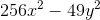
Quantity B: 
Quantitative Comparison
Quantity A:
Quantity B:
Tap to reveal answer
Plugging in numbers is not the best strategy here. Instead, let's see how we can equate the two expressions. Quantity A is actually a difference of squares. 256_x_2 = (16_x_)2 and 49_y_2 = (7_y_)2. These look like the expressions in Quantity B. The formula to remember here is the difference of squares formula, a very important one for this test! a_2 – b_2 = (a + b)(a – b). Thus, if a = 16_x and b = 7_y, 256_x_2 – 49_y_2 = (16_x_ – 7_y_)(16_x_ + 7_y_), and the quantities are equal.
Plugging in numbers is not the best strategy here. Instead, let's see how we can equate the two expressions. Quantity A is actually a difference of squares. 256_x_2 = (16_x_)2 and 49_y_2 = (7_y_)2. These look like the expressions in Quantity B. The formula to remember here is the difference of squares formula, a very important one for this test! a_2 – b_2 = (a + b)(a – b). Thus, if a = 16_x and b = 7_y, 256_x_2 – 49_y_2 = (16_x_ – 7_y_)(16_x_ + 7_y_), and the quantities are equal.
← Didn't Know|Knew It →
Quantitative Comparison
Quantity A: 
Quantity B: 
Quantitative Comparison
Quantity A:
Quantity B:
Tap to reveal answer
(x + y)2 = x_2 + 2_xy + _y_2
Now, since there are no specifications on what x and y can equal, one or both of them could be 0, making the two columns equal. Any value other than 0 will make the columns unequal because of the additional 2xy term, so the answer cannot be determined.
(x + y)2 = x_2 + 2_xy + _y_2
Now, since there are no specifications on what x and y can equal, one or both of them could be 0, making the two columns equal. Any value other than 0 will make the columns unequal because of the additional 2xy term, so the answer cannot be determined.
← Didn't Know|Knew It →
Quantitative Comparison
x and y are non-zero integers.
Quantity A: (x – y)2
Quantity B: (x + y)2
Quantitative Comparison
x and y are non-zero integers.
Quantity A: (x – y)2
Quantity B: (x + y)2
Tap to reveal answer
Quantity A: (x – y)2 = x_2 – 2_xy + _y_2
Quantity B: (x + y)2 = x_2 + 2_xy + _y_2
Both have x_2 + y_2 so cancel those from both columns and just compare –2_xy in Quantity A to 2_xy in Quantity B. If x = 1 and y = 1, –2_xy_ = –2 and 2_xy_ = 2, so Quantity B is greater. But if x = 1 and y = –1, –2_xy_ = 2 and 2_xy_ = –2, so Quantity A is greater. The contradiction means the answer cannot be determined.
Quantity A: (x – y)2 = x_2 – 2_xy + _y_2
Quantity B: (x + y)2 = x_2 + 2_xy + _y_2
Both have x_2 + y_2 so cancel those from both columns and just compare –2_xy in Quantity A to 2_xy in Quantity B. If x = 1 and y = 1, –2_xy_ = –2 and 2_xy_ = 2, so Quantity B is greater. But if x = 1 and y = –1, –2_xy_ = 2 and 2_xy_ = –2, so Quantity A is greater. The contradiction means the answer cannot be determined.
← Didn't Know|Knew It →
Which is the greater quantity: the median of 5 positive sequential integers or the mean of 5 positive sequential integers?
Which is the greater quantity: the median of 5 positive sequential integers or the mean of 5 positive sequential integers?
Tap to reveal answer
If the first integer is n, then n+(n+1)+(n+2)+(n+3)+(n+4)=5n+10
$\frac{5n+10}{5}$=n+2
This is the same as the median.
If the first integer is n, then n+(n+1)+(n+2)+(n+3)+(n+4)=5n+10
$\frac{5n+10}{5}$=n+2
This is the same as the median.
← Didn't Know|Knew It →
You are told that x can be determined from the expression:
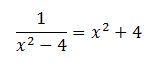
Determine whether the absolute value of x is greater than or less than 2.
You are told that x can be determined from the expression:
Determine whether the absolute value of x is greater than or less than 2.
Tap to reveal answer
The expression is simplified as follows:
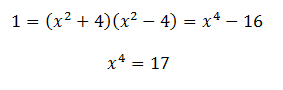
Since $2^{4}$=16 the value of x must be slightly greater for it to be 17 when raised to the 4th power.
The expression is simplified as follows:
Since $2^{4}$=16 the value of x must be slightly greater for it to be 17 when raised to the 4th power.
← Didn't Know|Knew It →
Which best describes the relationship between  and
and  if
if  ?
?
Which best describes the relationship between
Tap to reveal answer
Use substitution to determine the relationship.
For example, we could plug in  and
and  .
.


So far it looks like the first expression is greater, but it's a good idea to try other values of x and y to be sure. This time, we'll try some negative values, say,  and
and  .
.


This time the first quantity is smaller. Therefore the relationship cannot be determined from the information given.
Use substitution to determine the relationship.
For example, we could plug in
So far it looks like the first expression is greater, but it's a good idea to try other values of x and y to be sure. This time, we'll try some negative values, say,
This time the first quantity is smaller. Therefore the relationship cannot be determined from the information given.
← Didn't Know|Knew It →
a # b = (a * b) + a
What is 3 # (4 # 1)?
a # b = (a * b) + a
What is 3 # (4 # 1)?
Tap to reveal answer
Work from the "inside" outward. Therefore, first solve 4 # 1 by replacing a with 4 and b with 1:
4 # 1 = (4 * 1) + 4 = 4 + 4 = 8
That means: 3 # (4 # 1) = 3 # 8. Solve this now:
3 # 8 = (3 * 8) + 3 = 24 + 3 = 27
Work from the "inside" outward. Therefore, first solve 4 # 1 by replacing a with 4 and b with 1:
4 # 1 = (4 * 1) + 4 = 4 + 4 = 8
That means: 3 # (4 # 1) = 3 # 8. Solve this now:
3 # 8 = (3 * 8) + 3 = 24 + 3 = 27
← Didn't Know|Knew It →
If and , then
If
Tap to reveal answer
We have three variables and only two equations, so we will not be able to solve for each independent variable. We need to think of another solution.
Notice what happens if we line up the two equations and add them together.
(x + y) + (3_x –_ y + z) = 4x + z
and 5 + 3 = 8
Lets take this equation and multiply the whole thing by 3:
3(4_x_ + z = 8)
Thus, 12_x_ + 3_z_ = 24.
We have three variables and only two equations, so we will not be able to solve for each independent variable. We need to think of another solution.
Notice what happens if we line up the two equations and add them together.
(x + y) + (3_x –_ y + z) = 4x + z
and 5 + 3 = 8
Lets take this equation and multiply the whole thing by 3:
3(4_x_ + z = 8)
Thus, 12_x_ + 3_z_ = 24.
← Didn't Know|Knew It →
Simplify the result of the following steps, to be completed in order:
1. Add 7_x_ to 3_y_
2. Multiply the sum by 4
3. Add x to the product
4. Subtract x – y from the sum
Simplify the result of the following steps, to be completed in order:
1. Add 7_x_ to 3_y_
2. Multiply the sum by 4
3. Add x to the product
4. Subtract x – y from the sum
Tap to reveal answer
Step 1: 7_x_ + 3_y_
Step 2: 4 * (7_x_ + 3_y_) = 28_x_ + 12_y_
Step 3: 28_x_ + 12_y_ + x = 29_x_ + 12_y_
Step 4: 29_x_ + 12_y_ – (x – y) = 29_x_ + 12_y_ – x + y = 28_x_ + 13_y_
Step 1: 7_x_ + 3_y_
Step 2: 4 * (7_x_ + 3_y_) = 28_x_ + 12_y_
Step 3: 28_x_ + 12_y_ + x = 29_x_ + 12_y_
Step 4: 29_x_ + 12_y_ – (x – y) = 29_x_ + 12_y_ – x + y = 28_x_ + 13_y_
← Didn't Know|Knew It →
Quantitative Comparison
is an integer.
Quantity A:
Quantity B:
Quantitative Comparison
Quantity A:
Quantity B:
Tap to reveal answer
Plugging in numbers is not the best strategy here. Instead, let's see how we can equate the two expressions. Quantity A is actually a difference of squares. 256_x_2 = (16_x_)2 and 49_y_2 = (7_y_)2. These look like the expressions in Quantity B. The formula to remember here is the difference of squares formula, a very important one for this test! a_2 – b_2 = (a + b)(a – b). Thus, if a = 16_x and b = 7_y, 256_x_2 – 49_y_2 = (16_x_ – 7_y_)(16_x_ + 7_y_), and the quantities are equal.
Plugging in numbers is not the best strategy here. Instead, let's see how we can equate the two expressions. Quantity A is actually a difference of squares. 256_x_2 = (16_x_)2 and 49_y_2 = (7_y_)2. These look like the expressions in Quantity B. The formula to remember here is the difference of squares formula, a very important one for this test! a_2 – b_2 = (a + b)(a – b). Thus, if a = 16_x and b = 7_y, 256_x_2 – 49_y_2 = (16_x_ – 7_y_)(16_x_ + 7_y_), and the quantities are equal.
← Didn't Know|Knew It →
Quantitative Comparison
Quantity A:
Quantity B:
Quantitative Comparison
Quantity A:
Quantity B:
Tap to reveal answer
(x + y)2 = x_2 + 2_xy + _y_2
Now, since there are no specifications on what x and y can equal, one or both of them could be 0, making the two columns equal. Any value other than 0 will make the columns unequal because of the additional 2xy term, so the answer cannot be determined.
(x + y)2 = x_2 + 2_xy + _y_2
Now, since there are no specifications on what x and y can equal, one or both of them could be 0, making the two columns equal. Any value other than 0 will make the columns unequal because of the additional 2xy term, so the answer cannot be determined.
← Didn't Know|Knew It →
Quantitative Comparison
x and y are non-zero integers.
Quantity A: (x – y)2
Quantity B: (x + y)2
Quantitative Comparison
x and y are non-zero integers.
Quantity A: (x – y)2
Quantity B: (x + y)2
Tap to reveal answer
Quantity A: (x – y)2 = x_2 – 2_xy + _y_2
Quantity B: (x + y)2 = x_2 + 2_xy + _y_2
Both have x_2 + y_2 so cancel those from both columns and just compare –2_xy in Quantity A to 2_xy in Quantity B. If x = 1 and y = 1, –2_xy_ = –2 and 2_xy_ = 2, so Quantity B is greater. But if x = 1 and y = –1, –2_xy_ = 2 and 2_xy_ = –2, so Quantity A is greater. The contradiction means the answer cannot be determined.
Quantity A: (x – y)2 = x_2 – 2_xy + _y_2
Quantity B: (x + y)2 = x_2 + 2_xy + _y_2
Both have x_2 + y_2 so cancel those from both columns and just compare –2_xy in Quantity A to 2_xy in Quantity B. If x = 1 and y = 1, –2_xy_ = –2 and 2_xy_ = 2, so Quantity B is greater. But if x = 1 and y = –1, –2_xy_ = 2 and 2_xy_ = –2, so Quantity A is greater. The contradiction means the answer cannot be determined.
← Didn't Know|Knew It →
Which is the greater quantity: the median of 5 positive sequential integers or the mean of 5 positive sequential integers?
Which is the greater quantity: the median of 5 positive sequential integers or the mean of 5 positive sequential integers?
Tap to reveal answer
If the first integer is n, then n+(n+1)+(n+2)+(n+3)+(n+4)=5n+10
$\frac{5n+10}{5}$=n+2
This is the same as the median.
If the first integer is n, then n+(n+1)+(n+2)+(n+3)+(n+4)=5n+10
$\frac{5n+10}{5}$=n+2
This is the same as the median.
← Didn't Know|Knew It →
You are told that x can be determined from the expression:
Determine whether the absolute value of x is greater than or less than 2.
You are told that x can be determined from the expression:
Determine whether the absolute value of x is greater than or less than 2.
Tap to reveal answer
The expression is simplified as follows:
Since $2^{4}$=16 the value of x must be slightly greater for it to be 17 when raised to the 4th power.
The expression is simplified as follows:
Since $2^{4}$=16 the value of x must be slightly greater for it to be 17 when raised to the 4th power.
← Didn't Know|Knew It →
Which best describes the relationship between and if ?
Which best describes the relationship between
Tap to reveal answer
Use substitution to determine the relationship.
For example, we could plug in and .
So far it looks like the first expression is greater, but it's a good idea to try other values of x and y to be sure. This time, we'll try some negative values, say, and .
This time the first quantity is smaller. Therefore the relationship cannot be determined from the information given.
Use substitution to determine the relationship.
For example, we could plug in
So far it looks like the first expression is greater, but it's a good idea to try other values of x and y to be sure. This time, we'll try some negative values, say,
This time the first quantity is smaller. Therefore the relationship cannot be determined from the information given.
← Didn't Know|Knew It →
a # b = (a * b) + a
What is 3 # (4 # 1)?
a # b = (a * b) + a
What is 3 # (4 # 1)?
Tap to reveal answer
Work from the "inside" outward. Therefore, first solve 4 # 1 by replacing a with 4 and b with 1:
4 # 1 = (4 * 1) + 4 = 4 + 4 = 8
That means: 3 # (4 # 1) = 3 # 8. Solve this now:
3 # 8 = (3 * 8) + 3 = 24 + 3 = 27
Work from the "inside" outward. Therefore, first solve 4 # 1 by replacing a with 4 and b with 1:
4 # 1 = (4 * 1) + 4 = 4 + 4 = 8
That means: 3 # (4 # 1) = 3 # 8. Solve this now:
3 # 8 = (3 * 8) + 3 = 24 + 3 = 27
← Didn't Know|Knew It →
If and , then
If
Tap to reveal answer
We have three variables and only two equations, so we will not be able to solve for each independent variable. We need to think of another solution.
Notice what happens if we line up the two equations and add them together.
(x + y) + (3_x –_ y + z) = 4x + z
and 5 + 3 = 8
Lets take this equation and multiply the whole thing by 3:
3(4_x_ + z = 8)
Thus, 12_x_ + 3_z_ = 24.
We have three variables and only two equations, so we will not be able to solve for each independent variable. We need to think of another solution.
Notice what happens if we line up the two equations and add them together.
(x + y) + (3_x –_ y + z) = 4x + z
and 5 + 3 = 8
Lets take this equation and multiply the whole thing by 3:
3(4_x_ + z = 8)
Thus, 12_x_ + 3_z_ = 24.
← Didn't Know|Knew It →