How to find the length of the side of a right triangle - GRE Quantitative Reasoning
Card 1 of 40
2 triangles are similar
Triangle 1 has sides 6, 8, 10
Triangle 2 has sides 5 , 3, x
find x
2 triangles are similar
Triangle 1 has sides 6, 8, 10
Triangle 2 has sides 5 , 3, x
find x
Tap to reveal answer
Draw the triangles
Triangle 1 is a 6,8,10 right triangle with 10 as the hypotenuse
Triangle 2: 3 is half of 6, 5 is half of 10; x must be half of 8
Draw the triangles
Triangle 1 is a 6,8,10 right triangle with 10 as the hypotenuse
Triangle 2: 3 is half of 6, 5 is half of 10; x must be half of 8
← Didn't Know|Knew It →

Given the diagram, indicate if Quantity A is larger, Quantity B is larger, if they are equal, or if there is not enough information given to determine the relationship.
Quantity A: x
Quantity B: 7.5
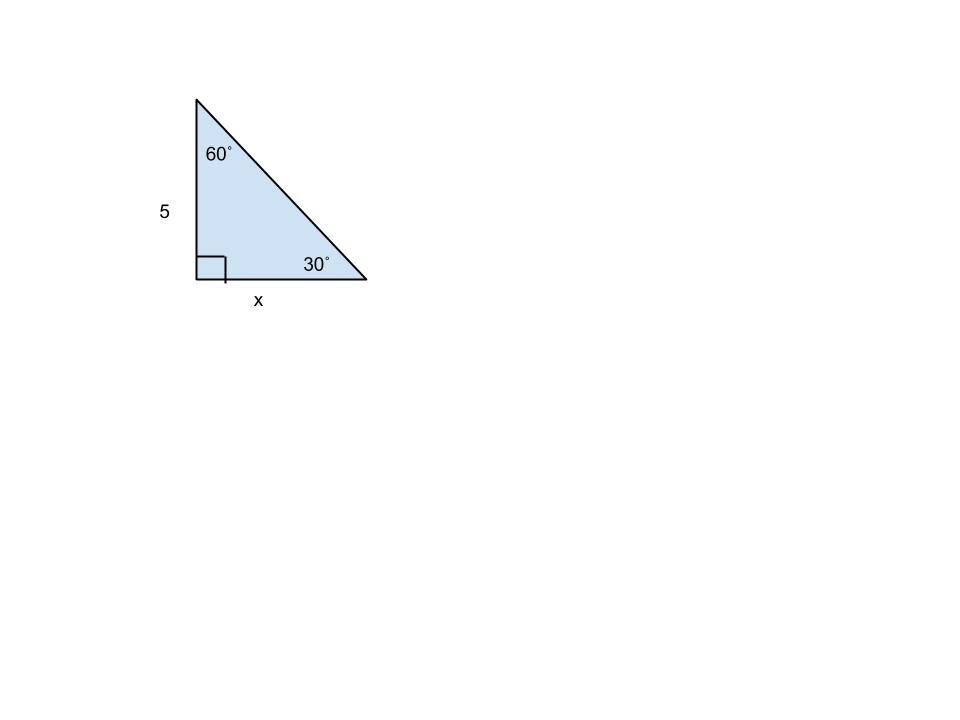
Given the diagram, indicate if Quantity A is larger, Quantity B is larger, if they are equal, or if there is not enough information given to determine the relationship.
Quantity A: x
Quantity B: 7.5
Tap to reveal answer
Since this is a 30-60-90 triangle, we know that the length of the side opposite the 60 degree angle is $\sqrt{3}$ times the side opposite the 30 degree angle. Thus, 5$\sqrt{3}$, which is about 8.66. This is larger than 7.5.
Since this is a 30-60-90 triangle, we know that the length of the side opposite the 60 degree angle is $\sqrt{3}$ times the side opposite the 30 degree angle. Thus, 5$\sqrt{3}$, which is about 8.66. This is larger than 7.5.
← Didn't Know|Knew It →
A right triangle's perimeter is 3+$\sqrt{3}$. The other two angles of the triangle are 30 degrees and 60 degrees.
Quantity A: The triangle's hypotenuse length
Quantity B: 2
A right triangle's perimeter is 3+$\sqrt{3}$. The other two angles of the triangle are 30 degrees and 60 degrees.
Quantity A: The triangle's hypotenuse length
Quantity B: 2
Tap to reveal answer
The ratio of the sides of a 30-60-90 triangle is x:x{$\sqrt{3}$}:2x, with the hypotenuse being 2x. Thus, the perimeter of this triangle would be x+x$\sqrt{3}$+2x=3x$\sqrt{3}$. Since the triangle depicted in this problem has a perimeter of 3$\sqrt{3}$, x must equal 1, which would make the hypotenuse equal to 2.
The ratio of the sides of a 30-60-90 triangle is x:x{$\sqrt{3}$}:2x, with the hypotenuse being 2x. Thus, the perimeter of this triangle would be x+x$\sqrt{3}$+2x=3x$\sqrt{3}$. Since the triangle depicted in this problem has a perimeter of 3$\sqrt{3}$, x must equal 1, which would make the hypotenuse equal to 2.
← Didn't Know|Knew It →
If the shortest side of a right triangle has length  and its hypotenuse has length
  , what is the length of the remaining side?
If the shortest side of a right triangle has length
Tap to reveal answer
Use the Pythagorean theorem, $a^2$ + $b^2$ = $c^2$ , with a=x-4 and c=x+4, and solve for b.
$(x-4)^2$ + $b^2$ = $(x+4)^2$
Rearrange to isolate $b^{2}$:
$b^2$ = $(x+4)^2$ - $(x-4)^2$
$b^2$ = (x+4)(x+4) - (x-4)(x-4)
Use FOIL to multiply out:
$b^2$ = $(x^2$ + 8x + 16) - $(x^2$ - 8x + 16)
Distribute the minus sign to rewrite without parentheses:
$b^2$ = $x^2$ + 8x + 16 - $x^2$ + 8x - 16
Combine like terms:
$b^2$ = 16x
Take the square root of both sides:
b = 4$\sqrt{x}$
Use the Pythagorean theorem, $a^2$ + $b^2$ = $c^2$ , with a=x-4 and c=x+4, and solve for b.
$(x-4)^2$ + $b^2$ = $(x+4)^2$
Rearrange to isolate $b^{2}$:
$b^2$ = $(x+4)^2$ - $(x-4)^2$
$b^2$ = (x+4)(x+4) - (x-4)(x-4)
Use FOIL to multiply out:
$b^2$ = $(x^2$ + 8x + 16) - $(x^2$ - 8x + 16)
Distribute the minus sign to rewrite without parentheses:
$b^2$ = $x^2$ + 8x + 16 - $x^2$ + 8x - 16
Combine like terms:
$b^2$ = 16x
Take the square root of both sides:
b = 4$\sqrt{x}$
← Didn't Know|Knew It →
Given the following triangle, what is the length of the unknown side?
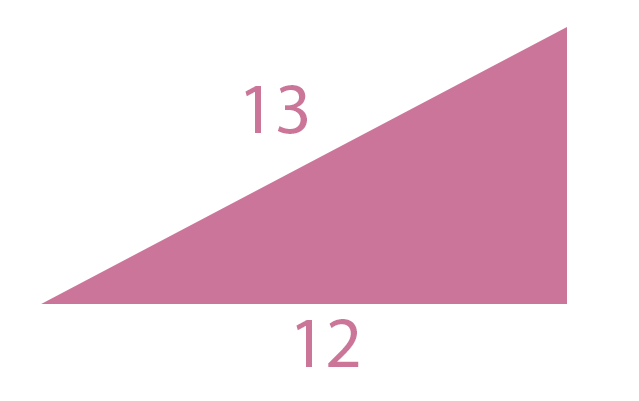
Given the following triangle, what is the length of the unknown side?
Tap to reveal answer
At first sight, it's tempting to assume this is a right triangle and to thus use the Pythagorean Theorem to find a length of 5 for the missing side.
However, the triangle was not stated to be a right triangle in the problem statement, and no indication was given in the drawing to indicate that it was a right triangle either, such as a square demarcation in the vertex opposite the side measuring 13.
Thus there is not enough information to give the length of the missing side. When taking standardized math tests, be careful making assumptions about information that is not given.
At first sight, it's tempting to assume this is a right triangle and to thus use the Pythagorean Theorem to find a length of 5 for the missing side.
However, the triangle was not stated to be a right triangle in the problem statement, and no indication was given in the drawing to indicate that it was a right triangle either, such as a square demarcation in the vertex opposite the side measuring 13.
Thus there is not enough information to give the length of the missing side. When taking standardized math tests, be careful making assumptions about information that is not given.
← Didn't Know|Knew It →
2 triangles are similar
Triangle 1 has sides 6, 8, 10
Triangle 2 has sides 5 , 3, x
find x
2 triangles are similar
Triangle 1 has sides 6, 8, 10
Triangle 2 has sides 5 , 3, x
find x
Tap to reveal answer
Draw the triangles
Triangle 1 is a 6,8,10 right triangle with 10 as the hypotenuse
Triangle 2: 3 is half of 6, 5 is half of 10; x must be half of 8
Draw the triangles
Triangle 1 is a 6,8,10 right triangle with 10 as the hypotenuse
Triangle 2: 3 is half of 6, 5 is half of 10; x must be half of 8
← Didn't Know|Knew It →
Given the diagram, indicate if Quantity A is larger, Quantity B is larger, if they are equal, or if there is not enough information given to determine the relationship.
Quantity A: x
Quantity B: 7.5
Given the diagram, indicate if Quantity A is larger, Quantity B is larger, if they are equal, or if there is not enough information given to determine the relationship.
Quantity A: x
Quantity B: 7.5
Tap to reveal answer
Since this is a 30-60-90 triangle, we know that the length of the side opposite the 60 degree angle is $\sqrt{3}$ times the side opposite the 30 degree angle. Thus, 5$\sqrt{3}$, which is about 8.66. This is larger than 7.5.
Since this is a 30-60-90 triangle, we know that the length of the side opposite the 60 degree angle is $\sqrt{3}$ times the side opposite the 30 degree angle. Thus, 5$\sqrt{3}$, which is about 8.66. This is larger than 7.5.
← Didn't Know|Knew It →
A right triangle's perimeter is 3+$\sqrt{3}$. The other two angles of the triangle are 30 degrees and 60 degrees.
Quantity A: The triangle's hypotenuse length
Quantity B: 2
A right triangle's perimeter is 3+$\sqrt{3}$. The other two angles of the triangle are 30 degrees and 60 degrees.
Quantity A: The triangle's hypotenuse length
Quantity B: 2
Tap to reveal answer
The ratio of the sides of a 30-60-90 triangle is x:x{$\sqrt{3}$}:2x, with the hypotenuse being 2x. Thus, the perimeter of this triangle would be x+x$\sqrt{3}$+2x=3x$\sqrt{3}$. Since the triangle depicted in this problem has a perimeter of 3$\sqrt{3}$, x must equal 1, which would make the hypotenuse equal to 2.
The ratio of the sides of a 30-60-90 triangle is x:x{$\sqrt{3}$}:2x, with the hypotenuse being 2x. Thus, the perimeter of this triangle would be x+x$\sqrt{3}$+2x=3x$\sqrt{3}$. Since the triangle depicted in this problem has a perimeter of 3$\sqrt{3}$, x must equal 1, which would make the hypotenuse equal to 2.
← Didn't Know|Knew It →
If the shortest side of a right triangle has length and its hypotenuse has length , what is the length of the remaining side?
If the shortest side of a right triangle has length
Tap to reveal answer
Use the Pythagorean theorem, $a^2$ + $b^2$ = $c^2$ , with a=x-4 and c=x+4, and solve for b.
$(x-4)^2$ + $b^2$ = $(x+4)^2$
Rearrange to isolate $b^{2}$:
$b^2$ = $(x+4)^2$ - $(x-4)^2$
$b^2$ = (x+4)(x+4) - (x-4)(x-4)
Use FOIL to multiply out:
$b^2$ = $(x^2$ + 8x + 16) - $(x^2$ - 8x + 16)
Distribute the minus sign to rewrite without parentheses:
$b^2$ = $x^2$ + 8x + 16 - $x^2$ + 8x - 16
Combine like terms:
$b^2$ = 16x
Take the square root of both sides:
b = 4$\sqrt{x}$
Use the Pythagorean theorem, $a^2$ + $b^2$ = $c^2$ , with a=x-4 and c=x+4, and solve for b.
$(x-4)^2$ + $b^2$ = $(x+4)^2$
Rearrange to isolate $b^{2}$:
$b^2$ = $(x+4)^2$ - $(x-4)^2$
$b^2$ = (x+4)(x+4) - (x-4)(x-4)
Use FOIL to multiply out:
$b^2$ = $(x^2$ + 8x + 16) - $(x^2$ - 8x + 16)
Distribute the minus sign to rewrite without parentheses:
$b^2$ = $x^2$ + 8x + 16 - $x^2$ + 8x - 16
Combine like terms:
$b^2$ = 16x
Take the square root of both sides:
b = 4$\sqrt{x}$
← Didn't Know|Knew It →
Given the following triangle, what is the length of the unknown side?
Given the following triangle, what is the length of the unknown side?
Tap to reveal answer
At first sight, it's tempting to assume this is a right triangle and to thus use the Pythagorean Theorem to find a length of 5 for the missing side.
However, the triangle was not stated to be a right triangle in the problem statement, and no indication was given in the drawing to indicate that it was a right triangle either, such as a square demarcation in the vertex opposite the side measuring 13.
Thus there is not enough information to give the length of the missing side. When taking standardized math tests, be careful making assumptions about information that is not given.
At first sight, it's tempting to assume this is a right triangle and to thus use the Pythagorean Theorem to find a length of 5 for the missing side.
However, the triangle was not stated to be a right triangle in the problem statement, and no indication was given in the drawing to indicate that it was a right triangle either, such as a square demarcation in the vertex opposite the side measuring 13.
Thus there is not enough information to give the length of the missing side. When taking standardized math tests, be careful making assumptions about information that is not given.
← Didn't Know|Knew It →
2 triangles are similar
Triangle 1 has sides 6, 8, 10
Triangle 2 has sides 5 , 3, x
find x
2 triangles are similar
Triangle 1 has sides 6, 8, 10
Triangle 2 has sides 5 , 3, x
find x
Tap to reveal answer
Draw the triangles
Triangle 1 is a 6,8,10 right triangle with 10 as the hypotenuse
Triangle 2: 3 is half of 6, 5 is half of 10; x must be half of 8
Draw the triangles
Triangle 1 is a 6,8,10 right triangle with 10 as the hypotenuse
Triangle 2: 3 is half of 6, 5 is half of 10; x must be half of 8
← Didn't Know|Knew It →
Given the diagram, indicate if Quantity A is larger, Quantity B is larger, if they are equal, or if there is not enough information given to determine the relationship.
Quantity A: x
Quantity B: 7.5
Given the diagram, indicate if Quantity A is larger, Quantity B is larger, if they are equal, or if there is not enough information given to determine the relationship.
Quantity A: x
Quantity B: 7.5
Tap to reveal answer
Since this is a 30-60-90 triangle, we know that the length of the side opposite the 60 degree angle is $\sqrt{3}$ times the side opposite the 30 degree angle. Thus, 5$\sqrt{3}$, which is about 8.66. This is larger than 7.5.
Since this is a 30-60-90 triangle, we know that the length of the side opposite the 60 degree angle is $\sqrt{3}$ times the side opposite the 30 degree angle. Thus, 5$\sqrt{3}$, which is about 8.66. This is larger than 7.5.
← Didn't Know|Knew It →
A right triangle's perimeter is 3+$\sqrt{3}$. The other two angles of the triangle are 30 degrees and 60 degrees.
Quantity A: The triangle's hypotenuse length
Quantity B: 2
A right triangle's perimeter is 3+$\sqrt{3}$. The other two angles of the triangle are 30 degrees and 60 degrees.
Quantity A: The triangle's hypotenuse length
Quantity B: 2
Tap to reveal answer
The ratio of the sides of a 30-60-90 triangle is x:x{$\sqrt{3}$}:2x, with the hypotenuse being 2x. Thus, the perimeter of this triangle would be x+x$\sqrt{3}$+2x=3x$\sqrt{3}$. Since the triangle depicted in this problem has a perimeter of 3$\sqrt{3}$, x must equal 1, which would make the hypotenuse equal to 2.
The ratio of the sides of a 30-60-90 triangle is x:x{$\sqrt{3}$}:2x, with the hypotenuse being 2x. Thus, the perimeter of this triangle would be x+x$\sqrt{3}$+2x=3x$\sqrt{3}$. Since the triangle depicted in this problem has a perimeter of 3$\sqrt{3}$, x must equal 1, which would make the hypotenuse equal to 2.
← Didn't Know|Knew It →
If the shortest side of a right triangle has length and its hypotenuse has length , what is the length of the remaining side?
If the shortest side of a right triangle has length
Tap to reveal answer
Use the Pythagorean theorem, $a^2$ + $b^2$ = $c^2$ , with a=x-4 and c=x+4, and solve for b.
$(x-4)^2$ + $b^2$ = $(x+4)^2$
Rearrange to isolate $b^{2}$:
$b^2$ = $(x+4)^2$ - $(x-4)^2$
$b^2$ = (x+4)(x+4) - (x-4)(x-4)
Use FOIL to multiply out:
$b^2$ = $(x^2$ + 8x + 16) - $(x^2$ - 8x + 16)
Distribute the minus sign to rewrite without parentheses:
$b^2$ = $x^2$ + 8x + 16 - $x^2$ + 8x - 16
Combine like terms:
$b^2$ = 16x
Take the square root of both sides:
b = 4$\sqrt{x}$
Use the Pythagorean theorem, $a^2$ + $b^2$ = $c^2$ , with a=x-4 and c=x+4, and solve for b.
$(x-4)^2$ + $b^2$ = $(x+4)^2$
Rearrange to isolate $b^{2}$:
$b^2$ = $(x+4)^2$ - $(x-4)^2$
$b^2$ = (x+4)(x+4) - (x-4)(x-4)
Use FOIL to multiply out:
$b^2$ = $(x^2$ + 8x + 16) - $(x^2$ - 8x + 16)
Distribute the minus sign to rewrite without parentheses:
$b^2$ = $x^2$ + 8x + 16 - $x^2$ + 8x - 16
Combine like terms:
$b^2$ = 16x
Take the square root of both sides:
b = 4$\sqrt{x}$
← Didn't Know|Knew It →
Given the following triangle, what is the length of the unknown side?
Given the following triangle, what is the length of the unknown side?
Tap to reveal answer
At first sight, it's tempting to assume this is a right triangle and to thus use the Pythagorean Theorem to find a length of 5 for the missing side.
However, the triangle was not stated to be a right triangle in the problem statement, and no indication was given in the drawing to indicate that it was a right triangle either, such as a square demarcation in the vertex opposite the side measuring 13.
Thus there is not enough information to give the length of the missing side. When taking standardized math tests, be careful making assumptions about information that is not given.
At first sight, it's tempting to assume this is a right triangle and to thus use the Pythagorean Theorem to find a length of 5 for the missing side.
However, the triangle was not stated to be a right triangle in the problem statement, and no indication was given in the drawing to indicate that it was a right triangle either, such as a square demarcation in the vertex opposite the side measuring 13.
Thus there is not enough information to give the length of the missing side. When taking standardized math tests, be careful making assumptions about information that is not given.
← Didn't Know|Knew It →
2 triangles are similar
Triangle 1 has sides 6, 8, 10
Triangle 2 has sides 5 , 3, x
find x
2 triangles are similar
Triangle 1 has sides 6, 8, 10
Triangle 2 has sides 5 , 3, x
find x
Tap to reveal answer
Draw the triangles
Triangle 1 is a 6,8,10 right triangle with 10 as the hypotenuse
Triangle 2: 3 is half of 6, 5 is half of 10; x must be half of 8
Draw the triangles
Triangle 1 is a 6,8,10 right triangle with 10 as the hypotenuse
Triangle 2: 3 is half of 6, 5 is half of 10; x must be half of 8
← Didn't Know|Knew It →
Given the diagram, indicate if Quantity A is larger, Quantity B is larger, if they are equal, or if there is not enough information given to determine the relationship.
Quantity A: x
Quantity B: 7.5
Given the diagram, indicate if Quantity A is larger, Quantity B is larger, if they are equal, or if there is not enough information given to determine the relationship.
Quantity A: x
Quantity B: 7.5
Tap to reveal answer
Since this is a 30-60-90 triangle, we know that the length of the side opposite the 60 degree angle is $\sqrt{3}$ times the side opposite the 30 degree angle. Thus, 5$\sqrt{3}$, which is about 8.66. This is larger than 7.5.
Since this is a 30-60-90 triangle, we know that the length of the side opposite the 60 degree angle is $\sqrt{3}$ times the side opposite the 30 degree angle. Thus, 5$\sqrt{3}$, which is about 8.66. This is larger than 7.5.
← Didn't Know|Knew It →
A right triangle's perimeter is 3+$\sqrt{3}$. The other two angles of the triangle are 30 degrees and 60 degrees.
Quantity A: The triangle's hypotenuse length
Quantity B: 2
A right triangle's perimeter is 3+$\sqrt{3}$. The other two angles of the triangle are 30 degrees and 60 degrees.
Quantity A: The triangle's hypotenuse length
Quantity B: 2
Tap to reveal answer
The ratio of the sides of a 30-60-90 triangle is x:x{$\sqrt{3}$}:2x, with the hypotenuse being 2x. Thus, the perimeter of this triangle would be x+x$\sqrt{3}$+2x=3x$\sqrt{3}$. Since the triangle depicted in this problem has a perimeter of 3$\sqrt{3}$, x must equal 1, which would make the hypotenuse equal to 2.
The ratio of the sides of a 30-60-90 triangle is x:x{$\sqrt{3}$}:2x, with the hypotenuse being 2x. Thus, the perimeter of this triangle would be x+x$\sqrt{3}$+2x=3x$\sqrt{3}$. Since the triangle depicted in this problem has a perimeter of 3$\sqrt{3}$, x must equal 1, which would make the hypotenuse equal to 2.
← Didn't Know|Knew It →
If the shortest side of a right triangle has length and its hypotenuse has length , what is the length of the remaining side?
If the shortest side of a right triangle has length
Tap to reveal answer
Use the Pythagorean theorem, $a^2$ + $b^2$ = $c^2$ , with a=x-4 and c=x+4, and solve for b.
$(x-4)^2$ + $b^2$ = $(x+4)^2$
Rearrange to isolate $b^{2}$:
$b^2$ = $(x+4)^2$ - $(x-4)^2$
$b^2$ = (x+4)(x+4) - (x-4)(x-4)
Use FOIL to multiply out:
$b^2$ = $(x^2$ + 8x + 16) - $(x^2$ - 8x + 16)
Distribute the minus sign to rewrite without parentheses:
$b^2$ = $x^2$ + 8x + 16 - $x^2$ + 8x - 16
Combine like terms:
$b^2$ = 16x
Take the square root of both sides:
b = 4$\sqrt{x}$
Use the Pythagorean theorem, $a^2$ + $b^2$ = $c^2$ , with a=x-4 and c=x+4, and solve for b.
$(x-4)^2$ + $b^2$ = $(x+4)^2$
Rearrange to isolate $b^{2}$:
$b^2$ = $(x+4)^2$ - $(x-4)^2$
$b^2$ = (x+4)(x+4) - (x-4)(x-4)
Use FOIL to multiply out:
$b^2$ = $(x^2$ + 8x + 16) - $(x^2$ - 8x + 16)
Distribute the minus sign to rewrite without parentheses:
$b^2$ = $x^2$ + 8x + 16 - $x^2$ + 8x - 16
Combine like terms:
$b^2$ = 16x
Take the square root of both sides:
b = 4$\sqrt{x}$
← Didn't Know|Knew It →
Given the following triangle, what is the length of the unknown side?
Given the following triangle, what is the length of the unknown side?
Tap to reveal answer
At first sight, it's tempting to assume this is a right triangle and to thus use the Pythagorean Theorem to find a length of 5 for the missing side.
However, the triangle was not stated to be a right triangle in the problem statement, and no indication was given in the drawing to indicate that it was a right triangle either, such as a square demarcation in the vertex opposite the side measuring 13.
Thus there is not enough information to give the length of the missing side. When taking standardized math tests, be careful making assumptions about information that is not given.
At first sight, it's tempting to assume this is a right triangle and to thus use the Pythagorean Theorem to find a length of 5 for the missing side.
However, the triangle was not stated to be a right triangle in the problem statement, and no indication was given in the drawing to indicate that it was a right triangle either, such as a square demarcation in the vertex opposite the side measuring 13.
Thus there is not enough information to give the length of the missing side. When taking standardized math tests, be careful making assumptions about information that is not given.
← Didn't Know|Knew It →