How to find the area of a right triangle - GRE Quantitative Reasoning
Card 1 of 48
Quantitative Comparison
Column A
Area
Column B
Perimeter
Quantitative Comparison
Column A
Area
Column B
Perimeter
Tap to reveal answer
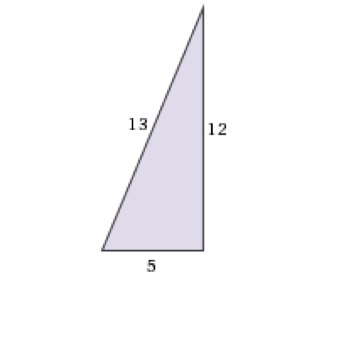
To find the perimeter, add up the sides, here 5 + 12 + 13 = 30. To find the area, multiply the two legs together and divide by 2, here (5 * 12)/2 = 30.
To find the perimeter, add up the sides, here 5 + 12 + 13 = 30. To find the area, multiply the two legs together and divide by 2, here (5 * 12)/2 = 30.
← Didn't Know|Knew It →
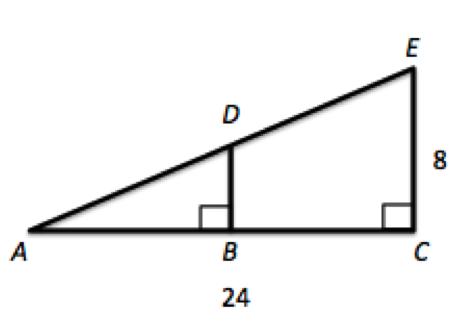
Given triangle ACE where B is the midpoint of AC, what is the area of triangle ABD?
Given triangle ACE where B is the midpoint of AC, what is the area of triangle ABD?
Tap to reveal answer
If B is a midpoint of AC, then we know AB is 12. Moreover, triangles ACE and ABD share angle DAB and have right angles which makes them similar triangles. Thus, their sides will all be proportional, and BD is 4. 1/2bh gives us 1/2 * 12 * 4, or 24.
If B is a midpoint of AC, then we know AB is 12. Moreover, triangles ACE and ABD share angle DAB and have right angles which makes them similar triangles. Thus, their sides will all be proportional, and BD is 4. 1/2bh gives us 1/2 * 12 * 4, or 24.
← Didn't Know|Knew It →
What is the area of a right triangle with hypotenuse of 13 and base of 12?
What is the area of a right triangle with hypotenuse of 13 and base of 12?
Tap to reveal answer
Area = 1/2(base)(height). You could use Pythagorean theorem to find the height or, if you know the special right triangles, recognize the 5-12-13. The area = 1/2(12)(5) = 30.
Area = 1/2(base)(height). You could use Pythagorean theorem to find the height or, if you know the special right triangles, recognize the 5-12-13. The area = 1/2(12)(5) = 30.
← Didn't Know|Knew It →
Quantitative Comparison
Quantity A: the area of a right triangle with sides 10, 24, 26
Quantity B: twice the area of a right triangle with sides 5, 12, 13
Quantitative Comparison
Quantity A: the area of a right triangle with sides 10, 24, 26
Quantity B: twice the area of a right triangle with sides 5, 12, 13
Tap to reveal answer
Quantity A: area = base * height / 2 = 10 * 24 / 2 = 120
Quantity B: 2 * area = 2 * base * height / 2 = base * height = 5 * 12 = 60
Therefore Quantity A is greater.
Quantity A: area = base * height / 2 = 10 * 24 / 2 = 120
Quantity B: 2 * area = 2 * base * height / 2 = base * height = 5 * 12 = 60
Therefore Quantity A is greater.
← Didn't Know|Knew It →
Quantitative Comparison
Quantity A: The area of a triangle with a height of 6 and a base of 7
Quantity B: Half the area of a trapezoid with a height of 6, a base of 6, and another base of 10
Quantitative Comparison
Quantity A: The area of a triangle with a height of 6 and a base of 7
Quantity B: Half the area of a trapezoid with a height of 6, a base of 6, and another base of 10
Tap to reveal answer
Quantity A: Area = 1/2 * b * h = 1/2 * 6 * 7 = 42/2 = 21
Quantity B: Area = 1/2 * (_b_1 + _b_2) * h = 1/2 * (6 + 10) * 6 = 48
Half of the area = 48/2 = 24
Quantity B is greater.
Quantity A: Area = 1/2 * b * h = 1/2 * 6 * 7 = 42/2 = 21
Quantity B: Area = 1/2 * (_b_1 + _b_2) * h = 1/2 * (6 + 10) * 6 = 48
Half of the area = 48/2 = 24
Quantity B is greater.
← Didn't Know|Knew It →
The radius of the circle is 2. What is the area of the shaded equilateral triangle?
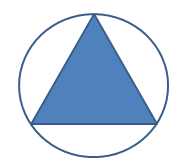
The radius of the circle is 2. What is the area of the shaded equilateral triangle?
Tap to reveal answer
This is easier to see when the triangle is divided into six parts (blue). Each one contains an angle which is half of 120 degrees and contains a 90 degree angle. This means each triangle is a 30/60/90 triangle with its long side equal to the radius of the circle. Knowing that means that the height of each triangle is $\frac{rsqrt{3}$}{2} and the base is $\frac{r}{2}$.
Applying $\frac{bh}{2}$ and multiplying by 6 gives 3$\sqrt{3}$).
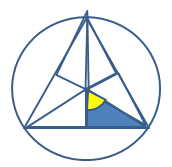
This is easier to see when the triangle is divided into six parts (blue). Each one contains an angle which is half of 120 degrees and contains a 90 degree angle. This means each triangle is a 30/60/90 triangle with its long side equal to the radius of the circle. Knowing that means that the height of each triangle is $\frac{rsqrt{3}$}{2} and the base is $\frac{r}{2}$.
Applying $\frac{bh}{2}$ and multiplying by 6 gives 3$\sqrt{3}$).
← Didn't Know|Knew It →
Quantitative Comparison
Column A
Area
Column B
Perimeter
Quantitative Comparison
Column A
Area
Column B
Perimeter
Tap to reveal answer
To find the perimeter, add up the sides, here 5 + 12 + 13 = 30. To find the area, multiply the two legs together and divide by 2, here (5 * 12)/2 = 30.
To find the perimeter, add up the sides, here 5 + 12 + 13 = 30. To find the area, multiply the two legs together and divide by 2, here (5 * 12)/2 = 30.
← Didn't Know|Knew It →
Given triangle ACE where B is the midpoint of AC, what is the area of triangle ABD?
Given triangle ACE where B is the midpoint of AC, what is the area of triangle ABD?
Tap to reveal answer
If B is a midpoint of AC, then we know AB is 12. Moreover, triangles ACE and ABD share angle DAB and have right angles which makes them similar triangles. Thus, their sides will all be proportional, and BD is 4. 1/2bh gives us 1/2 * 12 * 4, or 24.
If B is a midpoint of AC, then we know AB is 12. Moreover, triangles ACE and ABD share angle DAB and have right angles which makes them similar triangles. Thus, their sides will all be proportional, and BD is 4. 1/2bh gives us 1/2 * 12 * 4, or 24.
← Didn't Know|Knew It →
What is the area of a right triangle with hypotenuse of 13 and base of 12?
What is the area of a right triangle with hypotenuse of 13 and base of 12?
Tap to reveal answer
Area = 1/2(base)(height). You could use Pythagorean theorem to find the height or, if you know the special right triangles, recognize the 5-12-13. The area = 1/2(12)(5) = 30.
Area = 1/2(base)(height). You could use Pythagorean theorem to find the height or, if you know the special right triangles, recognize the 5-12-13. The area = 1/2(12)(5) = 30.
← Didn't Know|Knew It →
Quantitative Comparison
Quantity A: the area of a right triangle with sides 10, 24, 26
Quantity B: twice the area of a right triangle with sides 5, 12, 13
Quantitative Comparison
Quantity A: the area of a right triangle with sides 10, 24, 26
Quantity B: twice the area of a right triangle with sides 5, 12, 13
Tap to reveal answer
Quantity A: area = base * height / 2 = 10 * 24 / 2 = 120
Quantity B: 2 * area = 2 * base * height / 2 = base * height = 5 * 12 = 60
Therefore Quantity A is greater.
Quantity A: area = base * height / 2 = 10 * 24 / 2 = 120
Quantity B: 2 * area = 2 * base * height / 2 = base * height = 5 * 12 = 60
Therefore Quantity A is greater.
← Didn't Know|Knew It →
Quantitative Comparison
Quantity A: The area of a triangle with a height of 6 and a base of 7
Quantity B: Half the area of a trapezoid with a height of 6, a base of 6, and another base of 10
Quantitative Comparison
Quantity A: The area of a triangle with a height of 6 and a base of 7
Quantity B: Half the area of a trapezoid with a height of 6, a base of 6, and another base of 10
Tap to reveal answer
Quantity A: Area = 1/2 * b * h = 1/2 * 6 * 7 = 42/2 = 21
Quantity B: Area = 1/2 * (_b_1 + _b_2) * h = 1/2 * (6 + 10) * 6 = 48
Half of the area = 48/2 = 24
Quantity B is greater.
Quantity A: Area = 1/2 * b * h = 1/2 * 6 * 7 = 42/2 = 21
Quantity B: Area = 1/2 * (_b_1 + _b_2) * h = 1/2 * (6 + 10) * 6 = 48
Half of the area = 48/2 = 24
Quantity B is greater.
← Didn't Know|Knew It →
The radius of the circle is 2. What is the area of the shaded equilateral triangle?
The radius of the circle is 2. What is the area of the shaded equilateral triangle?
Tap to reveal answer
This is easier to see when the triangle is divided into six parts (blue). Each one contains an angle which is half of 120 degrees and contains a 90 degree angle. This means each triangle is a 30/60/90 triangle with its long side equal to the radius of the circle. Knowing that means that the height of each triangle is $\frac{rsqrt{3}$}{2} and the base is $\frac{r}{2}$.
Applying $\frac{bh}{2}$ and multiplying by 6 gives 3$\sqrt{3}$).
This is easier to see when the triangle is divided into six parts (blue). Each one contains an angle which is half of 120 degrees and contains a 90 degree angle. This means each triangle is a 30/60/90 triangle with its long side equal to the radius of the circle. Knowing that means that the height of each triangle is $\frac{rsqrt{3}$}{2} and the base is $\frac{r}{2}$.
Applying $\frac{bh}{2}$ and multiplying by 6 gives 3$\sqrt{3}$).
← Didn't Know|Knew It →
Quantitative Comparison
Column A
Area
Column B
Perimeter
Quantitative Comparison
Column A
Area
Column B
Perimeter
Tap to reveal answer
To find the perimeter, add up the sides, here 5 + 12 + 13 = 30. To find the area, multiply the two legs together and divide by 2, here (5 * 12)/2 = 30.
To find the perimeter, add up the sides, here 5 + 12 + 13 = 30. To find the area, multiply the two legs together and divide by 2, here (5 * 12)/2 = 30.
← Didn't Know|Knew It →
Given triangle ACE where B is the midpoint of AC, what is the area of triangle ABD?
Given triangle ACE where B is the midpoint of AC, what is the area of triangle ABD?
Tap to reveal answer
If B is a midpoint of AC, then we know AB is 12. Moreover, triangles ACE and ABD share angle DAB and have right angles which makes them similar triangles. Thus, their sides will all be proportional, and BD is 4. 1/2bh gives us 1/2 * 12 * 4, or 24.
If B is a midpoint of AC, then we know AB is 12. Moreover, triangles ACE and ABD share angle DAB and have right angles which makes them similar triangles. Thus, their sides will all be proportional, and BD is 4. 1/2bh gives us 1/2 * 12 * 4, or 24.
← Didn't Know|Knew It →
What is the area of a right triangle with hypotenuse of 13 and base of 12?
What is the area of a right triangle with hypotenuse of 13 and base of 12?
Tap to reveal answer
Area = 1/2(base)(height). You could use Pythagorean theorem to find the height or, if you know the special right triangles, recognize the 5-12-13. The area = 1/2(12)(5) = 30.
Area = 1/2(base)(height). You could use Pythagorean theorem to find the height or, if you know the special right triangles, recognize the 5-12-13. The area = 1/2(12)(5) = 30.
← Didn't Know|Knew It →
Quantitative Comparison
Quantity A: the area of a right triangle with sides 10, 24, 26
Quantity B: twice the area of a right triangle with sides 5, 12, 13
Quantitative Comparison
Quantity A: the area of a right triangle with sides 10, 24, 26
Quantity B: twice the area of a right triangle with sides 5, 12, 13
Tap to reveal answer
Quantity A: area = base * height / 2 = 10 * 24 / 2 = 120
Quantity B: 2 * area = 2 * base * height / 2 = base * height = 5 * 12 = 60
Therefore Quantity A is greater.
Quantity A: area = base * height / 2 = 10 * 24 / 2 = 120
Quantity B: 2 * area = 2 * base * height / 2 = base * height = 5 * 12 = 60
Therefore Quantity A is greater.
← Didn't Know|Knew It →
Quantitative Comparison
Quantity A: The area of a triangle with a height of 6 and a base of 7
Quantity B: Half the area of a trapezoid with a height of 6, a base of 6, and another base of 10
Quantitative Comparison
Quantity A: The area of a triangle with a height of 6 and a base of 7
Quantity B: Half the area of a trapezoid with a height of 6, a base of 6, and another base of 10
Tap to reveal answer
Quantity A: Area = 1/2 * b * h = 1/2 * 6 * 7 = 42/2 = 21
Quantity B: Area = 1/2 * (_b_1 + _b_2) * h = 1/2 * (6 + 10) * 6 = 48
Half of the area = 48/2 = 24
Quantity B is greater.
Quantity A: Area = 1/2 * b * h = 1/2 * 6 * 7 = 42/2 = 21
Quantity B: Area = 1/2 * (_b_1 + _b_2) * h = 1/2 * (6 + 10) * 6 = 48
Half of the area = 48/2 = 24
Quantity B is greater.
← Didn't Know|Knew It →
The radius of the circle is 2. What is the area of the shaded equilateral triangle?
The radius of the circle is 2. What is the area of the shaded equilateral triangle?
Tap to reveal answer
This is easier to see when the triangle is divided into six parts (blue). Each one contains an angle which is half of 120 degrees and contains a 90 degree angle. This means each triangle is a 30/60/90 triangle with its long side equal to the radius of the circle. Knowing that means that the height of each triangle is $\frac{rsqrt{3}$}{2} and the base is $\frac{r}{2}$.
Applying $\frac{bh}{2}$ and multiplying by 6 gives 3$\sqrt{3}$).
This is easier to see when the triangle is divided into six parts (blue). Each one contains an angle which is half of 120 degrees and contains a 90 degree angle. This means each triangle is a 30/60/90 triangle with its long side equal to the radius of the circle. Knowing that means that the height of each triangle is $\frac{rsqrt{3}$}{2} and the base is $\frac{r}{2}$.
Applying $\frac{bh}{2}$ and multiplying by 6 gives 3$\sqrt{3}$).
← Didn't Know|Knew It →
Quantitative Comparison
Column A
Area
Column B
Perimeter
Quantitative Comparison
Column A
Area
Column B
Perimeter
Tap to reveal answer
To find the perimeter, add up the sides, here 5 + 12 + 13 = 30. To find the area, multiply the two legs together and divide by 2, here (5 * 12)/2 = 30.
To find the perimeter, add up the sides, here 5 + 12 + 13 = 30. To find the area, multiply the two legs together and divide by 2, here (5 * 12)/2 = 30.
← Didn't Know|Knew It →
Given triangle ACE where B is the midpoint of AC, what is the area of triangle ABD?
Given triangle ACE where B is the midpoint of AC, what is the area of triangle ABD?
Tap to reveal answer
If B is a midpoint of AC, then we know AB is 12. Moreover, triangles ACE and ABD share angle DAB and have right angles which makes them similar triangles. Thus, their sides will all be proportional, and BD is 4. 1/2bh gives us 1/2 * 12 * 4, or 24.
If B is a midpoint of AC, then we know AB is 12. Moreover, triangles ACE and ABD share angle DAB and have right angles which makes them similar triangles. Thus, their sides will all be proportional, and BD is 4. 1/2bh gives us 1/2 * 12 * 4, or 24.
← Didn't Know|Knew It →