How to find the amount of rational numbers between two numbers - GRE Quantitative Reasoning
Card 1 of 48
In terms of  , what is the arithmetic mean of
  ,
,  , and
, and  ?
?
In terms of
Tap to reveal answer
The arithmetic mean of a set is defined as the sum of terms in the set divided by the number of terms of a set. Therefore, the mean for this problem can be found as:

The arithmetic mean of a set is defined as the sum of terms in the set divided by the number of terms of a set. Therefore, the mean for this problem can be found as:
← Didn't Know|Knew It →

Quantity A: The average of the numbers above.
Quantity B: The median of the numbers above
Quantity A: The average of the numbers above.
Quantity B: The median of the numbers above
Tap to reveal answer
The average, or arithmetic mean, of a set can be found by dividing the sum of the set by the amount of values in the set:

The median for a set depends on if there's an even or odd number of values in the set.
For an odd number of values in a set that is arranged in numerical order,  , the median is given as the middle value,
  .
.
For an even number of values in a set that is again arranged in numerical order,  ,there is no value exactly in the middle; rather there are two. The median is then given as the average of these two values:
Rearranging the set into numerical order gives  , thus the median is
The average, or arithmetic mean, of a set can be found by dividing the sum of the set by the amount of values in the set:
The median for a set depends on if there's an even or odd number of values in the set.
For an odd number of values in a set that is arranged in numerical order,
For an even number of values in a set that is again arranged in numerical order,
Rearranging the set into numerical order gives
← Didn't Know|Knew It →
Harold is drawing numbered slips of paper from a hat that are labeled  through
  . What is the probability that he'll draw three numbers in a row that are divisible by three, given that a slip is not replaced after it is drawn?
Harold is drawing numbered slips of paper from a hat that are labeled
Tap to reveal answer
There are  slips of paper that have a number divisible by
  , which are
  .
.
The probability of one being drawn is  . Once that slip is drawn, the probability of drawing a number divisible by
  becomes
  , and on the third draw it is
  .
.
For this sequence of events to happen, the probability is the product of the three separate probabilities:

There are
The probability of one being drawn is
For this sequence of events to happen, the probability is the product of the three separate probabilities:
← Didn't Know|Knew It →
Happy Harold's Creamery offers specials during the week on particular sundaes. Monday they offer the Triple Trouble, in which three different scoops may be chosen from the full thirty-one that HHC offers. Tuesday features, for the same price, the Fearsome Four, which is a sundae of four scoops; however, only twenty-one flavors may be chosen from.
Quantity A: The amount of sundae options available for the Triple Trouble.
Quantity B: The amount of sundae options available for the Fearsome Four.
Happy Harold's Creamery offers specials during the week on particular sundaes. Monday they offer the Triple Trouble, in which three different scoops may be chosen from the full thirty-one that HHC offers. Tuesday features, for the same price, the Fearsome Four, which is a sundae of four scoops; however, only twenty-one flavors may be chosen from.
Quantity A: The amount of sundae options available for the Triple Trouble.
Quantity B: The amount of sundae options available for the Fearsome Four.
Tap to reveal answer
Both of these sundae options are dealing with combinations, i.e. the order the scoops are chosen does not matter, and so the amount of possible combos is given by the formula:
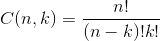
Where  is the total number of options and
  is the size of the combination created.
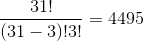
For the Triple Trouble, the total amount of possible sundaes is:
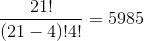
And for the Fearsome Four:
Both of these sundae options are dealing with combinations, i.e. the order the scoops are chosen does not matter, and so the amount of possible combos is given by the formula:
Where
For the Triple Trouble, the total amount of possible sundaes is:
And for the Fearsome Four:
← Didn't Know|Knew It →
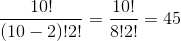
A shelf has  shirts, each a different pattern.
Quantity A: The total number of possible combinations of shirts if  shirts are drawn.
Quantity B: The total number of possible combinations of shirts if  shirts are drawn.
A shelf has
Quantity A: The total number of possible combinations of shirts if
Quantity B: The total number of possible combinations of shirts if
Tap to reveal answer
It is important to realize that this problem deals with combinations, rather than permutations; the order the shirts are drawn does not matter. That being said, the formula for a combination is given as:
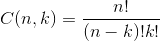
Where  is the total number of options and
  is the size of the combination created.
Quantity A:
Quantity B:
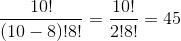
It is important to realize that this problem deals with combinations, rather than permutations; the order the shirts are drawn does not matter. That being said, the formula for a combination is given as:
Where
Quantity A:
Quantity B:
← Didn't Know|Knew It →
On a trip to his friend Leslie's house, Ron drives  miles per hour for
  hours and
  miles per hour for
  hours. What was his average speed in miles per hour for the trip?
On a trip to his friend Leslie's house, Ron drives
Tap to reveal answer
To solve this problem, you may find the total distance traveled and divide that by the total time taken. The distance traveled in miles is:

Since the trip took  hours in total, Ron's average speed in miles per hour is:

To solve this problem, you may find the total distance traveled and divide that by the total time taken. The distance traveled in miles is:
Since the trip took
← Didn't Know|Knew It →
In terms of , what is the arithmetic mean of , , and ?
In terms of
Tap to reveal answer
The arithmetic mean of a set is defined as the sum of terms in the set divided by the number of terms of a set. Therefore, the mean for this problem can be found as:
The arithmetic mean of a set is defined as the sum of terms in the set divided by the number of terms of a set. Therefore, the mean for this problem can be found as:
← Didn't Know|Knew It →
Quantity A: The average of the numbers above.
Quantity B: The median of the numbers above
Quantity A: The average of the numbers above.
Quantity B: The median of the numbers above
Tap to reveal answer
The average, or arithmetic mean, of a set can be found by dividing the sum of the set by the amount of values in the set:
The median for a set depends on if there's an even or odd number of values in the set.
For an odd number of values in a set that is arranged in numerical order, , the median is given as the middle value, .
For an even number of values in a set that is again arranged in numerical order, ,there is no value exactly in the middle; rather there are two. The median is then given as the average of these two values:
Rearranging the set into numerical order gives , thus the median is
The average, or arithmetic mean, of a set can be found by dividing the sum of the set by the amount of values in the set:
The median for a set depends on if there's an even or odd number of values in the set.
For an odd number of values in a set that is arranged in numerical order,
For an even number of values in a set that is again arranged in numerical order,
Rearranging the set into numerical order gives
← Didn't Know|Knew It →
Harold is drawing numbered slips of paper from a hat that are labeled through . What is the probability that he'll draw three numbers in a row that are divisible by three, given that a slip is not replaced after it is drawn?
Harold is drawing numbered slips of paper from a hat that are labeled
Tap to reveal answer
There are slips of paper that have a number divisible by , which are .
The probability of one being drawn is . Once that slip is drawn, the probability of drawing a number divisible by becomes , and on the third draw it is .
For this sequence of events to happen, the probability is the product of the three separate probabilities:
There are
The probability of one being drawn is
For this sequence of events to happen, the probability is the product of the three separate probabilities:
← Didn't Know|Knew It →
Happy Harold's Creamery offers specials during the week on particular sundaes. Monday they offer the Triple Trouble, in which three different scoops may be chosen from the full thirty-one that HHC offers. Tuesday features, for the same price, the Fearsome Four, which is a sundae of four scoops; however, only twenty-one flavors may be chosen from.
Quantity A: The amount of sundae options available for the Triple Trouble.
Quantity B: The amount of sundae options available for the Fearsome Four.
Happy Harold's Creamery offers specials during the week on particular sundaes. Monday they offer the Triple Trouble, in which three different scoops may be chosen from the full thirty-one that HHC offers. Tuesday features, for the same price, the Fearsome Four, which is a sundae of four scoops; however, only twenty-one flavors may be chosen from.
Quantity A: The amount of sundae options available for the Triple Trouble.
Quantity B: The amount of sundae options available for the Fearsome Four.
Tap to reveal answer
Both of these sundae options are dealing with combinations, i.e. the order the scoops are chosen does not matter, and so the amount of possible combos is given by the formula:
Where is the total number of options and is the size of the combination created.
For the Triple Trouble, the total amount of possible sundaes is:
And for the Fearsome Four:
Both of these sundae options are dealing with combinations, i.e. the order the scoops are chosen does not matter, and so the amount of possible combos is given by the formula:
Where
For the Triple Trouble, the total amount of possible sundaes is:
And for the Fearsome Four:
← Didn't Know|Knew It →
A shelf has shirts, each a different pattern.
Quantity A: The total number of possible combinations of shirts if shirts are drawn.
Quantity B: The total number of possible combinations of shirts if shirts are drawn.
A shelf has
Quantity A: The total number of possible combinations of shirts if
Quantity B: The total number of possible combinations of shirts if
Tap to reveal answer
It is important to realize that this problem deals with combinations, rather than permutations; the order the shirts are drawn does not matter. That being said, the formula for a combination is given as:
Where is the total number of options and is the size of the combination created.
Quantity A:
Quantity B:
It is important to realize that this problem deals with combinations, rather than permutations; the order the shirts are drawn does not matter. That being said, the formula for a combination is given as:
Where
Quantity A:
Quantity B:
← Didn't Know|Knew It →
On a trip to his friend Leslie's house, Ron drives miles per hour for hours and miles per hour for hours. What was his average speed in miles per hour for the trip?
On a trip to his friend Leslie's house, Ron drives
Tap to reveal answer
To solve this problem, you may find the total distance traveled and divide that by the total time taken. The distance traveled in miles is:
Since the trip took hours in total, Ron's average speed in miles per hour is:
To solve this problem, you may find the total distance traveled and divide that by the total time taken. The distance traveled in miles is:
Since the trip took
← Didn't Know|Knew It →
In terms of , what is the arithmetic mean of , , and ?
In terms of
Tap to reveal answer
The arithmetic mean of a set is defined as the sum of terms in the set divided by the number of terms of a set. Therefore, the mean for this problem can be found as:
The arithmetic mean of a set is defined as the sum of terms in the set divided by the number of terms of a set. Therefore, the mean for this problem can be found as:
← Didn't Know|Knew It →
Quantity A: The average of the numbers above.
Quantity B: The median of the numbers above
Quantity A: The average of the numbers above.
Quantity B: The median of the numbers above
Tap to reveal answer
The average, or arithmetic mean, of a set can be found by dividing the sum of the set by the amount of values in the set:
The median for a set depends on if there's an even or odd number of values in the set.
For an odd number of values in a set that is arranged in numerical order, , the median is given as the middle value, .
For an even number of values in a set that is again arranged in numerical order, ,there is no value exactly in the middle; rather there are two. The median is then given as the average of these two values:
Rearranging the set into numerical order gives , thus the median is
The average, or arithmetic mean, of a set can be found by dividing the sum of the set by the amount of values in the set:
The median for a set depends on if there's an even or odd number of values in the set.
For an odd number of values in a set that is arranged in numerical order,
For an even number of values in a set that is again arranged in numerical order,
Rearranging the set into numerical order gives
← Didn't Know|Knew It →
Harold is drawing numbered slips of paper from a hat that are labeled through . What is the probability that he'll draw three numbers in a row that are divisible by three, given that a slip is not replaced after it is drawn?
Harold is drawing numbered slips of paper from a hat that are labeled
Tap to reveal answer
There are slips of paper that have a number divisible by , which are .
The probability of one being drawn is . Once that slip is drawn, the probability of drawing a number divisible by becomes , and on the third draw it is .
For this sequence of events to happen, the probability is the product of the three separate probabilities:
There are
The probability of one being drawn is
For this sequence of events to happen, the probability is the product of the three separate probabilities:
← Didn't Know|Knew It →
Happy Harold's Creamery offers specials during the week on particular sundaes. Monday they offer the Triple Trouble, in which three different scoops may be chosen from the full thirty-one that HHC offers. Tuesday features, for the same price, the Fearsome Four, which is a sundae of four scoops; however, only twenty-one flavors may be chosen from.
Quantity A: The amount of sundae options available for the Triple Trouble.
Quantity B: The amount of sundae options available for the Fearsome Four.
Happy Harold's Creamery offers specials during the week on particular sundaes. Monday they offer the Triple Trouble, in which three different scoops may be chosen from the full thirty-one that HHC offers. Tuesday features, for the same price, the Fearsome Four, which is a sundae of four scoops; however, only twenty-one flavors may be chosen from.
Quantity A: The amount of sundae options available for the Triple Trouble.
Quantity B: The amount of sundae options available for the Fearsome Four.
Tap to reveal answer
Both of these sundae options are dealing with combinations, i.e. the order the scoops are chosen does not matter, and so the amount of possible combos is given by the formula:
Where is the total number of options and is the size of the combination created.
For the Triple Trouble, the total amount of possible sundaes is:
And for the Fearsome Four:
Both of these sundae options are dealing with combinations, i.e. the order the scoops are chosen does not matter, and so the amount of possible combos is given by the formula:
Where
For the Triple Trouble, the total amount of possible sundaes is:
And for the Fearsome Four:
← Didn't Know|Knew It →
A shelf has shirts, each a different pattern.
Quantity A: The total number of possible combinations of shirts if shirts are drawn.
Quantity B: The total number of possible combinations of shirts if shirts are drawn.
A shelf has
Quantity A: The total number of possible combinations of shirts if
Quantity B: The total number of possible combinations of shirts if
Tap to reveal answer
It is important to realize that this problem deals with combinations, rather than permutations; the order the shirts are drawn does not matter. That being said, the formula for a combination is given as:
Where is the total number of options and is the size of the combination created.
Quantity A:
Quantity B:
It is important to realize that this problem deals with combinations, rather than permutations; the order the shirts are drawn does not matter. That being said, the formula for a combination is given as:
Where
Quantity A:
Quantity B:
← Didn't Know|Knew It →
On a trip to his friend Leslie's house, Ron drives miles per hour for hours and miles per hour for hours. What was his average speed in miles per hour for the trip?
On a trip to his friend Leslie's house, Ron drives
Tap to reveal answer
To solve this problem, you may find the total distance traveled and divide that by the total time taken. The distance traveled in miles is:
Since the trip took hours in total, Ron's average speed in miles per hour is:
To solve this problem, you may find the total distance traveled and divide that by the total time taken. The distance traveled in miles is:
Since the trip took
← Didn't Know|Knew It →
In terms of , what is the arithmetic mean of , , and ?
In terms of
Tap to reveal answer
The arithmetic mean of a set is defined as the sum of terms in the set divided by the number of terms of a set. Therefore, the mean for this problem can be found as:
The arithmetic mean of a set is defined as the sum of terms in the set divided by the number of terms of a set. Therefore, the mean for this problem can be found as:
← Didn't Know|Knew It →
Quantity A: The average of the numbers above.
Quantity B: The median of the numbers above
Quantity A: The average of the numbers above.
Quantity B: The median of the numbers above
Tap to reveal answer
The average, or arithmetic mean, of a set can be found by dividing the sum of the set by the amount of values in the set:
The median for a set depends on if there's an even or odd number of values in the set.
For an odd number of values in a set that is arranged in numerical order, , the median is given as the middle value, .
For an even number of values in a set that is again arranged in numerical order, ,there is no value exactly in the middle; rather there are two. The median is then given as the average of these two values:
Rearranging the set into numerical order gives , thus the median is
The average, or arithmetic mean, of a set can be found by dividing the sum of the set by the amount of values in the set:
The median for a set depends on if there's an even or odd number of values in the set.
For an odd number of values in a set that is arranged in numerical order,
For an even number of values in a set that is again arranged in numerical order,
Rearranging the set into numerical order gives
← Didn't Know|Knew It →