How to divide fractions - GRE Quantitative Reasoning
Card 1 of 32
Car A traveled 120 miles with 5 gallons of fuel.
Car B can travel 25 miles per gallon of fuel.
Quantity A: The fuel efficiency of car A
Quantity B: The fuel efficiency of car B
Car A traveled 120 miles with 5 gallons of fuel.
Car B can travel 25 miles per gallon of fuel.
Quantity A: The fuel efficiency of car A
Quantity B: The fuel efficiency of car B
Tap to reveal answer
Let's make the two quantities look the same.
Quantity A: 120 miles / 5 gallons = 24 miles / gallon
Quantity B: 25 miles / gallon
Quantity B is greater.
Let's make the two quantities look the same.
Quantity A: 120 miles / 5 gallons = 24 miles / gallon
Quantity B: 25 miles / gallon
Quantity B is greater.
← Didn't Know|Knew It →
Quantity A:
The  -value of the equation
  when
when 
Quantity B:

Quantity A:
The
Quantity B:
Tap to reveal answer
In order to solve quantitative comparison problems, you must first deduce whether or not the problem is actually solvable. Since this consists of finding the solution to an  -coordinate on a line where nothing too complicated occurs, it will be possible.
Thus, your next step is to solve the problem.
Since  and
and  , you can plug in the
  -value and solve for
  :
:

Plug in y:
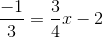
Add 2 to both sides:

Divide by 3/4. To divide, first take the reciprocal of 3/4 (aka, flip it) to get 4/3, then multiply that by 5/3:

Make the improper fraction a mixed number:

Now that you have what x equals, you can compare it to Quantity B.
Since  is bigger than 2, the answer is that Quantity A is greater
In order to solve quantitative comparison problems, you must first deduce whether or not the problem is actually solvable. Since this consists of finding the solution to an
Thus, your next step is to solve the problem.
Since
Plug in y:
Add 2 to both sides:
Divide by 3/4. To divide, first take the reciprocal of 3/4 (aka, flip it) to get 4/3, then multiply that by 5/3:
Make the improper fraction a mixed number:
Now that you have what x equals, you can compare it to Quantity B.
Since
← Didn't Know|Knew It →
What is equivalent to  ?
?
What is equivalent to
Tap to reveal answer
Remember that when you divide by a fraction, you multiply by the reciprocal of that fraction. Therefore, this division really is:

At this point, it is merely a matter of simplification and finishing the multiplication:
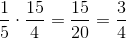
Remember that when you divide by a fraction, you multiply by the reciprocal of that fraction. Therefore, this division really is:
At this point, it is merely a matter of simplification and finishing the multiplication:
← Didn't Know|Knew It →
Which of the following is equivalent to  ?
?
Which of the following is equivalent to
Tap to reveal answer
To begin with, most students find it easy to remember that...

From this, you can apply the rule of division of fractions. That is, multiply by the reciprocal:
Therefore,
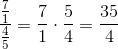
Since nothing needs to be reduced, this is your answer.
To begin with, most students find it easy to remember that...
From this, you can apply the rule of division of fractions. That is, multiply by the reciprocal:
Therefore,
Since nothing needs to be reduced, this is your answer.
← Didn't Know|Knew It →
Car A traveled 120 miles with 5 gallons of fuel.
Car B can travel 25 miles per gallon of fuel.
Quantity A: The fuel efficiency of car A
Quantity B: The fuel efficiency of car B
Car A traveled 120 miles with 5 gallons of fuel.
Car B can travel 25 miles per gallon of fuel.
Quantity A: The fuel efficiency of car A
Quantity B: The fuel efficiency of car B
Tap to reveal answer
Let's make the two quantities look the same.
Quantity A: 120 miles / 5 gallons = 24 miles / gallon
Quantity B: 25 miles / gallon
Quantity B is greater.
Let's make the two quantities look the same.
Quantity A: 120 miles / 5 gallons = 24 miles / gallon
Quantity B: 25 miles / gallon
Quantity B is greater.
← Didn't Know|Knew It →
Quantity A:
The -value of the equation when
Quantity B:
Quantity A:
The
Quantity B:
Tap to reveal answer
In order to solve quantitative comparison problems, you must first deduce whether or not the problem is actually solvable. Since this consists of finding the solution to an -coordinate on a line where nothing too complicated occurs, it will be possible.
Thus, your next step is to solve the problem.
Since and , you can plug in the -value and solve for :
Plug in y:
Add 2 to both sides:
Divide by 3/4. To divide, first take the reciprocal of 3/4 (aka, flip it) to get 4/3, then multiply that by 5/3:
Make the improper fraction a mixed number:
Now that you have what x equals, you can compare it to Quantity B.
Since is bigger than 2, the answer is that Quantity A is greater
In order to solve quantitative comparison problems, you must first deduce whether or not the problem is actually solvable. Since this consists of finding the solution to an
Thus, your next step is to solve the problem.
Since
Plug in y:
Add 2 to both sides:
Divide by 3/4. To divide, first take the reciprocal of 3/4 (aka, flip it) to get 4/3, then multiply that by 5/3:
Make the improper fraction a mixed number:
Now that you have what x equals, you can compare it to Quantity B.
Since
← Didn't Know|Knew It →
What is equivalent to ?
What is equivalent to
Tap to reveal answer
Remember that when you divide by a fraction, you multiply by the reciprocal of that fraction. Therefore, this division really is:
At this point, it is merely a matter of simplification and finishing the multiplication:
Remember that when you divide by a fraction, you multiply by the reciprocal of that fraction. Therefore, this division really is:
At this point, it is merely a matter of simplification and finishing the multiplication:
← Didn't Know|Knew It →
Which of the following is equivalent to ?
Which of the following is equivalent to
Tap to reveal answer
To begin with, most students find it easy to remember that...
From this, you can apply the rule of division of fractions. That is, multiply by the reciprocal:
Therefore,
Since nothing needs to be reduced, this is your answer.
To begin with, most students find it easy to remember that...
From this, you can apply the rule of division of fractions. That is, multiply by the reciprocal:
Therefore,
Since nothing needs to be reduced, this is your answer.
← Didn't Know|Knew It →
Car A traveled 120 miles with 5 gallons of fuel.
Car B can travel 25 miles per gallon of fuel.
Quantity A: The fuel efficiency of car A
Quantity B: The fuel efficiency of car B
Car A traveled 120 miles with 5 gallons of fuel.
Car B can travel 25 miles per gallon of fuel.
Quantity A: The fuel efficiency of car A
Quantity B: The fuel efficiency of car B
Tap to reveal answer
Let's make the two quantities look the same.
Quantity A: 120 miles / 5 gallons = 24 miles / gallon
Quantity B: 25 miles / gallon
Quantity B is greater.
Let's make the two quantities look the same.
Quantity A: 120 miles / 5 gallons = 24 miles / gallon
Quantity B: 25 miles / gallon
Quantity B is greater.
← Didn't Know|Knew It →
Quantity A:
The -value of the equation when
Quantity B:
Quantity A:
The
Quantity B:
Tap to reveal answer
In order to solve quantitative comparison problems, you must first deduce whether or not the problem is actually solvable. Since this consists of finding the solution to an -coordinate on a line where nothing too complicated occurs, it will be possible.
Thus, your next step is to solve the problem.
Since and , you can plug in the -value and solve for :
Plug in y:
Add 2 to both sides:
Divide by 3/4. To divide, first take the reciprocal of 3/4 (aka, flip it) to get 4/3, then multiply that by 5/3:
Make the improper fraction a mixed number:
Now that you have what x equals, you can compare it to Quantity B.
Since is bigger than 2, the answer is that Quantity A is greater
In order to solve quantitative comparison problems, you must first deduce whether or not the problem is actually solvable. Since this consists of finding the solution to an
Thus, your next step is to solve the problem.
Since
Plug in y:
Add 2 to both sides:
Divide by 3/4. To divide, first take the reciprocal of 3/4 (aka, flip it) to get 4/3, then multiply that by 5/3:
Make the improper fraction a mixed number:
Now that you have what x equals, you can compare it to Quantity B.
Since
← Didn't Know|Knew It →
What is equivalent to ?
What is equivalent to
Tap to reveal answer
Remember that when you divide by a fraction, you multiply by the reciprocal of that fraction. Therefore, this division really is:
At this point, it is merely a matter of simplification and finishing the multiplication:
Remember that when you divide by a fraction, you multiply by the reciprocal of that fraction. Therefore, this division really is:
At this point, it is merely a matter of simplification and finishing the multiplication:
← Didn't Know|Knew It →
Which of the following is equivalent to ?
Which of the following is equivalent to
Tap to reveal answer
To begin with, most students find it easy to remember that...
From this, you can apply the rule of division of fractions. That is, multiply by the reciprocal:
Therefore,
Since nothing needs to be reduced, this is your answer.
To begin with, most students find it easy to remember that...
From this, you can apply the rule of division of fractions. That is, multiply by the reciprocal:
Therefore,
Since nothing needs to be reduced, this is your answer.
← Didn't Know|Knew It →
Car A traveled 120 miles with 5 gallons of fuel.
Car B can travel 25 miles per gallon of fuel.
Quantity A: The fuel efficiency of car A
Quantity B: The fuel efficiency of car B
Car A traveled 120 miles with 5 gallons of fuel.
Car B can travel 25 miles per gallon of fuel.
Quantity A: The fuel efficiency of car A
Quantity B: The fuel efficiency of car B
Tap to reveal answer
Let's make the two quantities look the same.
Quantity A: 120 miles / 5 gallons = 24 miles / gallon
Quantity B: 25 miles / gallon
Quantity B is greater.
Let's make the two quantities look the same.
Quantity A: 120 miles / 5 gallons = 24 miles / gallon
Quantity B: 25 miles / gallon
Quantity B is greater.
← Didn't Know|Knew It →
Quantity A:
The -value of the equation when
Quantity B:
Quantity A:
The
Quantity B:
Tap to reveal answer
In order to solve quantitative comparison problems, you must first deduce whether or not the problem is actually solvable. Since this consists of finding the solution to an -coordinate on a line where nothing too complicated occurs, it will be possible.
Thus, your next step is to solve the problem.
Since and , you can plug in the -value and solve for :
Plug in y:
Add 2 to both sides:
Divide by 3/4. To divide, first take the reciprocal of 3/4 (aka, flip it) to get 4/3, then multiply that by 5/3:
Make the improper fraction a mixed number:
Now that you have what x equals, you can compare it to Quantity B.
Since is bigger than 2, the answer is that Quantity A is greater
In order to solve quantitative comparison problems, you must first deduce whether or not the problem is actually solvable. Since this consists of finding the solution to an
Thus, your next step is to solve the problem.
Since
Plug in y:
Add 2 to both sides:
Divide by 3/4. To divide, first take the reciprocal of 3/4 (aka, flip it) to get 4/3, then multiply that by 5/3:
Make the improper fraction a mixed number:
Now that you have what x equals, you can compare it to Quantity B.
Since
← Didn't Know|Knew It →
What is equivalent to ?
What is equivalent to
Tap to reveal answer
Remember that when you divide by a fraction, you multiply by the reciprocal of that fraction. Therefore, this division really is:
At this point, it is merely a matter of simplification and finishing the multiplication:
Remember that when you divide by a fraction, you multiply by the reciprocal of that fraction. Therefore, this division really is:
At this point, it is merely a matter of simplification and finishing the multiplication:
← Didn't Know|Knew It →
Which of the following is equivalent to ?
Which of the following is equivalent to
Tap to reveal answer
To begin with, most students find it easy to remember that...
From this, you can apply the rule of division of fractions. That is, multiply by the reciprocal:
Therefore,
Since nothing needs to be reduced, this is your answer.
To begin with, most students find it easy to remember that...
From this, you can apply the rule of division of fractions. That is, multiply by the reciprocal:
Therefore,
Since nothing needs to be reduced, this is your answer.
← Didn't Know|Knew It →
Car A traveled 120 miles with 5 gallons of fuel.
Car B can travel 25 miles per gallon of fuel.
Quantity A: The fuel efficiency of car A
Quantity B: The fuel efficiency of car B
Car A traveled 120 miles with 5 gallons of fuel.
Car B can travel 25 miles per gallon of fuel.
Quantity A: The fuel efficiency of car A
Quantity B: The fuel efficiency of car B
Tap to reveal answer
Let's make the two quantities look the same.
Quantity A: 120 miles / 5 gallons = 24 miles / gallon
Quantity B: 25 miles / gallon
Quantity B is greater.
Let's make the two quantities look the same.
Quantity A: 120 miles / 5 gallons = 24 miles / gallon
Quantity B: 25 miles / gallon
Quantity B is greater.
← Didn't Know|Knew It →
Quantity A:
The -value of the equation when
Quantity B:
Quantity A:
The
Quantity B:
Tap to reveal answer
In order to solve quantitative comparison problems, you must first deduce whether or not the problem is actually solvable. Since this consists of finding the solution to an -coordinate on a line where nothing too complicated occurs, it will be possible.
Thus, your next step is to solve the problem.
Since and , you can plug in the -value and solve for :
Plug in y:
Add 2 to both sides:
Divide by 3/4. To divide, first take the reciprocal of 3/4 (aka, flip it) to get 4/3, then multiply that by 5/3:
Make the improper fraction a mixed number:
Now that you have what x equals, you can compare it to Quantity B.
Since is bigger than 2, the answer is that Quantity A is greater
In order to solve quantitative comparison problems, you must first deduce whether or not the problem is actually solvable. Since this consists of finding the solution to an
Thus, your next step is to solve the problem.
Since
Plug in y:
Add 2 to both sides:
Divide by 3/4. To divide, first take the reciprocal of 3/4 (aka, flip it) to get 4/3, then multiply that by 5/3:
Make the improper fraction a mixed number:
Now that you have what x equals, you can compare it to Quantity B.
Since
← Didn't Know|Knew It →
What is equivalent to ?
What is equivalent to
Tap to reveal answer
Remember that when you divide by a fraction, you multiply by the reciprocal of that fraction. Therefore, this division really is:
At this point, it is merely a matter of simplification and finishing the multiplication:
Remember that when you divide by a fraction, you multiply by the reciprocal of that fraction. Therefore, this division really is:
At this point, it is merely a matter of simplification and finishing the multiplication:
← Didn't Know|Knew It →
Which of the following is equivalent to ?
Which of the following is equivalent to
Tap to reveal answer
To begin with, most students find it easy to remember that...
From this, you can apply the rule of division of fractions. That is, multiply by the reciprocal:
Therefore,
Since nothing needs to be reduced, this is your answer.
To begin with, most students find it easy to remember that...
From this, you can apply the rule of division of fractions. That is, multiply by the reciprocal:
Therefore,
Since nothing needs to be reduced, this is your answer.
← Didn't Know|Knew It →