How to divide exponents - GRE Quantitative Reasoning
Card 1 of 56
Which of the following is equal to the expression  , where
xyz ≠ 0?
Which of the following is equal to the expression , where
xyz ≠ 0?
Tap to reveal answer
(xy)4 can be rewritten as x4y4 and z0 = 1 because a number to the zero power equals 1. After simplifying, you get 1/y.
(xy)4 can be rewritten as x4y4 and z0 = 1 because a number to the zero power equals 1. After simplifying, you get 1/y.
← Didn't Know|Knew It →
If  , then
If
Tap to reveal answer
Start by simplifying the numerator and denominator separately. In the numerator, (c3)2 is equal to c6. In the denominator, c2 * c4 equals c6 as well. Dividing the numerator by the denominator, c6/c6, gives an answer of 1, because the numerator and the denominator are the equivalent.
Start by simplifying the numerator and denominator separately. In the numerator, (c3)2 is equal to c6. In the denominator, c2 * c4 equals c6 as well. Dividing the numerator by the denominator, c6/c6, gives an answer of 1, because the numerator and the denominator are the equivalent.
← Didn't Know|Knew It →
Evaluate:
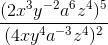
Evaluate:
Tap to reveal answer
Distribute the outside exponents first:
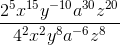
Divide the coefficient by subtracting the denominator exponents from the corresponding numerator exponents:

Distribute the outside exponents first:
Divide the coefficient by subtracting the denominator exponents from the corresponding numerator exponents:
← Didn't Know|Knew It →
If  , which of the following is equal to
  ?
?
If
Tap to reveal answer
The numerator is simplified to  (by adding the exponents), then cube the result. a24/a6 can then be simplified to
  .
.
The numerator is simplified to
← Didn't Know|Knew It →
\[641/2 + (–8)1/3\] * \[43/16 – 3171/3169\] =
\[641/2 + (–8)1/3\] * \[43/16 – 3171/3169\] =
Tap to reveal answer
Let's look at the two parts of the multiplication separately. Remember that (–8)1/3 will be negative. Then 641/2 + (–8)1/3 = 8 – 2 = 6.
For the second part, we can cancel some exponents to make this much easier. 43/16 = 43/42 = 4. Similarly, 3171/3169 = 3171–169 = 32 = 9. So 43/16 – 3171/3169 = 4 – 9 = –5.
Together, \[641/2 + (–8)1/3\] * \[43/16 – 3171/3169\] = 6 * (–5) = –30.
Let's look at the two parts of the multiplication separately. Remember that (–8)1/3 will be negative. Then 641/2 + (–8)1/3 = 8 – 2 = 6.
For the second part, we can cancel some exponents to make this much easier. 43/16 = 43/42 = 4. Similarly, 3171/3169 = 3171–169 = 32 = 9. So 43/16 – 3171/3169 = 4 – 9 = –5.
Together, \[641/2 + (–8)1/3\] * \[43/16 – 3171/3169\] = 6 * (–5) = –30.
← Didn't Know|Knew It →
Simplify
$$\frac{20x^{4}$$$y^{-3}$$z^{2}$$}{5z^{-1}$$y^{2}$$x^{2}$}=
Simplify
$$\frac{20x^{4}$$$y^{-3}$$z^{2}$$}{5z^{-1}$$y^{2}$$x^{2}$}=
Tap to reveal answer
Divide the coefficients and subtract the exponents.
Divide the coefficients and subtract the exponents.
← Didn't Know|Knew It →

Tap to reveal answer
The easiest way to solve this is to simplify the fraction as much as possible. We can do this by factoring out the greatest common factor of the numerator and the denominator. In this case, the GCF is  .
.

Now, we can cancel out the  from the numerator and denominator and continue simplifying the expression.

The easiest way to solve this is to simplify the fraction as much as possible. We can do this by factoring out the greatest common factor of the numerator and the denominator. In this case, the GCF is
Now, we can cancel out the
← Didn't Know|Knew It →
Which of the following is equal to the expression , where
xyz ≠ 0?
Which of the following is equal to the expression , where
xyz ≠ 0?
Tap to reveal answer
(xy)4 can be rewritten as x4y4 and z0 = 1 because a number to the zero power equals 1. After simplifying, you get 1/y.
(xy)4 can be rewritten as x4y4 and z0 = 1 because a number to the zero power equals 1. After simplifying, you get 1/y.
← Didn't Know|Knew It →
If , then
If
Tap to reveal answer
Start by simplifying the numerator and denominator separately. In the numerator, (c3)2 is equal to c6. In the denominator, c2 * c4 equals c6 as well. Dividing the numerator by the denominator, c6/c6, gives an answer of 1, because the numerator and the denominator are the equivalent.
Start by simplifying the numerator and denominator separately. In the numerator, (c3)2 is equal to c6. In the denominator, c2 * c4 equals c6 as well. Dividing the numerator by the denominator, c6/c6, gives an answer of 1, because the numerator and the denominator are the equivalent.
← Didn't Know|Knew It →
Evaluate:
Evaluate:
Tap to reveal answer
Distribute the outside exponents first:
Divide the coefficient by subtracting the denominator exponents from the corresponding numerator exponents:
Distribute the outside exponents first:
Divide the coefficient by subtracting the denominator exponents from the corresponding numerator exponents:
← Didn't Know|Knew It →
If , which of the following is equal to ?
If
Tap to reveal answer
The numerator is simplified to (by adding the exponents), then cube the result. a24/a6 can then be simplified to .
The numerator is simplified to
← Didn't Know|Knew It →
\[641/2 + (–8)1/3\] * \[43/16 – 3171/3169\] =
\[641/2 + (–8)1/3\] * \[43/16 – 3171/3169\] =
Tap to reveal answer
Let's look at the two parts of the multiplication separately. Remember that (–8)1/3 will be negative. Then 641/2 + (–8)1/3 = 8 – 2 = 6.
For the second part, we can cancel some exponents to make this much easier. 43/16 = 43/42 = 4. Similarly, 3171/3169 = 3171–169 = 32 = 9. So 43/16 – 3171/3169 = 4 – 9 = –5.
Together, \[641/2 + (–8)1/3\] * \[43/16 – 3171/3169\] = 6 * (–5) = –30.
Let's look at the two parts of the multiplication separately. Remember that (–8)1/3 will be negative. Then 641/2 + (–8)1/3 = 8 – 2 = 6.
For the second part, we can cancel some exponents to make this much easier. 43/16 = 43/42 = 4. Similarly, 3171/3169 = 3171–169 = 32 = 9. So 43/16 – 3171/3169 = 4 – 9 = –5.
Together, \[641/2 + (–8)1/3\] * \[43/16 – 3171/3169\] = 6 * (–5) = –30.
← Didn't Know|Knew It →
Simplify
$$\frac{20x^{4}$$$y^{-3}$$z^{2}$$}{5z^{-1}$$y^{2}$$x^{2}$}=
Simplify
$$\frac{20x^{4}$$$y^{-3}$$z^{2}$$}{5z^{-1}$$y^{2}$$x^{2}$}=
Tap to reveal answer
Divide the coefficients and subtract the exponents.
Divide the coefficients and subtract the exponents.
← Didn't Know|Knew It →
Tap to reveal answer
The easiest way to solve this is to simplify the fraction as much as possible. We can do this by factoring out the greatest common factor of the numerator and the denominator. In this case, the GCF is .
Now, we can cancel out the from the numerator and denominator and continue simplifying the expression.
The easiest way to solve this is to simplify the fraction as much as possible. We can do this by factoring out the greatest common factor of the numerator and the denominator. In this case, the GCF is
Now, we can cancel out the
← Didn't Know|Knew It →
Simplify
$$\frac{20x^{4}$$$y^{-3}$$z^{2}$$}{5z^{-1}$$y^{2}$$x^{2}$}=
Simplify
$$\frac{20x^{4}$$$y^{-3}$$z^{2}$$}{5z^{-1}$$y^{2}$$x^{2}$}=
Tap to reveal answer
Divide the coefficients and subtract the exponents.
Divide the coefficients and subtract the exponents.
← Didn't Know|Knew It →
Which of the following is equal to the expression , where
xyz ≠ 0?
Which of the following is equal to the expression , where
xyz ≠ 0?
Tap to reveal answer
(xy)4 can be rewritten as x4y4 and z0 = 1 because a number to the zero power equals 1. After simplifying, you get 1/y.
(xy)4 can be rewritten as x4y4 and z0 = 1 because a number to the zero power equals 1. After simplifying, you get 1/y.
← Didn't Know|Knew It →
If , then
If
Tap to reveal answer
Start by simplifying the numerator and denominator separately. In the numerator, (c3)2 is equal to c6. In the denominator, c2 * c4 equals c6 as well. Dividing the numerator by the denominator, c6/c6, gives an answer of 1, because the numerator and the denominator are the equivalent.
Start by simplifying the numerator and denominator separately. In the numerator, (c3)2 is equal to c6. In the denominator, c2 * c4 equals c6 as well. Dividing the numerator by the denominator, c6/c6, gives an answer of 1, because the numerator and the denominator are the equivalent.
← Didn't Know|Knew It →
Evaluate:
Evaluate:
Tap to reveal answer
Distribute the outside exponents first:
Divide the coefficient by subtracting the denominator exponents from the corresponding numerator exponents:
Distribute the outside exponents first:
Divide the coefficient by subtracting the denominator exponents from the corresponding numerator exponents:
← Didn't Know|Knew It →
If , which of the following is equal to ?
If
Tap to reveal answer
The numerator is simplified to (by adding the exponents), then cube the result. a24/a6 can then be simplified to .
The numerator is simplified to
← Didn't Know|Knew It →
\[641/2 + (–8)1/3\] * \[43/16 – 3171/3169\] =
\[641/2 + (–8)1/3\] * \[43/16 – 3171/3169\] =
Tap to reveal answer
Let's look at the two parts of the multiplication separately. Remember that (–8)1/3 will be negative. Then 641/2 + (–8)1/3 = 8 – 2 = 6.
For the second part, we can cancel some exponents to make this much easier. 43/16 = 43/42 = 4. Similarly, 3171/3169 = 3171–169 = 32 = 9. So 43/16 – 3171/3169 = 4 – 9 = –5.
Together, \[641/2 + (–8)1/3\] * \[43/16 – 3171/3169\] = 6 * (–5) = –30.
Let's look at the two parts of the multiplication separately. Remember that (–8)1/3 will be negative. Then 641/2 + (–8)1/3 = 8 – 2 = 6.
For the second part, we can cancel some exponents to make this much easier. 43/16 = 43/42 = 4. Similarly, 3171/3169 = 3171–169 = 32 = 9. So 43/16 – 3171/3169 = 4 – 9 = –5.
Together, \[641/2 + (–8)1/3\] * \[43/16 – 3171/3169\] = 6 * (–5) = –30.
← Didn't Know|Knew It →