Graphing - GRE Quantitative Reasoning
Card 1 of 32
Which of the following terms are linear?
Which of the following terms are linear?
Tap to reveal answer
Linear terms have only one variable in a product and no exponents other than 0 or 1. x2 has an exponent other than 0 or 1 so it is not linear. yz has two variables so is also not a linear term. Linear terms cannot have functions of variables either, so sin(x) is not linear.
We can also think of these terms somewhat like graphing equations. Linear equations are straight lines. You might recognize, for example, that x2 should be a parabola. Sin(x) has a graph that looks like a harmonic wave. Clearly these two shaps aren't straight lines!
Linear terms have only one variable in a product and no exponents other than 0 or 1. x2 has an exponent other than 0 or 1 so it is not linear. yz has two variables so is also not a linear term. Linear terms cannot have functions of variables either, so sin(x) is not linear.
We can also think of these terms somewhat like graphing equations. Linear equations are straight lines. You might recognize, for example, that x2 should be a parabola. Sin(x) has a graph that looks like a harmonic wave. Clearly these two shaps aren't straight lines!
← Didn't Know|Knew It →
The slope of a line segment with points  and
and  is:
is:
The slope of a line segment with points
Tap to reveal answer
The formula for calculating slope is rise over run, or the difference in  divided by the difference in
  . In this case, the difference in
  is 5 while the difference in
  is 5, resulting in a slope of
  or 1.
or 1.
The formula for calculating slope is rise over run, or the difference in
← Didn't Know|Knew It →
What is the slope of the linear line that passes through the origin and the point  ?
?
What is the slope of the linear line that passes through the origin and the point
Tap to reveal answer
Slope of a line given 2 points can be found using
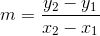 .
.
Therefore 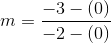
or

Slope of a line given 2 points can be found using
Therefore
or
← Didn't Know|Knew It →
Suppose  .
.
To obtain the graph of  , shift the graph
  a distance of
  units .
Suppose
To obtain the graph of
Tap to reveal answer
There are four shifts of the graph y = f(x):
y = f(x) + c shifts the graph c units upwards.
y = f(x) – c shifts the graph c units downwards.
y = f(x + c) shifts the graph c units to the left.
y = f(x – c) shifts the graph c units to the right.
There are four shifts of the graph y = f(x):
y = f(x) + c shifts the graph c units upwards.
y = f(x) – c shifts the graph c units downwards.
y = f(x + c) shifts the graph c units to the left.
y = f(x – c) shifts the graph c units to the right.
← Didn't Know|Knew It →
Which of the following terms are linear?
Which of the following terms are linear?
Tap to reveal answer
Linear terms have only one variable in a product and no exponents other than 0 or 1. x2 has an exponent other than 0 or 1 so it is not linear. yz has two variables so is also not a linear term. Linear terms cannot have functions of variables either, so sin(x) is not linear.
We can also think of these terms somewhat like graphing equations. Linear equations are straight lines. You might recognize, for example, that x2 should be a parabola. Sin(x) has a graph that looks like a harmonic wave. Clearly these two shaps aren't straight lines!
Linear terms have only one variable in a product and no exponents other than 0 or 1. x2 has an exponent other than 0 or 1 so it is not linear. yz has two variables so is also not a linear term. Linear terms cannot have functions of variables either, so sin(x) is not linear.
We can also think of these terms somewhat like graphing equations. Linear equations are straight lines. You might recognize, for example, that x2 should be a parabola. Sin(x) has a graph that looks like a harmonic wave. Clearly these two shaps aren't straight lines!
← Didn't Know|Knew It →
The slope of a line segment with points and is:
The slope of a line segment with points
Tap to reveal answer
The formula for calculating slope is rise over run, or the difference in divided by the difference in . In this case, the difference in is 5 while the difference in is 5, resulting in a slope of or 1.
The formula for calculating slope is rise over run, or the difference in
← Didn't Know|Knew It →
What is the slope of the linear line that passes through the origin and the point ?
What is the slope of the linear line that passes through the origin and the point
Tap to reveal answer
Slope of a line given 2 points can be found using
.
Therefore
or
Slope of a line given 2 points can be found using
Therefore
or
← Didn't Know|Knew It →
Suppose .
To obtain the graph of , shift the graph a distance of units .
Suppose
To obtain the graph of
Tap to reveal answer
There are four shifts of the graph y = f(x):
y = f(x) + c shifts the graph c units upwards.
y = f(x) – c shifts the graph c units downwards.
y = f(x + c) shifts the graph c units to the left.
y = f(x – c) shifts the graph c units to the right.
There are four shifts of the graph y = f(x):
y = f(x) + c shifts the graph c units upwards.
y = f(x) – c shifts the graph c units downwards.
y = f(x + c) shifts the graph c units to the left.
y = f(x – c) shifts the graph c units to the right.
← Didn't Know|Knew It →
Suppose .
To obtain the graph of , shift the graph a distance of units .
Suppose
To obtain the graph of
Tap to reveal answer
There are four shifts of the graph y = f(x):
y = f(x) + c shifts the graph c units upwards.
y = f(x) – c shifts the graph c units downwards.
y = f(x + c) shifts the graph c units to the left.
y = f(x – c) shifts the graph c units to the right.
There are four shifts of the graph y = f(x):
y = f(x) + c shifts the graph c units upwards.
y = f(x) – c shifts the graph c units downwards.
y = f(x + c) shifts the graph c units to the left.
y = f(x – c) shifts the graph c units to the right.
← Didn't Know|Knew It →
Which of the following terms are linear?
Which of the following terms are linear?
Tap to reveal answer
Linear terms have only one variable in a product and no exponents other than 0 or 1. x2 has an exponent other than 0 or 1 so it is not linear. yz has two variables so is also not a linear term. Linear terms cannot have functions of variables either, so sin(x) is not linear.
We can also think of these terms somewhat like graphing equations. Linear equations are straight lines. You might recognize, for example, that x2 should be a parabola. Sin(x) has a graph that looks like a harmonic wave. Clearly these two shaps aren't straight lines!
Linear terms have only one variable in a product and no exponents other than 0 or 1. x2 has an exponent other than 0 or 1 so it is not linear. yz has two variables so is also not a linear term. Linear terms cannot have functions of variables either, so sin(x) is not linear.
We can also think of these terms somewhat like graphing equations. Linear equations are straight lines. You might recognize, for example, that x2 should be a parabola. Sin(x) has a graph that looks like a harmonic wave. Clearly these two shaps aren't straight lines!
← Didn't Know|Knew It →
The slope of a line segment with points and is:
The slope of a line segment with points
Tap to reveal answer
The formula for calculating slope is rise over run, or the difference in divided by the difference in . In this case, the difference in is 5 while the difference in is 5, resulting in a slope of or 1.
The formula for calculating slope is rise over run, or the difference in
← Didn't Know|Knew It →
What is the slope of the linear line that passes through the origin and the point ?
What is the slope of the linear line that passes through the origin and the point
Tap to reveal answer
Slope of a line given 2 points can be found using
.
Therefore
or
Slope of a line given 2 points can be found using
Therefore
or
← Didn't Know|Knew It →
Which of the following terms are linear?
Which of the following terms are linear?
Tap to reveal answer
Linear terms have only one variable in a product and no exponents other than 0 or 1. x2 has an exponent other than 0 or 1 so it is not linear. yz has two variables so is also not a linear term. Linear terms cannot have functions of variables either, so sin(x) is not linear.
We can also think of these terms somewhat like graphing equations. Linear equations are straight lines. You might recognize, for example, that x2 should be a parabola. Sin(x) has a graph that looks like a harmonic wave. Clearly these two shaps aren't straight lines!
Linear terms have only one variable in a product and no exponents other than 0 or 1. x2 has an exponent other than 0 or 1 so it is not linear. yz has two variables so is also not a linear term. Linear terms cannot have functions of variables either, so sin(x) is not linear.
We can also think of these terms somewhat like graphing equations. Linear equations are straight lines. You might recognize, for example, that x2 should be a parabola. Sin(x) has a graph that looks like a harmonic wave. Clearly these two shaps aren't straight lines!
← Didn't Know|Knew It →
The slope of a line segment with points and is:
The slope of a line segment with points
Tap to reveal answer
The formula for calculating slope is rise over run, or the difference in divided by the difference in . In this case, the difference in is 5 while the difference in is 5, resulting in a slope of or 1.
The formula for calculating slope is rise over run, or the difference in
← Didn't Know|Knew It →
What is the slope of the linear line that passes through the origin and the point ?
What is the slope of the linear line that passes through the origin and the point
Tap to reveal answer
Slope of a line given 2 points can be found using
.
Therefore
or
Slope of a line given 2 points can be found using
Therefore
or
← Didn't Know|Knew It →
Suppose .
To obtain the graph of , shift the graph a distance of units .
Suppose
To obtain the graph of
Tap to reveal answer
There are four shifts of the graph y = f(x):
y = f(x) + c shifts the graph c units upwards.
y = f(x) – c shifts the graph c units downwards.
y = f(x + c) shifts the graph c units to the left.
y = f(x – c) shifts the graph c units to the right.
There are four shifts of the graph y = f(x):
y = f(x) + c shifts the graph c units upwards.
y = f(x) – c shifts the graph c units downwards.
y = f(x + c) shifts the graph c units to the left.
y = f(x – c) shifts the graph c units to the right.
← Didn't Know|Knew It →
Which of the following terms are linear?
Which of the following terms are linear?
Tap to reveal answer
Linear terms have only one variable in a product and no exponents other than 0 or 1. x2 has an exponent other than 0 or 1 so it is not linear. yz has two variables so is also not a linear term. Linear terms cannot have functions of variables either, so sin(x) is not linear.
We can also think of these terms somewhat like graphing equations. Linear equations are straight lines. You might recognize, for example, that x2 should be a parabola. Sin(x) has a graph that looks like a harmonic wave. Clearly these two shaps aren't straight lines!
Linear terms have only one variable in a product and no exponents other than 0 or 1. x2 has an exponent other than 0 or 1 so it is not linear. yz has two variables so is also not a linear term. Linear terms cannot have functions of variables either, so sin(x) is not linear.
We can also think of these terms somewhat like graphing equations. Linear equations are straight lines. You might recognize, for example, that x2 should be a parabola. Sin(x) has a graph that looks like a harmonic wave. Clearly these two shaps aren't straight lines!
← Didn't Know|Knew It →
The slope of a line segment with points and is:
The slope of a line segment with points
Tap to reveal answer
The formula for calculating slope is rise over run, or the difference in divided by the difference in . In this case, the difference in is 5 while the difference in is 5, resulting in a slope of or 1.
The formula for calculating slope is rise over run, or the difference in
← Didn't Know|Knew It →
What is the slope of the linear line that passes through the origin and the point ?
What is the slope of the linear line that passes through the origin and the point
Tap to reveal answer
Slope of a line given 2 points can be found using
.
Therefore
or
Slope of a line given 2 points can be found using
Therefore
or
← Didn't Know|Knew It →
Which of the following terms are linear?
Which of the following terms are linear?
Tap to reveal answer
Linear terms have only one variable in a product and no exponents other than 0 or 1. x2 has an exponent other than 0 or 1 so it is not linear. yz has two variables so is also not a linear term. Linear terms cannot have functions of variables either, so sin(x) is not linear.
We can also think of these terms somewhat like graphing equations. Linear equations are straight lines. You might recognize, for example, that x2 should be a parabola. Sin(x) has a graph that looks like a harmonic wave. Clearly these two shaps aren't straight lines!
Linear terms have only one variable in a product and no exponents other than 0 or 1. x2 has an exponent other than 0 or 1 so it is not linear. yz has two variables so is also not a linear term. Linear terms cannot have functions of variables either, so sin(x) is not linear.
We can also think of these terms somewhat like graphing equations. Linear equations are straight lines. You might recognize, for example, that x2 should be a parabola. Sin(x) has a graph that looks like a harmonic wave. Clearly these two shaps aren't straight lines!
← Didn't Know|Knew It →