Exponents - GRE Quantitative Reasoning
Card 1 of 584
The speed of light is approximately  .
.
In scientific notation how many kilometers per hour is the speed of light?
The speed of light is approximately
In scientific notation how many kilometers per hour is the speed of light?
Tap to reveal answer
For this problem we need to convert meters into kilometers and seconds into hours. Therefore we get,

Multiplying this out we get

For this problem we need to convert meters into kilometers and seconds into hours. Therefore we get,
Multiplying this out we get
← Didn't Know|Knew It →
If one mile is equal to 5,280 feet, how many feet are 100 miles equal to in scientific notation?
If one mile is equal to 5,280 feet, how many feet are 100 miles equal to in scientific notation?
Tap to reveal answer
100 miles = 528,000 feet. To put a number in scientific notation, we put a decimal point to the right of our first number, giving us 5.28. We then multiply by 10 to whatever power necessary to make our decimal equal the value we are looking for. For 5.28 to equal 528,000 we must multiply by $10^5$.
Therefore, our final answer becomes:

100 miles = 528,000 feet. To put a number in scientific notation, we put a decimal point to the right of our first number, giving us 5.28. We then multiply by 10 to whatever power necessary to make our decimal equal the value we are looking for. For 5.28 to equal 528,000 we must multiply by $10^5$.
Therefore, our final answer becomes:
← Didn't Know|Knew It →

Tap to reveal answer
This question requires you to have an understanding of scientific notation. Begin by multiplying the two numbers:

To use scientific notation, the number to the left of the decimal has to be between 1 and 10. In this case, we are looking to move the decimal place until we are left with 9 on the left of the decimal. Count the number of places that the decimal will have to move. In this case, it is five. Therefore:

Note: The notation is raised to a negative power because we moved the decimal from left to right.
This question requires you to have an understanding of scientific notation. Begin by multiplying the two numbers:
To use scientific notation, the number to the left of the decimal has to be between 1 and 10. In this case, we are looking to move the decimal place until we are left with 9 on the left of the decimal. Count the number of places that the decimal will have to move. In this case, it is five. Therefore:
Note: The notation is raised to a negative power because we moved the decimal from left to right.
← Didn't Know|Knew It →
Jack has  ,
, to invest. If he invests two-thirds of it into a high-yield savings account with an annual interest rate of
  , compounded quarterly, and the other third in a regular savings account at
  simple interest, how much does Jack earn after one year?
Jack has
Tap to reveal answer
First, break the problem into two segments: the amount Jack invests in the high-yield savings, and the amount Jack invests in the simple interest account (10,000 and 5,000 respectively).
Now let's work with the high-yield savings account. $10,000 is invested at an annual rate of 8%, compounded quarterly. We can use the compound interest formula to solve:

Plug in the values given:
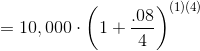


Therefore, Jack makes $824.32 off his high-yield savings account. Now let's calculate the other interest:



Add the two together, and we see that Jack makes a total of,  off of his investments.
First, break the problem into two segments: the amount Jack invests in the high-yield savings, and the amount Jack invests in the simple interest account (10,000 and 5,000 respectively).
Now let's work with the high-yield savings account. $10,000 is invested at an annual rate of 8%, compounded quarterly. We can use the compound interest formula to solve:
Plug in the values given:
Therefore, Jack makes $824.32 off his high-yield savings account. Now let's calculate the other interest:
Add the two together, and we see that Jack makes a total of,
← Didn't Know|Knew It →
A five-year bond is opened with  in it and an interest rate of
  %, compounded annually. This account is allowed to compound for five years. Which of the following most closely approximates the total amount in the account after that period of time?
A five-year bond is opened with
Tap to reveal answer
Each year, you can calculate your interest by multiplying the principle ( ) by
) by  . For one year, this would be:

For two years, it would be:
 , which is the same as
Therefore, you can solve for a five year period by doing:

Using your calculator, you can expand the  into a series of multiplications. This gives you
  , which is closest to
  .
.
Each year, you can calculate your interest by multiplying the principle (
For two years, it would be:
Therefore, you can solve for a five year period by doing:
Using your calculator, you can expand the
← Didn't Know|Knew It →
If a cash deposit account is opened with  for a three year period at
  % interest compounded once annually, which of the following is closest to the positive difference between the interest accrued in the third year and the interest accrued in the second year?
If a cash deposit account is opened with
Tap to reveal answer
It is easiest to break this down into steps. For each year, you will multiply by  to calculate the new value. Therefore, let's make a chart:
After year 1:  ; Total interest:
After year 2:  ; Let us round this to
  ; Total interest:
After year 3:  ; Let us round this to
  ; Total interest:
Thus, the positive difference of the interest from the last period and the interest from the first period is: 
It is easiest to break this down into steps. For each year, you will multiply by
After year 1:
After year 2:
After year 3:
Thus, the positive difference of the interest from the last period and the interest from the first period is:
← Didn't Know|Knew It →
What digit appears in the units place when  is multiplied out?
What digit appears in the units place when
Tap to reveal answer
This problem is quite simple if you recall that the units place of powers of 2 follows a simple 4-step sequence.
Observe the first few powers of 2:
21 = 2, 22 = 4, 23 = 8, 24 = 16, 25 = 32, 26 = 64, 27 = 128, 28 = 256 . . .
The units place follows a sequence of 2, 4, 8, 6, 2, 4, 8, 6, etc. Thus, divide 102 by 4. This gives a remainder of 2.
The second number in the sequence is 4, so the answer is 4.
This problem is quite simple if you recall that the units place of powers of 2 follows a simple 4-step sequence.
Observe the first few powers of 2:
21 = 2, 22 = 4, 23 = 8, 24 = 16, 25 = 32, 26 = 64, 27 = 128, 28 = 256 . . .
The units place follows a sequence of 2, 4, 8, 6, 2, 4, 8, 6, etc. Thus, divide 102 by 4. This gives a remainder of 2.
The second number in the sequence is 4, so the answer is 4.
← Didn't Know|Knew It →
If  , then which of the following must also be true?
If
Tap to reveal answer
We know that the expression must be negative. Therefore one or all of the terms x7, y8 and z10 must be negative; however, even powers always produce positive numbers, so y8 and z10 will both be positive. Odd powers can produce both negative and positive numbers, depending on whether the base term is negative or positive. In this case, x7 must be negative, so x must be negative. Thus, the answer is x < 0.
We know that the expression must be negative. Therefore one or all of the terms x7, y8 and z10 must be negative; however, even powers always produce positive numbers, so y8 and z10 will both be positive. Odd powers can produce both negative and positive numbers, depending on whether the base term is negative or positive. In this case, x7 must be negative, so x must be negative. Thus, the answer is x < 0.
← Didn't Know|Knew It →
Quantitative Comparison
Quantity A: _x_2
Quantity B: _x_3
Quantitative Comparison
Quantity A: _x_2
Quantity B: _x_3
Tap to reveal answer
Let's pick numbers. For quantitative comparisons with exponents, it's good to try 0, a negative number, and a fraction.
0: 02 = 0, 03 = 0, so the two quantities are equal.
–1: (–1)2 = 1, (–1)3 = –1, so Quantity A is greater.
Already we have a contradiction so the answer cannot be determined.
Let's pick numbers. For quantitative comparisons with exponents, it's good to try 0, a negative number, and a fraction.
0: 02 = 0, 03 = 0, so the two quantities are equal.
–1: (–1)2 = 1, (–1)3 = –1, so Quantity A is greater.
Already we have a contradiction so the answer cannot be determined.
← Didn't Know|Knew It →
Which quantity is the greatest?
Quantity A

Quantity B

Which quantity is the greatest?
Quantity A
Quantity B
Tap to reveal answer
First rewrite quantity B so that it has the same base as quantity A.
 can be rewriten as
  , which is equivalent to
  .
.
Now we can compare the two quantities.
 is greater than
  .
.
First rewrite quantity B so that it has the same base as quantity A.
Now we can compare the two quantities.
← Didn't Know|Knew It →
Which of the following is a multiple of  ?
?
Which of the following is a multiple of
Tap to reveal answer
For exponent problems like this, the easiest thing to do is to break down all the numbers that you have into their prime factors. Begin with the number given to you:

Now, in order for you to have a number that is a multiple of this, you will need to have at least  in the prime factorization of the given number. For each of the answer choices, you have:


 ; This is the answer.


For exponent problems like this, the easiest thing to do is to break down all the numbers that you have into their prime factors. Begin with the number given to you:
Now, in order for you to have a number that is a multiple of this, you will need to have at least
← Didn't Know|Knew It →
Simplify the following:

Simplify the following:
Tap to reveal answer
Because the numbers involved in your fraction are so large, you are going to need to do some careful manipulating to get your answer. (A basic calculator will not work for something like this.) These sorts of questions almost always work well when you isolate the large factors and notice patterns involved. Let's first focus on the numerator. Go ahead and break apart the  into its prime factors:

Note that these have a common factor of  . Therefore, you can rewrite the numerator as:

Now, put this back into your fraction:
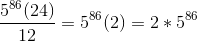
Because the numbers involved in your fraction are so large, you are going to need to do some careful manipulating to get your answer. (A basic calculator will not work for something like this.) These sorts of questions almost always work well when you isolate the large factors and notice patterns involved. Let's first focus on the numerator. Go ahead and break apart the
Note that these have a common factor of
Now, put this back into your fraction:
← Didn't Know|Knew It →
Simplify the following:

Simplify the following:
Tap to reveal answer
With problems like this, it is always best to break apart your values into their prime factors. Let's look at the numerator and the denominator separately:
Numerator

Continuing the simplification:

Now, these factors have in common a  . Factor this out:

Denominator
This is much simpler:

Now, return to your fraction:
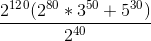
Cancel out the common factors of  :
:

With problems like this, it is always best to break apart your values into their prime factors. Let's look at the numerator and the denominator separately:
Numerator
Continuing the simplification:
Now, these factors have in common a
Denominator
This is much simpler:
Now, return to your fraction:
Cancel out the common factors of
← Didn't Know|Knew It →
Jack has , to invest. If he invests two-thirds of it into a high-yield savings account with an annual interest rate of , compounded quarterly, and the other third in a regular savings account at simple interest, how much does Jack earn after one year?
Jack has
Tap to reveal answer
First, break the problem into two segments: the amount Jack invests in the high-yield savings, and the amount Jack invests in the simple interest account (10,000 and 5,000 respectively).
Now let's work with the high-yield savings account. $10,000 is invested at an annual rate of 8%, compounded quarterly. We can use the compound interest formula to solve:
Plug in the values given:
Therefore, Jack makes $824.32 off his high-yield savings account. Now let's calculate the other interest:
Add the two together, and we see that Jack makes a total of, off of his investments.
First, break the problem into two segments: the amount Jack invests in the high-yield savings, and the amount Jack invests in the simple interest account (10,000 and 5,000 respectively).
Now let's work with the high-yield savings account. $10,000 is invested at an annual rate of 8%, compounded quarterly. We can use the compound interest formula to solve:
Plug in the values given:
Therefore, Jack makes $824.32 off his high-yield savings account. Now let's calculate the other interest:
Add the two together, and we see that Jack makes a total of,
← Didn't Know|Knew It →
A five-year bond is opened with in it and an interest rate of %, compounded annually. This account is allowed to compound for five years. Which of the following most closely approximates the total amount in the account after that period of time?
A five-year bond is opened with
Tap to reveal answer
Each year, you can calculate your interest by multiplying the principle () by . For one year, this would be:
For two years, it would be:
, which is the same as
Therefore, you can solve for a five year period by doing:
Using your calculator, you can expand the into a series of multiplications. This gives you , which is closest to .
Each year, you can calculate your interest by multiplying the principle (
For two years, it would be:
Therefore, you can solve for a five year period by doing:
Using your calculator, you can expand the
← Didn't Know|Knew It →
If a cash deposit account is opened with for a three year period at % interest compounded once annually, which of the following is closest to the positive difference between the interest accrued in the third year and the interest accrued in the second year?
If a cash deposit account is opened with
Tap to reveal answer
It is easiest to break this down into steps. For each year, you will multiply by to calculate the new value. Therefore, let's make a chart:
After year 1: ; Total interest:
After year 2: ; Let us round this to ; Total interest:
After year 3: ; Let us round this to ; Total interest:
Thus, the positive difference of the interest from the last period and the interest from the first period is:
It is easiest to break this down into steps. For each year, you will multiply by
After year 1:
After year 2:
After year 3:
Thus, the positive difference of the interest from the last period and the interest from the first period is:
← Didn't Know|Knew It →
Which of the following is equal to the expression  , where
xyz ≠ 0?
Which of the following is equal to the expression , where
xyz ≠ 0?
Tap to reveal answer
(xy)4 can be rewritten as x4y4 and z0 = 1 because a number to the zero power equals 1. After simplifying, you get 1/y.
(xy)4 can be rewritten as x4y4 and z0 = 1 because a number to the zero power equals 1. After simplifying, you get 1/y.
← Didn't Know|Knew It →
If  , then
If
Tap to reveal answer
Start by simplifying the numerator and denominator separately. In the numerator, (c3)2 is equal to c6. In the denominator, c2 * c4 equals c6 as well. Dividing the numerator by the denominator, c6/c6, gives an answer of 1, because the numerator and the denominator are the equivalent.
Start by simplifying the numerator and denominator separately. In the numerator, (c3)2 is equal to c6. In the denominator, c2 * c4 equals c6 as well. Dividing the numerator by the denominator, c6/c6, gives an answer of 1, because the numerator and the denominator are the equivalent.
← Didn't Know|Knew It →
Evaluate:
Evaluate:
Tap to reveal answer
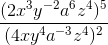
Distribute the outside exponents first:
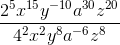
Divide the coefficient by subtracting the denominator exponents from the corresponding numerator exponents:

Distribute the outside exponents first:
Divide the coefficient by subtracting the denominator exponents from the corresponding numerator exponents:
← Didn't Know|Knew It →
If  , which of the following is equal to
  ?
?
If
Tap to reveal answer
The numerator is simplified to  (by adding the exponents), then cube the result. a24/a6 can then be simplified to
  .
.
The numerator is simplified to
← Didn't Know|Knew It →