Discount - GMAT Quantitative
Card 1 of 128
Susan went to a clearance sale and bought various items on sale. She saves 20% on a purse, retailing for $100. She saves 30% on a skirt that was marked down from a retail price of $40. She also bought a jacket that was on sale, and she spent a total of $150 . How much did the jacket retail for?
1. Her overall savings were 25% off the combined retail price of all three items.
2. Her discount on the jacket was $6 more than her savings on the skirt.
Susan went to a clearance sale and bought various items on sale. She saves 20% on a purse, retailing for $100. She saves 30% on a skirt that was marked down from a retail price of $40. She also bought a jacket that was on sale, and she spent a total of $150 . How much did the jacket retail for?
1. Her overall savings were 25% off the combined retail price of all three items.
2. Her discount on the jacket was $6 more than her savings on the skirt.
Tap to reveal answer
Using statement 1, it is easy to see how much the total retail amount should have been. The total retail amount discounted by 25% is the amount that Susan spent. So, we name a variable. Let x be the total retail amount. Then x - .25x = $122. We can rewrite this as x(1-.25) or x(.75)=150 thus, x = 200. So we subtract the known retail prices of the skirt and the purse to get the retail price of the jacket. So 200 - 100 - 40 = $60 is the retail price of the jacket.
Now, we should check statement 2. Using statement 2, we can calculate the savings we had on the jacket. We can first calculate how much we saved on the skirt. So 30% of the $40 retail price is $12. After we find this, we use the information from statement 2 to find the savings we had on the jacket. So $12 + $6 = $18 saved on the jacket.
Now, we need to figure out how much we spent on the jacket. We do this by taking the total amount we spent and subtracting the discounted price of the purse and the discounted price of the skirt. So, a $100 purse, at 20% off, is $80. We calculated our savings on the skirt earlier, so we know we spent $28 on the skirt. So $150 - $80 - $28 = $42.
Now combining these two pieces of information, we see we spent $42 and saved $18 so 42+18 = $60 retail price for the jacket.
We can see that either statement alone is sufficient to solve the problem.
Using statement 1, it is easy to see how much the total retail amount should have been. The total retail amount discounted by 25% is the amount that Susan spent. So, we name a variable. Let x be the total retail amount. Then x - .25x = $122. We can rewrite this as x(1-.25) or x(.75)=150 thus, x = 200. So we subtract the known retail prices of the skirt and the purse to get the retail price of the jacket. So 200 - 100 - 40 = $60 is the retail price of the jacket.
Now, we should check statement 2. Using statement 2, we can calculate the savings we had on the jacket. We can first calculate how much we saved on the skirt. So 30% of the $40 retail price is $12. After we find this, we use the information from statement 2 to find the savings we had on the jacket. So $12 + $6 = $18 saved on the jacket.
Now, we need to figure out how much we spent on the jacket. We do this by taking the total amount we spent and subtracting the discounted price of the purse and the discounted price of the skirt. So, a $100 purse, at 20% off, is $80. We calculated our savings on the skirt earlier, so we know we spent $28 on the skirt. So $150 - $80 - $28 = $42.
Now combining these two pieces of information, we see we spent $42 and saved $18 so 42+18 = $60 retail price for the jacket.
We can see that either statement alone is sufficient to solve the problem.
← Didn't Know|Knew It →
Data sufficiency question
During a semi-annual sale, the price of a shirt is discounted. Calculate the percent discount.
1. The sale price is $23.
2. The sale price is $6 less than the original price.
Data sufficiency question
During a semi-annual sale, the price of a shirt is discounted. Calculate the percent discount.
1. The sale price is $23.
2. The sale price is $6 less than the original price.
Tap to reveal answer
In order to calculate the percent discount, both the original price and the sale price must be known. From statement 1, we know the sale price and with the additional information from statement 2, we can calculate the original price and then overall percent discount.
In order to calculate the percent discount, both the original price and the sale price must be known. From statement 1, we know the sale price and with the additional information from statement 2, we can calculate the original price and then overall percent discount.
← Didn't Know|Knew It →
A lawn-mower is initially listed at  . Its the ticket lists a discount of
  off the full price. The item is placed in a 'extra discount' location where all prices are listed as being discounted
  off the listed ticket price.
The customer wants to know how much she saved,  , in dollars. In terms of
  ,
,  and
and  , with discounts
  and
and  expressed in percent, what is the formula for dollar savings off the initial list price,
  ?
?
A lawn-mower is initially listed at
The customer wants to know how much she saved,
Tap to reveal answer
The price charged at the register,  after two discounts is computed using the rule for a single discount applied serially.

The 100 represents the conversion from % to decimal.
The savings,  , is the difference between the price charged and the list price. So,

The price charged at the register,
The 100 represents the conversion from % to decimal.
The savings,
← Didn't Know|Knew It →
A lawn-mower is initially offerred at  . Its price is discounted
  off the full price. What is the final price?
A lawn-mower is initially offerred at
Tap to reveal answer
If the initial price is  , and the discount is
  , the final sale price is


If the initial price is
← Didn't Know|Knew It →
A lawn-mower is discounted  off the full price. A second discount of
  is applied at the register. What is the final discount?
A lawn-mower is discounted
Tap to reveal answer
If the initial price is P, and it is discounted twice at rates  and
and  , the final price
  is
is

Substituting values this is


or 
If the initial price is P, and it is discounted twice at rates
Substituting values this is
or
← Didn't Know|Knew It →
A lawn-mower is initially listed at  . Its price is discounted off the full price some unknown amount,
  . An employee uses their
  discount at the register and is charged
  .
.
What is the unknown initial discount, ?
?
A lawn-mower is initially listed at
What is the unknown initial discount,
Tap to reveal answer
The relationship between the list price,  , sale price,
  , and the employee's discount,
  , is
, is

Inserting values and re-organizing:

The relationship between the list price,
Inserting values and re-organizing:
← Didn't Know|Knew It →
A lawn-mower is initially listed at  . Its price is discounted
  off the full price. How much does the customer save relative to the initial list price?
A lawn-mower is initially listed at
Tap to reveal answer
If the initial price is  , and the discount is
  , the savings are

If the initial price is
← Didn't Know|Knew It →
A lawn-mower is initially listed at  . Its price is discounted
  off the full price.
In terms of  , and
, and  , with
  expressed in percent, what is the formula for the amount charged,
  at the register?
A lawn-mower is initially listed at
In terms of
Tap to reveal answer
The relationship between the list price,  , the discount
  in
in  , the price charged at the register is
 .
.
The factor of  represents the conversion from
  to a decimal value.
The relationship between the list price,
The factor of
← Didn't Know|Knew It →
A lawn-mower is initially listed at a full price of  . Its the ticket lists a discount of
  off the full price. The item is placed in a 'extra discount' location where all prices are listed as being discounted
  off the already discounted ticket price.
In terms of  ,
,  and
and  , with discounts
  and
and  expressed in percent, what is the formula for the amount,
  , charged at the register.
A lawn-mower is initially listed at a full price of
In terms of
Tap to reveal answer
The relationship between the original list price and the price charged after two discounts is obtained by applying the formula for a discount serially:

The factors of  represent the conversion from
  to decimal values.
The relationship between the original list price and the price charged after two discounts is obtained by applying the formula for a discount serially:
The factors of
← Didn't Know|Knew It →
A lawn-mower is initially listed at  . Its price is discounted
  off the full price. An employee uses their discount,
  , at the register and is charged
  .
.
In terms of  ,
,  in dollars and
  in percent, what is the formula for the employee discount,
  in percent?
A lawn-mower is initially listed at
In terms of
Tap to reveal answer
The relationship between the price charged at the register after two discounts is computed by applying the rule for discounts serially.

The factor of  converts
  to decimal values.
Rearranging algebraically and solving for  , we obtain

The relationship between the price charged at the register after two discounts is computed by applying the rule for discounts serially.
The factor of
Rearranging algebraically and solving for
← Didn't Know|Knew It →
A sewing machine is initially listed at  . Its price is discounted
  off the full price. It fails to sell and is placed in a location where all items are discounted
  off the already discounted ticket price. A customer carries it to the register and is charged
  .
.
In terms of  ,
, and dollars and
  in percent, what is the formula for the original discount,
  in percent?
A sewing machine is initially listed at
In terms of
Tap to reveal answer
The relationship between list price  , the two serial discounts,
  and E and the price charged is found by applying the formula for an individual discount serially:

The  represents the conversion from percent to decimal.
Rearranging to solve for  results in

The relationship between list price
The
Rearranging to solve for
← Didn't Know|Knew It →
A lawn-mower is initially listed as  in dollars
  but then discounted
  . A customer wants to know how much she will save.
In terms of  in dollars, and the discount
  in percent, what is the formula for savings,
  in dollars?
A lawn-mower is initially listed as
In terms of
Tap to reveal answer
When a single discount applies, the savings in dollars is the product of the discount,  in
in  and the list price,
  in dolalrs:

The factor of  represents the conversion from
  to decimal.
When a single discount applies, the savings in dollars is the product of the discount,
The factor of
← Didn't Know|Knew It →
A store owner applies a certain percentage of discount on items bought by customers who have a rewards card. What is the percentage of discount applied?
(1) A customer without a reward card pays 1.5 times what a customer with a reward card pays on the same articles.
(2) A customer with a reward card pays two thirds of any listed price.
A store owner applies a certain percentage of discount on items bought by customers who have a rewards card. What is the percentage of discount applied?
(1) A customer without a reward card pays 1.5 times what a customer with a reward card pays on the same articles.
(2) A customer with a reward card pays two thirds of any listed price.
Tap to reveal answer
(1) A customer without a reward card pays 1.5 times what a customer with a reward card pays on the same articles.
Let x be the price a customer with a reward card pays, a customer without a reward card pays 1.5x, 1.5x being the original selling price. We can calculate the percentage of discount as:
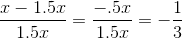
Statement (1) is sufficient.
(2) A customer with a reward card pays two thirds of any listed price.
Let y be the listed price of a given article. A customer with reward card pays  .
.
The percentage of discount is:
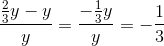
Statement (2) is sufficient.
Each Statement ALONE is sufficient.
(1) A customer without a reward card pays 1.5 times what a customer with a reward card pays on the same articles.
Let x be the price a customer with a reward card pays, a customer without a reward card pays 1.5x, 1.5x being the original selling price. We can calculate the percentage of discount as:
Statement (1) is sufficient.
(2) A customer with a reward card pays two thirds of any listed price.
Let y be the listed price of a given article. A customer with reward card pays
The percentage of discount is:
Statement (2) is sufficient.
Each Statement ALONE is sufficient.
← Didn't Know|Knew It →
What is the amount of tuition for a MBA degree at University X?
(1) Students with a GMAT score above 700 receive a 50% discount on the tuition.
(2) The average tuition paid by 5 students is $50,000, if only 2 of these students received a 50% discount.
What is the amount of tuition for a MBA degree at University X?
(1) Students with a GMAT score above 700 receive a 50% discount on the tuition.
(2) The average tuition paid by 5 students is $50,000, if only 2 of these students received a 50% discount.
Tap to reveal answer
(1) Students with a GMAT score above 700 receive a 50% discount on the tuition.
Statement (1) is not sufficient as we do not know how much half of the tuition is.
(2) The average tuition paid by 5 students is $50,000, if only 2 of these students received a 50% discount. Let x be the full amount of tuition for the MBA program.


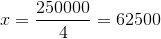
Statement(2) Alone is sufficient.
(1) Students with a GMAT score above 700 receive a 50% discount on the tuition.
Statement (1) is not sufficient as we do not know how much half of the tuition is.
(2) The average tuition paid by 5 students is $50,000, if only 2 of these students received a 50% discount. Let x be the full amount of tuition for the MBA program.
Statement(2) Alone is sufficient.
← Didn't Know|Knew It →
How many dollars does Jane save when using a coupon to buy a purse at a local store?
(1) The original price of the purse is $400.
(2) When using the coupon, Jane saves 25%.
How many dollars does Jane save when using a coupon to buy a purse at a local store?
(1) The original price of the purse is $400.
(2) When using the coupon, Jane saves 25%.
Tap to reveal answer
Note that the question does not ask for the percentage of discount but the amount of money saved.
(1) The original price of the purse is $400.
Statement (1) alone is not sufficient because it only gives the selling price prior to using the coupon.
(2) When using the coupon, Jane saves 25%.
Statement (2) alone is not sufficient. Even though we know the percentage of discount, we do not have the original price.
However, combining both statements, we get the amount of money saved as:
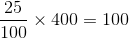
Jane saved $100 by using the coupon.
Both statements TOGETHER are sufficient, but NEITHER statement ALONE is sufficient.
Note that the question does not ask for the percentage of discount but the amount of money saved.
(1) The original price of the purse is $400.
Statement (1) alone is not sufficient because it only gives the selling price prior to using the coupon.
(2) When using the coupon, Jane saves 25%.
Statement (2) alone is not sufficient. Even though we know the percentage of discount, we do not have the original price.
However, combining both statements, we get the amount of money saved as:
Jane saved $100 by using the coupon.
Both statements TOGETHER are sufficient, but NEITHER statement ALONE is sufficient.
← Didn't Know|Knew It →
What is the new price on a car after a certain promotional offer is applied?
(1) The promotional offer is equivalent to a $4000 cash back card.
(2) The original price of the car is 1.2 times the new price after the promotional offer.
What is the new price on a car after a certain promotional offer is applied?
(1) The promotional offer is equivalent to a $4000 cash back card.
(2) The original price of the car is 1.2 times the new price after the promotional offer.
Tap to reveal answer
(1) The promotional offer is equivalent to a $4000 cash back card.
Statement (1) alone is not sufficient because we do not know the original price of the car.
(2) The original price of the car is 1.2 times the new price after the promotional offer.
Using the information statement (2), we can write:
Let x be the original price of the car and y the price after the promotional offer

Statement (2) alone is not sufficient.
Combining both statements:


We can calculate the original price as:



So we can find the new price:

(1) The promotional offer is equivalent to a $4000 cash back card.
Statement (1) alone is not sufficient because we do not know the original price of the car.
(2) The original price of the car is 1.2 times the new price after the promotional offer.
Using the information statement (2), we can write:
Let x be the original price of the car and y the price after the promotional offer
Statement (2) alone is not sufficient.
Combining both statements:
We can calculate the original price as:

So we can find the new price:

← Didn't Know|Knew It →
Susan went to a clearance sale and bought various items on sale. She saves 20% on a purse, retailing for $100. She saves 30% on a skirt that was marked down from a retail price of $40. She also bought a jacket that was on sale, and she spent a total of $150 . How much did the jacket retail for?
1. Her overall savings were 25% off the combined retail price of all three items.
2. Her discount on the jacket was $6 more than her savings on the skirt.
Susan went to a clearance sale and bought various items on sale. She saves 20% on a purse, retailing for $100. She saves 30% on a skirt that was marked down from a retail price of $40. She also bought a jacket that was on sale, and she spent a total of $150 . How much did the jacket retail for?
1. Her overall savings were 25% off the combined retail price of all three items.
2. Her discount on the jacket was $6 more than her savings on the skirt.
Tap to reveal answer
Using statement 1, it is easy to see how much the total retail amount should have been. The total retail amount discounted by 25% is the amount that Susan spent. So, we name a variable. Let x be the total retail amount. Then x - .25x = $122. We can rewrite this as x(1-.25) or x(.75)=150 thus, x = 200. So we subtract the known retail prices of the skirt and the purse to get the retail price of the jacket. So 200 - 100 - 40 = $60 is the retail price of the jacket.
Now, we should check statement 2. Using statement 2, we can calculate the savings we had on the jacket. We can first calculate how much we saved on the skirt. So 30% of the $40 retail price is $12. After we find this, we use the information from statement 2 to find the savings we had on the jacket. So $12 + $6 = $18 saved on the jacket.
Now, we need to figure out how much we spent on the jacket. We do this by taking the total amount we spent and subtracting the discounted price of the purse and the discounted price of the skirt. So, a $100 purse, at 20% off, is $80. We calculated our savings on the skirt earlier, so we know we spent $28 on the skirt. So $150 - $80 - $28 = $42.
Now combining these two pieces of information, we see we spent $42 and saved $18 so 42+18 = $60 retail price for the jacket.
We can see that either statement alone is sufficient to solve the problem.
Using statement 1, it is easy to see how much the total retail amount should have been. The total retail amount discounted by 25% is the amount that Susan spent. So, we name a variable. Let x be the total retail amount. Then x - .25x = $122. We can rewrite this as x(1-.25) or x(.75)=150 thus, x = 200. So we subtract the known retail prices of the skirt and the purse to get the retail price of the jacket. So 200 - 100 - 40 = $60 is the retail price of the jacket.
Now, we should check statement 2. Using statement 2, we can calculate the savings we had on the jacket. We can first calculate how much we saved on the skirt. So 30% of the $40 retail price is $12. After we find this, we use the information from statement 2 to find the savings we had on the jacket. So $12 + $6 = $18 saved on the jacket.
Now, we need to figure out how much we spent on the jacket. We do this by taking the total amount we spent and subtracting the discounted price of the purse and the discounted price of the skirt. So, a $100 purse, at 20% off, is $80. We calculated our savings on the skirt earlier, so we know we spent $28 on the skirt. So $150 - $80 - $28 = $42.
Now combining these two pieces of information, we see we spent $42 and saved $18 so 42+18 = $60 retail price for the jacket.
We can see that either statement alone is sufficient to solve the problem.
← Didn't Know|Knew It →
Data sufficiency question
During a semi-annual sale, the price of a shirt is discounted. Calculate the percent discount.
1. The sale price is $23.
2. The sale price is $6 less than the original price.
Data sufficiency question
During a semi-annual sale, the price of a shirt is discounted. Calculate the percent discount.
1. The sale price is $23.
2. The sale price is $6 less than the original price.
Tap to reveal answer
In order to calculate the percent discount, both the original price and the sale price must be known. From statement 1, we know the sale price and with the additional information from statement 2, we can calculate the original price and then overall percent discount.
In order to calculate the percent discount, both the original price and the sale price must be known. From statement 1, we know the sale price and with the additional information from statement 2, we can calculate the original price and then overall percent discount.
← Didn't Know|Knew It →
A lawn-mower is initially listed at . Its the ticket lists a discount of off the full price. The item is placed in a 'extra discount' location where all prices are listed as being discounted off the listed ticket price.
The customer wants to know how much she saved, , in dollars. In terms of , and , with discounts and expressed in percent, what is the formula for dollar savings off the initial list price, ?
A lawn-mower is initially listed at
The customer wants to know how much she saved,
Tap to reveal answer
The price charged at the register, after two discounts is computed using the rule for a single discount applied serially.
The 100 represents the conversion from % to decimal.
The savings, , is the difference between the price charged and the list price. So,
The price charged at the register,
The 100 represents the conversion from % to decimal.
The savings,
← Didn't Know|Knew It →
A lawn-mower is initially offerred at . Its price is discounted off the full price. What is the final price?
A lawn-mower is initially offerred at
Tap to reveal answer
If the initial price is , and the discount is , the final sale price is
If the initial price is
← Didn't Know|Knew It →