Graphing inverse variation - GMAT Quantitative
Card 1 of 40
Give the  -intercept of the graph of the equation
  .
.
Give the
Tap to reveal answer
Set  in the equation:

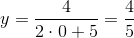
The  -intercept is
  .
.
Set
The
← Didn't Know|Knew It →
Give the  -intercept(s), if any, of the graph of the equation

Give the
Tap to reveal answer
Set  in the equation and solve for
  .
.




This is impossible, so the equation has no solution. Therefore, the graph has no  -intercept.
Set
This is impossible, so the equation has no solution. Therefore, the graph has no
← Didn't Know|Knew It →
Give the vertical asymptote of the graph of the equation

Give the vertical asymptote of the graph of the equation
Tap to reveal answer
The vertical asymptote is  , where
  is found by setting the denominator equal to 0 and solving for
  :
:





This is the equation of the vertical asymptote.
The vertical asymptote is
This is the equation of the vertical asymptote.
← Didn't Know|Knew It →
Give the -intercept(s), if any, of the graph of the equation

Give the
Tap to reveal answer
Set in the equation and solve for .


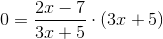





The  -intercept is
Set
The
← Didn't Know|Knew It →
Give the horizontal asymptote, if there is one, of the graph of the equation

Give the horizontal asymptote, if there is one, of the graph of the equation
Tap to reveal answer
To find the horizontal asymptote, we can divide both numerator and denominator in the right expression by  :
:


As  approaches positive or negative infinity,
  and
and  both approach 0. Therefore,
  approaches
  , making the horizontal asymptote the line of the equation
  .
.
To find the horizontal asymptote, we can divide both numerator and denominator in the right expression by
As
← Didn't Know|Knew It →
Give the -intercept of the graph of the equation .
Give the
Tap to reveal answer
Set in the equation:
The -intercept is .
Set
The
← Didn't Know|Knew It →
Give the -intercept(s), if any, of the graph of the equation
Give the
Tap to reveal answer
Set in the equation and solve for .
This is impossible, so the equation has no solution. Therefore, the graph has no -intercept.
Set
This is impossible, so the equation has no solution. Therefore, the graph has no
← Didn't Know|Knew It →
Give the vertical asymptote of the graph of the equation
Give the vertical asymptote of the graph of the equation
Tap to reveal answer
The vertical asymptote is , where is found by setting the denominator equal to 0 and solving for :
This is the equation of the vertical asymptote.
The vertical asymptote is
This is the equation of the vertical asymptote.
← Didn't Know|Knew It →
Give the -intercept(s), if any, of the graph of the equation
Give the
Tap to reveal answer
Set in the equation and solve for .
The -intercept is
Set
The
← Didn't Know|Knew It →
Give the horizontal asymptote, if there is one, of the graph of the equation
Give the horizontal asymptote, if there is one, of the graph of the equation
Tap to reveal answer
To find the horizontal asymptote, we can divide both numerator and denominator in the right expression by :
As approaches positive or negative infinity, and both approach 0. Therefore, approaches , making the horizontal asymptote the line of the equation .
To find the horizontal asymptote, we can divide both numerator and denominator in the right expression by
As
← Didn't Know|Knew It →
Give the -intercept of the graph of the equation .
Give the
Tap to reveal answer
Set in the equation:
The -intercept is .
Set
The
← Didn't Know|Knew It →
Give the -intercept(s), if any, of the graph of the equation
Give the
Tap to reveal answer
Set in the equation and solve for .
This is impossible, so the equation has no solution. Therefore, the graph has no -intercept.
Set
This is impossible, so the equation has no solution. Therefore, the graph has no
← Didn't Know|Knew It →
Give the vertical asymptote of the graph of the equation
Give the vertical asymptote of the graph of the equation
Tap to reveal answer
The vertical asymptote is , where is found by setting the denominator equal to 0 and solving for :
This is the equation of the vertical asymptote.
The vertical asymptote is
This is the equation of the vertical asymptote.
← Didn't Know|Knew It →
Give the -intercept(s), if any, of the graph of the equation
Give the
Tap to reveal answer
Set in the equation and solve for .
The -intercept is
Set
The
← Didn't Know|Knew It →
Give the horizontal asymptote, if there is one, of the graph of the equation
Give the horizontal asymptote, if there is one, of the graph of the equation
Tap to reveal answer
To find the horizontal asymptote, we can divide both numerator and denominator in the right expression by :
As approaches positive or negative infinity, and both approach 0. Therefore, approaches , making the horizontal asymptote the line of the equation .
To find the horizontal asymptote, we can divide both numerator and denominator in the right expression by
As
← Didn't Know|Knew It →
Give the -intercept of the graph of the equation .
Give the
Tap to reveal answer
Set in the equation:
The -intercept is .
Set
The
← Didn't Know|Knew It →
Give the -intercept(s), if any, of the graph of the equation
Give the
Tap to reveal answer
Set in the equation and solve for .
This is impossible, so the equation has no solution. Therefore, the graph has no -intercept.
Set
This is impossible, so the equation has no solution. Therefore, the graph has no
← Didn't Know|Knew It →
Give the vertical asymptote of the graph of the equation
Give the vertical asymptote of the graph of the equation
Tap to reveal answer
The vertical asymptote is , where is found by setting the denominator equal to 0 and solving for :
This is the equation of the vertical asymptote.
The vertical asymptote is
This is the equation of the vertical asymptote.
← Didn't Know|Knew It →
Give the -intercept(s), if any, of the graph of the equation
Give the
Tap to reveal answer
Set in the equation and solve for .
The -intercept is
Set
The
← Didn't Know|Knew It →
Give the horizontal asymptote, if there is one, of the graph of the equation
Give the horizontal asymptote, if there is one, of the graph of the equation
Tap to reveal answer
To find the horizontal asymptote, we can divide both numerator and denominator in the right expression by :
As approaches positive or negative infinity, and both approach 0. Therefore, approaches , making the horizontal asymptote the line of the equation .
To find the horizontal asymptote, we can divide both numerator and denominator in the right expression by
As
← Didn't Know|Knew It →