DSQ: Solving linear equations with two unknowns - GMAT Quantitative
Card 1 of 88
What is the value of z?
Statement 1: x+y+z=4
Statement 2: $2x+y^{2}$+z=17
What is the value of z?
Statement 1: x+y+z=4
Statement 2: $2x+y^{2}$+z=17
Tap to reveal answer
To solve for three variables, you must have three equations. Statements 1 and 2 together only give two equations, so the statements together are not sufficient.
To solve for three variables, you must have three equations. Statements 1 and 2 together only give two equations, so the statements together are not sufficient.
← Didn't Know|Knew It →
Is the equation linear?
Statement 1: 
Statement 2:  is a constant
Is the equation linear?
Statement 1:
Statement 2:
Tap to reveal answer
If we only look at statement 1, we might think the equation is not linear because of the  term. But statement 2 tells us the
  is a constant. Then the equation is linear. We need both statements to answer this question.
If we only look at statement 1, we might think the equation is not linear because of the
← Didn't Know|Knew It →
Data sufficiency question- do not actually solve the question
Solve for  :
:
2x+3xy+4y=7
1. x=1
2. x+4y=13
Data sufficiency question- do not actually solve the question
Solve for
2x+3xy+4y=7
1. x=1
2. x+4y=13
Tap to reveal answer
When solving an equation with 2 variables, a second equation or the solution of 1 variable is necessary to solve.
When solving an equation with 2 variables, a second equation or the solution of 1 variable is necessary to solve.
← Didn't Know|Knew It →
Data Sufficiency Question
Solve for  and
and  .
.

1. 
2. Both  and
and  are positive integers
Data Sufficiency Question
Solve for
1.
2. Both
Tap to reveal answer
Using statement 1 we can set up a series of equations and solve for both  and
and  .
. 
Additionally, the information in statement 2 indicates that there is only one possible solution that satisfies the requirement that both are positive integers.
Using statement 1 we can set up a series of equations and solve for both
Additionally, the information in statement 2 indicates that there is only one possible solution that satisfies the requirement that both are positive integers.
← Didn't Know|Knew It →
Solve the following for x:
4x+7y = 169
1. x > y
2. x - y = 12
Solve the following for x:
4x+7y = 169
1. x > y
2. x - y = 12
Tap to reveal answer
To solve with 2 unknowns, we must create a system of equations with at least 2 equations. Using statement 2 as a second equation we can easily get our answer. Solve statement 2 for x or y, and plug in for the corresponding variable in the equation given by the problem.
So, solving statement 2 for x, we get x=12+y. Replacing x in the equation from the problem, we get 4(12+y) + 7y=169. We can distribute the 4, and combine terms to find 48+11y=169. Subtract 48 from both sides, we get 11y=121. So y=11. Reusing either equation and plugging in our y value gives our x value. So x - 11=12, or x=23. This shows that x > y, and statement 1 is true. But even though it's true, it is completely unneccessary information. Therefore the answer is that we only need the information from statement 2, and statement 1 is not needed.
To solve with 2 unknowns, we must create a system of equations with at least 2 equations. Using statement 2 as a second equation we can easily get our answer. Solve statement 2 for x or y, and plug in for the corresponding variable in the equation given by the problem.
So, solving statement 2 for x, we get x=12+y. Replacing x in the equation from the problem, we get 4(12+y) + 7y=169. We can distribute the 4, and combine terms to find 48+11y=169. Subtract 48 from both sides, we get 11y=121. So y=11. Reusing either equation and plugging in our y value gives our x value. So x - 11=12, or x=23. This shows that x > y, and statement 1 is true. But even though it's true, it is completely unneccessary information. Therefore the answer is that we only need the information from statement 2, and statement 1 is not needed.
← Didn't Know|Knew It →
How many solutions does this system of equations have: one, none, or infinitely many?


Statement 1: 
Statement 2: 
How many solutions does this system of equations have: one, none, or infinitely many?
Statement 1:
Statement 2:
Tap to reveal answer
If the slopes of the lines are not equal, then the lines intersect at one solution; if they are equal, then they do not intersect, or the lines are the same line. Write each equation in slope-intercept form,  :
:




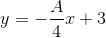



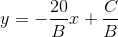
The slopes of the lines are  .
.
We need to know both  and
and  in order to determine their equality or inequality, and only if they are unequal can we answer the question.
Set  and
and  .
.
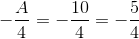
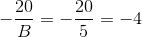
The slopes are unequal, so the lines intersect at one point; the system has exactly one solution.
If the slopes of the lines are not equal, then the lines intersect at one solution; if they are equal, then they do not intersect, or the lines are the same line. Write each equation in slope-intercept form,
The slopes of the lines are
We need to know both
Set
The slopes are unequal, so the lines intersect at one point; the system has exactly one solution.
← Didn't Know|Knew It →
Given that both  , how many solutions does this system of equations have: one, none, or infinitely many?


Statement 1: 
Statement 2: 
Given that both
Statement 1:
Statement 2:
Tap to reveal answer
If the slopes of the lines are not equal, then the lines intersect at one solution. If the slopes are equal, then there are two possibilties: either they do not intersect or they are the same line. Write each equation in slope-intercept form:




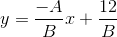




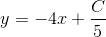
The slopes of these lines are  .
.
If Statement 1 is true, then we can rewrite the first slope as  , meaning that the lines have unequal slopes, and that there is only one solution. Statement 2 tells us the value of
  , which is irrelevant.
If the slopes of the lines are not equal, then the lines intersect at one solution. If the slopes are equal, then there are two possibilties: either they do not intersect or they are the same line. Write each equation in slope-intercept form:
The slopes of these lines are
If Statement 1 is true, then we can rewrite the first slope as
← Didn't Know|Knew It →
Data Sufficiency Question
Solve for  and
and  :
:

1. 
2. 
Data Sufficiency Question
Solve for
1.
2.
Tap to reveal answer
In order to solve an equation set, one requires a number of equations equal to the number of variables. Therefore, either of the statements allow the problem to be solved.
In order to solve an equation set, one requires a number of equations equal to the number of variables. Therefore, either of the statements allow the problem to be solved.
← Didn't Know|Knew It →
Data Sufficiency Question
Solve for  ,
,  , and
, and  :
:

1. 
2. 
Data Sufficiency Question
Solve for
1.
2.
Tap to reveal answer
In order to solve an equation set, one requires a number of equations equal to the number of variables. Therefore, three equations are needed and both statements are required to solve the problem.
In order to solve an equation set, one requires a number of equations equal to the number of variables. Therefore, three equations are needed and both statements are required to solve the problem.
← Didn't Know|Knew It →
Given that  , evaluate
  .
.
Statement 1: 
Statement 2: 
Given that
Statement 1:
Statement 2:
Tap to reveal answer
Solve for  in each statement.
Statement 1:





Statement 2:






From either statement alone, it can be deduced that  .
.
Solve for
Statement 1:
Statement 2:
From either statement alone, it can be deduced that
← Didn't Know|Knew It →
A toy store sells dolls for  dollars each and trucks for
  dollars each. How many dolls did the store sell last week?
(1) Last week, the store sold twice as many trucks as dolls.
(2) Last week, the store made  ,
, dollars from selling trucks and dolls.
A toy store sells dolls for
(1) Last week, the store sold twice as many trucks as dolls.
(2) Last week, the store made
Tap to reveal answer
Let:
t: the number of trucks sold last week
d: the number of dolls sold last week - d is the value we are looking to find
To evaluate the statements, we translate the word problems into equations
(1):  or
or 
(2): 
Each statement provides a single equation with two unknowns which is unsolvable, so each statement alone is not enough.
The two statements taken together give us a system of two equations with two unknowns, which we can solve.
Therefore the right answer is C.
Let:
t: the number of trucks sold last week
d: the number of dolls sold last week - d is the value we are looking to find
To evaluate the statements, we translate the word problems into equations
(1):
(2):
Each statement provides a single equation with two unknowns which is unsolvable, so each statement alone is not enough.
The two statements taken together give us a system of two equations with two unknowns, which we can solve.
Therefore the right answer is C.
← Didn't Know|Knew It →
What is the value of z?
Statement 1: x+y+z=4
Statement 2: $2x+y^{2}$+z=17
What is the value of z?
Statement 1: x+y+z=4
Statement 2: $2x+y^{2}$+z=17
Tap to reveal answer
To solve for three variables, you must have three equations. Statements 1 and 2 together only give two equations, so the statements together are not sufficient.
To solve for three variables, you must have three equations. Statements 1 and 2 together only give two equations, so the statements together are not sufficient.
← Didn't Know|Knew It →
Is the equation linear?
Statement 1:
Statement 2: is a constant
Is the equation linear?
Statement 1:
Statement 2:
Tap to reveal answer
If we only look at statement 1, we might think the equation is not linear because of the term. But statement 2 tells us the is a constant. Then the equation is linear. We need both statements to answer this question.
If we only look at statement 1, we might think the equation is not linear because of the
← Didn't Know|Knew It →
Data sufficiency question- do not actually solve the question
Solve for :
2x+3xy+4y=7
1. x=1
2. x+4y=13
Data sufficiency question- do not actually solve the question
Solve for
2x+3xy+4y=7
1. x=1
2. x+4y=13
Tap to reveal answer
When solving an equation with 2 variables, a second equation or the solution of 1 variable is necessary to solve.
When solving an equation with 2 variables, a second equation or the solution of 1 variable is necessary to solve.
← Didn't Know|Knew It →
Data Sufficiency Question
Solve for and .
1.
2. Both and are positive integers
Data Sufficiency Question
Solve for
1.
2. Both
Tap to reveal answer
Using statement 1 we can set up a series of equations and solve for both and .
Additionally, the information in statement 2 indicates that there is only one possible solution that satisfies the requirement that both are positive integers.
Using statement 1 we can set up a series of equations and solve for both
Additionally, the information in statement 2 indicates that there is only one possible solution that satisfies the requirement that both are positive integers.
← Didn't Know|Knew It →
Solve the following for x:
4x+7y = 169
1. x > y
2. x - y = 12
Solve the following for x:
4x+7y = 169
1. x > y
2. x - y = 12
Tap to reveal answer
To solve with 2 unknowns, we must create a system of equations with at least 2 equations. Using statement 2 as a second equation we can easily get our answer. Solve statement 2 for x or y, and plug in for the corresponding variable in the equation given by the problem.
So, solving statement 2 for x, we get x=12+y. Replacing x in the equation from the problem, we get 4(12+y) + 7y=169. We can distribute the 4, and combine terms to find 48+11y=169. Subtract 48 from both sides, we get 11y=121. So y=11. Reusing either equation and plugging in our y value gives our x value. So x - 11=12, or x=23. This shows that x > y, and statement 1 is true. But even though it's true, it is completely unneccessary information. Therefore the answer is that we only need the information from statement 2, and statement 1 is not needed.
To solve with 2 unknowns, we must create a system of equations with at least 2 equations. Using statement 2 as a second equation we can easily get our answer. Solve statement 2 for x or y, and plug in for the corresponding variable in the equation given by the problem.
So, solving statement 2 for x, we get x=12+y. Replacing x in the equation from the problem, we get 4(12+y) + 7y=169. We can distribute the 4, and combine terms to find 48+11y=169. Subtract 48 from both sides, we get 11y=121. So y=11. Reusing either equation and plugging in our y value gives our x value. So x - 11=12, or x=23. This shows that x > y, and statement 1 is true. But even though it's true, it is completely unneccessary information. Therefore the answer is that we only need the information from statement 2, and statement 1 is not needed.
← Didn't Know|Knew It →
How many solutions does this system of equations have: one, none, or infinitely many?
Statement 1:
Statement 2:
How many solutions does this system of equations have: one, none, or infinitely many?
Statement 1:
Statement 2:
Tap to reveal answer
If the slopes of the lines are not equal, then the lines intersect at one solution; if they are equal, then they do not intersect, or the lines are the same line. Write each equation in slope-intercept form, :
The slopes of the lines are .
We need to know both and in order to determine their equality or inequality, and only if they are unequal can we answer the question.
Set and .
The slopes are unequal, so the lines intersect at one point; the system has exactly one solution.
If the slopes of the lines are not equal, then the lines intersect at one solution; if they are equal, then they do not intersect, or the lines are the same line. Write each equation in slope-intercept form,
The slopes of the lines are
We need to know both
Set
The slopes are unequal, so the lines intersect at one point; the system has exactly one solution.
← Didn't Know|Knew It →
Given that both , how many solutions does this system of equations have: one, none, or infinitely many?
Statement 1:
Statement 2:
Given that both
Statement 1:
Statement 2:
Tap to reveal answer
If the slopes of the lines are not equal, then the lines intersect at one solution. If the slopes are equal, then there are two possibilties: either they do not intersect or they are the same line. Write each equation in slope-intercept form:
The slopes of these lines are .
If Statement 1 is true, then we can rewrite the first slope as , meaning that the lines have unequal slopes, and that there is only one solution. Statement 2 tells us the value of , which is irrelevant.
If the slopes of the lines are not equal, then the lines intersect at one solution. If the slopes are equal, then there are two possibilties: either they do not intersect or they are the same line. Write each equation in slope-intercept form:
The slopes of these lines are
If Statement 1 is true, then we can rewrite the first slope as
← Didn't Know|Knew It →
Data Sufficiency Question
Solve for and :
1.
2.
Data Sufficiency Question
Solve for
1.
2.
Tap to reveal answer
In order to solve an equation set, one requires a number of equations equal to the number of variables. Therefore, either of the statements allow the problem to be solved.
In order to solve an equation set, one requires a number of equations equal to the number of variables. Therefore, either of the statements allow the problem to be solved.
← Didn't Know|Knew It →
Data Sufficiency Question
Solve for , , and :
1.
2.
Data Sufficiency Question
Solve for
1.
2.
Tap to reveal answer
In order to solve an equation set, one requires a number of equations equal to the number of variables. Therefore, three equations are needed and both statements are required to solve the problem.
In order to solve an equation set, one requires a number of equations equal to the number of variables. Therefore, three equations are needed and both statements are required to solve the problem.
← Didn't Know|Knew It →