DSQ: Calculating the volume of a tetrahedron - GMAT Quantitative
Card 1 of 192
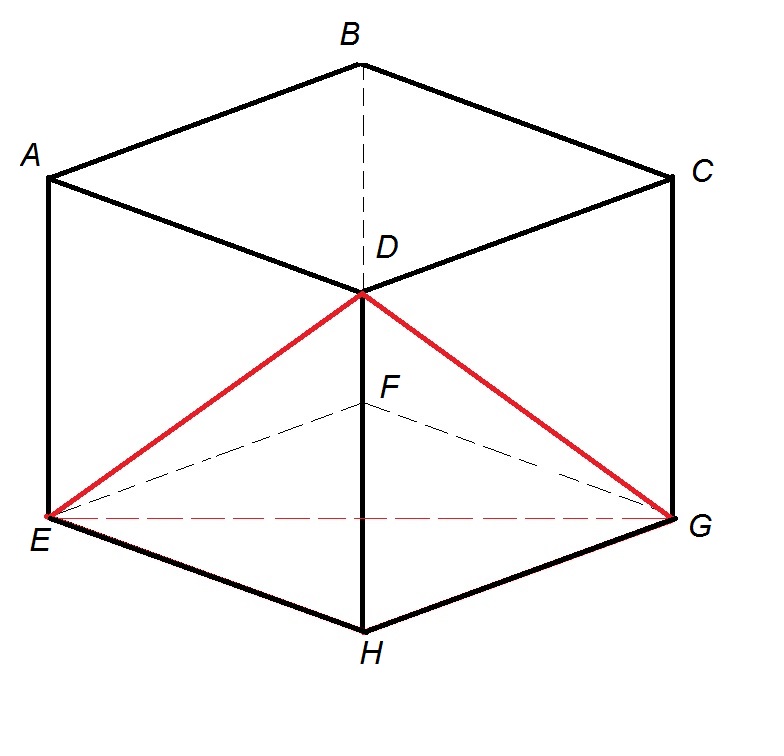
In the above diagram, a tetrahedron—a triangular pyramid—with vertices  is shown inside a cube. Give the volume of the tetrahedron.
Statement 1: The cube can be inscribed inside a sphere with volume  .
.
Statement 2: A sphere with surface area  can be inscribed inside the cube.
In the above diagram, a tetrahedron—a triangular pyramid—with vertices
Statement 1: The cube can be inscribed inside a sphere with volume
Statement 2: A sphere with surface area
Tap to reveal answer
The volume of the pyramid is one third the product of height  and the area of its base, which in turn, since here it is a right triangle, is half the product of the lengths
  and
and  of its legs. Since the prism in the figure is a cube, the three lengths are equal, so we can set each to
  . The volume of the pyramid is
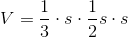

Therefore, knowing the length of one edge of the cube is sufficient to determine the volume of the pyramid.
Assume Statement 1 alone. If the volume of the circumscribing sphere is known to be  , the radius can be calculated as follows:


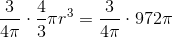


The diameter, which is twice this, or 18, is the length of a diagonal of the cube. By the three-dimensional extension of the Pythagorean Theorem, the relationship of this length to the side length of the cube is
 , or
, or

so

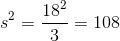
 ,
,
Assume Statement 2 alone. If the surface area of the inscribed sphere is known to be  , then its radius can be calculated as follows:


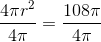

 .
.
The diameter of the inscribed sphere, which is twice this, or  , is equal to the length
  of one edge of the cube.
Either statement alone gives us the length of one side of the cube, which is enough to allow the volume of the pyramid to be calculated.
The volume of the pyramid is one third the product of height
Therefore, knowing the length of one edge of the cube is sufficient to determine the volume of the pyramid.
Assume Statement 1 alone. If the volume of the circumscribing sphere is known to be
The diameter, which is twice this, or 18, is the length of a diagonal of the cube. By the three-dimensional extension of the Pythagorean Theorem, the relationship of this length to the side length of the cube is
so
Assume Statement 2 alone. If the surface area of the inscribed sphere is known to be
The diameter of the inscribed sphere, which is twice this, or
Either statement alone gives us the length of one side of the cube, which is enough to allow the volume of the pyramid to be calculated.
← Didn't Know|Knew It →

Note: Figure NOT drawn to scale.
The above figure shows a rectangular prism with an inscribed tetrahedron, or triangular pyramid, with vertices  . What is the volume of the tetrahedron?
Statement 1: 
Statement 2: 
Note: Figure NOT drawn to scale.
The above figure shows a rectangular prism with an inscribed tetrahedron, or triangular pyramid, with vertices
Statement 1:
Statement 2:
Tap to reveal answer
We show that the two statements together provide insufficient information by assuming them both to be true.
The volume of the pyramid is one third the product of the height, which is  , and the area of the base; this base, being a right triangle, is equal to one half the product of the lengths of its legs, or
  and
and  . Therefore,

or

By Statement 1,  , and by Statement 2, , so by substitution,


Without any further information, however, the volume cannot be determined.
We show that the two statements together provide insufficient information by assuming them both to be true.
The volume of the pyramid is one third the product of the height, which is
or
By Statement 1,
Without any further information, however, the volume cannot be determined.
← Didn't Know|Knew It →
A tetrahedron is a solid with four triangular faces.
Give the volume of a tetrahedron.
Statement 1: The tetrahedron has four equilateral faces.
Statement 2: The surface area of the tetrahedron is  .
.
A tetrahedron is a solid with four triangular faces.
Give the volume of a tetrahedron.
Statement 1: The tetrahedron has four equilateral faces.
Statement 2: The surface area of the tetrahedron is
Tap to reveal answer
Neither statement is enough to determine the volume of the tetrahedron; Statement 1 alone gives no actual measurements, and Statement 2 gives only the surface area, which can apply to infinitely many tetrahedrons.
Assume both statements to be true. A tetrahedron with four equilateral faces is a regular tetrahedron, whose surface area, relative to the common length  of its edges, is defined by the formula
 .
.
By substituting for  , it is possible to calculate
  . Consequently, the volume of the tetrahedron can be calculated using the volume formula
 .
.
Neither statement is enough to determine the volume of the tetrahedron; Statement 1 alone gives no actual measurements, and Statement 2 gives only the surface area, which can apply to infinitely many tetrahedrons.
Assume both statements to be true. A tetrahedron with four equilateral faces is a regular tetrahedron, whose surface area, relative to the common length
By substituting
← Didn't Know|Knew It →
A regular tetrahedron is a solid with four faces, each of which is an equilateral triangle.
Give the volume of a regular tetrahedron.
Statement 1: Each edge has length 8.
Statement 2: Each face has area  .
.
A regular tetrahedron is a solid with four faces, each of which is an equilateral triangle.
Give the volume of a regular tetrahedron.
Statement 1: Each edge has length 8.
Statement 2: Each face has area
Tap to reveal answer
The formula for the volume of a regular tetrahedron given the length of each edge  is
is
.
Statement 1 gives  information explicitly. Statement 2 gives the means to find
  , since, if is substituted for
  in the formula for an equilateral triangle:
 ,
,
the value of  can be determined.
The formula for the volume of a regular tetrahedron given the length of each edge
Statement 1 gives
the value of
← Didn't Know|Knew It →
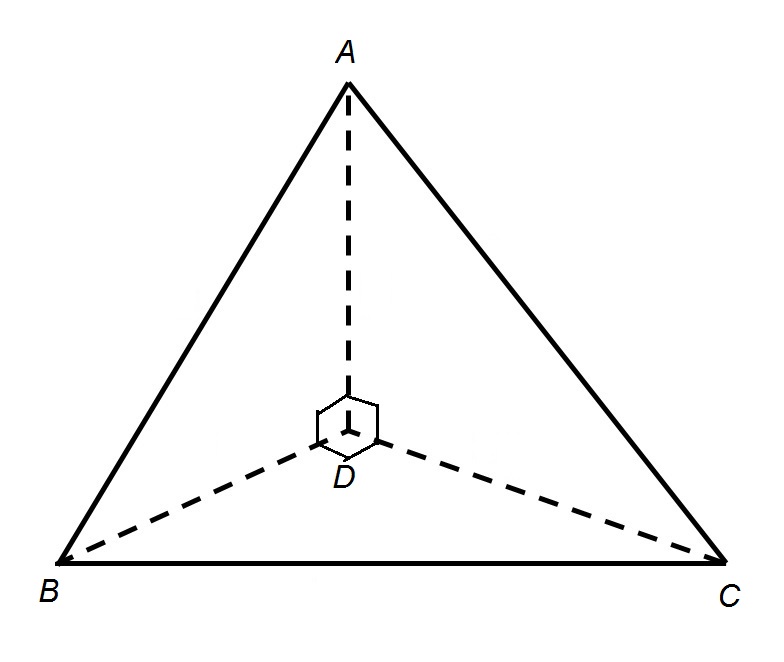
Note: Figure NOT drawn to scale.
Refer to the above figure, which shows a tetrahedron, or triangular pyramid. What is the volume of the tetrahedron?
Statement 1:  is an isosceles triangle with area 64.
Statement 2:  is an equilateral triangle with perimeter 48.
Note: Figure NOT drawn to scale.
Refer to the above figure, which shows a tetrahedron, or triangular pyramid. What is the volume of the tetrahedron?
Statement 1:
Statement 2:
Tap to reveal answer
Each statement gives enough information about one triangle to determine its area, its angles, and its sidelengths, but no information about the other three triangles is given except for one side.
Assume both statements are known. is an isosceles triangle with area 64. Since  , we can find this common sidelength using the area formula for a triangle, with these lengths as height and base:


 .
.
This is the length of both  and
and  .
.
By the 45-45-90 Theorem,  has length
  times this, or
  .
.
Since is an equilateral triangle,  . Since
  is a right triangle,
  , and
, and  , the triangle is also isosceles, and
  ; by a similar argument,
  .
.
The volume of the pyramid can be calculated. Its base, which is congruent to , has area 64, and its height is  ; multiply one third by their product to get the volume.
Each statement gives enough information about one triangle to determine its area, its angles, and its sidelengths, but no information about the other three triangles is given except for one side.
Assume both statements are known.
This is the length of both
By the 45-45-90 Theorem,
Since
The volume of the pyramid can be calculated. Its base, which is congruent to
← Didn't Know|Knew It →

In the above diagram, a tetrahedron - a triangular pyramid - with vertices  is shown inside a cube. Give the volume of the tetrahedron.
Statement 1: The perimeter of Square  is 16.
Statement 2: The area of  is 8.
is 8.
In the above diagram, a tetrahedron - a triangular pyramid - with vertices
Statement 1: The perimeter of Square
Statement 2: The area of
Tap to reveal answer
The volume of the pyramid is one third the product of height  and the area of its base, which in turn, since here it is a right triangle, is half the product of the lengths
  and
and  of its legs. Since the prism in the figure is a cube, the three lengths are equal, so we can set each to
  . The volume of the pyramid is


Therefore, knowing the length of one edge of the cube is sufficient to determine the volume of the pyramid.
Assume Statement 1 alone. Since the perimeter of Square is 16, each side of the square, and each edge of the cube has one fourth this measure, or 4.
Assume Statement 2 alone. has congruent legs, each of measure  ; since its area is 8,
  can be found as follows:


From either statement alone, the length of each side of the cube, and, subsequently, the volume of the pyramid, can be calculated.
The volume of the pyramid is one third the product of height
Therefore, knowing the length of one edge of the cube is sufficient to determine the volume of the pyramid.
Assume Statement 1 alone. Since the perimeter of Square
Assume Statement 2 alone.
From either statement alone, the length of each side of the cube, and, subsequently, the volume of the pyramid, can be calculated.
← Didn't Know|Knew It →
Note: Figure NOT drawn to scale.
The above figure shows a rectangular prism with an inscribed tetrahedron, or triangular pyramid, with vertices  . What is the volume of the tetrahedron?
Statement 1: Isosceles right triangle  has area 32.
Statement 2: 
Note: Figure NOT drawn to scale.
The above figure shows a rectangular prism with an inscribed tetrahedron, or triangular pyramid, with vertices
Statement 1: Isosceles right triangle
Statement 2:
Tap to reveal answer
The volume of the pyramid is one third the product of the height, which is , and the area of the base; this base, being a right triangle, is equal to one half the product of the lengths of its legs, or and . Therefore,
or
From Statement 1 alone, we know is isosceles and has area 32; therefore, its common leg length can be determined using the area formula:


Therefore,  . However, nothing can be determined about
  .
.
Statement 2 alone does not give any of the three desired lengths or any information necessary to find them.
However, Statement 2, along with the information from Statement 1, can be used to find  . From Statement 2,
  , and from Statement 1,
  ; the Pythagorean Theorem can be used to find
  . Therefore, all three of
  ,
,  , and
, and  can be found, and the volume of the pyramid can be calculated.
The volume of the pyramid is one third the product of the height, which is
or
From Statement 1 alone, we know
Therefore,
Statement 2 alone does not give any of the three desired lengths or any information necessary to find them.
However, Statement 2, along with the information from Statement 1, can be used to find
← Didn't Know|Knew It →
A solid in three-dimensional coordinate space has four vertices, at points  ,
,  ,
,  , and
, and  for some positive values of
  . What is the volume of the solid?
Statement 1: 
Statement 2: 
A solid in three-dimensional coordinate space has four vertices, at points
Statement 1:
Statement 2:
Tap to reveal answer
The figure described is the triangular pyramid, or tetrahedron, in the coordinate three-space below.

The base of the pyramid can be seen as a triangle with the three known coordinates , , and , and the area of its base is half the product of the lengths of its legs, which is
 .
.
The volume of the pyramid is one third the product of the area of its base, which is 48, and its height, which is the perpendicular distance from the unknown point to the base. Since the base is entirely within the  -plane, this distance is the
  -coordinate of the apex, which is
  . Therefore, the only thing that is needed to determine the volume of the pyramid is
  ; this information is provided in Statement 2, but not Statement 1.
The figure described is the triangular pyramid, or tetrahedron, in the coordinate three-space below.
The base of the pyramid can be seen as a triangle with the three known coordinates
The volume of the pyramid is one third the product of the area of its base, which is 48, and its height, which is the perpendicular distance from the unknown point to the base. Since the base is entirely within the
← Didn't Know|Knew It →
Note: Figure NOT drawn to scale.
The above figure shows a rectangular prism with an inscribed tetrahedron, or triangular pyramid, with vertices  . What is the volume of the tetrahedron?
Statement 1: Rectangle  has area 240.
Statement 2: Square  has area 144.
Note: Figure NOT drawn to scale.
The above figure shows a rectangular prism with an inscribed tetrahedron, or triangular pyramid, with vertices
Statement 1: Rectangle
Statement 2: Square
Tap to reveal answer
The volume of the pyramid is one third the product of the height, which is , and the area of the base; this base, being a right triangle, is equal to one half the product of the lengths of its legs, or and . Therefore,
or

From Statement 1, it can be determined that  , but without knowing anything about
  , the volume of the pyramid cannot be determined. Similarly, from Statement 2, it can be determined that
  , but nothing is given about
  .
.
Now assume both statements are true. Statement 2 gives that Quadrilateral is a square with area 144, so  . From Statement 1, we can tell
  . The volume of the pyramid can be calculated as
 .
.
The volume of the pyramid is one third the product of the height, which is
or
From Statement 1, it can be determined that
Now assume both statements are true. Statement 2 gives that Quadrilateral
← Didn't Know|Knew It →
A solid on the three-dimensional coordinate plane has four vertices, at points  ,
,  ,
,  , and for some positive values of . What is the volume of the solid?
Statement 1: 
Statement 2: 
A solid on the three-dimensional coordinate plane has four vertices, at points
Statement 1:
Statement 2:
Tap to reveal answer
The figure described is the triangular pyramid, or tetrahedron, in the coordinate three-space below.

The base of the pyramid can be seen as a triangle with the three known coordinates , , and , and the area of its base is half the product of the lengths of its legs, which is
 .
.
The volume of the pyramid is one third the product of the area of its base, which is 70, and its height, which is the perpendicular distance from the unknown point to the base. Since the base is entirely within the -plane, this distance is the -coordinate, which is . Therefore, the only thing that is needed to determine the volume of the pyramid is . However, the two statements together only yield  , and therefore do not give sufficient information to solve the problem.
The figure described is the triangular pyramid, or tetrahedron, in the coordinate three-space below.
The base of the pyramid can be seen as a triangle with the three known coordinates
The volume of the pyramid is one third the product of the area of its base, which is 70, and its height, which is the perpendicular distance from the unknown point to the base. Since the base is entirely within the
← Didn't Know|Knew It →
Note: Figure NOT drawn to scale.
The above figure shows a rectangular prism with an inscribed tetrahedron, or triangular pyramid, with vertices  . What is the volume of the tetrahedron?
Statement 1: Rectangle  has area 200.
Statement 2: Rectangle  has area 120.
Note: Figure NOT drawn to scale.
The above figure shows a rectangular prism with an inscribed tetrahedron, or triangular pyramid, with vertices
Statement 1: Rectangle
Statement 2: Rectangle
Tap to reveal answer
The volume of the pyramid is one third the product of the height, which is , and the area of the base; this base, being a right triangle, is equal to one half the product of the lengths of its legs, or and . Therefore,
or
We need to know the values of  ,
,  , and
, and  to find the volume of of the pyramid. We show that the two statements give insufficient information by examining two scenarios.
Case 1: 
Rectangle  has area
  .
.
Rectangle has area  .
.
The volume of the pyramid is

Case 2: 
Rectangle  has area
  .
.
Rectangle has area  .
.
The volume of the pyramid is

In each case, the conditions of both statements are met, but the volumes of the pyramids differ.
The volume of the pyramid is one third the product of the height, which is
or
We need to know the values of
Case 1:
Rectangle
Rectangle
The volume of the pyramid is
Case 2:
Rectangle
Rectangle
The volume of the pyramid is
In each case, the conditions of both statements are met, but the volumes of the pyramids differ.
← Didn't Know|Knew It →
A solid on the three-dimensional coordinate plane has four vertices, at points , , , and for some positive values of . What is the volume of the solid?
Statement 1: 
Statement 2: 
A solid on the three-dimensional coordinate plane has four vertices, at points
Statement 1:
Statement 2:
Tap to reveal answer
The figure described is the triangular pyramid, or tetrahedron, in the coordinate three-space below.
The base of the pyramid can be seen as a triangle with the three known coordinates , , and , and the area of its base is half the product of the lengths of its legs, which is
.
The volume of the pyramid is one third the product of the area of its base, which is 70, and its height, which is the perpendicular distance from the unknown point to the base. Since the base is entirely within the -plane, this distance is the -coordinate, which is . Therefore, the only thing that is needed to determine the volume of the pyramid is .
Neither statement alone is enough to gain this information. However, if both statements are assumed true, we can subtract each side of the latter equation from the former as follows:


The value of  is obtained and the volume of the pyramid can be calculated.
The figure described is the triangular pyramid, or tetrahedron, in the coordinate three-space below.
The base of the pyramid can be seen as a triangle with the three known coordinates
The volume of the pyramid is one third the product of the area of its base, which is 70, and its height, which is the perpendicular distance from the unknown point to the base. Since the base is entirely within the
Neither statement alone is enough to gain this information. However, if both statements are assumed true, we can subtract each side of the latter equation from the former as follows:
The value of
← Didn't Know|Knew It →

Note: Figure NOT drawn to scale, but you may assume  .
.
In the above figure, a pyramid with a rectangular base is inscribed inside a rectangular prism; its vertices are  . What is the volume of the pyramid?
Statement 1: The hypotenuse  of 30-60-90 triangle
  has length 16.
Statement 2: The hypotenuse  of 45-45-90 right triangle
  has length
  .
.
Note: Figure NOT drawn to scale, but you may assume
In the above figure, a pyramid with a rectangular base is inscribed inside a rectangular prism; its vertices are
Statement 1: The hypotenuse
Statement 2: The hypotenuse
Tap to reveal answer
The volume of the pyramid is one third the product of height  and the area of its rectangular base, which is
  ; that is,

Assume Statement 1 alone. is a 30-60-90 triangle with a hypotenuse of length 16. By the 30-60-90 Triangle Theorem, short leg  has length half this, or 8, and long leg
  has length
  times that of
  , or
, or  . However, the length of
  cannot be determined.
Assume Statement 2 alone. is a 45-45-90 right triangle with a hypotenuse of length . By the 45-45-90 Theorem, its legs  and
and  each have length divided by
  , which is
  ; however, the length of
  cannot be determined.
From the two statements together, we can determine that  and
and  , and calculate the volume:
 .
.
The volume of the pyramid is one third the product of height
Assume Statement 1 alone.
Assume Statement 2 alone.
From the two statements together, we can determine that
← Didn't Know|Knew It →
Pyramid 1 in three-dimensional coordinate space has as its base the square with vertices at the origin,  ,
,  , and
, and  , and its apex at the point
  ; Pyramid 2 has as its base the square with vertices at the origin,
  ,
,  , and
, and  , and its apex at the point
  . All six variables represent positive quantities. Which pyramid has the greater volume?
Statement 1:  and
and 
Statement 2: 
Pyramid 1 in three-dimensional coordinate space has as its base the square with vertices at the origin,
Statement 1:
Statement 2:
Tap to reveal answer
The volume of a pyramid is one third the product of its height and the area its base.
Pyramid 1 is shown below:
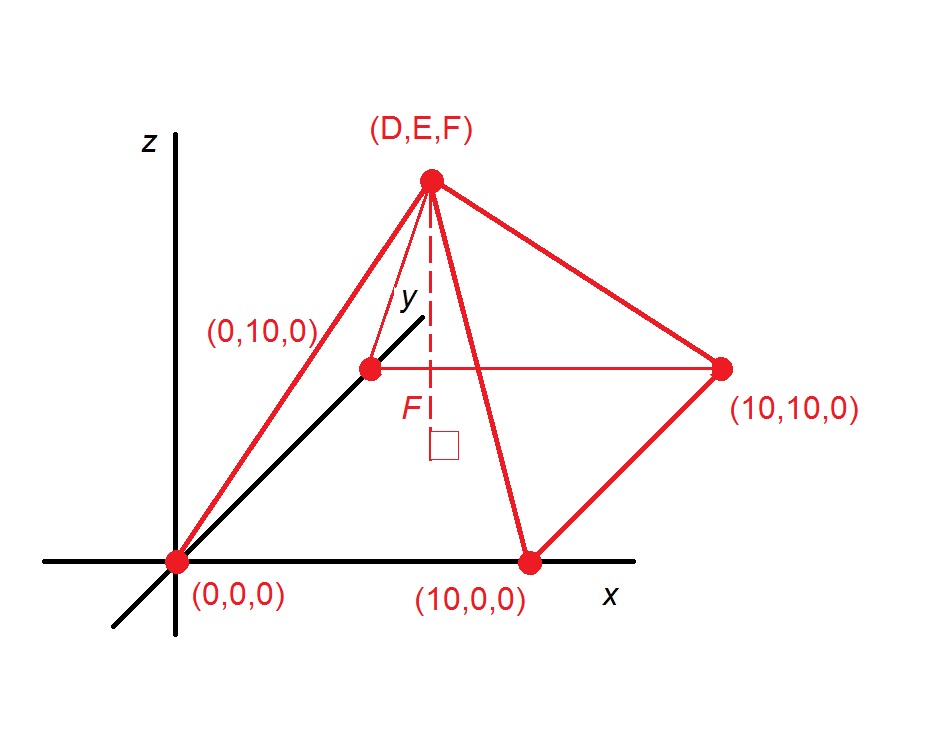
The base of the pyramid is on the  -plane, so the height of the pyramid is the perpendicular distance from apex
  to this plane; this is the
  -coordinate,
  . The base of the pyramid is a square of sidelength 10, so its area is the square of 10, or 100. This makes the volume of Pyramid 1

Similarly, the volume of Pyramid 2 is

Therefore, the problem asks us to determine which of  and
and  is the greater.
We show that the two statements together provide insufficient information by examining two scenarios.
Case 1: 



Case 2: 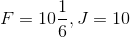



Each case fits the conditions of the two statements and the main body of the question; in one case, Pyramid 1 has the greater volume and in the other case, Pyramid 2 does.
The volume of a pyramid is one third the product of its height and the area its base.
Pyramid 1 is shown below:
The base of the pyramid is on the
Similarly, the volume of Pyramid 2 is
Therefore, the problem asks us to determine which of
We show that the two statements together provide insufficient information by examining two scenarios.
Case 1:
Case 2:
Each case fits the conditions of the two statements and the main body of the question; in one case, Pyramid 1 has the greater volume and in the other case, Pyramid 2 does.
← Didn't Know|Knew It →
Pyramid 1 and Pyramid 2 in three-dimensional coordinate space each have the same base: the square with vertices at the origin, , , and . Pyramid 1 has its fifth vertex at the point  ; Pyramid has its fifth vertex at the point
  . All six variables represent positive quantities. Which pyramid, if either, has the greater volume?
Statement 1: 
Statement 2: 
Pyramid 1 and Pyramid 2 in three-dimensional coordinate space each have the same base: the square with vertices at the origin,
Statement 1:
Statement 2:
Tap to reveal answer
The volume of a pyramid is one third the product of its height and the area its base. The two pyramids have the same base, so the pyramid with the greater height will have the greater volume (and if their heights are equal, their volumes are equal).
Pyramid 1 is shown below:
The base of the pyramid is on the -plane, so the height of the pyramid is the perpendicular distance from apex to this plane; this is the -coordinate, . Pyramid 2 has the same base and apex  , so its height is the
  -coordinate of its apex,
  .
.
Therefore, whichever is greater -  or
or  - determines which pyramid has the greater volume.
Neither statement alone gives a clue as to which is greater. However, if we assume both, then, by the subtraction property of inequality,

and

together imply that

and
 .
.
This means that Pyramid 1 has the greater height and, consequently, the greater volume.
The volume of a pyramid is one third the product of its height and the area its base. The two pyramids have the same base, so the pyramid with the greater height will have the greater volume (and if their heights are equal, their volumes are equal).
Pyramid 1 is shown below:
The base of the pyramid is on the
Therefore, whichever is greater -
Neither statement alone gives a clue as to which is greater. However, if we assume both, then, by the subtraction property of inequality,
and
together imply that
and
This means that Pyramid 1 has the greater height and, consequently, the greater volume.
← Didn't Know|Knew It →
Pyramid 1 and Pyramid 2 in three-dimensional coordinate space each have the same base: the square with vertices at the origin, , , and . Pyramid 1 has its fifth vertex at the point ; Pyramid 2 has its fifth vertex at the point . All six variables represent positive quantities. Which pyramid, if either, has the greater volume?
Statement 1: 
Statement 2: 
Pyramid 1 and Pyramid 2 in three-dimensional coordinate space each have the same base: the square with vertices at the origin,
Statement 1:
Statement 2:
Tap to reveal answer
The volume of a pyramid is one third the product of its height and the area its base. The two pyramids have the same base, so the pyramid with the greater height will have the greater volume (and if their heights are equal, their volumes are equal).
Pyramid 1 is shown below:
The base of the pyramid is on the -plane, so the height of the pyramid is the perpendicular distance from apex to this plane; this is the -coordinate, . Pyramid 2 has the same base and apex , so its height is the -coordinate of its apex, .
Therefore, whichever is greater -  or
or  - determines which pyramid has the greater volume. However, the two statements to not give this information.
The volume of a pyramid is one third the product of its height and the area its base. The two pyramids have the same base, so the pyramid with the greater height will have the greater volume (and if their heights are equal, their volumes are equal).
Pyramid 1 is shown below:
The base of the pyramid is on the
Therefore, whichever is greater -
← Didn't Know|Knew It →

The above figure shows a cube; a pyramid with vertices at  is inscribed. What is the volume of the pyramid?
Statement 1: The cube has volume 729.
Statement 2:  has area
  .
.
The above figure shows a cube; a pyramid with vertices at
Statement 1: The cube has volume 729.
Statement 2:
Tap to reveal answer
Let  be the common length of the edges of the cube.
The height of the pyramid is  , and the area of its base, Square
  , is
, is  . The volume of the pyramid is one third the product of these, or

Therefore, if the common length of the edges of the cube can be found, the volume of the pyramid can be calculated.
From Statement 1 alone, this length can be calculated as the cube root of the volume of the cube, 729; this cube root is equal to 9.
From Statement 2 alone, this length can also be calculated.  has as one leg
  with length
  ; its other leg, which is a diagonal of a square with sidelength
  has length
  by the 45-45-90 Theorem. The area is half the product of these legs; since this area is
  , we can find
  as follows:


From either statement alone,  can be calculated to be 9, and the volume of the pyramid can be found to be

Let
The height of the pyramid is
Therefore, if the common length of the edges of the cube can be found, the volume of the pyramid can be calculated.
From Statement 1 alone, this length can be calculated as the cube root of the volume of the cube, 729; this cube root is equal to 9.
From Statement 2 alone, this length can also be calculated.
From either statement alone,
← Didn't Know|Knew It →
Two right regular pyramids, Pyramid 1 and Pyramid 2, have the same height. Do the pyramids have the same volume?
Statement 1: The bases of the two pyramids have the same perimeter.
Statement 2: The base of Pyramid 1 is a hexagon; the base of Pyramid 2 is an octagon.
Two right regular pyramids, Pyramid 1 and Pyramid 2, have the same height. Do the pyramids have the same volume?
Statement 1: The bases of the two pyramids have the same perimeter.
Statement 2: The base of Pyramid 1 is a hexagon; the base of Pyramid 2 is an octagon.
Tap to reveal answer
The volume of any pyramid is one third the product of its height and the area of its base. Since both pyramids have the same height, their volumes are equal if and only if the areas of their bases are equal as well. Also, since both pyramids are regular, their bases are regular polygons.
Statement 1 alone is insufficient. It is possible for two regular polygons to have the same perimeter but different areas. For example, an equilateral triangle with perimeter 60 has sidelength 20 and, consequently, area

A square with perimeter 60 has sidelength 15, and, consequently, area equal to the square of this, 225.
Statement 2 only gives the number of sides, and no information about their measures.
Now assume both statements are true. If the common perimeter is  , then the length of one side of the base of Pyramid 1, it being a regular hexagon, is
  , likewise, the length of one side of the base of Pyramid 2 is
  . The area of each in terms of
  can be calculated, and the two can be compared.
The volume of any pyramid is one third the product of its height and the area of its base. Since both pyramids have the same height, their volumes are equal if and only if the areas of their bases are equal as well. Also, since both pyramids are regular, their bases are regular polygons.
Statement 1 alone is insufficient. It is possible for two regular polygons to have the same perimeter but different areas. For example, an equilateral triangle with perimeter 60 has sidelength 20 and, consequently, area
A square with perimeter 60 has sidelength 15, and, consequently, area equal to the square of this, 225.
Statement 2 only gives the number of sides, and no information about their measures.
Now assume both statements are true. If the common perimeter is
← Didn't Know|Knew It →
Do right regular pyramids Pyramid 1 and Pyramid 2 have the same volume?
Statement 1: The bases of the two pyramids have the same perimeter.
Statement 2: The two pyramids have the same height.
Do right regular pyramids Pyramid 1 and Pyramid 2 have the same volume?
Statement 1: The bases of the two pyramids have the same perimeter.
Statement 2: The two pyramids have the same height.
Tap to reveal answer
The volume of any pyramid is one third the product of its height and the area of its base. Also, the base of a right regular pyramid must be a regular polygon.
Assume both statements are true. Since, from Statement 2, both pyramids have the same height, their volumes are equal if and only if the areas of their bases are equal as well.
However, from Statement 1, the perimeters of the bases are what are given as being equal. Two regular poygons with the same perimeter and the same number of sides have the same area. But as exemplified below, two regular polygons with different numbers of sides and the same perimeter have different areas.
For example, an equilateral triangle with perimeter 60 has sidelength 20 and, consequently, area
A square with perimeter 60 has sidelength 15, and, consequently, area equal to the square of this, 225.
The volume of any pyramid is one third the product of its height and the area of its base. Also, the base of a right regular pyramid must be a regular polygon.
Assume both statements are true. Since, from Statement 2, both pyramids have the same height, their volumes are equal if and only if the areas of their bases are equal as well.
However, from Statement 1, the perimeters of the bases are what are given as being equal. Two regular poygons with the same perimeter and the same number of sides have the same area. But as exemplified below, two regular polygons with different numbers of sides and the same perimeter have different areas.
For example, an equilateral triangle with perimeter 60 has sidelength 20 and, consequently, area
A square with perimeter 60 has sidelength 15, and, consequently, area equal to the square of this, 225.
← Didn't Know|Knew It →
Two right regular pyramids, Pyramid 1 and Pyramid 2, have the same height. Do the pyramids have the same volume?
Statement 1: The bases of the two pyramids have the same area.
Statement 2: The base of Pyramid 1 has seven sides; the base of Pyramid 2 has nine sides.
Two right regular pyramids, Pyramid 1 and Pyramid 2, have the same height. Do the pyramids have the same volume?
Statement 1: The bases of the two pyramids have the same area.
Statement 2: The base of Pyramid 1 has seven sides; the base of Pyramid 2 has nine sides.
Tap to reveal answer
The volume of any pyramid is one third the product of its height and the area of its base. Since the two pyramids have the same height, their volume will be the same if and only if their bases have the same area. Statement 1 gives us this information explicity. Statement 2 is irrelevant, since the number of sides of a polygon by itself does not give a clue as to its area.
The volume of any pyramid is one third the product of its height and the area of its base. Since the two pyramids have the same height, their volume will be the same if and only if their bases have the same area. Statement 1 gives us this information explicity. Statement 2 is irrelevant, since the number of sides of a polygon by itself does not give a clue as to its area.
← Didn't Know|Knew It →