Powers & Roots of Numbers - GMAT Quantitative
Card 1 of 400
What is  ?
?
What is
Tap to reveal answer

← Didn't Know|Knew It →
What is  ?
?
What is
Tap to reveal answer


← Didn't Know|Knew It →
What is  ?
?
What is
Tap to reveal answer


← Didn't Know|Knew It →
Solve: $($\sqrt{5}$+$\sqrt{4}$)^2$
Solve: $($\sqrt{5}$+$\sqrt{4}$)^2$
Tap to reveal answer
First, FOIL:
$(sqrt5+sqrt4)^2$=(sqrt5+sqrt4)(sqrt5+sqrt4)=5+sqrt20+sqrt20+4
=9+2sqrt20
Factor out sqrt4
=9+4sqrt5
First, FOIL:
$(sqrt5+sqrt4)^2$=(sqrt5+sqrt4)(sqrt5+sqrt4)=5+sqrt20+sqrt20+4
=9+2sqrt20
Factor out sqrt4
=9+4sqrt5
← Didn't Know|Knew It →
Solve: $$\frac{10^9$$-10^7$}{99}$
Solve: $$\frac{10^9$$-10^7$}{99}$
Tap to reveal answer
First factor. $$\frac{10^9$$-10^7$}{99}$ = $$\frac{(10^7$$)(10^2$-1)}{99}$
Simplify. $$\frac{(10^7$$)(10^2$-1)}{99}$ = $$\frac{(10^7$)(100-1)}{99}$ = $$\frac{(10^7$)(99)}{99}$ = $10^7$
First factor. $$\frac{10^9$$-10^7$}{99}$ = $$\frac{(10^7$$)(10^2$-1)}{99}$
Simplify. $$\frac{(10^7$$)(10^2$-1)}{99}$ = $$\frac{(10^7$)(100-1)}{99}$ = $$\frac{(10^7$)(99)}{99}$ = $10^7$
← Didn't Know|Knew It →
If $x^2$=8, what is $x^4$?
If $x^2$=8, what is $x^4$?
Tap to reveal answer
$x^4$$=(x^2$$)^2$$=(8)^2$=64
$x^4$$=(x^2$$)^2$$=(8)^2$=64
← Didn't Know|Knew It →
If the side length of a cube is tripled, how does the volume of the cube change?
If the side length of a cube is tripled, how does the volume of the cube change?
Tap to reveal answer
The equation for the volume of a cube is  . If the length is tripled, it becomes
  , and
, and  , so the volume increases by 27 times the original size.
The equation for the volume of a cube is
← Didn't Know|Knew It →
Evaluate: 
Evaluate:
Tap to reveal answer

← Didn't Know|Knew It →
Solve: $$\frac{(0.5)^{6}$$$}{(0.5)^{9}$}
Solve: $$\frac{(0.5)^{6}$$$}{(0.5)^{9}$}
Tap to reveal answer
Solve: $$\frac{0.5^{6}$$$}{0.5^{9}$} = $0.5^{6-9}$= $0.5^{-3}$$=\frac{1}{0.5^{3}$$}=\frac{1}{0.125}$ = 8
Solve: $$\frac{0.5^{6}$$$}{0.5^{9}$} = $0.5^{6-9}$= $0.5^{-3}$$=\frac{1}{0.5^{3}$$}=\frac{1}{0.125}$ = 8
← Didn't Know|Knew It →
$$\frac{x^{2}$$$y^{3}$$z^{4}$$}{x^{3}$$yz^{3}$} =
$$\frac{x^{2}$$$y^{3}$$z^{4}$$}{x^{3}$$yz^{3}$} =
Tap to reveal answer
$$\frac{x^{2}$$$y^{3}$$z^{4}$$}{x^{3}$$yz^{3}$} = $$\frac{y^{3-1}$$$z^{4-3}$$}{x^{3-2}$} = $$\frac{y^{2}$$z}{x}
$$\frac{x^{2}$$$y^{3}$$z^{4}$$}{x^{3}$$yz^{3}$} = $$\frac{y^{3-1}$$$z^{4-3}$$}{x^{3-2}$} = $$\frac{y^{2}$$z}{x}
← Didn't Know|Knew It →
In the sequence 1, 3, 9, 27, 81, … , each term after the first is three times the previous term. What is the sum of the 9th and 10th terms in the sequence?
In the sequence 1, 3, 9, 27, 81, … , each term after the first is three times the previous term. What is the sum of the 9th and 10th terms in the sequence?
Tap to reveal answer
We can rewrite the sequence as  ,
,  ,
,  ,
,  ,
,  , … ,
, … ,
and we can see that the 9th term in the sequence is  and the 10th term in the sequence is
  . Therefore, the sum of the 9th and 10th terms would be

We can rewrite the sequence as
and we can see that the 9th term in the sequence is
← Didn't Know|Knew It →
Simplify this expression as much as possible:

Simplify this expression as much as possible:
Tap to reveal answer





← Didn't Know|Knew It →
Simplify 
Simplify
Tap to reveal answer
This can either be done by brute force (slow) or by recognizing the properties of roots and exponents (fast). Roots are simply fractional exponents:  ,
,  , etc. so they can be done in any order.
So we see a cube root, we can immediately cancel that with the exponent of 3. taking us from here:  to
to  . We now simplify
  to get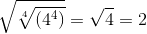
This can either be done by brute force (slow) or by recognizing the properties of roots and exponents (fast). Roots are simply fractional exponents:
So we see a cube root, we can immediately cancel that with the exponent of 3. taking us from here:
← Didn't Know|Knew It →

Tap to reveal answer
The two terms have the same base, 3. Therefore, we add the exponents to simplify:

The two terms have the same base, 3. Therefore, we add the exponents to simplify:
← Didn't Know|Knew It →
Which of the following is equivalent to  ?
?
Which of the following is equivalent to
Tap to reveal answer

← Didn't Know|Knew It →
What is  ?
?
What is
Tap to reveal answer

← Didn't Know|Knew It →
What is  ?
?
What is
Tap to reveal answer


← Didn't Know|Knew It →
Find the remainder

Find the remainder
Tap to reveal answer
Clearly, we aren't expected to calculate $75^75$. The clue is that since we are supposed to divide by 38, let's see if we can rewrite the numerator so that we have a 38 in it.
For example:  ,
,
and  ,
,
so we have:

If we expanded this expression, all of the terms but one will have a  in them, so all of the terms except for the last term, when divided by
  , will not leave a remainder.
The last term will be  , which is just
  .
.
Essentially, all we are asked to do is to figure out the remainder when  is divided by
  .
.
Otherwise stated:
 , where R is the remainder.
Clearly, 
Clearly, we aren't expected to calculate $75^75$. The clue is that since we are supposed to divide by 38, let's see if we can rewrite the numerator so that we have a 38 in it.
For example:
and
so we have:
If we expanded this expression, all of the terms but one will have a
The last term will be
Essentially, all we are asked to do is to figure out the remainder when
Otherwise stated:
Clearly,
← Didn't Know|Knew It →

Give the area of the above kite.
Give the area of the above kite.
Tap to reveal answer
 ,
,
so the lengths of the sides of each triangle comprise a Pythagorean triple. Therefore, each triangle is a right triangle with legs 7 and 24, and the kite is a composite of two such right triangles. Its area is therefore

so the lengths of the sides of each triangle comprise a Pythagorean triple. Therefore, each triangle is a right triangle with legs 7 and 24, and the kite is a composite of two such right triangles. Its area is therefore
← Didn't Know|Knew It →
If  , what is the value of
  ?
?
If
Tap to reveal answer
We need to put the expression under the format of 2 to the power of m:


Therefore the right answer is 7.
We need to put the expression under the format of 2 to the power of m:
Therefore the right answer is 7.
← Didn't Know|Knew It →