Powers & Roots of Numbers - GMAT Quantitative
Card 1 of 112
What is the value of twelve raised to the fourth power?
What is the value of twelve raised to the fourth power?
Tap to reveal answer
"Twelve raised to the fourth power" is 124. If you can translate the words into their mathematical counterpart, you're done, because the actual calculation should be done by your calculator. It will tell you that  . There is not enough time on the test for you to try to do this by hand.
"Twelve raised to the fourth power" is 124. If you can translate the words into their mathematical counterpart, you're done, because the actual calculation should be done by your calculator. It will tell you that
← Didn't Know|Knew It →
 and
and  are integers. Is
  positive, negative, or zero?
Statement 1:  is negative.
Statement 2:  is odd.
Statement 1:
Statement 2:
Tap to reveal answer
A negative integer to an even power is positive:
Example: 
A negative integer to an odd power is negative:
Example: 
A positive integer to an odd power is positive:
Example: 
So, as seen in the first two statements, knowing only that base  is negative is insufficient to detemine the sign of
  ; as seen in the last two statements, knowing only that exponent
  is odd is also insufficient. But by the middle statement, knowing both facts tells us
  is negative.
The answer is that both statements together are sufficient to answer the question, but neither statement alone is sufficient.
A negative integer to an even power is positive:
Example:
A negative integer to an odd power is negative:
Example:
A positive integer to an odd power is positive:
Example:
So, as seen in the first two statements, knowing only that base
The answer is that both statements together are sufficient to answer the question, but neither statement alone is sufficient.
← Didn't Know|Knew It →
Let  be positive integers. Is
  an integer?
Statement 1:  is a perfect square.
Statement 2:  is an even integer.
Let
Statement 1:
Statement 2:
Tap to reveal answer
We examine two examples of situations in which both statements hold.
Example 1: 
Then 
32 is not a perfect square, so  is not an integer.
Example 2: 
Then  , making
  an integer.
In both cases, both statements hold, but in only one,  is an integer. This makes the two statements together insufficient.
We examine two examples of situations in which both statements hold.
Example 1:
Then
32 is not a perfect square, so
Example 2:
Then
In both cases, both statements hold, but in only one,
← Didn't Know|Knew It →
Imagine an integer  such that the units digit of
  is greater than 5. What is the units digit of
  ?
?
(1) The units digit of  is the same as the units digit of
  .
.
(2) The units digit of  is the same as the units digit of
  .
.
Imagine an integer
(1) The units digit of
(2) The units digit of
Tap to reveal answer
(1) The only single-digit integer greater than 5 whose unit digit of its square term is equal to itself is 6. This statement is sufficient.
(2) There are two single-digit integers where the unit digit of the cubed term is equal to the integer itself: 6 and 9. This statement is insufficient.
(1) The only single-digit integer greater than 5 whose unit digit of its square term is equal to itself is 6. This statement is sufficient.
(2) There are two single-digit integers where the unit digit of the cubed term is equal to the integer itself: 6 and 9. This statement is insufficient.
← Didn't Know|Knew It →
 is a real number. Is
  positive, negative, or zero?
Statement 1: 
Statement 2: 
Statement 1:
Statement 2:
Tap to reveal answer
If  , then
  , and
, and  , so
, so  must be positive.
If  , then
  ,
,  . and
. and  , so again,
  must be positive. Either statement is enough to answer the question in the affirmative.
If
If
← Didn't Know|Knew It →
Simplify this expression as much as possible:

Simplify this expression as much as possible:
Tap to reveal answer


← Didn't Know|Knew It →
Calculate the fifth root of  :
:
(1) The square root of  is
is  .
.
(2) The tenth root of  is
is  .
.
Calculate the fifth root of
(1) The square root of
(2) The tenth root of
Tap to reveal answer
Using Statement (1):

Statement (1) ALONE is SUFFICIENT.
Using Statement (2):

Statement (2) ALONE is SUFFICIENT.
Therefore EACH Statement ALONE is sufficient.
Using Statement (1):
Statement (1) ALONE is SUFFICIENT.
Using Statement (2):
Statement (2) ALONE is SUFFICIENT.
Therefore EACH Statement ALONE is sufficient.
← Didn't Know|Knew It →
 is a positive real number. True or false:
  is a rational number.
Statement 1:  is irrational.
Statement 2:  is irrational.
Statement 1:
Statement 2:
Tap to reveal answer
If  is rational, then, since the product of two rational numbers is rational,
  is rational. If Statement 1 alone is assumed, then, since
  is irrational,
  must be irrational.
Assume Statement 2 alone, and note that

In other words, is the square root of . Since both rational and irrational numbers have irrational square roots, being irrational does not prove or disprove that is rational.
If
Assume Statement 2 alone, and note that
In other words,
← Didn't Know|Knew It →
 is a positive real number. True or false:
  is a rational number.
Statement 1:  is a rational number.
Statement 2:  is a rational number.
Statement 1:
Statement 2:
Tap to reveal answer
Statement 1 alone provides insufficient information.  is a number with a rational cube root,
  , and a rational square root,
  .
.  is a number with a rational cube root,
  , but an irrational square root.
Now assume Statement 2 alone.

In other words, is the square of  . The rational numbers are closed under multiplication, so if is rational,
  is rational.
Statement 1 alone provides insufficient information.
Now assume Statement 2 alone.
In other words,
← Didn't Know|Knew It →
 is a positive real number. True or false:
  is a rational number.
Statement 1:  is a rational number.
Statement 2:  is a rational number.
Statement 1:
Statement 2:
Tap to reveal answer
Statement 1 alone is not enough to determine whether  is rational or not;
  and
and  both have rational cubes, but only
  is rational. By a similar argument, Statement 2 alone is insufficient.
Assume both statements are true.  , the quotient of two rational numbers, which must itself be rational.
Statement 1 alone is not enough to determine whether
Assume both statements are true.
← Didn't Know|Knew It →
 is a positive real number. True or false:
  is a rational number.
Statement 1:  is an irrational number.
Statement 2:  is an irrational number.
Statement 1:
Statement 2:
Tap to reveal answer
An integer power of a rational number, being a product of rational numbers, must itself be rational. Either statement alone asserts that such a power is irrational, so conversely, either statement alone proves  irrational.
An integer power of a rational number, being a product of rational numbers, must itself be rational. Either statement alone asserts that such a power is irrational, so conversely, either statement alone proves
← Didn't Know|Knew It →
 . True or false:
  is rational.
Statement 1:  is rational.
Statement 2:  is rational.
Statement 1:
Statement 2:
Tap to reveal answer
Statement 1 alone is not enough to prove  is or is not rational. Examples:
If  , then
If  , then
In both cases,  is rational, but in one case,
  is rational and in the other,
  is irrational.
A similar argument demonstrates Statement 2 to be insufficient.
Assume both statements are true.  and
and  are rational, so their difference is as well:


 is rational, so by closure under division,
  is rational.
Statement 1 alone is not enough to prove
If
If
In both cases,
A similar argument demonstrates Statement 2 to be insufficient.
Assume both statements are true.
← Didn't Know|Knew It →
 . True or false:
  is rational.
Statement 1:  is irrational.
Statement 2:  is rational.
Statement 1:
Statement 2:
Tap to reveal answer
Statement 1 alone is not enough to prove  rational or irrational. Examples:
If  , then
If  , then
In both cases,  is irrational, but in only one case,
  is rational.
Assume Statement 2 alone.  is rational, so, by closure of the rational numbers under multiplication,
 is rational. The rationals are closed under addition, so the sum

is rational.
Statement 1 alone is not enough to prove
If
If
In both cases,
Assume Statement 2 alone.
is rational.
← Didn't Know|Knew It →
Simplify: 
Simplify:
Tap to reveal answer
When we are faced with a radical in the denominator of a fraction, the first step is to multiply the top and bottom of the fraction by the numerator:
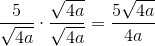
We can then reduce the fraction to:
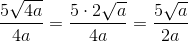
When we are faced with a radical in the denominator of a fraction, the first step is to multiply the top and bottom of the fraction by the numerator:
We can then reduce the fraction to:
← Didn't Know|Knew It →
What is the value of twelve raised to the fourth power?
What is the value of twelve raised to the fourth power?
Tap to reveal answer
"Twelve raised to the fourth power" is 124. If you can translate the words into their mathematical counterpart, you're done, because the actual calculation should be done by your calculator. It will tell you that . There is not enough time on the test for you to try to do this by hand.
"Twelve raised to the fourth power" is 124. If you can translate the words into their mathematical counterpart, you're done, because the actual calculation should be done by your calculator. It will tell you that
← Didn't Know|Knew It →
and are integers. Is positive, negative, or zero?
Statement 1: is negative.
Statement 2: is odd.
Statement 1:
Statement 2:
Tap to reveal answer
A negative integer to an even power is positive:
Example:
A negative integer to an odd power is negative:
Example:
A positive integer to an odd power is positive:
Example:
So, as seen in the first two statements, knowing only that base is negative is insufficient to detemine the sign of ; as seen in the last two statements, knowing only that exponent is odd is also insufficient. But by the middle statement, knowing both facts tells us is negative.
The answer is that both statements together are sufficient to answer the question, but neither statement alone is sufficient.
A negative integer to an even power is positive:
Example:
A negative integer to an odd power is negative:
Example:
A positive integer to an odd power is positive:
Example:
So, as seen in the first two statements, knowing only that base
The answer is that both statements together are sufficient to answer the question, but neither statement alone is sufficient.
← Didn't Know|Knew It →
Let be positive integers. Is an integer?
Statement 1: is a perfect square.
Statement 2: is an even integer.
Let
Statement 1:
Statement 2:
Tap to reveal answer
We examine two examples of situations in which both statements hold.
Example 1:
Then
32 is not a perfect square, so is not an integer.
Example 2:
Then , making an integer.
In both cases, both statements hold, but in only one, is an integer. This makes the two statements together insufficient.
We examine two examples of situations in which both statements hold.
Example 1:
Then
32 is not a perfect square, so
Example 2:
Then
In both cases, both statements hold, but in only one,
← Didn't Know|Knew It →
Imagine an integer such that the units digit of is greater than 5. What is the units digit of ?
(1) The units digit of is the same as the units digit of .
(2) The units digit of is the same as the units digit of .
Imagine an integer
(1) The units digit of
(2) The units digit of
Tap to reveal answer
(1) The only single-digit integer greater than 5 whose unit digit of its square term is equal to itself is 6. This statement is sufficient.
(2) There are two single-digit integers where the unit digit of the cubed term is equal to the integer itself: 6 and 9. This statement is insufficient.
(1) The only single-digit integer greater than 5 whose unit digit of its square term is equal to itself is 6. This statement is sufficient.
(2) There are two single-digit integers where the unit digit of the cubed term is equal to the integer itself: 6 and 9. This statement is insufficient.
← Didn't Know|Knew It →
is a real number. Is positive, negative, or zero?
Statement 1:
Statement 2:
Statement 1:
Statement 2:
Tap to reveal answer
If , then , and , so must be positive.
If , then , . and , so again, must be positive. Either statement is enough to answer the question in the affirmative.
If
If
← Didn't Know|Knew It →
Simplify this expression as much as possible:
Simplify this expression as much as possible:
Tap to reveal answer
← Didn't Know|Knew It →