Proving the Pythagorean Identity
Help Questions
Geometry › Proving the Pythagorean Identity
A student tries to prove $\sin^2\theta+\cos^2\theta=1$ from a right triangle but makes an error. Which reasoning proves $\sin^2\theta+\cos^2\theta=1$?
Start with $\sin\theta=\frac{\text{opposite}}{\text{hypotenuse}}$ and $\cos\theta=\frac{\text{adjacent}}{\text{hypotenuse}}$, then square and use $\text{opposite}^2+\text{adjacent}^2=\text{hypotenuse}^2$.
Start with $\sin\theta=\frac{\text{opposite}}{\text{hypotenuse}}$ and $\cos\theta=\frac{\text{adjacent}}{\text{hypotenuse}}$, then add to get $\frac{\text{opposite}+\text{adjacent}}{\text{hypotenuse}}=1$.
Start with $\sin\theta=\frac{\text{hypotenuse}}{\text{opposite}}$ and $\cos\theta=\frac{\text{hypotenuse}}{\text{adjacent}}$, then square and add to get $1$.
Because $\theta$ is acute, $\sin^2\theta+\cos^2\theta=2\sin\theta\cos\theta$ and this equals $1$.
Explanation
To correctly prove the Pythagorean identity sin²θ + cos²θ = 1, we must start with the proper definitions: sin θ = opposite/hypotenuse and cos θ = adjacent/hypotenuse. When we square these ratios, we get sin²θ = opposite²/hypotenuse² and cos²θ = adjacent²/hypotenuse². The Pythagorean Theorem tells us that opposite² + adjacent² = hypotenuse² in any right triangle. Adding our squared trigonometric ratios: sin²θ + cos²θ = opposite²/hypotenuse² + adjacent²/hypotenuse² = (opposite² + adjacent²)/hypotenuse² = hypotenuse²/hypotenuse² = 1. Choice A incorrectly tries to add the unsquared ratios, claiming that opposite + adjacent = hypotenuse, which is false. The key insight is that the Pythagorean Theorem applies to squared lengths, matching perfectly with the squared trigonometric ratios in the identity.
A right triangle is normalized so that its hypotenuse is $1$. In the diagram, $\angle M=\theta$, the adjacent leg to $\theta$ is labeled $x$, and the opposite leg is labeled $y$. The diagram indicates the right angle at the vertex between the legs. Which statement justifies the identity?
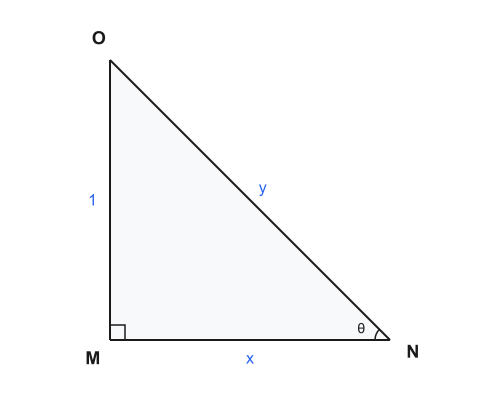
Since $x=\cos\theta$ and $y=\sin\theta$, then $x^2+y^2=1$ by the Pythagorean Theorem.
Since $x=\cos\theta$ and $y=\sin\theta$, then $x+y=1$ and so $\sin^2\theta+\cos^2\theta=1$.
Since $\theta$ is acute, $\sin\theta=\cos\theta$, so $\sin^2\theta+\cos^2\theta=1$.
Since $x=\sin\theta$ and $y=\cos\theta$, then $x^2+y^2=1$ by definition.
Explanation
The Pythagorean identity states that for any angle θ, sin²θ + cos²θ = 1. In a right triangle with angle θ at M, sine of θ is defined as the ratio of the opposite leg y to the hypotenuse 1, and cosine is the ratio of the adjacent leg x to the hypotenuse 1. Squaring these ratios gives sin²θ = y²/1² and cos²θ = x²/1². Adding them results in sin²θ + cos²θ = (y² + x²)/1², and by the Pythagorean theorem, y² + x² = 1². Therefore, sin²θ + cos²θ = 1/1 = 1, deriving the identity. A common misconception, as in choice A, is assuming x + y = 1 and then squaring, but the legs add differently and the identity requires squaring first. To remember this, always return to the geometry of the right triangle and apply the definitions and the theorem step by step.
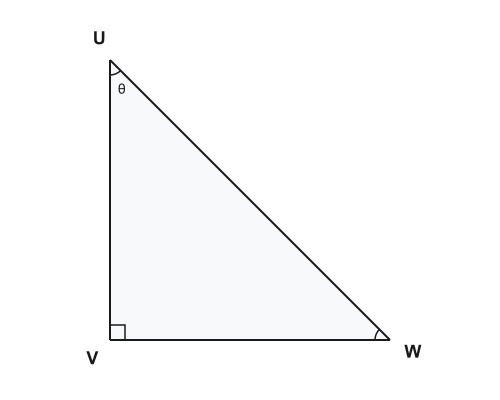
In the diagram, $\triangle UৱV W$ (triangle $UVW$) is right at $V$ with $\angle U=\theta$. The student wants to prove $\sin^2\theta+\cos^2\theta=1$ without memorizing the identity. Which explanation proves the identity for all $\theta$ where the right triangle is defined?
Assume the identity is true because it appears in a formula sheet, so no proof is needed.
Use $\sin\theta=\frac{\text{opposite}}{\text{hypotenuse}}$ and $\cos\theta=\frac{\text{adjacent}}{\text{hypotenuse}}$, then square and add and apply the Pythagorean Theorem.
Use $\sin\theta=\frac{\text{adjacent}}{\text{hypotenuse}}$ and $\cos\theta=\frac{\text{opposite}}{\text{hypotenuse}}$, then add to get 1.
Compute $\sin\theta$ and $\cos\theta$ for $\theta=30^\circ$ and conclude the identity is always true.
Explanation
The Pythagorean identity states that for any angle θ, sin²θ + cos²θ = 1. In a right triangle like △UVW with right angle at V and angle θ at U, sine of θ is defined as the ratio of the opposite side to the hypotenuse, and cosine is the ratio of the adjacent side to the hypotenuse. Squaring these ratios gives sin²θ = (opposite/hypotenuse)² and cos²θ = (adjacent/hypotenuse)². Adding them results in sin²θ + cos²θ = (opposite² + adjacent²)/hypotenuse², and by the Pythagorean theorem, opposite² + adjacent² = hypotenuse². Therefore, sin²θ + cos²θ = hypotenuse²/hypotenuse² = 1, deriving the identity. A common misconception, as in choice B, is swapping opposite and adjacent in the definitions, which inverts sine and cosine but fails to prove the identity correctly without adjustment. To remember this, always return to the geometry of the right triangle and apply the definitions and the theorem step by step.
In the diagram, $\triangle XYZ$ is a right triangle with right angle at $Y$ and $\angle X=\theta$. The side opposite $\theta$ is labeled $a$, the side adjacent to $\theta$ is labeled $b$, and the hypotenuse is labeled $c$. Which conclusion follows from the diagram and correctly proves $\sin^2\theta+\cos^2\theta=1$?
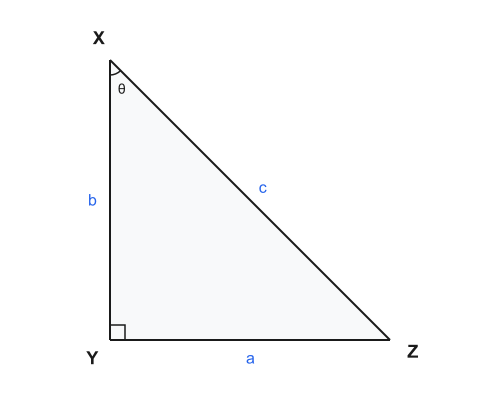
Because $\sin\theta=\frac{a}{c}$ and $\cos\theta=\frac{b}{c}$, then $\sin^2\theta+\cos^2\theta=\frac{a^2+b^2}{c^2}=\frac{c^2}{c^2}=1$.
Because $a+b=c$ in a right triangle, then $\left(\frac{a}{c}\right)^2+\left(\frac{b}{c}\right)^2=1$.
Because the triangle is not drawn to scale, $\sin\theta$ and $\cos\theta$ cannot be related.
Because $\sin\theta=\frac{a}{b}$ and $\cos\theta=\frac{b}{a}$, then $\sin^2\theta+\cos^2\theta=1$.
Explanation
The Pythagorean identity states that for any angle θ, sin²θ + cos²θ = 1. In a right triangle like △XYZ with right angle at Y and angle θ at X, sine of θ is defined as the ratio of the opposite side a to the hypotenuse c, and cosine is the ratio of the adjacent side b to the hypotenuse c. Squaring these ratios gives sin²θ = (a/c)² and cos²θ = (b/c)². Adding them results in sin²θ + cos²θ = (a² + b²)/c², and by the Pythagorean theorem, a² + b² = c². Therefore, sin²θ + cos²θ = c²/c² = 1, deriving the identity. A common misconception, as in choice C, is assuming the sum of legs equals the hypotenuse (a + b = c), which is incorrect and confuses addition with the Pythagorean sum of squares. To remember this, always return to the geometry of the right triangle and apply the definitions and the theorem step by step.
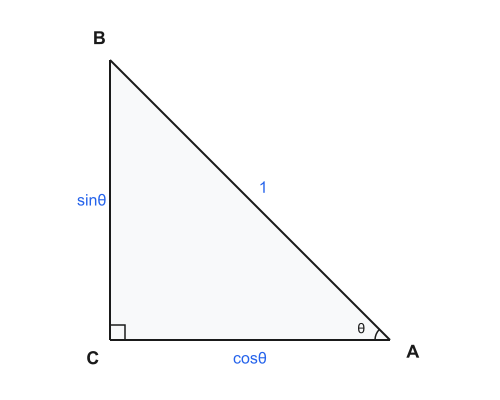
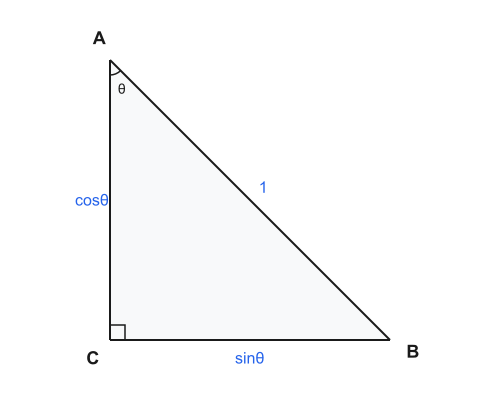
In the diagram, $\triangle ABC$ is a right triangle with right angle at $C$. The angle at $A$ is labeled $\theta$. The hypotenuse $\overline{AB}$ is labeled $1$, the leg $\overline{AC}$ (adjacent to $\theta$) is labeled $\cos\theta$, and the leg $\overline{BC}$ (opposite $\theta$) is labeled $\sin\theta$. Which reasoning proves $\sin^2\theta+\cos^2\theta=1$ for this setup (and thus for all $\theta$ where the triangle is defined)?
Because $\sin\theta+\cos\theta=1$ from the side labels, squaring gives $\sin^2\theta+\cos^2\theta=1$.
Using $\sin\theta=\frac{\sin\theta}{1}$ and $\cos\theta=\frac{\cos\theta}{1}$, add to get $\sin\theta+\cos\theta=1$.
By the Pythagorean Theorem, $AC^2+BC^2=AB^2$, so $(\cos\theta)^2+(\sin\theta)^2=1^2$.
Since the triangle is right, $\sin\theta=\cos\theta$, so $2\sin^2\theta=1$.
Explanation
The Pythagorean identity states that for any angle θ, sin²θ + cos²θ = 1. In a right triangle like △ABC with right angle at C and angle θ at A, sine of θ is defined as the ratio of the opposite side BC to the hypotenuse AB, and cosine is the ratio of the adjacent side AC to the hypotenuse AB. Squaring these ratios gives sin²θ = (BC/AB)² and cos²θ = (AC/AB)². Adding them results in sin²θ + cos²θ = (BC² + AC²)/AB², and by the Pythagorean theorem, BC² + AC² = AB². Therefore, sin²θ + cos²θ = AB²/AB² = 1, deriving the identity. A common misconception, as in choice A, is assuming sinθ + cosθ = 1 and then squaring, but adding before squaring does not hold true generally and ignores the geometric ratios. To remember this, always return to the geometry of the right triangle and apply the definitions and the theorem step by step.
A student draws a right triangle $\triangle DEF$ with right angle at $E$ and labels $\angle D=\theta$. The student labels $DE=\cos\theta$, $EF=\sin\theta$, and $DF=1$. Which statement justifies the identity $\sin^2\theta+\cos^2\theta=1$ using geometric reasoning?
Because $\sin\theta$ and $\cos\theta$ are defined by a triangle, they must add to 1.
Because $DE=DF\cos\theta$, then $\cos^2\theta=1$ and $\sin^2\theta=0$.
Because $DE^2+EF^2=DF^2$, then $\cos^2\theta+\sin^2\theta=1$.
Because the right angle is at $E$, the identity holds only when $\theta$ is acute.
Explanation
The Pythagorean identity states that for any angle θ, sin²θ + cos²θ = 1. In a right triangle like △DEF with right angle at E and angle θ at D, sine of θ is defined as the ratio of the opposite side EF to the hypotenuse DF, and cosine is the ratio of the adjacent side DE to the hypotenuse DF. Squaring these ratios gives sin²θ = (EF/DF)² and cos²θ = (DE/DF)². Adding them results in sin²θ + cos²θ = (EF² + DE²)/DF², and by the Pythagorean theorem, EF² + DE² = DF². Therefore, sin²θ + cos²θ = DF²/DF² = 1, deriving the identity. A common misconception, as in choice A, is thinking sinθ and cosθ must add to 1 simply because they are defined in a triangle, ignoring the need to square and apply the theorem. To remember this, always return to the geometry of the right triangle and apply the definitions and the theorem step by step.
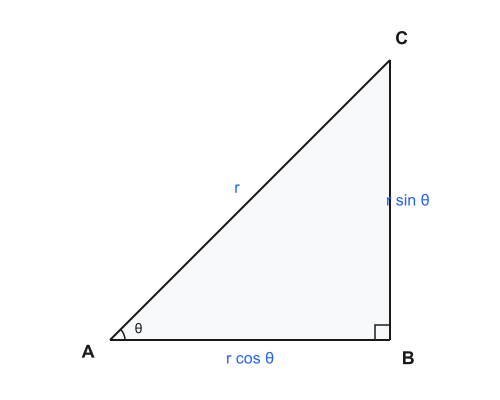
Use the diagram of right triangle $\triangle ABC$ (not drawn to scale). Angle $\theta$ is $\angle A$. Which reasoning proves $\sin^2\theta+\cos^2\theta=1$?
Image description: A right triangle $\triangle ABC$ with $A$ at the left, $B$ at the right, and $C$ above segment $\overline{AB}$. Segment $\overline{AB}$ is horizontal. Segment $\overline{AC}$ slopes upward from $A$ to $C$. Segment $\overline{BC}$ slopes upward from $B$ to $C$. A right-angle box marks $\angle B$ (so $\overline{AB}\perp\overline{BC}$). An angle arc at $A$ labels $\angle A=\theta$. The hypotenuse is $\overline{AC}$ and is labeled $r$ (with $r>0$). The leg $\overline{AB}$ is labeled $r\cos\theta$. The leg $\overline{BC}$ is labeled $r\sin\theta$. No other equalities or measures are marked.
Since the triangle is right, the identity holds only when $\theta=45^\circ$, so $\sin^2\theta+\cos^2\theta=1$.
Since $\sin\theta=\dfrac{r\sin\theta}{r}$ and $\cos\theta=\dfrac{r\cos\theta}{r}$, then $\sin\theta+\cos\theta=1$.
Using $\angle A=\theta$, $\sin\theta=\dfrac{r\sin\theta}{r}$ and $\cos\theta=\dfrac{r\cos\theta}{r}$; by the Pythagorean Theorem, $(r\sin\theta)^2+(r\cos\theta)^2=r^2$, so $\sin^2\theta+\cos^2\theta=1$.
Because $\overline{AB}$ is the hypotenuse, $\sin\theta=\dfrac{r\cos\theta}{r\cos\theta}=1$ and $\cos\theta=\dfrac{r\sin\theta}{r\cos\theta}$, so $\sin^2\theta+\cos^2\theta=1$.
Explanation
The Pythagorean identity states that for any angle θ, sin²θ + cos²θ = 1. In a right triangle, sine of θ is the ratio of the opposite side to the hypotenuse r, and cosine is the ratio of the adjacent side to r. Squaring these ratios gives sin²θ = (r sinθ)² / r² and cos²θ = (r cosθ)² / r², using the labeled sides. Applying the Pythagorean Theorem to the sides, (r sinθ)² + (r cosθ)² = r². Therefore, sin²θ + cos²θ = [(r sinθ)² + (r cosθ)²] / r² = r² / r² = 1, deriving the identity. A common distractor misconception is adding sine and cosine instead of squaring them, as in choice A, which incorrectly claims sinθ + cosθ = 1. To transfer this strategy, always return to the triangle geometry by identifying opposite, adjacent, and hypotenuse sides and applying the theorem step by step.
A right triangle is normalized so its hypotenuse has length $1$, and $\angle A=\theta$. Which conclusion follows from the diagram?
Image description: A right triangle $\triangle ABC$ with right angle at $C$ (right-angle box at $C$). Point $A$ is at the left, point $B$ is at the right, and point $C$ is below segment $\overline{AB}$. Segment $\overline{AB}$ is the hypotenuse and is labeled $1$. An angle arc at $A$ labels $\angle A=\theta$. The leg $\overline{AC}$ is labeled $\cos\theta$ and the leg $\overline{BC}$ is labeled $\sin\theta$. No other markings are shown; diagram not to scale.
Because the hypotenuse is $1$, $\cos\theta+\sin\theta=1$.
Because the diagram is not to scale, $\cos^2\theta+\sin^2\theta$ cannot equal a constant.
Since $\angle C$ is right, $\cos\theta=\sin\theta$ for all $\theta$.
By the Pythagorean Theorem, $\cos^2\theta+\sin^2\theta=1$.
Explanation
The Pythagorean identity states that for any angle θ, sin²θ + cos²θ = 1. In a right triangle, sine of θ is the ratio of the opposite side labeled sinθ to the hypotenuse of length 1, and cosine is the ratio of the adjacent side labeled cosθ to 1. Squaring these ratios gives sin²θ = (sinθ)² / 1² and cos²θ = (cosθ)² / 1². Applying the Pythagorean Theorem to the sides, (cosθ)² + (sinθ)² = 1². Therefore, sin²θ + cos²θ = 1, deriving the identity. A common distractor misconception is claiming sinθ + cosθ = 1 because the hypotenuse is 1, as in choice B, confusing addition with squaring. To transfer this strategy, always return to the triangle geometry by identifying opposite, adjacent, and hypotenuse sides and applying the theorem step by step.
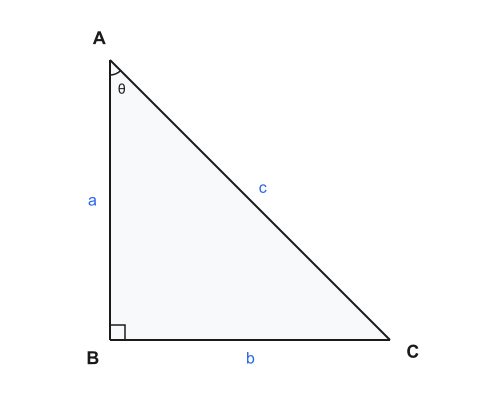
A student claims the diagram proves $\sin^2\theta+\cos^2\theta=1$ without memorization. Which statement justifies the identity?
Image description: A right triangle $\triangle ABC$ with right angle at $B$ (right-angle box). Angle at $A$ is marked with an arc and labeled $\theta$. The hypotenuse $\overline{AC}$ is labeled $c$. The leg adjacent to $\theta$, $\overline{AB}$, is labeled $a$. The leg opposite $\theta$, $\overline{BC}$, is labeled $b$. No numerical values are provided; diagram not drawn to scale.
Since the diagram looks symmetric, $a=b$, so $\sin^2\theta+\cos^2\theta=1$.
Define $\sin\theta=\dfrac{b}{c}$ and $\cos\theta=\dfrac{a}{c}$; then $\sin^2\theta+\cos^2\theta=\dfrac{b^2+a^2}{c^2}=\dfrac{c^2}{c^2}=1$ using $a^2+b^2=c^2$.
Define $\sin\theta=\dfrac{b}{c}$ and $\cos\theta=\dfrac{a}{c}$; then $\sin^2\theta+\cos^2\theta=\dfrac{b+a}{c}=1$ using $a+b=c$.
Because the triangle is right, $\sin\theta=\cos\theta$, so $\sin^2\theta+\cos^2\theta=1$.
Explanation
The Pythagorean identity states that for any angle θ, sin²θ + cos²θ = 1. In a right triangle, sine of θ is the ratio of the opposite side b to the hypotenuse c, and cosine is the ratio of the adjacent side a to c. Squaring these ratios gives sin²θ = b² / c² and cos²θ = a² / c². Applying the Pythagorean Theorem, a² + b² = c². Therefore, sin²θ + cos²θ = (a² + b²) / c² = c² / c² = 1, deriving the identity. A common distractor misconception is adding the sides instead of squaring, as in choice B, wrongly using a + b = c. To transfer this strategy, always return to the triangle geometry by identifying opposite, adjacent, and hypotenuse sides and applying the theorem step by step.
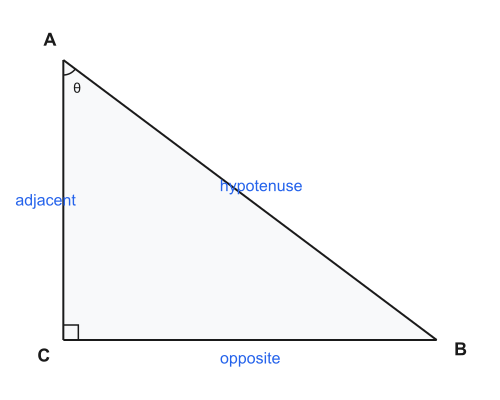
In the diagram, $\triangle ABC$ is right at $C$, and $\angle A=\theta$. The sides are labeled only by their roles: $AB$ is the hypotenuse, $AC$ is adjacent to $\theta$, and $BC$ is opposite $\theta$. Which conclusion follows from the diagram?
Image description (not drawn to scale): A right triangle with $A$ at left, $B$ at upper-right, and $C$ at lower-right. A right-angle box marks $\angle C=90^\circ$. Segment $AB$ is labeled “hypotenuse”. Segment $AC$ is labeled “adjacent”. Segment $BC$ is labeled “opposite”. An angle arc at $A$ labels $\theta$. No numbers or additional markings are given.
Because the triangle is right, $AC=BC$, so $\sin^2\theta+\cos^2\theta=1$.
From $AC^2+BC^2=AB^2$, dividing by $AB^2$ gives $\left(\dfrac{AC}{AB}\right)^2+\left(\dfrac{BC}{AB}\right)^2=1$, so $\cos^2\theta+\sin^2\theta=1$.
Because $AB$ is the hypotenuse, $\sin\theta=\dfrac{AC}{AB}$ and $\cos\theta=\dfrac{BC}{AB}$, so $\sin^2\theta+\cos^2\theta=1$.
From $AC^2+BC^2=AB^2$, dividing by $AB$ gives $\left(\dfrac{AC}{AB}\right)^2+\left(\dfrac{BC}{AB}\right)^2=1$.
Explanation
The Pythagorean identity states that sin²θ + cos²θ = 1 for any angle θ. In a right triangle, sine of θ is opposite over hypotenuse, and cosine is adjacent over hypotenuse. Squaring provides sin²θ = (opposite / hypotenuse)² and cos²θ = (adjacent / hypotenuse)². The Pythagorean theorem states opposite² + adjacent² = hypotenuse². Dividing by hypotenuse² derives sin²θ + cos²θ = 1. A distractor error is swapping sine and cosine definitions, but the sum of squares still equals 1, though the proof requires accuracy. For reinforcement, return to the right triangle geometry to confirm side labels.