Proving Angle Addition/Subtraction Formulas
Help Questions
Geometry › Proving Angle Addition/Subtraction Formulas
Which explanation correctly uses the geometry?
In triangle $ABC$, $\angle A$ is labeled $\theta$ and $\angle B$ is labeled $\varphi$. A segment from $C$ to $AB$ meets $AB$ at $D$ and is marked perpendicular to $AB$ (right-angle box at $D$). Thus $CD$ is an altitude.
Which statement gives a valid geometric justification path toward an identity involving $\sin(\theta+\varphi)$ (using that $\angle C = 180^\circ-(\theta+\varphi)$), without plugging in numbers or assuming the identity?
Because $\angle C=180^\circ-(\theta+\varphi)$, conclude $\sin(\theta+\varphi)=\sin\theta\sin\varphi$.
Use right triangles $\triangle ACD$ and $\triangle BCD$ to express $CD$ two ways with sines/cosines, then relate those expressions to an angle-sum through $\angle C$.
Because the triangle is not to scale, the altitude cannot be used to form right triangles.
Because $CD$ is an altitude, $\sin(\theta+\varphi)=\sin\theta+\sin\varphi$.
Explanation
The skill is proving the sine angle addition formula using an altitude in a triangle. The geometric setup involves triangle ABC with angles theta at A and phi at B, and altitude CD perpendicular to AB at D. This decomposes the supplementary angle at C as 180 degrees minus (theta + phi). Side relationships are tracked via CD expressed in right triangles ACD and BCD using sines and cosines of theta and phi. Relating these expressions through sin(180 - (theta + phi)) = sin(theta + phi) justifies the addition formula. A distractor misconception is adding sines directly due to the altitude, as in choice B, without considering the angle relations. To transfer this strategy, focus on geometric altitudes and right triangles before algebraic substitutions.
Which statement proves the formula?
A right triangle $\triangle OAB$ has right angle at $A$, with $OA$ along the positive $x$-axis and $AB$ vertical (right-angle box at $A$). The angle at $O$ between $OA$ and $OB$ is labeled $\theta+\varphi$. A ray from $O$ inside the triangle meets $AB$ at point $C$ and splits the angle at $O$ into $\angle AOC=\theta$ and $\angle COB=\varphi$.
Which reasoning correctly leads to an identity for $\tan(\theta+\varphi)$ using this decomposition?
Express slopes: $\tan\theta=\frac{AC}{OA}$ and $\tan\varphi=\frac{CB}{OC}$, then add to get $\tan(\theta+\varphi)=\tan\theta+\tan\varphi$.
Since $\triangle OAB$ is right, conclude $\tan(\theta+\varphi)=\frac{AB}{OB}$ and replace $OB$ by $OA+AB$.
Relate similar right triangles formed by dropping a perpendicular from $C$ to $OA$, then write the overall slope $\frac{AB}{OA}$ in terms of the two smaller slopes to obtain $\tan(\theta+\varphi)=\frac{\tan\theta+\tan\varphi}{1-\tan\theta\tan\varphi}$.
Because the angle is split, $\tan(\theta+\varphi)=\tan\theta\tan\varphi$ by multiplying the two tangent ratios.
Explanation
The skill is proving the tangent angle addition formula using a right triangle decomposition. The geometric setup features right triangle OAB with right angle at A, angle at O as theta + phi, and a ray OC splitting it into theta and phi, intersecting AB at C. This splits the angle at O into adjacent parts theta and phi. Side relationships are tracked via slopes, with tan theta as AC/OA and tan phi as CB/OC, and the overall slope AB/OA. By relating similar right triangles from a perpendicular at C, we justify tan(theta + phi) = (tan theta + tan phi)/(1 - tan theta tan phi). A distractor misconception is simply adding the tangents, as in choice A, disregarding the denominator adjustment. To transfer this strategy, focus on geometric slope decompositions in triangles before algebraic computations.
A unit circle is centered at $O$. Point $P$ corresponds to angle $\theta$ from the positive $x$-axis, and point $Q$ corresponds to angle $\varphi$ from the positive $x$-axis. The chord $PQ$ is drawn. Which reasoning supports the angle addition formula by relating the dot product $\overrightarrow{OP}\cdot\overrightarrow{OQ}$ to a cosine of a difference?
Use that the dot product of unit vectors equals the cosine of the angle between them.
Since the diagram is a circle, $\overrightarrow{OP}\cdot\overrightarrow{OQ}=\sin(\theta-\varphi)$, so $\sin(\theta-\varphi)=\cos\theta\cos\varphi+\sin\theta\sin\varphi$.
Since $|OP|=|OQ|=1$, $\overrightarrow{OP}\cdot\overrightarrow{OQ}=\cos(\theta-\varphi)$, and expanding the dot product using coordinates gives $\cos\theta\cos\varphi+\sin\theta\sin\varphi$.
Since chord $PQ$ is drawn, $\overrightarrow{OP}\cdot\overrightarrow{OQ}=|PQ|$, so $\cos(\theta-\varphi)=\cos\theta-\cos\varphi$.
Since $|OP|=|OQ|=1$, $\overrightarrow{OP}\cdot\overrightarrow{OQ}=\cos(\theta+\varphi)$, and expanding gives $\cos\theta\cos\varphi-\sin\theta\sin\varphi$.
Explanation
This question uses the dot product of unit vectors to derive angle subtraction formulas, specifically for cosine. Points P and Q on the unit circle correspond to angles θ and φ respectively, making vectors OP and OQ unit vectors. The dot product of two unit vectors equals the cosine of the angle between them, which is |θ-φ|. Expanding the dot product using coordinates gives OP·OQ = cosθ·cosφ + sinθ·sinφ = cos(θ-φ). Choice B incorrectly relates the dot product to cos(θ+φ) instead of cos(θ-φ), while choice C wrongly equates the dot product to the chord length |PQ|. The geometric insight is that the dot product naturally encodes the cosine of the angle between vectors, and coordinate expansion reveals the addition formula. This approach elegantly connects vector algebra to trigonometric identities through geometric interpretation.
A unit circle is centered at $O$. From point $A=(1,0)$, rotate by $\theta$ to reach point $B$ on the circle. Then rotate by $\varphi$ to reach point $C$ on the circle. A perpendicular from $C$ to the $x$-axis meets it at $H$. Which argument justifies $\sin(\theta+\varphi)$ by expressing the height $CH$ using components from the intermediate point $B$?
Use the idea that the second rotation mixes the $x$- and $y$-components of $B$.
Since $CH=\sin(\theta+\varphi)$, the height equals $\sin\theta+\sin\varphi$ because rotations add vertical changes.
Since $CH=\sin(\theta+\varphi)$, the height equals $\cos\theta\cos\varphi-\sin\theta\sin\varphi$ because $CH$ is adjacent to $\theta+\varphi$.
Since $CH=\sin(\theta+\varphi)$, the height equals $\sin\theta\cos\varphi-\cos\theta\sin\varphi$ because both angles are counterclockwise.
Since $CH=\sin(\theta+\varphi)$, rotating $(\cos\theta,\sin\theta)$ by $\varphi$ gives $CH=\sin\theta\cos\varphi+\cos\theta\sin\varphi$.
Explanation
This question derives the sine addition formula by tracking the height of a point after two successive rotations on a unit circle. Starting at A=(1,0), we rotate by θ to reach B=(cosθ, sinθ), then rotate by φ to reach C. The height CH represents sin(θ+φ), and we can express it by considering how the second rotation transforms B's coordinates. The y-coordinate of C equals the y-component of B times cosφ plus the x-component of B times sinφ, giving sin(θ+φ) = sinθcosφ + cosθsinφ. Choice B incorrectly assumes rotations add heights linearly, while choice C has the wrong sign, suggesting subtraction. The geometric principle is that each rotation mixes the existing x and y components according to the rotation angle, with both components contributing to the final height. This mixing effect is fundamental to understanding why trigonometric addition formulas involve products of different functions.
Which reasoning supports the angle addition formula?
In the diagram, triangle $ABC$ has point $D$ on segment $AC$. At vertex $A$, ray $AD$ splits $\angle BAC$ into two angles labeled $\theta$ (between $AB$ and $AD$) and $\varphi$ (between $AD$ and $AC$), so $\angle BAC=\theta+\varphi$. Segment $BD$ is drawn. A right-angle marker indicates $BD\perp AC$ at $D$.
Which statement proves an identity for $\sin(\theta+\varphi)$ using this construction?
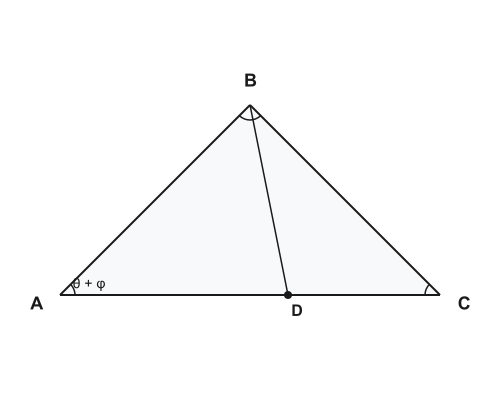
Decompose lengths using right triangles $\triangle ABD$ and $\triangle CBD$ to express the altitude $BD$ two ways, leading to $\sin(\theta+\varphi)=\sin\theta\cos\varphi+\cos\theta\sin\varphi$.
Since $BD\perp AC$, angles at $D$ are complementary, so $\sin(\theta+\varphi)=\sin\theta\cos\varphi-\cos\theta\sin\varphi$.
Because $\angle BAC=\theta+\varphi$, we can write $\sin(\theta+\varphi)=\sin\theta+\sin\varphi$ directly from the diagram.
Because $D$ lies on $AC$, triangles $ABD$ and $ABC$ are similar, so $\sin(\theta+\varphi)=\sin\theta\cos\varphi$.
Explanation
The skill focuses on proving the sine addition formula using triangle decompositions. The geometric setup features triangle ABC with point D on AC, ray AD splitting angle BAC into θ and φ, and BD perpendicular to AC. Angle BAC decomposes into θ between AB and AD plus φ between AD and AC, summing to θ + φ. Side relationships are tracked through right triangles ABD and CBD, expressing altitude BD in terms of opposite sides and angles. This justifies sin(θ + φ) = sinθ cosφ + cosθ sinφ by equating expressions for the height relative to the hypotenuse. A distractor misconception involves subtracting terms due to complementary angles, leading to an incorrect sign. Transfer strategy: think geometry before algebra by decomposing angles in triangles to build trig identities from basic definitions.
Which conclusion follows from the diagram?
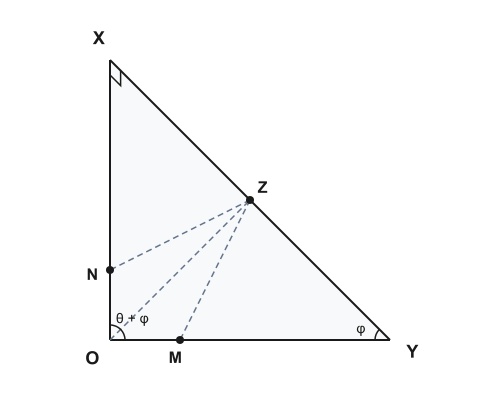
Triangle $OXY$ is a right triangle with right angle at $X$ (right-angle box at $X$). Ray $OZ$ lies inside $\angle XOY$ and splits it into two angles: $\angle XOZ=\theta$ and $\angle ZOY=\varphi$. From point $Z$ on ray $OZ$, perpendiculars are dropped to $OX$ and to $XY$ meeting them at $M$ and $N$ (right-angle boxes at $M$ and $N$). No other information is marked.
Which statement correctly describes a geometric strategy that can lead to a sum identity (rather than assuming it)?
Because $\theta$ and $\varphi$ share vertex $O$, conclude $\cos(\theta+\varphi)=\cos\theta+\cos\varphi$.
Use right triangles $\triangle OZM$ and $\triangle ZXN$ to relate projections along $OX$ and $XY$, then combine to express a projection corresponding to $\cos(\theta+\varphi)$.
Because the diagram is not to scale, no trigonometric identity can be derived from it.
Assume $\cos(\theta+\varphi)$ equals $\cos\theta\cos\varphi-\sin\theta\sin\varphi$ and label the segments to match.
Explanation
The skill focuses on proving cosine sum identities through projections in a right triangle. The geometric setup is right triangle OXY with right angle at X, ray OZ splitting angle at O into theta and phi, and perpendiculars from Z to OX and XY at M and N. This decomposes the angle at O as theta + phi. Side relationships are tracked via projections in right triangles OZM and ZXN along OX and XY. Combining these projections justifies cos(theta + phi) = cos theta cos phi - sin theta sin phi. A distractor misconception is adding cosines directly due to shared vertex, as in choice C, without projection adjustments. To transfer this strategy, visualize geometric perpendiculars and projections in triangles before algebraic work.
Which conclusion follows from the diagram?
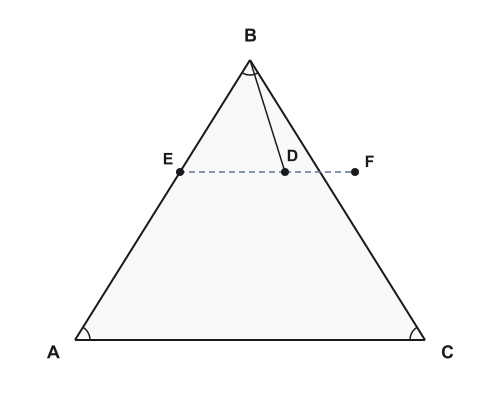
In triangle $ABC$, point $D$ lies on segment $AC$. Segment $BD$ is drawn. The angle at $B$ is split by ray $BD$ into two adjacent angles: $\angle ABD=\theta$ and $\angle DBC=\varphi$. A perpendicular from $D$ to line $AB$ meets $AB$ at $E$, and a perpendicular from $D$ to line $BC$ meets $BC$ at $F$ (right-angle boxes at $E$ and $F$). No other special relationships are marked.
Using only this construction, which statement provides a valid geometric route to an angle-addition identity?
Since $BD$ bisects $\angle ABC$ into $\theta$ and $\varphi$, conclude $\theta=\varphi$ and simplify $\sin(\theta+\varphi)$.
Write $\sin(\theta+\varphi)=\sin\theta+\sin\varphi$ because the angles are adjacent at $B$.
Assume $\sin(\theta+\varphi)=\sin\theta\cos\varphi+\cos\theta\sin\varphi$ and note the diagram is consistent with it.
Use right triangles $\triangle BDE$ and $\triangle BDF$ to express the same altitude $BD\sin\theta$ and $BD\sin\varphi$, then combine projections to relate $\sin(\theta+\varphi)$ to $\sin\theta$ and $\cos\varphi$.
Explanation
The skill is proving the sine angle addition formula through geometric decomposition in a triangle. The geometric setup includes triangle ABC with point D on AC, and BD splitting the angle at B into adjacent angles theta and phi, with perpendiculars from D to AB and BC at E and F. This construction decomposes the total angle at B as theta plus phi, using BD as the splitting ray. Side relationships are tracked via the altitudes in right triangles BDE and BDF, where BD relates to projections involving sin theta and sin phi along the sides. By combining these projections and equating expressions for the same lengths, we justify the formula sin(theta + phi) = sin theta cos phi + cos theta sin phi. A distractor misconception is simply adding the sines of adjacent angles, as in choice A, which overlooks the necessary cosine adjustments for proper projection. To transfer this strategy, prioritize visualizing the geometric splitting and perpendiculars in triangles before resorting to algebraic manipulations.
Which statement proves the formula?
A unit circle centered at $O$ is shown with point $A$ on the positive $x$-axis. Point $P$ is on the circle with $\angle AOP=\theta$. From ray $OP$, rotate clockwise by angle $\varphi$ to ray $OQ$ (the clockwise arc is labeled $\varphi$), so $\angle AOQ=\theta-\varphi$. A perpendicular from $Q$ meets the $x$-axis at $N$.
Which claim correctly justifies a formula for $\cos(\theta-\varphi)$ from this rotation idea?
Because $\angle AOQ=\theta-\varphi$, we can read off $\cos(\theta-\varphi)=ON=\cos\theta-\cos\varphi$.
Using rotation of the point $(\cos\theta,\sin\theta)$ by $-\varphi$, the new $x$-coordinate is $\cos\theta\cos\varphi+\sin\theta\sin\varphi$.
Since $Q$ lies on the unit circle, $\cos(\theta-\varphi)=\cos\theta\cos\varphi$.
Clockwise rotation changes only the sign of sine, so $\cos(\theta-\varphi)=\cos\theta+\cos\varphi$.
Explanation
The skill focuses on deriving the cosine subtraction formula using clockwise rotations on a unit circle. The geometric setup features a unit circle centered at O, point P at angle θ from OA on the x-axis, and Q obtained by rotating clockwise by φ from OP, resulting in angle AOQ as θ - φ. The angle θ - φ decomposes through the clockwise rotation from θ. Side relationships are tracked by x-coordinates, with the rotation by -φ affecting projections. This justifies cos(θ - φ) = cosθ cosφ + sinθ sinφ via the rotation matrix applied to point P. A distractor misconception assumes subtraction like cos(θ - φ) = cosθ - cosφ, ignoring the additive sine terms. Transfer strategy: think geometry before algebra by incorporating directionality in rotations to derive difference formulas.