Physics
Help Questions
GED Science › Physics
A car drives 


Explanation
The car has covered a total distance of 
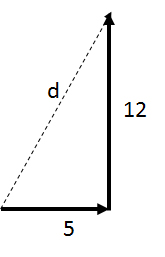
To solve this question, it is best to draw a sketch. The resulting sketch will be a right triangle with the hypotenuse equal to the displacement. The Pythagorean Theorem can be used to solve the problem.


A car drives
Explanation
The car has covered a total distance of
To solve this question, it is best to draw a sketch. The resulting sketch will be a right triangle with the hypotenuse equal to the displacement. The Pythagorean Theorem can be used to solve the problem.
A car drives
Explanation
The car has covered a total distance of
To solve this question, it is best to draw a sketch. The resulting sketch will be a right triangle with the hypotenuse equal to the displacement. The Pythagorean Theorem can be used to solve the problem.
A car drives
Explanation
The car has covered a total distance of
To solve this question, it is best to draw a sketch. The resulting sketch will be a right triangle with the hypotenuse equal to the displacement. The Pythagorean Theorem can be used to solve the problem.
Which of the following best illustrates Newton's Second Law?
If an object is not accelerating, then the net force on it is zero
A ball is rolled across a table and does not stop until it hits an area with friction
When two cymbals collide, some kinetic energy is converted into sound
As a hammer hits a nail, the nail also exerts a force on the hammer
Explanation
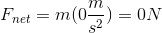
Newton's Second Law is best represented as an equation, in which the product of mass and acceleration is equal to net force:

By this principle, if there is zero acceleration, then the force must also be zero.
A non-zero acceleration must be present if there is a non-zero net force.
Which of the following best illustrates Newton's Second Law?
If an object is not accelerating, then the net force on it is zero
A ball is rolled across a table and does not stop until it hits an area with friction
When two cymbals collide, some kinetic energy is converted into sound
As a hammer hits a nail, the nail also exerts a force on the hammer
Explanation
Newton's Second Law is best represented as an equation, in which the product of mass and acceleration is equal to net force:
By this principle, if there is zero acceleration, then the force must also be zero.
A non-zero acceleration must be present if there is a non-zero net force.
Which of the following best illustrates Newton's Second Law?
If an object is not accelerating, then the net force on it is zero
A ball is rolled across a table and does not stop until it hits an area with friction
When two cymbals collide, some kinetic energy is converted into sound
As a hammer hits a nail, the nail also exerts a force on the hammer
Explanation
Newton's Second Law is best represented as an equation, in which the product of mass and acceleration is equal to net force:
By this principle, if there is zero acceleration, then the force must also be zero.
A non-zero acceleration must be present if there is a non-zero net force.
Which of the following best illustrates Newton's Second Law?
If an object is not accelerating, then the net force on it is zero
A ball is rolled across a table and does not stop until it hits an area with friction
When two cymbals collide, some kinetic energy is converted into sound
As a hammer hits a nail, the nail also exerts a force on the hammer
Explanation
Newton's Second Law is best represented as an equation, in which the product of mass and acceleration is equal to net force:
By this principle, if there is zero acceleration, then the force must also be zero.
A non-zero acceleration must be present if there is a non-zero net force.
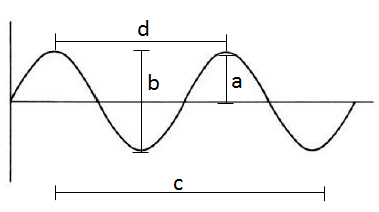
Which of the following measures depicts the amplitude?
A
B
C
D
Explanation
The amplitude measures the greatest displacement (either positive or negative) of a wave from the x-axis. Visually, the amplitude appears to be the distance from the x-axis (center line) to the top of one peak. In the figure, this value is given by A.
The other relevant measure given in the figure is segment D, which measures the distance between two peaks. This distance is known as the wavelength.
Segments B and C do not provide useful measurements of the wave function.
Which of the following measures depicts the amplitude?
A
B
C
D
Explanation
The amplitude measures the greatest displacement (either positive or negative) of a wave from the x-axis. Visually, the amplitude appears to be the distance from the x-axis (center line) to the top of one peak. In the figure, this value is given by A.
The other relevant measure given in the figure is segment D, which measures the distance between two peaks. This distance is known as the wavelength.
Segments B and C do not provide useful measurements of the wave function.