Applications of Quadratic Equations Practice Test
•1 QuestionsQuadratic equations appear often in physics. The basic kinematic equations for the position  of a particle as a function of time
  , with an initial velocity
  (a constant) and constant acceleration
  can be written as,
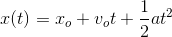
This is a quadratic function in  . The function therefore gives the position as a quadratic function of time
  . If we are dealing with a free-falling object under Earth's gravitational field, we might write this function in the form,
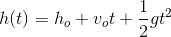
to express the "height"  of the object at a given time
  falling with a constant acceleration
  . Here
  the initial height (a constant). The units for acceleration are meters-per-square second
  . The negative acceleration is a convention to signify that the direction of the acceleration is downward.
Find the time required for a ball dropped from a height of 100 m from rest to reach the ground using the quadratic function for height written below,
(Hint, what is the value of the height  when the ball strikes the ground?).
Quadratic equations appear often in physics. The basic kinematic equations for the position
This is a quadratic function in
to express the "height"
Find the time required for a ball dropped from a height of 100 m from rest to reach the ground using the quadratic function for height written below,
(Hint, what is the value of the height