Analyzing the Form of Nineteenth-Century 2D Visual Art - CLEP Humanities
Card 1 of 8

The above image is a woodblock print, meaning it .
The above image is a woodblock print, meaning it .
Tap to reveal answer
The woodblock format, popular throughout Asia, is an artistic format that is produced by having a large piece of wood cut into and dyed by the artist. Thereafter, this woodblock can be printed onto canvas or paper, making it extremely easy to duplicate the work of art again and again.
The woodblock format, popular throughout Asia, is an artistic format that is produced by having a large piece of wood cut into and dyed by the artist. Thereafter, this woodblock can be printed onto canvas or paper, making it extremely easy to duplicate the work of art again and again.
← Didn't Know|Knew It →
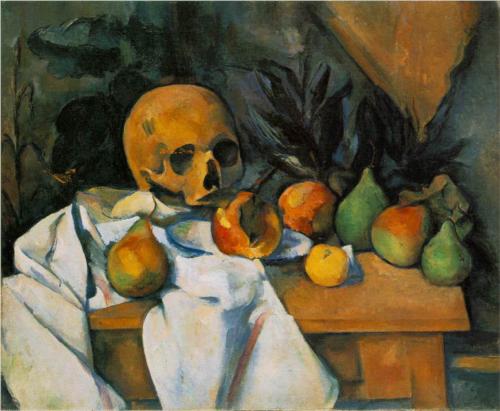
The composition above is a painting in the genre of .
The composition above is a painting in the genre of .
Tap to reveal answer
The painter of this work, Paul Cézanne, was particularly noted for his still lifes. The one in this question, "Still Life with Skull," was painted in 1898 and is particularly notable for the inclusion of a skull, a notable feature of Cezanne's later work from the 1890s on. Cézanne's use of broad brushstrokes, layered color, and different perspectives helped create a bridge from impressionism to modern art movements like cubism.
The painter of this work, Paul Cézanne, was particularly noted for his still lifes. The one in this question, "Still Life with Skull," was painted in 1898 and is particularly notable for the inclusion of a skull, a notable feature of Cezanne's later work from the 1890s on. Cézanne's use of broad brushstrokes, layered color, and different perspectives helped create a bridge from impressionism to modern art movements like cubism.
← Didn't Know|Knew It →
The above image is a woodblock print, meaning it .
The above image is a woodblock print, meaning it .
Tap to reveal answer
The woodblock format, popular throughout Asia, is an artistic format that is produced by having a large piece of wood cut into and dyed by the artist. Thereafter, this woodblock can be printed onto canvas or paper, making it extremely easy to duplicate the work of art again and again.
The woodblock format, popular throughout Asia, is an artistic format that is produced by having a large piece of wood cut into and dyed by the artist. Thereafter, this woodblock can be printed onto canvas or paper, making it extremely easy to duplicate the work of art again and again.
← Didn't Know|Knew It →
The composition above is a painting in the genre of .
The composition above is a painting in the genre of .
Tap to reveal answer
The painter of this work, Paul Cézanne, was particularly noted for his still lifes. The one in this question, "Still Life with Skull," was painted in 1898 and is particularly notable for the inclusion of a skull, a notable feature of Cezanne's later work from the 1890s on. Cézanne's use of broad brushstrokes, layered color, and different perspectives helped create a bridge from impressionism to modern art movements like cubism.
The painter of this work, Paul Cézanne, was particularly noted for his still lifes. The one in this question, "Still Life with Skull," was painted in 1898 and is particularly notable for the inclusion of a skull, a notable feature of Cezanne's later work from the 1890s on. Cézanne's use of broad brushstrokes, layered color, and different perspectives helped create a bridge from impressionism to modern art movements like cubism.
← Didn't Know|Knew It →
The above image is a woodblock print, meaning it .
The above image is a woodblock print, meaning it .
Tap to reveal answer
The woodblock format, popular throughout Asia, is an artistic format that is produced by having a large piece of wood cut into and dyed by the artist. Thereafter, this woodblock can be printed onto canvas or paper, making it extremely easy to duplicate the work of art again and again.
The woodblock format, popular throughout Asia, is an artistic format that is produced by having a large piece of wood cut into and dyed by the artist. Thereafter, this woodblock can be printed onto canvas or paper, making it extremely easy to duplicate the work of art again and again.
← Didn't Know|Knew It →
The composition above is a painting in the genre of .
The composition above is a painting in the genre of .
Tap to reveal answer
The painter of this work, Paul Cézanne, was particularly noted for his still lifes. The one in this question, "Still Life with Skull," was painted in 1898 and is particularly notable for the inclusion of a skull, a notable feature of Cezanne's later work from the 1890s on. Cézanne's use of broad brushstrokes, layered color, and different perspectives helped create a bridge from impressionism to modern art movements like cubism.
The painter of this work, Paul Cézanne, was particularly noted for his still lifes. The one in this question, "Still Life with Skull," was painted in 1898 and is particularly notable for the inclusion of a skull, a notable feature of Cezanne's later work from the 1890s on. Cézanne's use of broad brushstrokes, layered color, and different perspectives helped create a bridge from impressionism to modern art movements like cubism.
← Didn't Know|Knew It →
The above image is a woodblock print, meaning it .
The above image is a woodblock print, meaning it .
Tap to reveal answer
The woodblock format, popular throughout Asia, is an artistic format that is produced by having a large piece of wood cut into and dyed by the artist. Thereafter, this woodblock can be printed onto canvas or paper, making it extremely easy to duplicate the work of art again and again.
The woodblock format, popular throughout Asia, is an artistic format that is produced by having a large piece of wood cut into and dyed by the artist. Thereafter, this woodblock can be printed onto canvas or paper, making it extremely easy to duplicate the work of art again and again.
← Didn't Know|Knew It →
The composition above is a painting in the genre of .
The composition above is a painting in the genre of .
Tap to reveal answer
The painter of this work, Paul Cézanne, was particularly noted for his still lifes. The one in this question, "Still Life with Skull," was painted in 1898 and is particularly notable for the inclusion of a skull, a notable feature of Cezanne's later work from the 1890s on. Cézanne's use of broad brushstrokes, layered color, and different perspectives helped create a bridge from impressionism to modern art movements like cubism.
The painter of this work, Paul Cézanne, was particularly noted for his still lifes. The one in this question, "Still Life with Skull," was painted in 1898 and is particularly notable for the inclusion of a skull, a notable feature of Cezanne's later work from the 1890s on. Cézanne's use of broad brushstrokes, layered color, and different perspectives helped create a bridge from impressionism to modern art movements like cubism.
← Didn't Know|Knew It →