Analyzing the Form of 2D Visual Art - CLEP Humanities
Card 1 of 40
The kind of artwork that features many pieces of glass or tile arranged into a portrait or other image is called a .
The kind of artwork that features many pieces of glass or tile arranged into a portrait or other image is called a .
Tap to reveal answer
While "mosaic" is a very broad term, it refers to any artwork made by assembling together small pieces of glass and tile. Roman artists and architects frequently used mosaics to create artwork in homes and buildings, and these were frequently realistic depictions of people or landscapes. Mosaics are still used by artists today, but can often take on abstract forms.
While "mosaic" is a very broad term, it refers to any artwork made by assembling together small pieces of glass and tile. Roman artists and architects frequently used mosaics to create artwork in homes and buildings, and these were frequently realistic depictions of people or landscapes. Mosaics are still used by artists today, but can often take on abstract forms.
← Didn't Know|Knew It →
The kind of artwork that features many pieces of glass or tile arranged into a portrait or other image is called a .
The kind of artwork that features many pieces of glass or tile arranged into a portrait or other image is called a .
Tap to reveal answer
While "mosaic" is a very broad term, it refers to any artwork made by assembling together small pieces of glass and tile. Roman artists and architects frequently used mosaics to create artwork in homes and buildings, and these were frequently realistic depictions of people or landscapes. Mosaics are still used by artists today, but can often take on abstract forms.
While "mosaic" is a very broad term, it refers to any artwork made by assembling together small pieces of glass and tile. Roman artists and architects frequently used mosaics to create artwork in homes and buildings, and these were frequently realistic depictions of people or landscapes. Mosaics are still used by artists today, but can often take on abstract forms.
← Didn't Know|Knew It →

The above image is a woodblock print, meaning it .
The above image is a woodblock print, meaning it .
Tap to reveal answer
The woodblock format, popular throughout Asia, is an artistic format that is produced by having a large piece of wood cut into and dyed by the artist. Thereafter, this woodblock can be printed onto canvas or paper, making it extremely easy to duplicate the work of art again and again.
The woodblock format, popular throughout Asia, is an artistic format that is produced by having a large piece of wood cut into and dyed by the artist. Thereafter, this woodblock can be printed onto canvas or paper, making it extremely easy to duplicate the work of art again and again.
← Didn't Know|Knew It →
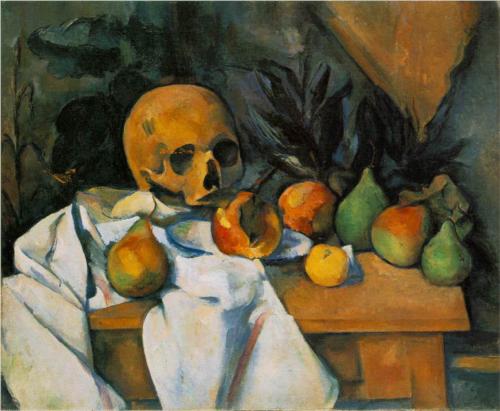
The composition above is a painting in the genre of .
The composition above is a painting in the genre of .
Tap to reveal answer
The painter of this work, Paul Cézanne, was particularly noted for his still lifes. The one in this question, "Still Life with Skull," was painted in 1898 and is particularly notable for the inclusion of a skull, a notable feature of Cezanne's later work from the 1890s on. Cézanne's use of broad brushstrokes, layered color, and different perspectives helped create a bridge from impressionism to modern art movements like cubism.
The painter of this work, Paul Cézanne, was particularly noted for his still lifes. The one in this question, "Still Life with Skull," was painted in 1898 and is particularly notable for the inclusion of a skull, a notable feature of Cezanne's later work from the 1890s on. Cézanne's use of broad brushstrokes, layered color, and different perspectives helped create a bridge from impressionism to modern art movements like cubism.
← Didn't Know|Knew It →
The American painter who painted canvases of large blocks of color with broad, visible brushstrokes is .
The American painter who painted canvases of large blocks of color with broad, visible brushstrokes is .
Tap to reveal answer
Utilizing large canvases featuring only one or two bold colors in large blocks, Mark Rothko deconstructed the principles of Abstract Expressionism to their simplest form. Beginning in 1949, Rothko's "multiforms" became his chief artistic format, and made him a world-famous artist.
Utilizing large canvases featuring only one or two bold colors in large blocks, Mark Rothko deconstructed the principles of Abstract Expressionism to their simplest form. Beginning in 1949, Rothko's "multiforms" became his chief artistic format, and made him a world-famous artist.
← Didn't Know|Knew It →
The Mexican artist Diego Rivera was most well known for working in what medium?
The Mexican artist Diego Rivera was most well known for working in what medium?
Tap to reveal answer
Diego Rivera began his artistic career in Paris during the first decade of the twentieth century as a cubist influenced by Picasso. On moving back to his native Mexico in the 1910s, Rivera began embracing revolutionary politics, more direct figures, and native Mexican culture, as well as painting massive murals on the sides of buildings. These murals made Rivera much more successful, and produced many different commissions around the world.
Diego Rivera began his artistic career in Paris during the first decade of the twentieth century as a cubist influenced by Picasso. On moving back to his native Mexico in the 1910s, Rivera began embracing revolutionary politics, more direct figures, and native Mexican culture, as well as painting massive murals on the sides of buildings. These murals made Rivera much more successful, and produced many different commissions around the world.
← Didn't Know|Knew It →
A work of art that is a compilation of various images put together in one piece is known as a .
A work of art that is a compilation of various images put together in one piece is known as a .
Tap to reveal answer
A collage is constructed not as one image, but by compiling a variety of images into one larger piece. This can be done for a variety of reasons, including ironic juxtaposition, social commentary, or refreshing traditional imagery. Collages became more widely used in the twentieth century as various forms of media were brought into widespread use.
A collage is constructed not as one image, but by compiling a variety of images into one larger piece. This can be done for a variety of reasons, including ironic juxtaposition, social commentary, or refreshing traditional imagery. Collages became more widely used in the twentieth century as various forms of media were brought into widespread use.
← Didn't Know|Knew It →
Jackson Pollack is well known for what distinctive artistic style?
Jackson Pollack is well known for what distinctive artistic style?
Tap to reveal answer
Jackson Pollack began his career as an expressionist painter, using representative shapes and traditional methods. Beginning in the late 40s, however, Pollack began using the technique of "drip painting," which involved laying the canvas on the floor and splattering liquid paint on it from above. This produced paintings that were extremely abstract, but vivid and emotional, which garnered Pollack worldwide acclaim.
Jackson Pollack began his career as an expressionist painter, using representative shapes and traditional methods. Beginning in the late 40s, however, Pollack began using the technique of "drip painting," which involved laying the canvas on the floor and splattering liquid paint on it from above. This produced paintings that were extremely abstract, but vivid and emotional, which garnered Pollack worldwide acclaim.
← Didn't Know|Knew It →
What twentieth century artist made large-scale screen prints of famous photographs in outlandish colors?
What twentieth century artist made large-scale screen prints of famous photographs in outlandish colors?
Tap to reveal answer
Andy Warhol sought to make art that directly engaged and confronted popular culture in unique and surprising ways. Warhol also liked to experiment with methods that had a sense of automation, such as screenprinting. Both of these aspects of Warhol's work were shown in a series of paintings he did in the 1960s, which had images of celebrities like Marilyn Monroe, Elizabeth Taylor, and James Dean reprinted in bright pinks, blues, and greens.
Andy Warhol sought to make art that directly engaged and confronted popular culture in unique and surprising ways. Warhol also liked to experiment with methods that had a sense of automation, such as screenprinting. Both of these aspects of Warhol's work were shown in a series of paintings he did in the 1960s, which had images of celebrities like Marilyn Monroe, Elizabeth Taylor, and James Dean reprinted in bright pinks, blues, and greens.
← Didn't Know|Knew It →
What form of art was developed by Islamic artists who did not draw living figures because of proscriptions in the Quran?
What form of art was developed by Islamic artists who did not draw living figures because of proscriptions in the Quran?
Tap to reveal answer
The Quran, the Islamic holy book, made Muslim artists pursue calligraphy for two different but related reasons. Calligraphy was the easiest mode of transmission for the written Quran in the early years of the religion. Additionally, Quranic prohibitions on creating figurative art made many Muslim artists pursue the geometrical and literary art of calligraphy.
The Quran, the Islamic holy book, made Muslim artists pursue calligraphy for two different but related reasons. Calligraphy was the easiest mode of transmission for the written Quran in the early years of the religion. Additionally, Quranic prohibitions on creating figurative art made many Muslim artists pursue the geometrical and literary art of calligraphy.
← Didn't Know|Knew It →
What form of art was developed by Islamic artists who did not draw living figures because of proscriptions in the Quran?
What form of art was developed by Islamic artists who did not draw living figures because of proscriptions in the Quran?
Tap to reveal answer
The Quran, the Islamic holy book, made Muslim artists pursue calligraphy for two different but related reasons. Calligraphy was the easiest mode of transmission for the written Quran in the early years of the religion. Additionally, Quranic prohibitions on creating figurative art made many Muslim artists pursue the geometrical and literary art of calligraphy.
The Quran, the Islamic holy book, made Muslim artists pursue calligraphy for two different but related reasons. Calligraphy was the easiest mode of transmission for the written Quran in the early years of the religion. Additionally, Quranic prohibitions on creating figurative art made many Muslim artists pursue the geometrical and literary art of calligraphy.
← Didn't Know|Knew It →
The American painter who painted canvases of large blocks of color with broad, visible brushstrokes is .
The American painter who painted canvases of large blocks of color with broad, visible brushstrokes is .
Tap to reveal answer
Utilizing large canvases featuring only one or two bold colors in large blocks, Mark Rothko deconstructed the principles of Abstract Expressionism to their simplest form. Beginning in 1949, Rothko's "multiforms" became his chief artistic format, and made him a world-famous artist.
Utilizing large canvases featuring only one or two bold colors in large blocks, Mark Rothko deconstructed the principles of Abstract Expressionism to their simplest form. Beginning in 1949, Rothko's "multiforms" became his chief artistic format, and made him a world-famous artist.
← Didn't Know|Knew It →
The Mexican artist Diego Rivera was most well known for working in what medium?
The Mexican artist Diego Rivera was most well known for working in what medium?
Tap to reveal answer
Diego Rivera began his artistic career in Paris during the first decade of the twentieth century as a cubist influenced by Picasso. On moving back to his native Mexico in the 1910s, Rivera began embracing revolutionary politics, more direct figures, and native Mexican culture, as well as painting massive murals on the sides of buildings. These murals made Rivera much more successful, and produced many different commissions around the world.
Diego Rivera began his artistic career in Paris during the first decade of the twentieth century as a cubist influenced by Picasso. On moving back to his native Mexico in the 1910s, Rivera began embracing revolutionary politics, more direct figures, and native Mexican culture, as well as painting massive murals on the sides of buildings. These murals made Rivera much more successful, and produced many different commissions around the world.
← Didn't Know|Knew It →
A work of art that is a compilation of various images put together in one piece is known as a .
A work of art that is a compilation of various images put together in one piece is known as a .
Tap to reveal answer
A collage is constructed not as one image, but by compiling a variety of images into one larger piece. This can be done for a variety of reasons, including ironic juxtaposition, social commentary, or refreshing traditional imagery. Collages became more widely used in the twentieth century as various forms of media were brought into widespread use.
A collage is constructed not as one image, but by compiling a variety of images into one larger piece. This can be done for a variety of reasons, including ironic juxtaposition, social commentary, or refreshing traditional imagery. Collages became more widely used in the twentieth century as various forms of media were brought into widespread use.
← Didn't Know|Knew It →
Jackson Pollack is well known for what distinctive artistic style?
Jackson Pollack is well known for what distinctive artistic style?
Tap to reveal answer
Jackson Pollack began his career as an expressionist painter, using representative shapes and traditional methods. Beginning in the late 40s, however, Pollack began using the technique of "drip painting," which involved laying the canvas on the floor and splattering liquid paint on it from above. This produced paintings that were extremely abstract, but vivid and emotional, which garnered Pollack worldwide acclaim.
Jackson Pollack began his career as an expressionist painter, using representative shapes and traditional methods. Beginning in the late 40s, however, Pollack began using the technique of "drip painting," which involved laying the canvas on the floor and splattering liquid paint on it from above. This produced paintings that were extremely abstract, but vivid and emotional, which garnered Pollack worldwide acclaim.
← Didn't Know|Knew It →
What twentieth century artist made large-scale screen prints of famous photographs in outlandish colors?
What twentieth century artist made large-scale screen prints of famous photographs in outlandish colors?
Tap to reveal answer
Andy Warhol sought to make art that directly engaged and confronted popular culture in unique and surprising ways. Warhol also liked to experiment with methods that had a sense of automation, such as screenprinting. Both of these aspects of Warhol's work were shown in a series of paintings he did in the 1960s, which had images of celebrities like Marilyn Monroe, Elizabeth Taylor, and James Dean reprinted in bright pinks, blues, and greens.
Andy Warhol sought to make art that directly engaged and confronted popular culture in unique and surprising ways. Warhol also liked to experiment with methods that had a sense of automation, such as screenprinting. Both of these aspects of Warhol's work were shown in a series of paintings he did in the 1960s, which had images of celebrities like Marilyn Monroe, Elizabeth Taylor, and James Dean reprinted in bright pinks, blues, and greens.
← Didn't Know|Knew It →
Renaissance art made a dramatic departure from medieval art by .
Renaissance art made a dramatic departure from medieval art by .
Tap to reveal answer
During the Renaissance, with a renewed focus on classical art and scientific understanding, visual arts underwent a significant change. In particular, religious themes dwindled in importance in comparison to classical subjects, and deeper, more varied colors were used to represent more realistic depictions of the human form.
During the Renaissance, with a renewed focus on classical art and scientific understanding, visual arts underwent a significant change. In particular, religious themes dwindled in importance in comparison to classical subjects, and deeper, more varied colors were used to represent more realistic depictions of the human form.
← Didn't Know|Knew It →
Renaissance art made a dramatic departure from medieval art by .
Renaissance art made a dramatic departure from medieval art by .
Tap to reveal answer
During the Renaissance, with a renewed focus on classical art and scientific understanding, visual arts underwent a significant change. In particular, religious themes dwindled in importance in comparison to classical subjects, and deeper, more varied colors were used to represent more realistic depictions of the human form.
During the Renaissance, with a renewed focus on classical art and scientific understanding, visual arts underwent a significant change. In particular, religious themes dwindled in importance in comparison to classical subjects, and deeper, more varied colors were used to represent more realistic depictions of the human form.
← Didn't Know|Knew It →
Renaissance art made a dramatic departure from medieval art by .
Renaissance art made a dramatic departure from medieval art by .
Tap to reveal answer
During the Renaissance, with a renewed focus on classical art and scientific understanding, visual arts underwent a significant change. In particular, religious themes dwindled in importance in comparison to classical subjects, and deeper, more varied colors were used to represent more realistic depictions of the human form.
During the Renaissance, with a renewed focus on classical art and scientific understanding, visual arts underwent a significant change. In particular, religious themes dwindled in importance in comparison to classical subjects, and deeper, more varied colors were used to represent more realistic depictions of the human form.
← Didn't Know|Knew It →
What form of art was developed by Islamic artists who did not draw living figures because of proscriptions in the Quran?
What form of art was developed by Islamic artists who did not draw living figures because of proscriptions in the Quran?
Tap to reveal answer
The Quran, the Islamic holy book, made Muslim artists pursue calligraphy for two different but related reasons. Calligraphy was the easiest mode of transmission for the written Quran in the early years of the religion. Additionally, Quranic prohibitions on creating figurative art made many Muslim artists pursue the geometrical and literary art of calligraphy.
The Quran, the Islamic holy book, made Muslim artists pursue calligraphy for two different but related reasons. Calligraphy was the easiest mode of transmission for the written Quran in the early years of the religion. Additionally, Quranic prohibitions on creating figurative art made many Muslim artists pursue the geometrical and literary art of calligraphy.
← Didn't Know|Knew It →