Enzyme Kinetics and Models - Biochemistry
Card 1 of 216
Suppose that an enzyme has a critical functional group in its active site that is heavily involved in carrying out the catalytic mechanism. To perform its role in catalyzing its target reaction, this particular functional group must be able to accept a proton from the intermediate during the process. If the pKa of this functional group is equal to 7.0, then what percentage of the total enzyme active sites for this enzyme would be in the active form in a solution in which the pH is equal to 6.4?
Suppose that an enzyme has a critical functional group in its active site that is heavily involved in carrying out the catalytic mechanism. To perform its role in catalyzing its target reaction, this particular functional group must be able to accept a proton from the intermediate during the process. If the pKa of this functional group is equal to 7.0, then what percentage of the total enzyme active sites for this enzyme would be in the active form in a solution in which the pH is equal to 6.4?
Tap to reveal answer
In order to solve this problem, we'll need to make use of the Henderson-Hasselbalch equation.
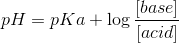
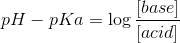
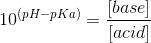

Therefore, for every 0.25mol of base (deprotonated functional group), there is 1mol of acid (protonated functional group). Furthermore, we're told in the question stem that the functional group must be able to accept a proton from the intermediate during the catalytic mechanism. To accept a proton, the functional group would need to be in its deprotonated form to be active. Hence, we're trying to find the percentage of the deprotonated form. To find this value, we'll use the following expression:



In order to solve this problem, we'll need to make use of the Henderson-Hasselbalch equation.
Therefore, for every 0.25mol of base (deprotonated functional group), there is 1mol of acid (protonated functional group). Furthermore, we're told in the question stem that the functional group must be able to accept a proton from the intermediate during the catalytic mechanism. To accept a proton, the functional group would need to be in its deprotonated form to be active. Hence, we're trying to find the percentage of the deprotonated form. To find this value, we'll use the following expression:
← Didn't Know|Knew It →
Which of the following does not increase reaction rate?
Which of the following does not increase reaction rate?
Tap to reveal answer
Catalysts lower activation energy. Lowering activation energy causes the reaction rate to increase. Removing catalysts will cause the reaction to slow down because the activation energy will be higher. Cofactors assist in the function of enzymes and can increase reaction rate.
Catalysts lower activation energy. Lowering activation energy causes the reaction rate to increase. Removing catalysts will cause the reaction to slow down because the activation energy will be higher. Cofactors assist in the function of enzymes and can increase reaction rate.
← Didn't Know|Knew It →
There are at least four types of glucose transporter in the body. GLUT1 and GLUT3 are located in most tissues including the brain and the red blood cells. These glucose transporters rapidly take up glucose from the blood but have the lowest  value. GLUT2 is commonly found in the liver and the pancreas. GLUT2 has a lower affinity for glucose but has the highest
  value. GLUT4 is common in skeletal tissues and in adipose tissues. This transporter is normally not active for uptake unless stimulated by insulin or during exercise.
What is the mechanism by which the GLUT proteins in the transport glucose into the cell from the blood?
There are at least four types of glucose transporter in the body. GLUT1 and GLUT3 are located in most tissues including the brain and the red blood cells. These glucose transporters rapidly take up glucose from the blood but have the lowest
What is the mechanism by which the GLUT proteins in the transport glucose into the cell from the blood?
Tap to reveal answer
Since there will be more glucose surrounding the cell, the GLUT proteins utilize a chemical gradient to transport glucose into the cell.
Since there will be more glucose surrounding the cell, the GLUT proteins utilize a chemical gradient to transport glucose into the cell.
← Didn't Know|Knew It →
If the level of ATP suddenly increases in a cell, facilitated diffusion in the cell will .
If the level of ATP suddenly increases in a cell, facilitated diffusion in the cell will .
Tap to reveal answer
Facilitated diffusion acts independently of the level of intracellular ATP. Therefore, a change in ATP concentration will not affect the rate of facilitated diffusion.
Facilitated diffusion acts independently of the level of intracellular ATP. Therefore, a change in ATP concentration will not affect the rate of facilitated diffusion.
← Didn't Know|Knew It →
If the chloride concentration is  in the cell and
  in the blood, what is the electrochemical potential of chloride ions across the plasma membrane at
  when the electrical potential across the membrane is
  and the inside is negative?
If the chloride concentration is
Tap to reveal answer
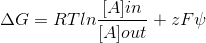
Where  is Faraday's constant
  ,
,  is the charge of a chloride ion, which is
  , and
, and  is
is  or
or  . Be sure to keep units consistent.


Where
← Didn't Know|Knew It →
You make a Hill plot reflecting the binding kinetics of a receptor and see that the slope (the Hill coefficient) is 1. What does this indicate about your receptor?
You make a Hill plot reflecting the binding kinetics of a receptor and see that the slope (the Hill coefficient) is 1. What does this indicate about your receptor?
Tap to reveal answer
If the Hill coefficient of the Hill plot is equal to 1, then binding is non-cooperative. If the Hill coefficient is greater than 1, binding is positively cooperative; if less than 1, binding is negatively cooperative. The Hill plot does not make any conclusions about the rate of a reaction, which involves Michaelis-Menten kinetics.
If the Hill coefficient of the Hill plot is equal to 1, then binding is non-cooperative. If the Hill coefficient is greater than 1, binding is positively cooperative; if less than 1, binding is negatively cooperative. The Hill plot does not make any conclusions about the rate of a reaction, which involves Michaelis-Menten kinetics.
← Didn't Know|Knew It →
Given the following kinetic parameters, which of the following enzymes would show the most efficiency?
Given the following kinetic parameters, which of the following enzymes would show the most efficiency?
Tap to reveal answer
To answer this question, we need to understand what enzyme efficiency is and how it's calculated.
Enzyme efficiency refers to how much substrate a given enzyme can convert into product for a given amount of substrate. In other words, an enzyme that is very efficient can convert substrate into product very quickly, even when there is not very much of that substrate around.
To calculate an enzyme's efficiency, we need to take into account these two factors by considering the variables they are associated with.
The  for a given enzyme represents the "turnover number." This value is a rate constant that is unique to a particular enzyme at a certain temperature (generally under physiological conditions). This rate constant refers to the maximum amount of substrate that an enzyme can convert into product in a given amount of time. Or, put another way, the rate constant gives the maximum reaction rate for a particular enzyme when that enzyme is completely saturated with substrate.
On the other hand, the  of an enzyme tells us the amount of substrate that needs to be present in order for the reaction rate to be at exactly half of its maximal value. This is almost the same as saying how much attraction a given enzyme has for its substrate. In fact, under certain conditions, we can use the of an enzyme as an accurate measure of the affinity that the enzyme has for its substrate.
Relating these two values back to enzyme efficiency, we can calculate its value by taking the ratio of the two. In other words,

So, the greater the and the lower the , the greater the enzyme's efficiency will be.
From the answer choices shown, we can see that the ratio is greatest for the enzyme that has a of  and a of
  , which gives an efficiency value of
  .
.
To answer this question, we need to understand what enzyme efficiency is and how it's calculated.
Enzyme efficiency refers to how much substrate a given enzyme can convert into product for a given amount of substrate. In other words, an enzyme that is very efficient can convert substrate into product very quickly, even when there is not very much of that substrate around.
To calculate an enzyme's efficiency, we need to take into account these two factors by considering the variables they are associated with.
The
On the other hand, the
Relating these two values back to enzyme efficiency, we can calculate its value by taking the ratio of the two. In other words,
So, the greater the
From the answer choices shown, we can see that the ratio is greatest for the enzyme that has a
← Didn't Know|Knew It →
Which of the following coenzymes functions primarily by transferring one-carbon groups?
Which of the following coenzymes functions primarily by transferring one-carbon groups?
Tap to reveal answer
This question is asking us to identify a coenzyme that functions by transferring one-carbon groups. So let's take a look at each answer choice to determine what it does.
Nicotinamide Adenine Dinucleotide ( ) and Flavin Adenine Dinucleotide (
 ) both function as carriers of high-energy electrons. Both of these coenzymes are heavily involved in taking high-energy electrons from various compounds as they are broken down during catabolic reactions. Once collected, these coenzymes deposit their high-energy electrons into the electron transport chain, allowing for a great deal of ATP to be generated for energy.
Pyridoxal Phosphate ( ) is a coenzyme that is primarily involved in transamination reactions. These are reactions that take an amino group from amino acids, and transfer that amino group to an alpha-keto acid, converting it into an amino acid in the process. Thus, this coenzyme transfers amino groups.
Thiamine Pyrophosphate ( ) is a coenzyme responsible for transferring two-carbon groups. For instance,
  serves as a coenzyme for the pyruvate dehydrogenase complex, which is responsible for converting pyruvate into acetyl-CoA.
Finally, S-Adenosyl Methionine ( ) is a coenzyme mainly responsible for transferring one-carbon groups in their most reduced form, as methyl groups. As the most potent methyl group donor in biological systems,
  functions as a coenzyme for many methyltransferase enzymes.
This question is asking us to identify a coenzyme that functions by transferring one-carbon groups. So let's take a look at each answer choice to determine what it does.
Nicotinamide Adenine Dinucleotide (
Pyridoxal Phosphate (
Thiamine Pyrophosphate (
Finally, S-Adenosyl Methionine (
← Didn't Know|Knew It →
According to Michaelis-Menton kinetics, what is a characteristic of the rate limiting step in enzyme kinetics?
According to Michaelis-Menton kinetics, what is a characteristic of the rate limiting step in enzyme kinetics?
Tap to reveal answer
The enzyme-substrate complex dissociates into enzyme + product. The rate limiting step is providing the activation energy to get to the transition state, which is greatly decreased by an enzyme.
The enzyme-substrate complex dissociates into enzyme + product. The rate limiting step is providing the activation energy to get to the transition state, which is greatly decreased by an enzyme.
← Didn't Know|Knew It →
Which of the following best describes the rate-limiting step in a chemical reaction?
Which of the following best describes the rate-limiting step in a chemical reaction?
Tap to reveal answer
Although chemical reactions are typically displayed in the form of an equation, with reactants on the left and products on the right, these reactions are not a simple one step conversion. Often, there are several individual steps that the reactants go through on their way to becoming products. This is shown by the mechanism for that particular reaction.
Furthermore, when talking about chemical reactions, it is very important to distinguish between two concepts that are sometimes confused with one another. The first concerns the kinetics of the reaction, while the second concerns the thermodynamics.
Chemical kinetics is concerned with time. If a chemical reaction is occurring, kinetics answers the question of how fast the reaction is going. Thermodynamics, on the other hand, is not concerned with time. It doesn't care how fast or how slow a reaction goes. All it cares about is whether a chemical reaction is spontaneous or nonspontaneous. To answer this, thermodynamics considers the energetics of a reaction.
When looking at the answer choices, we can immediately eliminate three of them based on this information. The rate-limiting step of a chemical reaction is not concerned with how much energy is liberated or consumed. Instead, the rate-limiting step is defined as the slowest step out of all the steps that occur for a given chemical reaction. In other words, a reaction can only proceed as fast as its slowest step, just like a chain is only as strong as its weakest link. Further, the rate-limiting step in a reaction may be anabolic or catabolic.
It is important to note, however, that there is one component of energy that does affect the rate of a reaction. This energy is called the activation energy, and it represents how much energy needs to be invested into a reaction in order for that reaction to proceed. The reason why this is distinct from thermodynamics, however, is because thermodynamics cares only about initial and final energy states; it doesn't care about how a reaction goes from initial to final, whereas kinetics does. Even though the activation energy for a reaction can change (via enzymes, for instance), this will not affect the initial and final energy levels.
Although chemical reactions are typically displayed in the form of an equation, with reactants on the left and products on the right, these reactions are not a simple one step conversion. Often, there are several individual steps that the reactants go through on their way to becoming products. This is shown by the mechanism for that particular reaction.
Furthermore, when talking about chemical reactions, it is very important to distinguish between two concepts that are sometimes confused with one another. The first concerns the kinetics of the reaction, while the second concerns the thermodynamics.
Chemical kinetics is concerned with time. If a chemical reaction is occurring, kinetics answers the question of how fast the reaction is going. Thermodynamics, on the other hand, is not concerned with time. It doesn't care how fast or how slow a reaction goes. All it cares about is whether a chemical reaction is spontaneous or nonspontaneous. To answer this, thermodynamics considers the energetics of a reaction.
When looking at the answer choices, we can immediately eliminate three of them based on this information. The rate-limiting step of a chemical reaction is not concerned with how much energy is liberated or consumed. Instead, the rate-limiting step is defined as the slowest step out of all the steps that occur for a given chemical reaction. In other words, a reaction can only proceed as fast as its slowest step, just like a chain is only as strong as its weakest link. Further, the rate-limiting step in a reaction may be anabolic or catabolic.
It is important to note, however, that there is one component of energy that does affect the rate of a reaction. This energy is called the activation energy, and it represents how much energy needs to be invested into a reaction in order for that reaction to proceed. The reason why this is distinct from thermodynamics, however, is because thermodynamics cares only about initial and final energy states; it doesn't care about how a reaction goes from initial to final, whereas kinetics does. Even though the activation energy for a reaction can change (via enzymes, for instance), this will not affect the initial and final energy levels.
← Didn't Know|Knew It →
Consider the following series of reactions.
Reaction 1:  (fast)
Reaction 2:  (slow)
Reaction 3:  (fast)
What is the rate law for the overall reaction? ( and
and  are arbitrary reaction orders)
Consider the following series of reactions.
Reaction 1:
Reaction 2:
Reaction 3:
What is the rate law for the overall reaction? (
Tap to reveal answer
The overall reaction is as follows.

The rest of the molecules are intermediates (meaning they are produced and consumed in the reaction). The overall reaction rate always depends on the slowest step, which is also called the rate-determining step. Reaction 2 is the rate-determining step in this series of reactions; therefore, the rate law for the overall reaction is:

where  is the reaction order. Since it is an intermediate, molecule C is not part of the final reaction and, therefore, not part of the rate law. We cannot determine the reaction order from the given information.
The overall reaction is as follows.
The rest of the molecules are intermediates (meaning they are produced and consumed in the reaction). The overall reaction rate always depends on the slowest step, which is also called the rate-determining step. Reaction 2 is the rate-determining step in this series of reactions; therefore, the rate law for the overall reaction is:
where
← Didn't Know|Knew It →
Which of the following is true regarding the rate-limiting reaction?
Which of the following is true regarding the rate-limiting reaction?
Tap to reveal answer
Rate-limiting reaction is the slowest reaction in a series of reactions. It is used to calculate the rate law of the overall reaction. Recall from thermochemistry that slow reactions tend to have higher activation energy (energy “hill’). Slower reactions have to climb a higher energy hill to produce transition states and, subsequently, products; therefore, rate-limiting reaction will have the highest activation energy of all reactions in the series. Enthalpy (exothermic or endothermic) does not determine the speed of a reaction; therefore, a rate-limiting reaction could be exothermic or endothermic.
Rate-limiting reaction is the slowest reaction in a series of reactions. It is used to calculate the rate law of the overall reaction. Recall from thermochemistry that slow reactions tend to have higher activation energy (energy “hill’). Slower reactions have to climb a higher energy hill to produce transition states and, subsequently, products; therefore, rate-limiting reaction will have the highest activation energy of all reactions in the series. Enthalpy (exothermic or endothermic) does not determine the speed of a reaction; therefore, a rate-limiting reaction could be exothermic or endothermic.
← Didn't Know|Knew It →
Suppose that an enzyme has a critical functional group in its active site that is heavily involved in carrying out the catalytic mechanism. To perform its role in catalyzing its target reaction, this particular functional group must be able to accept a proton from the intermediate during the process. If the pKa of this functional group is equal to 7.0, then what percentage of the total enzyme active sites for this enzyme would be in the active form in a solution in which the pH is equal to 6.4?
Suppose that an enzyme has a critical functional group in its active site that is heavily involved in carrying out the catalytic mechanism. To perform its role in catalyzing its target reaction, this particular functional group must be able to accept a proton from the intermediate during the process. If the pKa of this functional group is equal to 7.0, then what percentage of the total enzyme active sites for this enzyme would be in the active form in a solution in which the pH is equal to 6.4?
Tap to reveal answer
In order to solve this problem, we'll need to make use of the Henderson-Hasselbalch equation.
Therefore, for every 0.25mol of base (deprotonated functional group), there is 1mol of acid (protonated functional group). Furthermore, we're told in the question stem that the functional group must be able to accept a proton from the intermediate during the catalytic mechanism. To accept a proton, the functional group would need to be in its deprotonated form to be active. Hence, we're trying to find the percentage of the deprotonated form. To find this value, we'll use the following expression:
In order to solve this problem, we'll need to make use of the Henderson-Hasselbalch equation.
Therefore, for every 0.25mol of base (deprotonated functional group), there is 1mol of acid (protonated functional group). Furthermore, we're told in the question stem that the functional group must be able to accept a proton from the intermediate during the catalytic mechanism. To accept a proton, the functional group would need to be in its deprotonated form to be active. Hence, we're trying to find the percentage of the deprotonated form. To find this value, we'll use the following expression:
← Didn't Know|Knew It →
Which of the following does not increase reaction rate?
Which of the following does not increase reaction rate?
Tap to reveal answer
Catalysts lower activation energy. Lowering activation energy causes the reaction rate to increase. Removing catalysts will cause the reaction to slow down because the activation energy will be higher. Cofactors assist in the function of enzymes and can increase reaction rate.
Catalysts lower activation energy. Lowering activation energy causes the reaction rate to increase. Removing catalysts will cause the reaction to slow down because the activation energy will be higher. Cofactors assist in the function of enzymes and can increase reaction rate.
← Didn't Know|Knew It →
There are at least four types of glucose transporter in the body. GLUT1 and GLUT3 are located in most tissues including the brain and the red blood cells. These glucose transporters rapidly take up glucose from the blood but have the lowest value. GLUT2 is commonly found in the liver and the pancreas. GLUT2 has a lower affinity for glucose but has the highest value. GLUT4 is common in skeletal tissues and in adipose tissues. This transporter is normally not active for uptake unless stimulated by insulin or during exercise.
What is the mechanism by which the GLUT proteins in the transport glucose into the cell from the blood?
There are at least four types of glucose transporter in the body. GLUT1 and GLUT3 are located in most tissues including the brain and the red blood cells. These glucose transporters rapidly take up glucose from the blood but have the lowest
What is the mechanism by which the GLUT proteins in the transport glucose into the cell from the blood?
Tap to reveal answer
Since there will be more glucose surrounding the cell, the GLUT proteins utilize a chemical gradient to transport glucose into the cell.
Since there will be more glucose surrounding the cell, the GLUT proteins utilize a chemical gradient to transport glucose into the cell.
← Didn't Know|Knew It →
If the level of ATP suddenly increases in a cell, facilitated diffusion in the cell will .
If the level of ATP suddenly increases in a cell, facilitated diffusion in the cell will .
Tap to reveal answer
Facilitated diffusion acts independently of the level of intracellular ATP. Therefore, a change in ATP concentration will not affect the rate of facilitated diffusion.
Facilitated diffusion acts independently of the level of intracellular ATP. Therefore, a change in ATP concentration will not affect the rate of facilitated diffusion.
← Didn't Know|Knew It →
If the chloride concentration is in the cell and in the blood, what is the electrochemical potential of chloride ions across the plasma membrane at when the electrical potential across the membrane is and the inside is negative?
If the chloride concentration is
Tap to reveal answer
Where is Faraday's constant , is the charge of a chloride ion, which is , and is or . Be sure to keep units consistent.
Where
← Didn't Know|Knew It →
You make a Hill plot reflecting the binding kinetics of a receptor and see that the slope (the Hill coefficient) is 1. What does this indicate about your receptor?
You make a Hill plot reflecting the binding kinetics of a receptor and see that the slope (the Hill coefficient) is 1. What does this indicate about your receptor?
Tap to reveal answer
If the Hill coefficient of the Hill plot is equal to 1, then binding is non-cooperative. If the Hill coefficient is greater than 1, binding is positively cooperative; if less than 1, binding is negatively cooperative. The Hill plot does not make any conclusions about the rate of a reaction, which involves Michaelis-Menten kinetics.
If the Hill coefficient of the Hill plot is equal to 1, then binding is non-cooperative. If the Hill coefficient is greater than 1, binding is positively cooperative; if less than 1, binding is negatively cooperative. The Hill plot does not make any conclusions about the rate of a reaction, which involves Michaelis-Menten kinetics.
← Didn't Know|Knew It →
Given the following kinetic parameters, which of the following enzymes would show the most efficiency?
Given the following kinetic parameters, which of the following enzymes would show the most efficiency?
Tap to reveal answer
To answer this question, we need to understand what enzyme efficiency is and how it's calculated.
Enzyme efficiency refers to how much substrate a given enzyme can convert into product for a given amount of substrate. In other words, an enzyme that is very efficient can convert substrate into product very quickly, even when there is not very much of that substrate around.
To calculate an enzyme's efficiency, we need to take into account these two factors by considering the variables they are associated with.
The for a given enzyme represents the "turnover number." This value is a rate constant that is unique to a particular enzyme at a certain temperature (generally under physiological conditions). This rate constant refers to the maximum amount of substrate that an enzyme can convert into product in a given amount of time. Or, put another way, the rate constant gives the maximum reaction rate for a particular enzyme when that enzyme is completely saturated with substrate.
On the other hand, the of an enzyme tells us the amount of substrate that needs to be present in order for the reaction rate to be at exactly half of its maximal value. This is almost the same as saying how much attraction a given enzyme has for its substrate. In fact, under certain conditions, we can use the of an enzyme as an accurate measure of the affinity that the enzyme has for its substrate.
Relating these two values back to enzyme efficiency, we can calculate its value by taking the ratio of the two. In other words,
So, the greater the and the lower the , the greater the enzyme's efficiency will be.
From the answer choices shown, we can see that the ratio is greatest for the enzyme that has a of and a of , which gives an efficiency value of .
To answer this question, we need to understand what enzyme efficiency is and how it's calculated.
Enzyme efficiency refers to how much substrate a given enzyme can convert into product for a given amount of substrate. In other words, an enzyme that is very efficient can convert substrate into product very quickly, even when there is not very much of that substrate around.
To calculate an enzyme's efficiency, we need to take into account these two factors by considering the variables they are associated with.
The
On the other hand, the
Relating these two values back to enzyme efficiency, we can calculate its value by taking the ratio of the two. In other words,
So, the greater the
From the answer choices shown, we can see that the ratio is greatest for the enzyme that has a
← Didn't Know|Knew It →
Which of the following coenzymes functions primarily by transferring one-carbon groups?
Which of the following coenzymes functions primarily by transferring one-carbon groups?
Tap to reveal answer
This question is asking us to identify a coenzyme that functions by transferring one-carbon groups. So let's take a look at each answer choice to determine what it does.
Nicotinamide Adenine Dinucleotide () and Flavin Adenine Dinucleotide () both function as carriers of high-energy electrons. Both of these coenzymes are heavily involved in taking high-energy electrons from various compounds as they are broken down during catabolic reactions. Once collected, these coenzymes deposit their high-energy electrons into the electron transport chain, allowing for a great deal of ATP to be generated for energy.
Pyridoxal Phosphate () is a coenzyme that is primarily involved in transamination reactions. These are reactions that take an amino group from amino acids, and transfer that amino group to an alpha-keto acid, converting it into an amino acid in the process. Thus, this coenzyme transfers amino groups.
Thiamine Pyrophosphate () is a coenzyme responsible for transferring two-carbon groups. For instance, serves as a coenzyme for the pyruvate dehydrogenase complex, which is responsible for converting pyruvate into acetyl-CoA.
Finally, S-Adenosyl Methionine () is a coenzyme mainly responsible for transferring one-carbon groups in their most reduced form, as methyl groups. As the most potent methyl group donor in biological systems, functions as a coenzyme for many methyltransferase enzymes.
This question is asking us to identify a coenzyme that functions by transferring one-carbon groups. So let's take a look at each answer choice to determine what it does.
Nicotinamide Adenine Dinucleotide (
Pyridoxal Phosphate (
Thiamine Pyrophosphate (
Finally, S-Adenosyl Methionine (
← Didn't Know|Knew It →