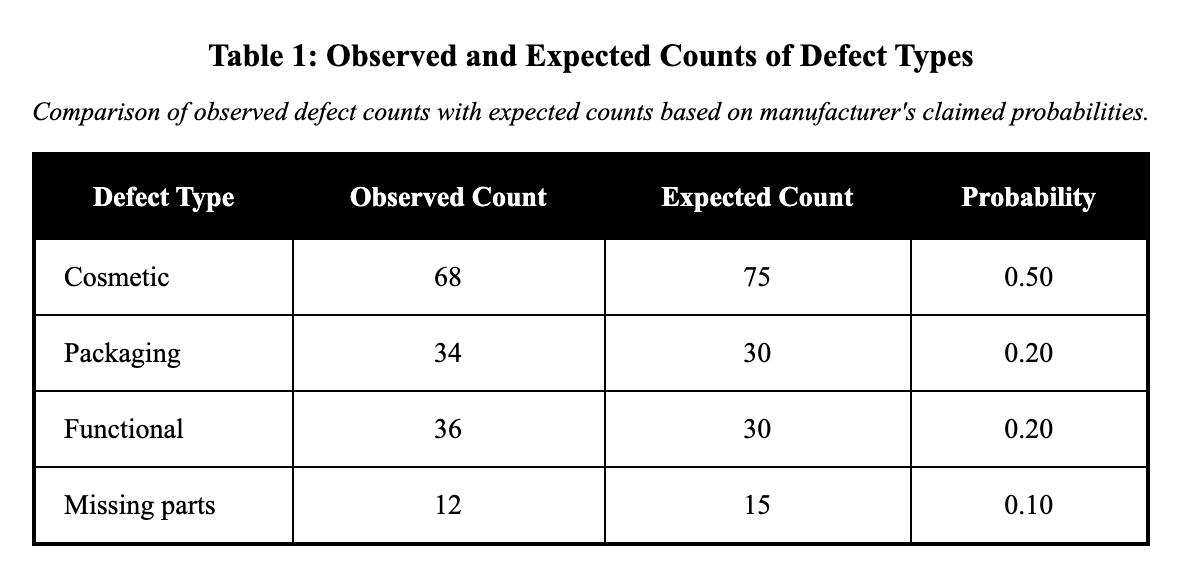
Chi-Square Goodness of Fit (Setup) - AP Statistics
Card 1 of 30
What is the null hypothesis for a Chi-Square Goodness of Fit test?
Tap to reveal answer
The observed distribution matches the expected distribution. This states no difference exists between observed and expected distributions.
← Didn't Know|Knew It →
What is the alternative hypothesis for a Chi-Square Goodness of Fit test?
Tap to reveal answer
The observed distribution does not match the expected distribution. This states a significant difference exists between observed and expected distributions.
← Didn't Know|Knew It →
State the formula for the Chi-Square test statistic.
Tap to reveal answer
$\chi^2 = \sum \frac{(O_i - E_i)^2}{E_i}$. Sums squared differences between observed and expected, divided by expected.
← Didn't Know|Knew It →
Identify the symbol $O_i$ in the Chi-Square test statistic formula.
Tap to reveal answer
$O_i$ represents the observed frequency for category $i$. This is the actual count observed in each category of the data.
← Didn't Know|Knew It →
Identify the symbol $E_i$ in the Chi-Square test statistic formula.
Tap to reveal answer
$E_i$ represents the expected frequency for category $i$. This is the theoretical count predicted for each category under $H_0$.
← Didn't Know|Knew It →
How do you calculate degrees of freedom for a Chi-Square Goodness of Fit test?
Tap to reveal answer
Degrees of freedom = number of categories - 1. Subtract 1 from categories because we lose one degree of freedom.
← Didn't Know|Knew It →
What is the significance level typically used in hypothesis testing?
Tap to reveal answer
A common significance level is $\alpha = 0.05$. This is the standard threshold for statistical significance in most tests.
← Didn't Know|Knew It →
What is a p-value in the context of hypothesis testing?
Tap to reveal answer
The p-value is the probability of observing a test statistic as extreme as the one observed. Measures how likely the observed result is if the null hypothesis is true.
← Didn't Know|Knew It →
What decision do you make if the p-value is less than the significance level?
Tap to reveal answer
Reject the null hypothesis. When p-value < $\alpha$, evidence strongly contradicts the null hypothesis.
← Didn't Know|Knew It →
What decision do you make if the p-value is greater than the significance level?
Tap to reveal answer
Fail to reject the null hypothesis. When p-value ≥ $\alpha$, insufficient evidence exists to reject the null hypothesis.
← Didn't Know|Knew It →
Identify the test: Testing if a die is fair based on observed roll frequencies.
Tap to reveal answer
Chi-Square Goodness of Fit test. Tests if observed roll frequencies match expected equal probabilities for fairness.
← Didn't Know|Knew It →
Calculate expected frequency: Total 200 trials, 4 categories, equal distribution.
Tap to reveal answer
Expected frequency = 50 for each category. Divide total trials (200) by number of categories (4) for equal distribution.
← Didn't Know|Knew It →
Which distribution does the Chi-Square test statistic follow?
Tap to reveal answer
Chi-Square distribution. The test statistic follows this right-skewed distribution under the null hypothesis.
← Didn't Know|Knew It →
What condition must be met for expected frequencies in Chi-Square tests?
Tap to reveal answer
Expected frequency in each category should be at least 5. This ensures the normal approximation to the Chi-Square distribution is valid.
← Didn't Know|Knew It →
What does a large Chi-Square test statistic indicate?
Tap to reveal answer
A large deviation between observed and expected frequencies. Large values suggest the observed data doesn't fit the expected model well.
← Didn't Know|Knew It →
What does a small Chi-Square test statistic indicate?
Tap to reveal answer
A small deviation between observed and expected frequencies. Small values suggest the observed data closely matches the expected model.
← Didn't Know|Knew It →
In what situation would you use a Chi-Square Goodness of Fit test?
Tap to reveal answer
To test how well an observed distribution fits an expected distribution. This test determines if data follows a specific theoretical distribution pattern.
← Didn't Know|Knew It →
Which statistical test is used to compare observed data with a model?
Tap to reveal answer
Chi-Square Goodness of Fit test. This test compares actual observations against theoretical expectations or models.
← Didn't Know|Knew It →
Find the degrees of freedom: 5 categories in a Chi-Square test.
Tap to reveal answer
Degrees of freedom = 4. Apply the formula: df = categories - 1 = 5 - 1 = 4.
← Didn't Know|Knew It →
What is the result if $\chi^2 = 0$ in a Chi-Square test?
Tap to reveal answer
Observed frequencies match expected frequencies exactly. Zero indicates perfect agreement between observed and expected frequency values.
← Didn't Know|Knew It →
What is the role of the Chi-Square distribution table?
Tap to reveal answer
To find p-values and critical values for Chi-Square tests. The table provides probability values for different Chi-Square statistics and df.
← Didn't Know|Knew It →
Select the correct hypothesis test: Testing if a coin is fair.
Tap to reveal answer
Chi-Square Goodness of Fit test. Tests if observed heads/tails frequencies match expected 50/50 distribution.
← Didn't Know|Knew It →
Calculate the Chi-Square statistic: $O_i = 30, E_i = 25$ for one category.
Tap to reveal answer
$\frac{(30 - 25)^2}{25} = 1.0$. Apply the formula: $(30-25)^2/25 = 25/25 = 1.0$.
← Didn't Know|Knew It →
What does a Chi-Square Goodness of Fit test assess?
Tap to reveal answer
Whether observed frequencies significantly differ from expected frequencies. Determines if the sample data matches a proposed theoretical distribution model.
← Didn't Know|Knew It →
What assumption is needed for using the Chi-Square test?
Tap to reveal answer
Random sampling and independence of observations. These ensure valid probability calculations and prevent bias in the test.
← Didn't Know|Knew It →
Interpret $p < 0.05$ in a Chi-Square test.
Tap to reveal answer
There is a statistically significant difference; reject the null hypothesis. The difference is statistically significant at the 5% level of significance.
← Didn't Know|Knew It →
What is the shape of a Chi-Square distribution?
Tap to reveal answer
Skewed to the right, especially with low degrees of freedom. The distribution becomes more symmetric as degrees of freedom increase.
← Didn't Know|Knew It →
What is the mean of a Chi-Square distribution with $k$ degrees of freedom?
Tap to reveal answer
Mean = $k$. The mean equals the number of degrees of freedom in the distribution.
← Didn't Know|Knew It →
What is the variance of a Chi-Square distribution with $k$ degrees of freedom?
Tap to reveal answer
Variance = $2k$. The variance is always twice the degrees of freedom value.
← Didn't Know|Knew It →
Explain the purpose of a Chi-Square Goodness of Fit test briefly.
Tap to reveal answer
To test if observed data fits a specified distribution. Determines if sample data follows a hypothesized probability distribution pattern.
← Didn't Know|Knew It →