Work, Energy, and Power
Help Questions
AP Physics C: Electricity and Magnetism › Work, Energy, and Power
Starting from rest, a skateboarder travels down a 25o incline that's 22m long. Using conservation of energy, calculate the skateboarder's speed when he reaches the bottom. Ignore friction.


Explanation
Conservation of energy states that 
The skateboarder starts from rest; thus, 


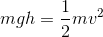
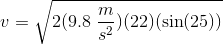
Solve for v.

Using trigonometry, 

An object is pushed across a rough surface with a force of 53N. The rough surface exerts a frictional force of 3.47N on the object. If the object is pushed 7.9m, how much work is done on the object?


Explanation
The defintion of work is:

The net force on this object is:

We can calculate this term using the given values:

The distance is given. Substituting these values:

An object is pushed across a rough surface with a force of 53N. The rough surface exerts a frictional force of 3.47N on the object. If the object is pushed 7.9m, how much work is done on the object?
Explanation
The defintion of work is:
The net force on this object is:
We can calculate this term using the given values:
The distance is given. Substituting these values:
A 25kg child climbs up a tree. How much work is required for him to climb up this tree to a height of three meters?


Explanation
The forces acting on the child are the force of gravity and the upward force provided by the child himself. Choosing the upward direction as positive, Newton's second law applied to the child gives the following equation.


To calculate the work done by the child to bring himself three meters up the tree, we use the work equation below.

Starting from rest, a skateboarder travels down a 25o incline that's 22m long. Using conservation of energy, calculate the skateboarder's speed when he reaches the bottom. Ignore friction.
Explanation
Conservation of energy states that
The skateboarder starts from rest; thus,
Solve for v.
Using trigonometry,
A 25kg child climbs up a tree. How much work is required for him to climb up this tree to a height of three meters?
Explanation
The forces acting on the child are the force of gravity and the upward force provided by the child himself. Choosing the upward direction as positive, Newton's second law applied to the child gives the following equation.
To calculate the work done by the child to bring himself three meters up the tree, we use the work equation below.
A 25kg child climbs up a tree. How much work is required for him to climb up this tree to a height of three meters?
Explanation
The forces acting on the child are the force of gravity and the upward force provided by the child himself. Choosing the upward direction as positive, Newton's second law applied to the child gives the following equation.
To calculate the work done by the child to bring himself three meters up the tree, we use the work equation below.
An object is pushed across a rough surface with a force of 53N. The rough surface exerts a frictional force of 3.47N on the object. If the object is pushed 7.9m, how much work is done on the object?
Explanation
The defintion of work is:
The net force on this object is:
We can calculate this term using the given values:
The distance is given. Substituting these values:
Starting from rest, a skateboarder travels down a 25o incline that's 22m long. Using conservation of energy, calculate the skateboarder's speed when he reaches the bottom. Ignore friction.
Explanation
Conservation of energy states that
The skateboarder starts from rest; thus,
Solve for v.
Using trigonometry,
A crane lifts a crate with a mass of 50kg. The crate is raised at a constant velocity for ten seconds and and moves a vertical distance upwards of 20m. What power is being supplied to the crane during this time?


Explanation
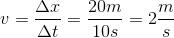
For this problem we can calculate the power as the product of force and velocity:

First, we need to find the velocity:
Our force will be equal to the weight of the crate:

Now, we can solve for power:
