The Production Function
Help Questions
AP Microeconomics › The Production Function
A small factory produces assembled toolkits (single output) using labor as the variable input; the assembly line (capital) is fixed. Based on the production data shown, what is the marginal product of the 6th worker?
Table: Total Product (TP) of Toolkits
| Labor (L), workers | Total Product (TP), toolkits/day |
|---|---|
| 0 | 0 |
| 1 | 3 |
| 2 | 8 |
| 3 | 14 |
| 4 | 19 |
| 5 | 23 |
| 6 | 26 |
| 7 | 28 |
5 toolkits per day
26 toolkits per day
4 toolkits per day
6 toolkits per day
3 toolkits per day
Explanation
This question focuses on the production function and the concept of marginal product of labor in AP Microeconomics. Marginal product (MP) is the additional output from hiring one more worker, and diminishing marginal returns refer to the stage where each additional worker adds less output than the previous one due to fixed capital. Using the provided table, we calculate MP for each worker to understand the pattern. The marginal product of the 6th worker is 26 - 23 = 3 toolkits per day, as shown by the change in TP from 5 to 6 workers. Don't confuse marginal product with average product, which is TP divided by labor (e.g., AP at 6 workers is 26/6 ≈4.33). To compute marginal product, always use the formula MP = ΔTP / ΔL, where ΔL is usually 1. Look for diminishing returns by observing when MP starts declining as labor increases while capital is fixed.
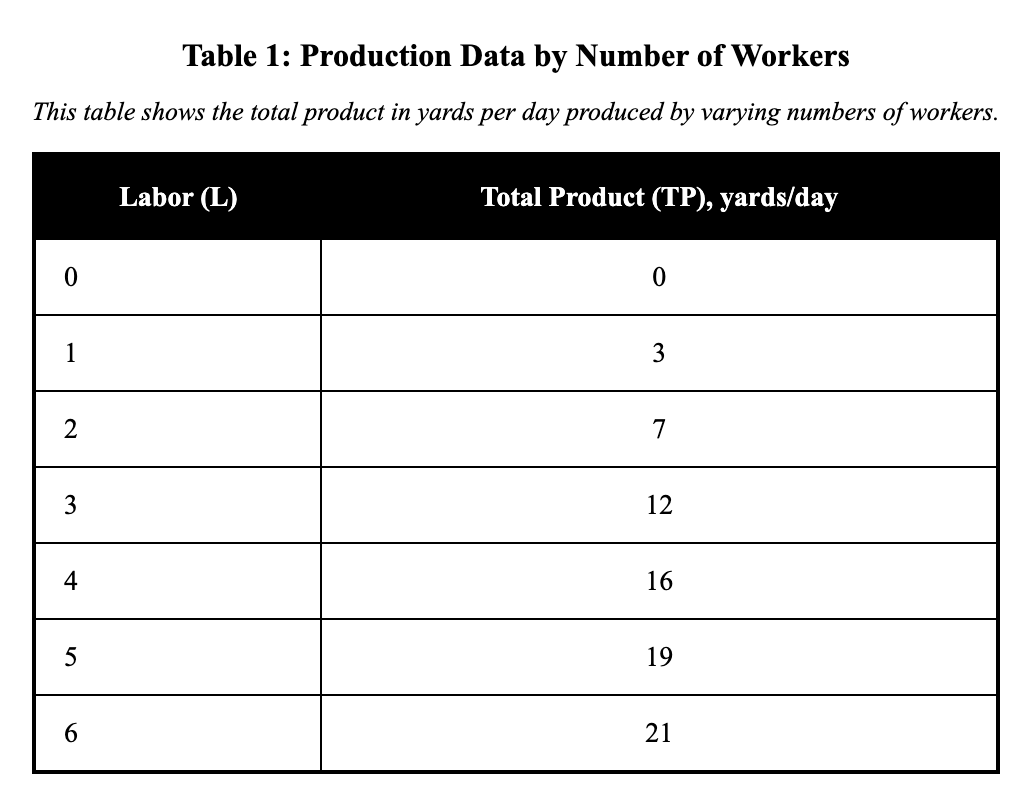
A landscaping company produces completed yards per day using labor (workers) as the variable input; equipment is fixed. Based on the production data shown in the table, what is the marginal product of the 5th worker?
| Labor (L) | Total Product (TP), yards/day |
|---|---|
| 0 | 0 |
| 1 | 3 |
| 2 | 7 |
| 3 | 12 |
| 4 | 16 |
| 5 | 19 |
| 6 | 21 |
$3.8$ yards/day
$19$ yards/day
$2$ yards/day
$4$ yards/day
$3$ yards/day
Explanation
This question tests your ability to calculate the marginal product of labor from a production function table. Marginal product (MP) is the additional output produced by one more unit of labor, calculated as the change in total product divided by the change in labor. For the 5th worker, MP = (TP at L=5 - TP at L=4)/(5-4) = (19-16)/1 = 3 yards/day. The 5th worker adds exactly 3 yards to daily production. A common error is reporting total product (19) or average product (19/5=3.8) instead of marginal product. To find any worker's marginal product, subtract the previous total product from the current total product—this gives the additional output that specific worker contributes to production.
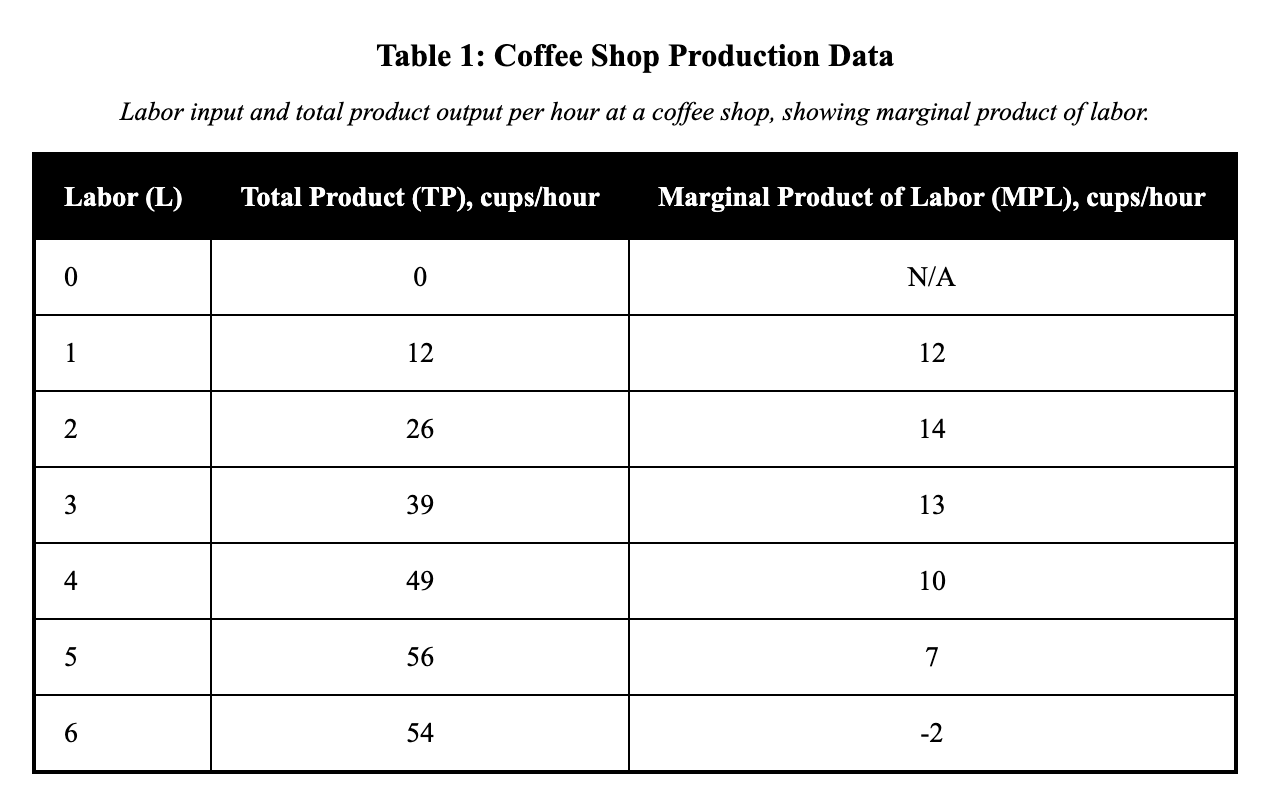
A coffee shop produces cups of coffee per hour using labor (baristas) as the variable input; espresso machines are fixed. Based on the production data shown in the table, which range shows negative marginal returns to labor?
| Labor (L) | Total Product (TP), cups/hour |
|---|---|
| 0 | 0 |
| 1 | 12 |
| 2 | 26 |
| 3 | 39 |
| 4 | 49 |
| 5 | 56 |
| 6 | 54 |
From $L=3$ to $L=4$
From $L=5$ to $L=6$
From $L=4$ to $L=5$
From $L=1$ to $L=2$
From $L=2$ to $L=3$
Explanation
This question tests your understanding of negative marginal returns in the production function. Marginal product of labor (MPL) is the additional output from hiring one more worker, and negative marginal returns occur when MPL becomes negative—meaning total product actually decreases when adding labor. Calculate MPL for each worker: L=1: 12, L=2: 14, L=3: 13, L=4: 10, L=5: 7, L=6: -2. From L=5 to L=6, total product falls from 56 to 54, giving MPL = -2 cups/hour. This happens when workers become so crowded they interfere with each other's productivity. Don't confuse diminishing returns (positive but declining MP) with negative returns (negative MP). To identify negative returns, look for where total product decreases as labor increases—this is the only range where hiring more workers actually reduces output.
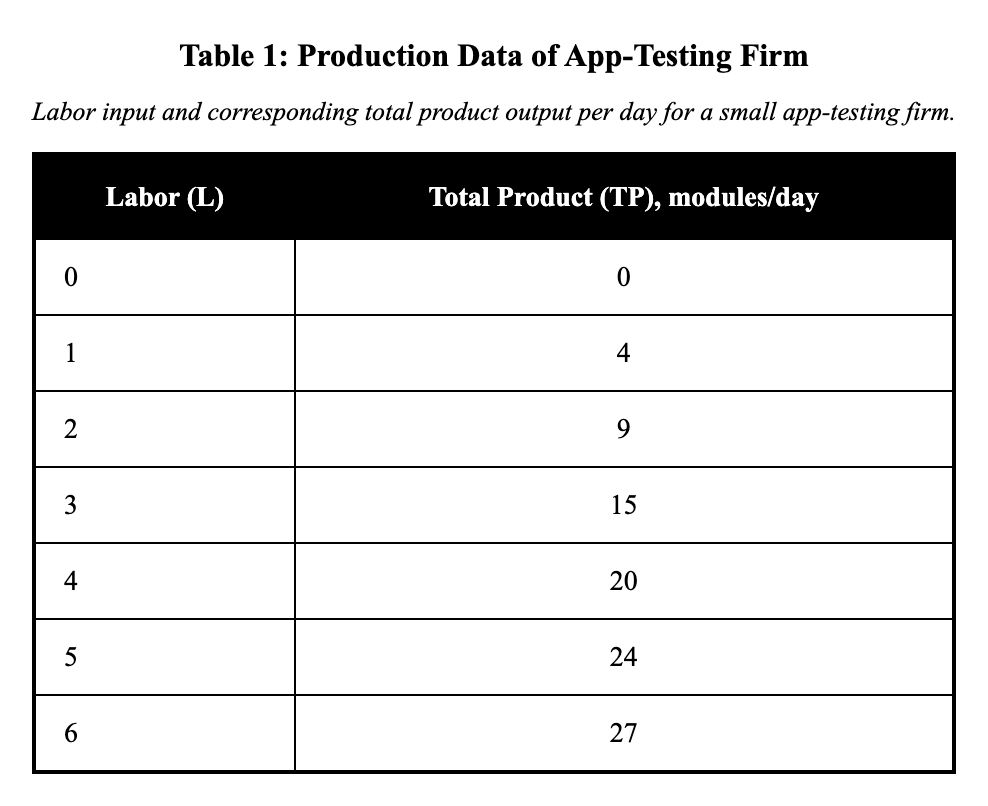
A small app-testing firm completes tested modules per day using labor (testers) as the variable input; computer lab capacity is fixed. Based on the production data shown in the table, over which range of labor does the firm experience diminishing marginal returns?
| Labor (L) | Total Product (TP), modules/day |
|---|---|
| 0 | 0 |
| 1 | 4 |
| 2 | 9 |
| 3 | 15 |
| 4 | 20 |
| 5 | 24 |
| 6 | 27 |
From $L=4$ to $L=6$ only
From $L=1$ to $L=6$ (constant marginal returns)
From $L=0$ to $L=2$ only
From $L=1$ to $L=3$ only
From $L=3$ to $L=6$
Explanation
This question tests your understanding of diminishing marginal returns in the production function. Marginal product of labor (MPL) is the additional output from each worker, and diminishing returns occur when MPL decreases as labor increases. Calculate MPL for each worker: L=1: 4, L=2: 5, L=3: 6, L=4: 5, L=5: 4, L=6: 3. MPL increases from L=1 to L=3 (4→5→6), then decreases from L=3 to L=6 (6→5→4→3), so diminishing returns begin after the 3rd tester. The key is recognizing that MPL peaks at L=3 then declines. Don't mistake steady total product growth for constant marginal returns—TP can increase while MP decreases. To identify diminishing returns, always calculate MP = ΔTP/ΔL and look for where MP starts declining, indicating reduced productivity gains from additional workers.
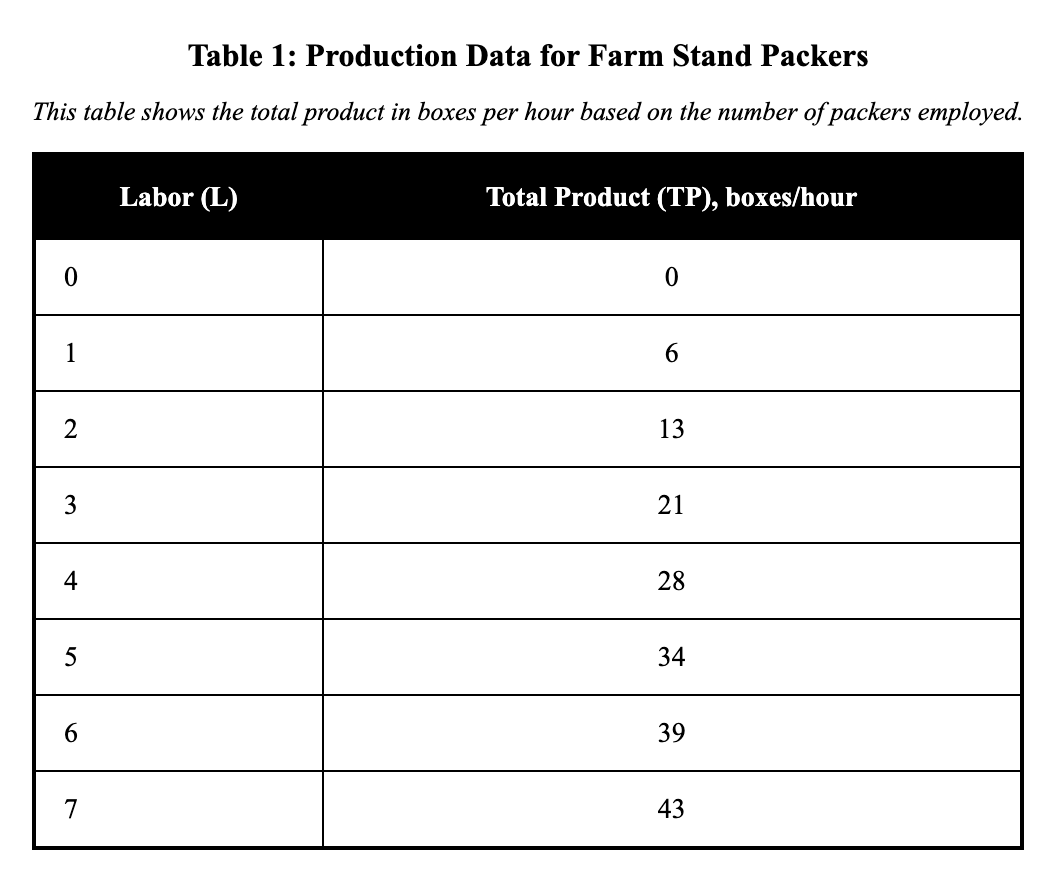
A farm stand packs boxes of produce per hour using labor (packers) as the variable input; packing tables are fixed. Based on the production data shown in the table, what is the marginal product of the 6th packer?
| Labor (L) | Total Product (TP), boxes/hour |
|---|---|
| 0 | 0 |
| 1 | 6 |
| 2 | 13 |
| 3 | 21 |
| 4 | 28 |
| 5 | 34 |
| 6 | 39 |
| 7 | 43 |
$6$ boxes/hour
$4$ boxes/hour
$6.5$ boxes/hour per packer (average product)
$39$ boxes/hour
$5$ boxes/hour
Explanation
This question tests your ability to calculate the marginal product of labor from a production function table. Marginal product (MP) is the additional output produced by one more worker, calculated as the change in total product. For the 6th packer, MP = (TP at L=6 - TP at L=5)/(6-5) = (39-34)/1 = 5 boxes/hour. The 6th packer adds 5 boxes per hour to production. A common error is confusing marginal product with average product (39/6=6.5)—marginal product focuses on the contribution of the specific worker, not the average across all workers. To find any worker's marginal product, use MP = ΔTP/ΔL, subtracting the previous total from the current total to isolate that worker's individual contribution to output.
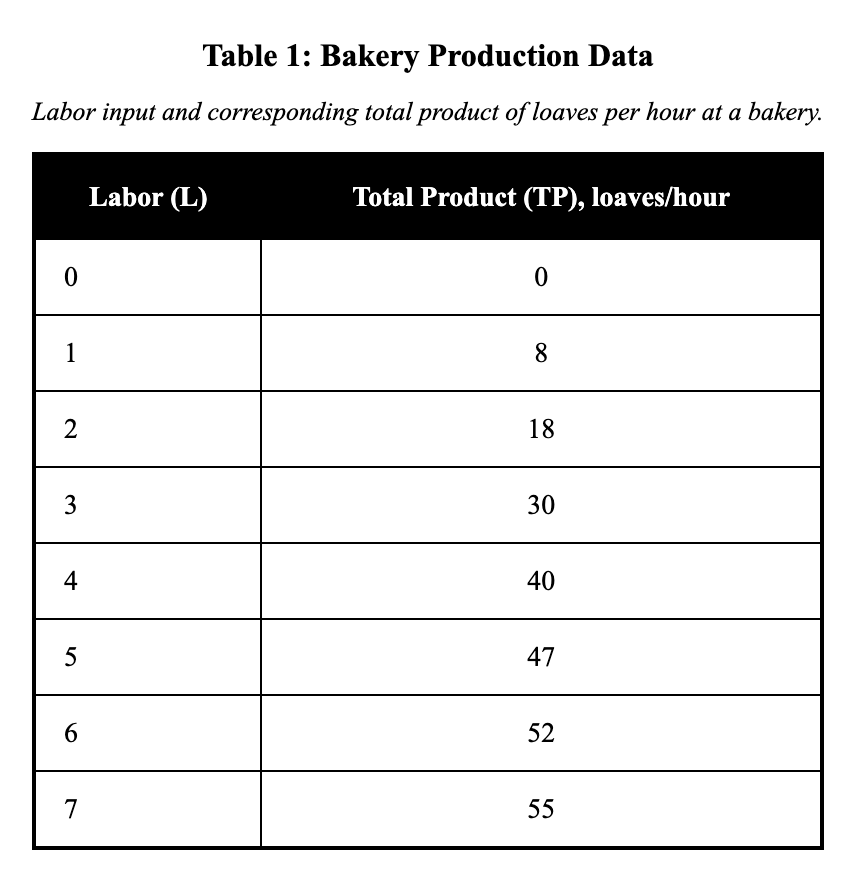
A small bakery produces loaves of bread per hour using labor (bakers) as the variable input, while the number of ovens is fixed. Based on the production data shown in the table, over which range of labor does the firm experience diminishing marginal returns?
| Labor (L) | Total Product (TP), loaves/hour |
|---|---|
| 0 | 0 |
| 1 | 8 |
| 2 | 18 |
| 3 | 30 |
| 4 | 40 |
| 5 | 47 |
| 6 | 52 |
| 7 | 55 |
From $L=1$ to $L=3$ only
From $L=0$ to $L=2$ only
From $L=1$ to $L=7$ (constant marginal returns)
From $L=4$ to $L=7$ only
From $L=3$ to $L=7$
Explanation
This question tests your understanding of the production function and marginal product of labor (MPL). Marginal product is the additional output from hiring one more worker, and diminishing marginal returns occur when MPL decreases as more labor is added while capital remains fixed. To find diminishing returns, calculate MPL for each worker: L=1: 8, L=2: 10, L=3: 12, L=4: 10, L=5: 7, L=6: 5, L=7: 3. MPL increases from L=1 to L=3 (8→10→12), then decreases from L=3 to L=7 (12→10→7→5→3), so diminishing returns begin after the 3rd worker. A common mistake is confusing total product trends with marginal product changes—TP can still increase while MP decreases. To identify diminishing returns, always compute MP as ΔTP/ΔL and look for where MP starts declining, which indicates each additional worker adds less output than the previous one.
A small bakery produces loaves of bread (single output) using labor as the variable input; its ovens and floor space (capital) are fixed. Based on the production data shown, what is the marginal product of the 5th worker?
Table: Total Product (TP) of Bread
| Labor (L), workers | Total Product (TP), loaves/hour |
|---|---|
| 0 | 0 |
| 1 | 6 |
| 2 | 14 |
| 3 | 24 |
| 4 | 33 |
| 5 | 40 |
| 6 | 45 |
7 loaves per hour
40 loaves per hour
10 loaves per hour
8 loaves per hour
9 loaves per hour
Explanation
This question focuses on the production function and the concept of marginal product of labor in AP Microeconomics. Marginal product (MP) is the additional output from hiring one more worker, and diminishing marginal returns refer to the stage where each additional worker adds less output than the previous one due to fixed capital. Using the provided table, we calculate MP for each worker to understand the pattern. The marginal product of the 5th worker is 40 - 33 = 7 loaves per hour, as shown by the change in TP from 4 to 5 workers. Don't confuse marginal product with average product, which is TP divided by labor (e.g., AP at 5 workers is 40/5=8). To compute marginal product, always use the formula MP = ΔTP / ΔL, where ΔL is usually 1. Look for diminishing returns by observing when MP starts declining as labor increases while capital is fixed.
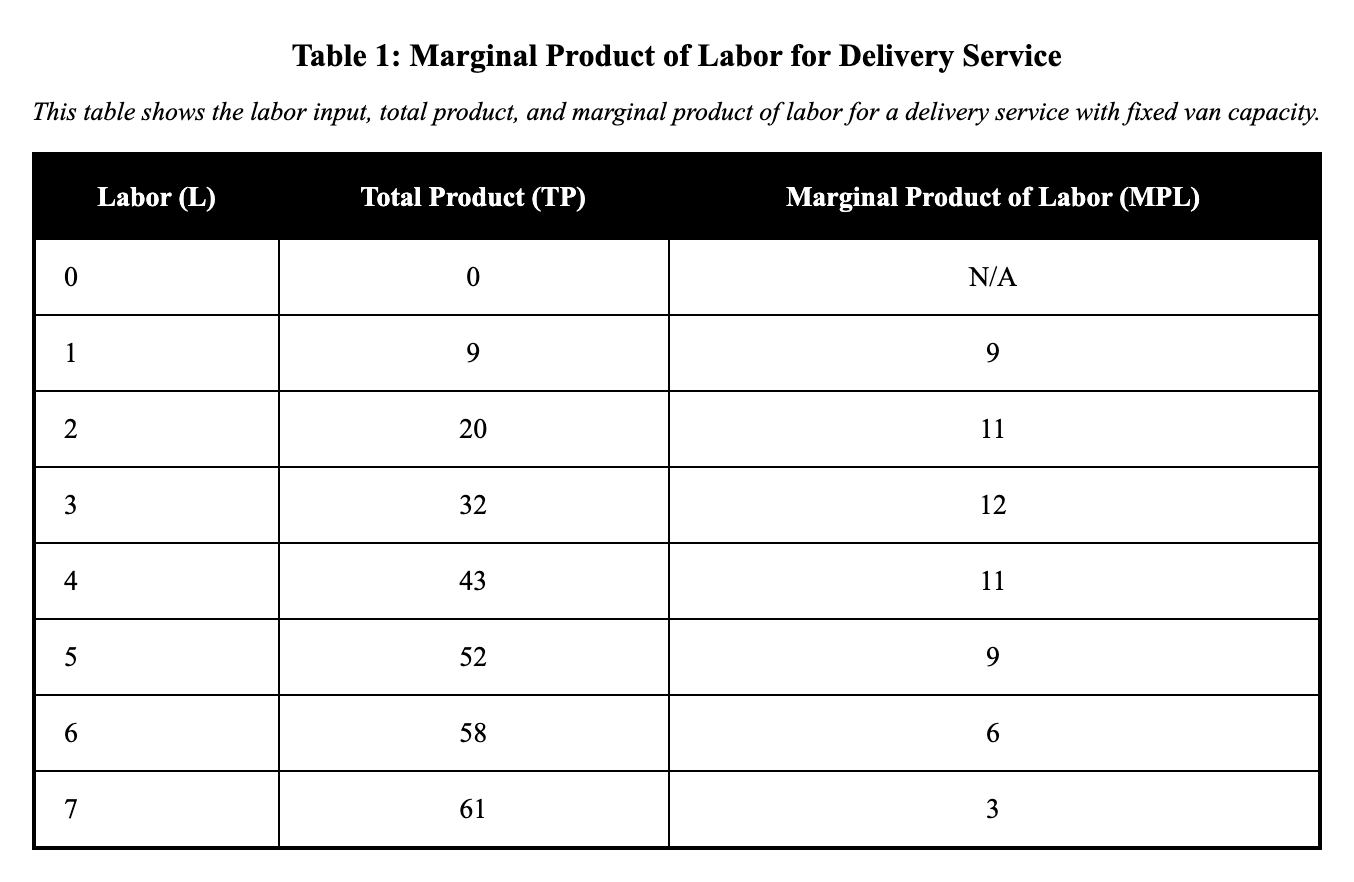
A delivery service completes deliveries per shift using labor (drivers) as the variable input; the number of vans is fixed. Based on the production data shown in the table, over which range of labor does the firm experience diminishing marginal returns?
| Labor (L) | Total Product (TP), deliveries/shift |
|---|---|
| 0 | 0 |
| 1 | 9 |
| 2 | 20 |
| 3 | 32 |
| 4 | 43 |
| 5 | 52 |
| 6 | 58 |
| 7 | 61 |
From $L=0$ to $L=2$ only
From $L=1$ to $L=7$ (constant marginal returns)
From $L=1$ to $L=4$ only
From $L=2$ to $L=5$ only
From $L=4$ to $L=7$
Explanation
This question tests your understanding of diminishing marginal returns in the production function. Marginal product of labor (MPL) is the additional output from each driver, and diminishing returns occur when MPL decreases as labor increases. Calculate MPL: L=1: 9, L=2: 11, L=3: 12, L=4: 11, L=5: 9, L=6: 6, L=7: 3. MPL increases from L=1 to L=3 (9→11→12), then decreases from L=4 to L=7 (11→9→6→3), indicating diminishing returns begin after the 3rd driver. The pattern shows initial gains from specialization followed by congestion effects. To identify diminishing returns, compute MP = ΔTP/ΔL for each worker and find where MP starts declining—this reveals when additional workers contribute less due to fixed van capacity.
A small greenhouse produces potted plants (single output) using labor as the variable input; the greenhouse space and watering system (capital) are fixed. Based on the production data shown, what is the marginal product of the 7th worker?
Table: Total Product (TP) of Potted Plants
| Labor (L), workers | Total Product (TP), plants/day |
|---|---|
| 0 | 0 |
| 1 | 4 |
| 2 | 9 |
| 3 | 15 |
| 4 | 20 |
| 5 | 24 |
| 6 | 27 |
| 7 | 29 |
| 8 | 28 |
2 plants per day
29 plants per day
5 plants per day
1 plant per day
3 plants per day
Explanation
This question focuses on the production function and the concept of marginal product of labor in AP Microeconomics. Marginal product (MP) is the additional output from hiring one more worker, and diminishing marginal returns refer to the stage where each additional worker adds less output than the previous one due to fixed capital. Using the provided table, we calculate MP for each worker to understand the pattern. The marginal product of the 7th worker is 29 - 27 = 2 plants per day, as shown by the change in TP from 6 to 7 workers. Don't confuse marginal product with average product, which is TP divided by labor (e.g., AP at 7 workers is 29/7 ≈4.14). To compute marginal product, always use the formula MP = ΔTP / ΔL, where ΔL is usually 1. Look for diminishing returns by observing when MP starts declining as labor increases while capital is fixed.
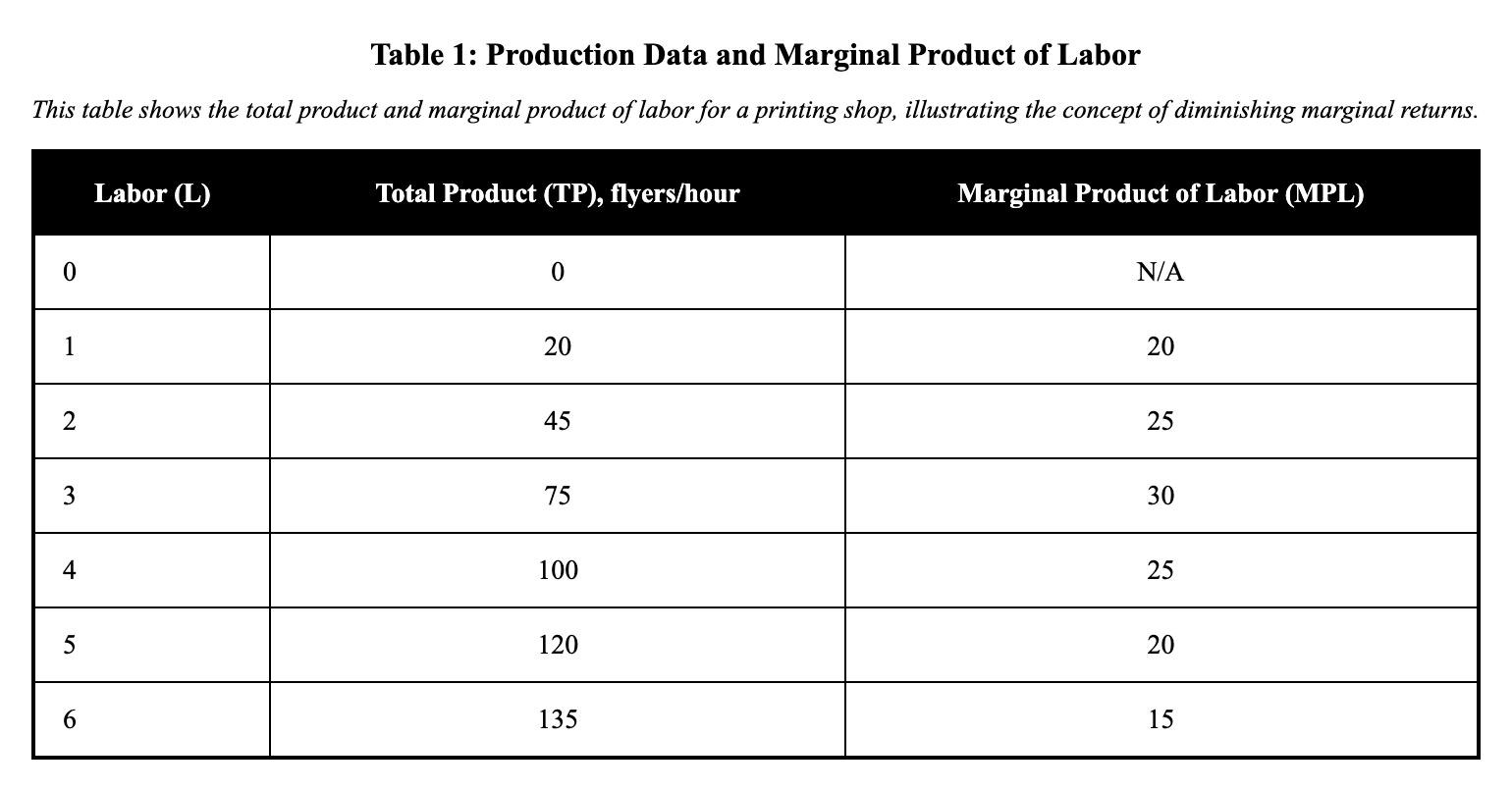
A printing shop produces flyers per hour using labor (workers) as the variable input; printing presses are fixed. Based on the production data shown in the table, over which range of labor does the firm experience diminishing marginal returns?
| Labor (L) | Total Product (TP), flyers/hour |
|---|---|
| 0 | 0 |
| 1 | 20 |
| 2 | 45 |
| 3 | 75 |
| 4 | 100 |
| 5 | 120 |
| 6 | 135 |
From $L=2$ to $L=5$ only
From $L=1$ to $L=6$ (constant marginal returns)
From $L=1$ to $L=4$ only
From $L=0$ to $L=3$
From $L=4$ to $L=6$
Explanation
This question tests your understanding of diminishing marginal returns in the production function. Marginal product of labor (MPL) is the additional output from each worker, and diminishing returns occur when MPL decreases as more labor is added. Calculate MPL: L=1: 20, L=2: 25, L=3: 30, L=4: 25, L=5: 20, L=6: 15. MPL increases from L=1 to L=3 (20→25→30), then decreases from L=4 to L=6 (25→20→15), indicating diminishing returns begin after the 3rd worker. Don't confuse this with negative returns—total product still increases, just at a decreasing rate. To identify diminishing returns, compute MP = ΔTP/ΔL for each worker and find where MP starts declining, which shows that each additional worker contributes less than the previous one due to fixed capital constraints.