Socially Efficient and Inefficient Market Outcomes
Help Questions
AP Microeconomics › Socially Efficient and Inefficient Market Outcomes
Based on the market outcome shown in the table, at which quantity is total surplus maximized? The market is currently producing $Q=4$ units. Total surplus is maximized by producing through the last unit where $MB\ge MC$.
$Q=6$ units, because producing more output cannot create deadweight loss
$Q=2$ units, because efficiency occurs where $MC$ is lowest
$Q=4$ units, because the observed market outcome is always socially efficient
$Q=4$ units, because any difference between MB and MC is a transfer
$Q=5$ units, because $MB$ remains at least as large as $MC$ through unit 5
Explanation
This question asks you to identify the socially efficient quantity given a current market outcome. Social efficiency maximizes total surplus by producing through the last unit where marginal benefit is at least as large as marginal cost (MB ≥ MC). We need to check each unit: if MB ≥ MC holds through unit 5 but not for unit 6, then Q=5 is efficient. The current market outcome (Q=4) may underproduce if unit 5 has MB ≥ MC. Students often assume the observed quantity is efficient, but markets don't always reach the social optimum. To find efficiency, produce units sequentially while MB ≥ MC and stop when this condition fails.
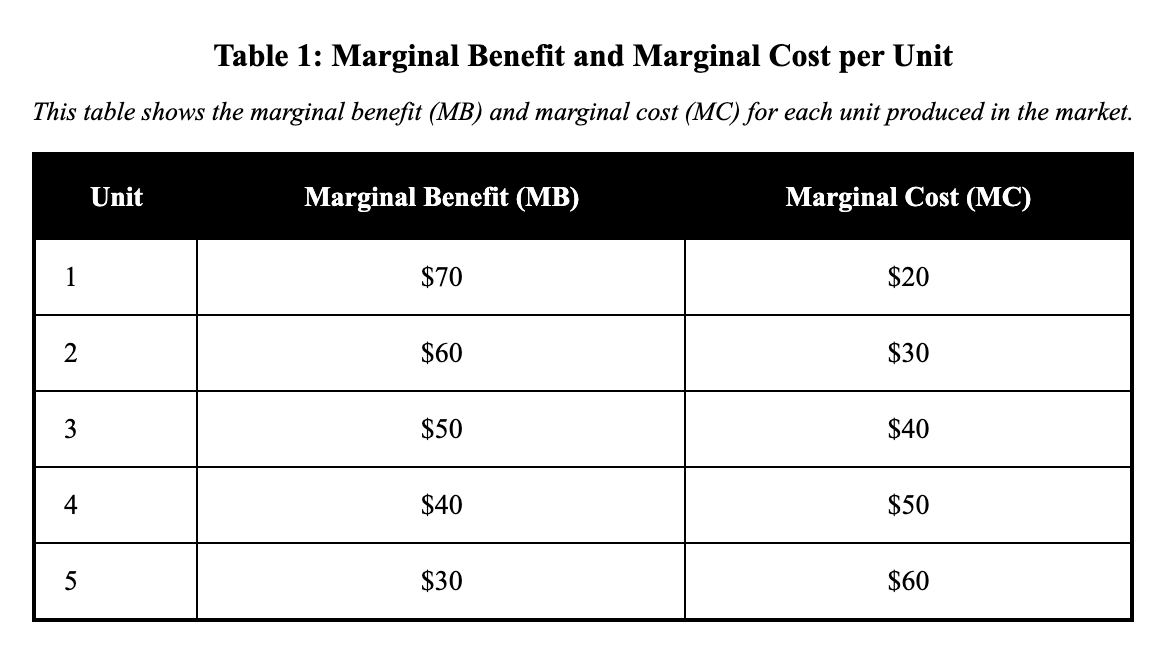
Based on the market outcome shown in the table, which statement correctly identifies the deadweight loss (DWL) when the market produces $Q=1$ unit?
Table (per unit):
- Unit 1: $MB=\$70$, $MC=$20$
- Unit 2: $MB=\$60$, $MC=$30$
- Unit 3: $MB=\$50$, $MC=$40$
- Unit 4: $MB=\$40$, $MC=$50$
- Unit 5: $MB=\$30$, $MC=$60$
DWL is the tax revenue collected on units 2 and 3
DWL is the transfer from producers to consumers on unit 1
DWL is the total spending by consumers on unit 1
DWL is the loss from not producing units 2 and 3, where $MB>MC$
DWL is zero because $MB>MC$ for the unit that is produced
Explanation
This question asks about deadweight loss when the market underproduces relative to the socially efficient quantity. Social efficiency requires producing where marginal benefit equals marginal cost to maximize total surplus. Looking at the table, units 2 and 3 both have MB > MC (unit 2: $60 > $30 = $30 surplus; unit 3: $50 > $40 = $10 surplus), meaning society loses $40 total by not producing these units—this is the deadweight loss. The market stops at Q=1, missing these beneficial trades. Students often confuse DWL with consumer spending or transfers, but DWL represents lost surplus from trades that should happen but don't. To find DWL from underproduction, identify all units where MB > MC that aren't being produced and sum the differences.
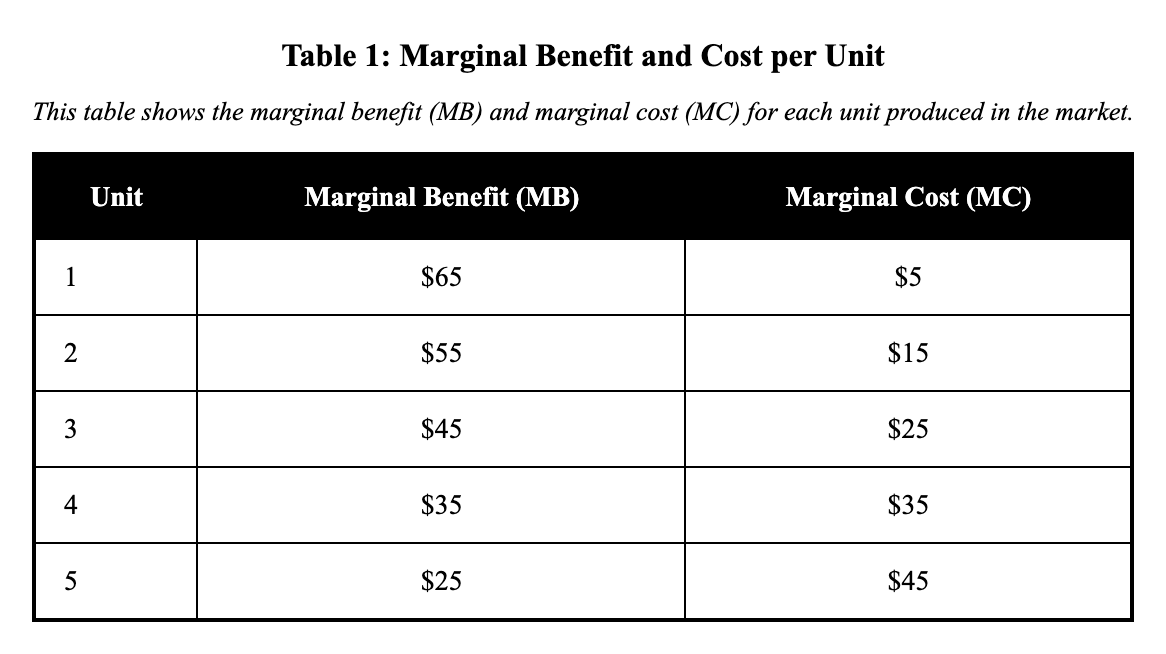
Based on the market outcome shown in the table, at which quantity is total surplus maximized (the socially efficient quantity)? The market currently produces $Q=4$ units.
Table (per unit):
- Unit 1: $MB=\$65$, $MC=$5$
- Unit 2: $MB=\$55$, $MC=$15$
- Unit 3: $MB=\$45$, $MC=$25$
- Unit 4: $MB=\$35$, $MC=$35$
- Unit 5: $MB=\$25$, $MC=$45$
Total surplus is maximized at $Q=4$ units
Total surplus is maximized at $Q=5$ units
Total surplus is maximized at $Q=1$ unit
Total surplus is maximized at $Q=3$ units
Total surplus is maximized at $Q=2$ units
Explanation
This question asks you to identify the socially efficient quantity where total surplus is maximized. Social efficiency occurs when we produce all units where marginal benefit equals or exceeds marginal cost. Looking at the table, MB > MC for units 1-3, MB = MC = $35 for unit 4, and MB < MC for unit 5. The efficient quantity is Q=4 because we capture all positive surplus and stop before creating losses. The market happening to produce Q=4 doesn't determine efficiency—what matters is the MB-MC relationship. Students sometimes think efficiency means equal consumer and producer surplus, but it only requires producing where MB = MC at the margin. To find the efficient quantity, produce all units where MB ≥ MC and stop when the next unit would have MB < MC.
Based on the market outcome shown in the table, is the outcome socially efficient? The market is producing $Q=2$ units. Social efficiency occurs at the quantity where the last unit produced has $MB\ge MC$, and all units with $MB>MC$ are produced.
Yes, because $MB$ is greater than $MC$ on unit 2
Yes, because any unproduced gains are transfers rather than deadweight loss
Yes, because the market outcome equals the profit-maximizing quantity
No, because consumer surplus is larger than producer surplus at $Q=2$
No, because additional units with $MB>MC$ are not produced, creating deadweight loss
Explanation
This question tests whether you recognize an inefficient market outcome due to underproduction. Social efficiency requires producing all units where marginal benefit exceeds marginal cost (MB > MC). At Q=2 units, we must check if additional units would have MB > MC. If units beyond Q=2 have MB > MC, then the market is inefficiently underproducing and creating deadweight loss. A misconception is that any market outcome must be efficient, but markets can fail to produce all mutually beneficial units. To assess efficiency, check whether any unproduced units would generate positive net benefits (MB > MC).
Based on the market outcome shown in the table, at which quantity is total surplus maximized? The market is currently producing $Q=1$ unit. Total surplus is maximized at the quantity where the last unit produced has $MB\ge MC$.
$Q=5$ units, because total surplus rises as long as some buyers are willing to pay
$Q=4$ units, because deadweight loss is only a transfer from consumers to producers
$Q=1$ unit, because producing the first unit generates the largest net benefit
$Q=3$ units, because $MB$ exceeds $MC$ through the third unit but not beyond
$Q=2$ units, because the market outcome must be efficient
Explanation
This question asks you to find the socially efficient quantity when the market is underproducing. Social efficiency maximizes total surplus by producing through the last unit where marginal benefit is at least as large as marginal cost (MB ≥ MC). Starting from Q=1, we need to check additional units: if MB exceeds MC through unit 3 but not beyond, then Q=3 is efficient. A common error is stopping at Q=1 just because it has the largest net benefit per unit, but efficiency requires producing all positive net benefit units. To find the efficient quantity, continue producing as long as MB ≥ MC on each additional unit.
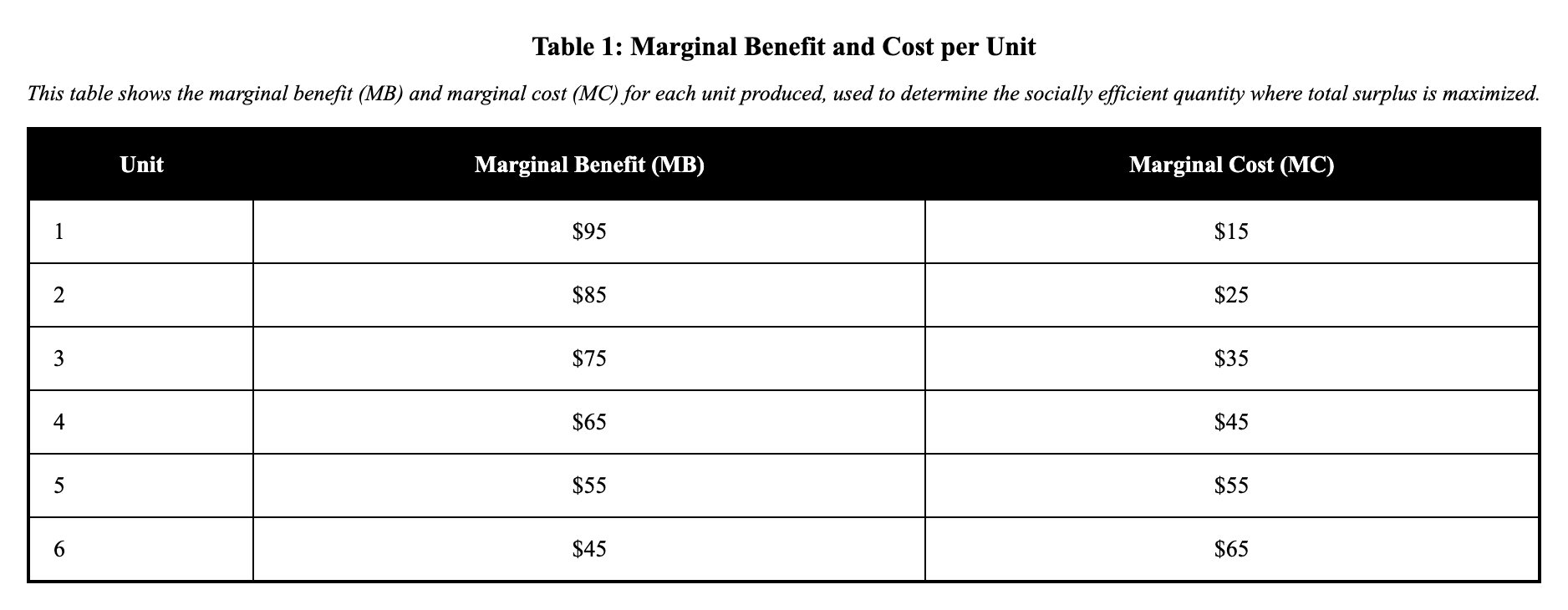
Based on the market outcome shown in the table, at which quantity is total surplus maximized (the socially efficient quantity)? The market currently produces $Q=6$ units.
Table (per unit):
- Unit 1: $MB=\$95$, $MC=$15$
- Unit 2: $MB=\$85$, $MC=$25$
- Unit 3: $MB=\$75$, $MC=$35$
- Unit 4: $MB=\$65$, $MC=$45$
- Unit 5: $MB=\$55$, $MC=$55$
- Unit 6: $MB=\$45$, $MC=$65$
Total surplus is maximized at $Q=3$ units
Total surplus is maximized at $Q=2$ units
Total surplus is maximized at $Q=5$ units
Total surplus is maximized at $Q=6$ units
Total surplus is maximized at $Q=4$ units
Explanation
This question tests your ability to find the socially efficient quantity where total surplus is maximized. Social efficiency occurs when marginal benefit equals marginal cost for the last unit produced. Examining the table, we see MB > MC for units 1-4, MB = MC = $55 for unit 5, and MB < MC for unit 6. The efficient quantity is Q=5 because we produce all units where MB ≥ MC and stop before MB < MC. The fact that the market currently produces Q=6 (overproducing) doesn't change where efficiency occurs. Students sometimes think more production is always better, but producing unit 6 creates a $20 loss ($45 - $65). To find efficiency, produce each unit where MB ≥ MC and stop when MB would be less than MC.
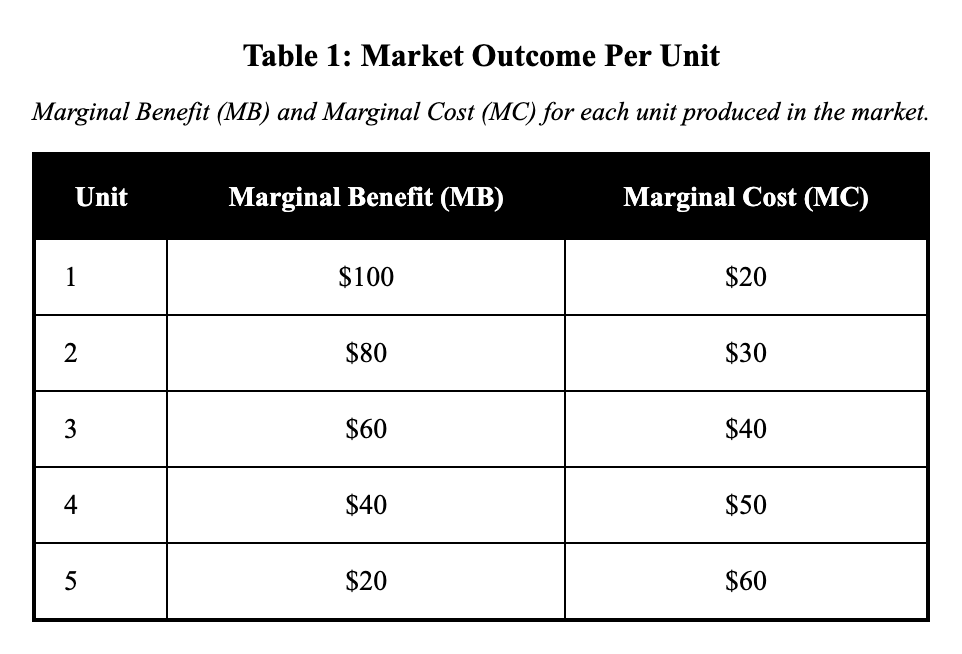
Based on the market outcome shown in the table, which statement correctly identifies the deadweight loss (DWL) when the market produces $Q=5$ units?
Table (per unit):
- Unit 1: $MB=\$100$, $MC=$20$
- Unit 2: $MB=\$80$, $MC=$30$
- Unit 3: $MB=\$60$, $MC=$40$
- Unit 4: $MB=\$40$, $MC=$50$
- Unit 5: $MB=\$20$, $MC=$60$
DWL is zero because the market produces all 5 units demanded
DWL is the transfer from consumers to producers on units 1 through 3
DWL is the producer surplus on unit 3 because that is where profit is highest
DWL is the consumer surplus on units 1 and 2 because $MB$ is highest there
DWL is the loss from producing units where $MC>MB$, which occurs on units 4 and 5
Explanation
This question tests understanding of deadweight loss and social efficiency. Social efficiency requires producing where marginal benefit equals marginal cost, maximizing total surplus. Looking at the table, efficiency occurs at Q=3 where MB = MC = $40, but the market produces Q=5. For units 4 and 5, MC exceeds MB (unit 4: $50 > $40; unit 5: $60 > $20), creating net losses of $10 and $40 respectively—this is the deadweight loss. Students often confuse transfers (like consumer or producer surplus) with deadweight loss, but DWL represents destroyed value, not redistributed value. To identify DWL, find units where MC > MB (overproduction) or where MB > MC but units aren't produced (underproduction).
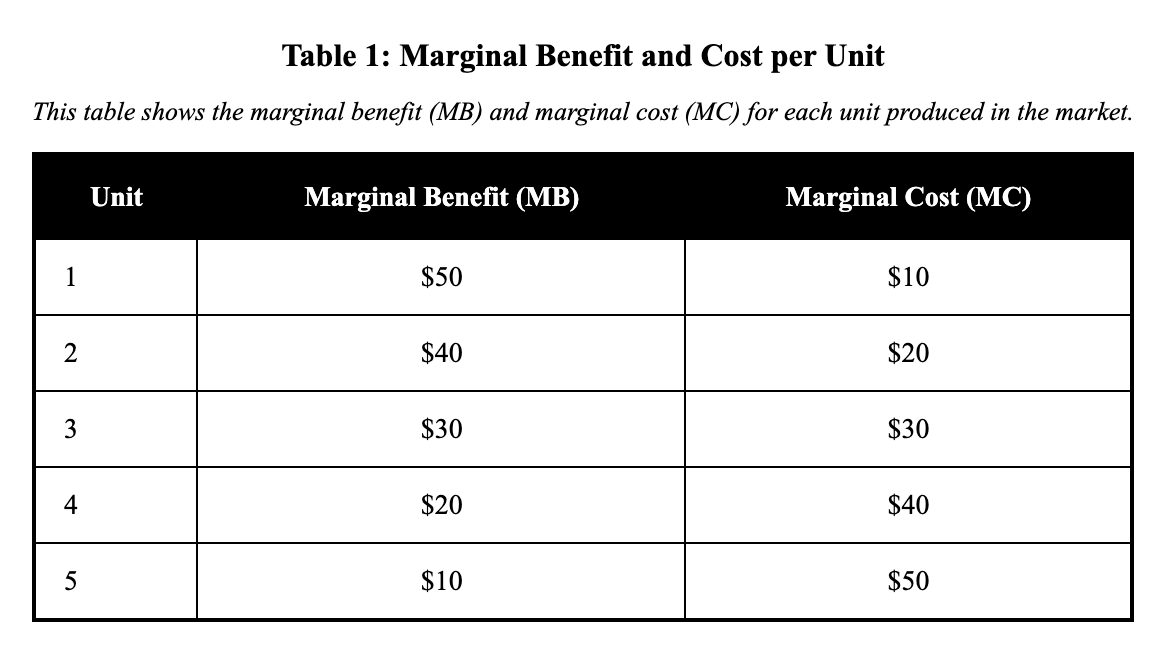
Based on the market outcome shown in the table, is the outcome socially efficient? The market currently produces $Q=3$ units.
Table (per unit):
- Unit 1: $MB=\$50$, $MC=$10$
- Unit 2: $MB=\$40$, $MC=$20$
- Unit 3: $MB=\$30$, $MC=$30$
- Unit 4: $MB=\$20$, $MC=$40$
- Unit 5: $MB=\$10$, $MC=$50$
Yes; the outcome is efficient because $MB=MC$ on the third unit and $MB<MC$ on the fourth unit
No; the outcome is inefficient because the market outcome differs from the highest $MB$
No; the outcome is inefficient because consumer surplus is positive at $Q=3$
Yes; the outcome is efficient because firms earn zero economic profit at $Q=3$
No; the outcome is inefficient because the market should always produce 5 units
Explanation
This question asks whether a market outcome is socially efficient, which occurs when marginal benefit equals marginal cost. Social efficiency maximizes total surplus by producing all units where MB ≥ MC and stopping where MB < MC. The table shows that at Q=3, MB = MC = $30, and for unit 4, MB ($20) < MC ($40), which would create a loss. Since the market produces exactly Q=3 and stops before the inefficient fourth unit, this outcome is socially efficient. Students often think efficiency requires special conditions like zero profit, but it simply means producing where MB = MC at the margin. To verify efficiency, check that the last unit produced has MB = MC and the next unit would have MB < MC.
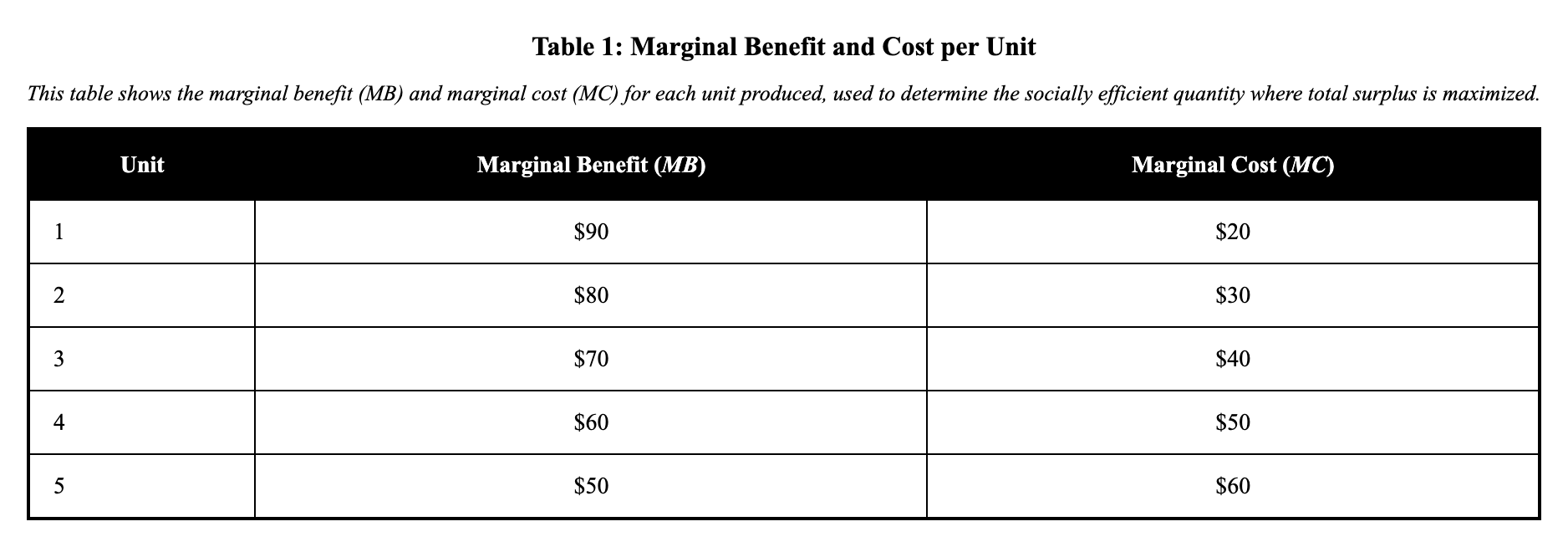
Based on the market outcome shown in the table, at which quantity is total surplus maximized (the socially efficient quantity)? Assume each row is an additional unit and $MC$ is the marginal cost of producing that unit.
Table (per unit):
- Unit 1: $MB=\$90$, $MC=$20$
- Unit 2: $MB=\$80$, $MC=$30$
- Unit 3: $MB=\$70$, $MC=$40$
- Unit 4: $MB=\$60$, $MC=$50$
- Unit 5: $MB=\$50$, $MC=$60$ The market produces $Q=3$ units.
Total surplus is maximized at $Q=1$ unit
Total surplus is maximized at $Q=2$ units
Total surplus is maximized at $Q=4$ units
Total surplus is maximized at $Q=3$ units
Total surplus is maximized at $Q=5$ units
Explanation
This question tests your understanding of social efficiency in markets. Social efficiency occurs when marginal benefit (MB) equals marginal cost (MC), maximizing total surplus. Looking at the table, we need to find where MB = MC or where MB last exceeds MC. For units 1-4, MB > MC (adding positive surplus), but at unit 5, MB ($50) < MC ($60), creating a loss. Many students confuse the market equilibrium (Q=3) with the efficient quantity, but efficiency depends on MB vs MC, not what the market produces. To find efficiency, check each unit: if MB > MC, produce it; if MB < MC, don't produce it—here, produce through unit 4.
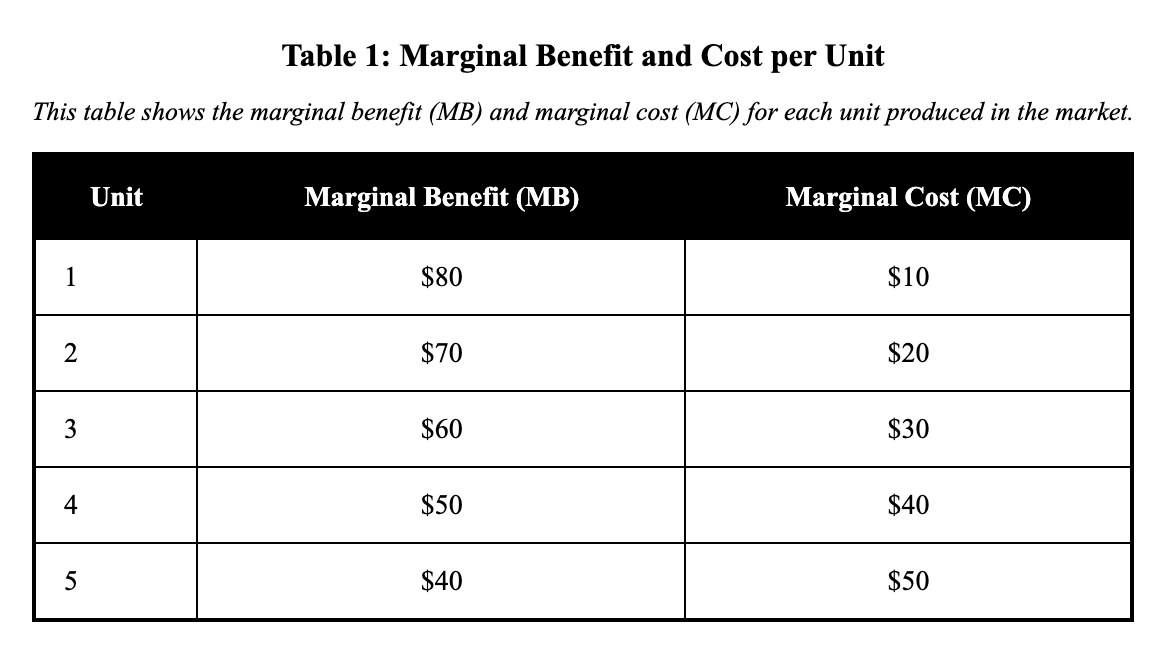
Based on the market outcome shown in the table, which region corresponds to deadweight loss (DWL) when the market produces $Q=2$ units instead of the socially efficient quantity?
Table (per unit):
- Unit 1: $MB=\$80$, $MC=$10$
- Unit 2: $MB=\$70$, $MC=$20$
- Unit 3: $MB=\$60$, $MC=$30$
- Unit 4: $MB=\$50$, $MC=$40$
- Unit 5: $MB=\$40$, $MC=$50$
The consumer surplus on units 1 and 2 because buyers gain from trade
The total revenue earned by sellers on the first two units
The producer surplus on units 1 and 2 because sellers gain from trade
The net loss from not producing units 3 and 4, where $MB>MC$
The transfer between buyers and sellers on unit 2 due to the market price
Explanation
This question tests understanding of deadweight loss from underproduction relative to social efficiency. Social efficiency requires producing where marginal benefit equals marginal cost to maximize total surplus. The efficient quantity here is Q=4 (where MB last exceeds MC), but the market only produces Q=2. Units 3 and 4 have MB > MC (unit 3: $60 > $30 = $30 surplus; unit 4: $50 > $40 = $10 surplus), so not producing them creates $40 of deadweight loss. Students often confuse existing surpluses with deadweight loss—consumer and producer surplus on units 1-2 represent gains from trade, not losses. To identify DWL, find the net benefit (MB - MC) for each unit that should be produced but isn't, then sum these losses.