Profit-Maximizing Behavior in Factor Markets
Help Questions
AP Microeconomics › Profit-Maximizing Behavior in Factor Markets
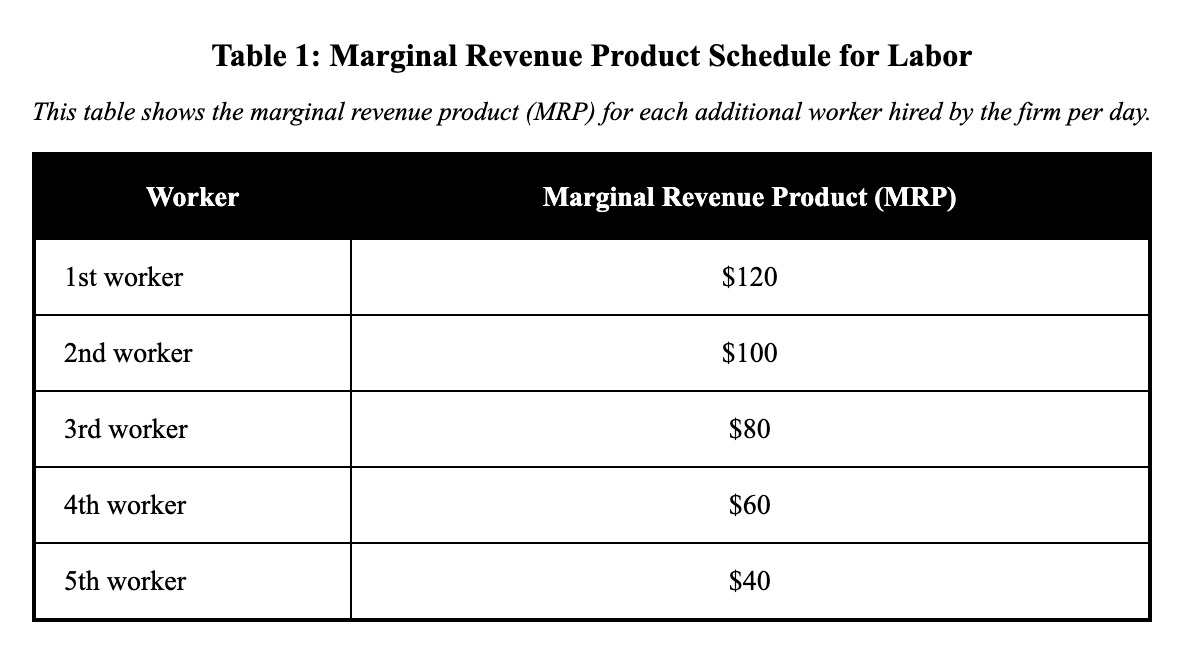
A perfectly competitive firm is a price taker in both the output and labor markets. The market wage is $W = $60 per worker per day. The firm’s marginal revenue product (MRP) schedule for labor is shown in the table. Based on the firm’s MRP and wage, how many workers should the firm hire to maximize profit?
MRP schedule (per day):
- 1st worker: $120
- 2nd worker: $100
- 3rd worker: $80
- 4th worker: $60
- 5th worker: $40
Hire 1 worker
Hire 2 workers
Hire 3 workers
Hire 5 workers
Hire 4 workers
Explanation
This question tests profit-maximizing hiring decisions in factor markets. Marginal Revenue Product (MRP) represents the additional revenue generated by hiring one more worker. With a wage of $60, we compare each worker's MRP to the wage: 1st worker ($120 > $60), 2nd worker ($100 > $60), 3rd worker ($80 > $60), and 4th worker ($60 = $60). The firm should hire the 4th worker since MRP equals the wage at this point. A common misconception is confusing marginal product (physical output) with MRP (revenue from output). The profit-maximizing strategy is to hire workers as long as MRP ≥ wage, stopping when they're equal—this ensures each worker adds more to revenue than to cost.
A perfectly competitive firm is a price taker in both the output and labor markets. The market wage is $W = $50 per worker per hour. The firm’s marginal revenue product (MRP) schedule for labor is shown below. Based on the firm’s MRP and wage, at what employment level is profit maximized?
MRP schedule (per hour):
- 1st worker: $110
- 2nd worker: $90
- 3rd worker: $70
- 4th worker: $50
- 5th worker: $30
Hire 1 worker
Hire 3 workers
Hire 2 workers
Hire 5 workers
Hire 4 workers
Explanation
This problem tests understanding of profit-maximizing hiring in factor markets. MRP measures the revenue contribution of each additional worker hired. At a wage of $50, we analyze: 1st worker ($110 > $50), 2nd worker ($90 > $50), 3rd worker ($70 > $50), 4th worker ($50 = $50), and 5th worker ($30 < $50). The firm maximizes profit by hiring 4 workers, where MRP exactly equals the wage. A common error is thinking firms should hire until MRP becomes negative rather than comparing it to the wage. The universal strategy for profit maximization is to expand employment until MRP falls to the wage level, ensuring the last worker hired just covers their cost.
A perfectly competitive firm is a price taker in both the output and labor markets. The market wage is $W = $40 per worker per hour. The firm’s marginal revenue product (MRP) schedule for labor is shown below. Based on the firm’s MRP and wage, how many workers should the firm hire?
MRP schedule (per hour):
- 1st worker: $60
- 2nd worker: $55
- 3rd worker: $45
- 4th worker: $35
- 5th worker: $25
Hire 1 worker
Hire 3 workers
Hire 5 workers
Hire 2 workers
Hire 4 workers
Explanation
This problem examines profit-maximizing employment in competitive markets. MRP measures the dollar value of output produced by an additional worker. At a wage of $40, we compare: 1st worker ($60 > $40), 2nd worker ($55 > $40), 3rd worker ($45 > $40), but 4th worker ($35 < $40). The firm maximizes profit by hiring 3 workers, stopping before the 4th whose MRP falls below the wage. A frequent misconception is thinking firms should minimize labor costs rather than maximize the difference between MRP and wages. The optimal strategy is to hire workers in sequence until you reach the point where the next worker's MRP would be less than their wage—this ensures maximum profit contribution from the workforce.
A perfectly competitive firm is a price taker in both the output and labor markets. The market wage is $W = $110 per worker per day. The firm’s marginal revenue product (MRP) schedule for labor is shown below. Based on the firm’s MRP and wage, at what employment level is profit maximized?
MRP schedule (per day):
- 1st worker: $160
- 2nd worker: $140
- 3rd worker: $120
- 4th worker: $100
- 5th worker: $80
Hire 3 workers
Hire 1 worker
Hire 5 workers
Hire 2 workers
Hire 4 workers
Explanation
This question tests profit-maximizing hiring decisions in factor markets. MRP represents the revenue generated by each additional worker hired. With a wage of $110, we analyze: 1st worker ($160 > $110), 2nd worker ($140 > $110), 3rd worker ($120 > $110), but 4th worker ($100 < $110). The firm maximizes profit at 3 workers, as hiring the 4th would reduce profit. Students sometimes mistakenly use total product rather than marginal revenue product to make hiring decisions. The key principle is to expand employment as long as each worker's MRP exceeds their wage cost, stopping at the last profitable hire—this ensures each worker contributes positively to profit.
A perfectly competitive firm is a price taker in both the output and labor markets. The market wage is $W = $30 per worker per hour. The firm’s marginal revenue product (MRP) schedule for labor is shown below. Based on the firm’s MRP and wage, at what employment level is profit maximized?
MRP schedule (per hour):
- 1st worker: $75
- 2nd worker: $55
- 3rd worker: $35
- 4th worker: $25
- 5th worker: $15
Hire 3 workers
Hire 2 workers
Hire 1 worker
Hire 4 workers
Hire 5 workers
Explanation
This question examines optimal employment decisions in competitive markets. MRP represents the dollar value of additional output from each worker hired. At a wage of $30, we compare: 1st worker ($75 > $30), 2nd worker ($55 > $30), 3rd worker ($35 > $30), but 4th worker ($25 < $30). The firm maximizes profit by hiring 3 workers, stopping before the 4th whose MRP falls below the wage. Students often incorrectly assume firms should hire until MRP reaches zero rather than comparing to the wage. The universal profit-maximizing rule is to continue hiring as long as MRP exceeds or equals the wage, ensuring each worker adds more to revenue than to cost.
A perfectly competitive firm is a price taker in both the output and labor markets. The market wage is $W = $70 per worker per day. The firm’s marginal revenue product (MRP) schedule for labor is shown below. Based on the firm’s MRP and wage, how many workers should the firm hire?
MRP schedule (per day):
- 1st worker: $90
- 2nd worker: $80
- 3rd worker: $70
- 4th worker: $60
- 5th worker: $50
Hire 4 workers
Hire 1 worker
Hire 5 workers
Hire 3 workers
Hire 2 workers
Explanation
This question examines profit-maximizing employment decisions in competitive markets. MRP represents the dollar value of additional output from hiring another worker. With wages at $70, we compare: 1st worker ($90 > $70), 2nd worker ($80 > $70), 3rd worker ($70 = $70), and 4th worker ($60 < $70). The firm should hire exactly 3 workers where MRP equals the wage. Many students incorrectly focus on total revenue rather than marginal revenue product when making hiring decisions. The profit-maximizing rule is straightforward: hire additional workers as long as their MRP is at least as high as their wage cost, stopping at the point of equality.
A perfectly competitive firm is a price taker in both the output and labor markets. The market wage is $W = $65 per worker per hour. The firm’s marginal revenue product (MRP) schedule for labor is shown below. Based on the firm’s MRP and wage, how many workers should the firm hire?
MRP schedule (per hour):
- 1st worker: $95
- 2nd worker: $85
- 3rd worker: $75
- 4th worker: $65
- 5th worker: $55
Hire 3 workers
Hire 5 workers
Hire 1 worker
Hire 4 workers
Hire 2 workers
Explanation
This problem requires applying profit-maximizing rules in competitive labor markets. MRP measures the additional revenue from hiring one more worker. Given a wage of $65, we evaluate: 1st worker ($95 > $65), 2nd worker ($85 > $65), 3rd worker ($75 > $65), 4th worker ($65 = $65), and 5th worker ($55 < $65). The firm should hire exactly 4 workers where MRP equals the wage. A common error is confusing the firm's product price with the worker's marginal revenue product. The profit-maximizing strategy remains consistent: hire workers sequentially until MRP equals the wage rate, as this point represents the boundary where additional hiring would reduce profit.
A perfectly competitive firm is a price taker in both the output and labor markets. The market wage is $W = $85 per worker per day. The firm’s marginal revenue product (MRP) schedule for labor is shown below. Based on the firm’s MRP and wage, how many workers should the firm hire?
MRP schedule (per day):
- 1st worker: $150
- 2nd worker: $120
- 3rd worker: $90
- 4th worker: $80
- 5th worker: $70
Hire 4 workers
Hire 2 workers
Hire 1 worker
Hire 5 workers
Hire 3 workers
Explanation
This problem tests understanding of profit-maximizing hiring in factor markets. MRP measures the revenue contribution of each additional worker. With a wage of $85, we analyze: 1st worker ($150 > $85), 2nd worker ($120 > $85), 3rd worker ($90 > $85), but 4th worker ($80 < $85). The firm should hire 3 workers to maximize profit, as the 4th would cost more than their revenue contribution. A frequent misconception is using average product instead of marginal revenue product for hiring decisions. The optimal strategy is straightforward: expand employment until the next worker's MRP would fall below their wage, ensuring maximum profit from your hiring decisions.
A perfectly competitive firm is a price taker in both the output and labor markets. The market wage is $W = $75 per worker per day. The firm’s marginal revenue product (MRP) schedule for labor is shown below. Based on the firm’s MRP and wage, how many workers should the firm hire?
MRP schedule (per day):
- 1st worker: $130
- 2nd worker: $105
- 3rd worker: $85
- 4th worker: $70
- 5th worker: $60
Hire 4 workers
Hire 1 worker
Hire 2 workers
Hire 3 workers
Hire 5 workers
Explanation
This question addresses optimal hiring decisions in competitive factor markets. MRP represents the additional revenue generated when hiring one more worker. With a wage of $75, we evaluate each worker: 1st ($130 > $75), 2nd ($105 > $75), 3rd ($85 > $75), but 4th ($70 < $75). The firm should hire 3 workers, as the 4th would cost more than the revenue they generate. Students often confuse average revenue product with marginal revenue product when making hiring decisions. The profit-maximizing approach is to hire workers sequentially as long as each one's MRP exceeds or equals their wage, stopping before hiring any worker whose MRP falls below the wage rate.
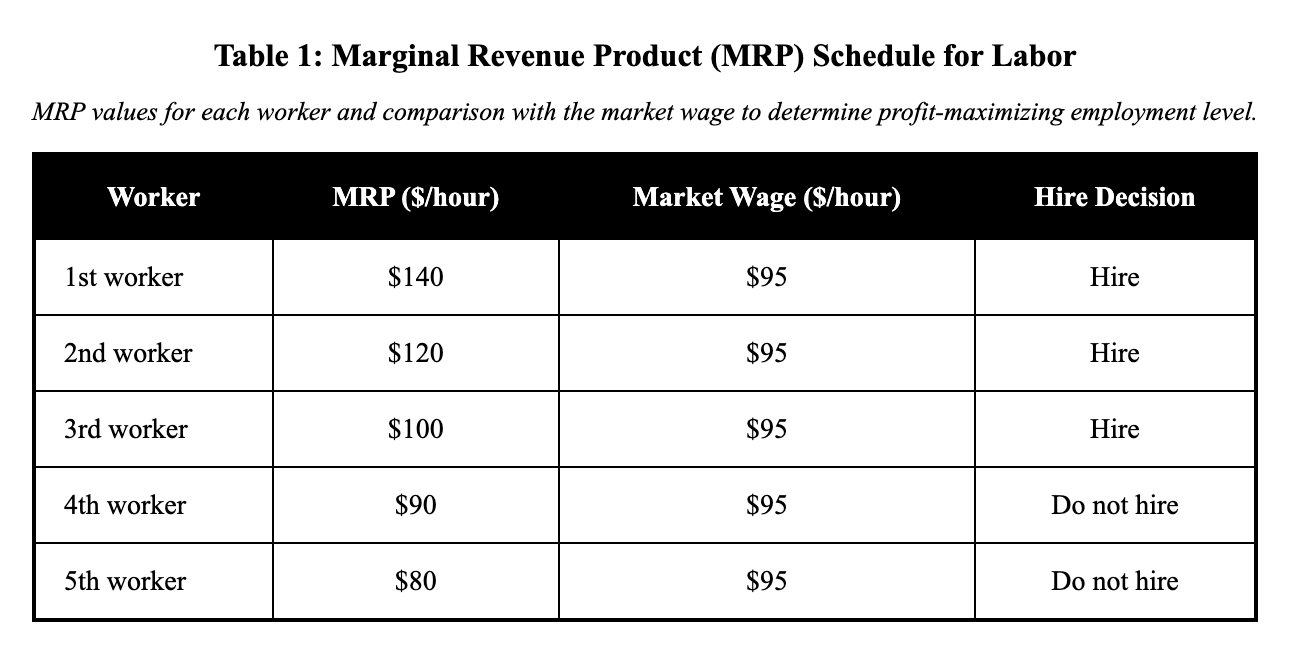
A perfectly competitive firm is a price taker in both the output and labor markets. The market wage is $W = $95 per worker per hour. The firm’s marginal revenue product (MRP) schedule for labor is shown in the table. Based on the firm’s MRP and wage, at what employment level is profit maximized?
MRP schedule (per hour):
- 1st worker: $140
- 2nd worker: $120
- 3rd worker: $100
- 4th worker: $90
- 5th worker: $80
Hire 3 workers
Hire 1 worker
Hire 5 workers
Hire 2 workers
Hire 4 workers
Explanation
This problem requires applying profit-maximizing hiring rules in competitive factor markets. MRP measures the additional revenue from hiring one more worker—it's the value of what that worker produces. Given a wage of $95, we evaluate: 1st worker ($140 > $95), 2nd worker ($120 > $95), 3rd worker ($100 > $95), but 4th worker ($90 < $95). The firm maximizes profit by hiring 3 workers, as the 4th would cost more than the revenue generated. Students often mistakenly hire until MRP falls below wage rather than stopping at the last profitable worker. The key strategy is to continue hiring while MRP exceeds or equals the wage rate, ensuring positive marginal profit from each worker.