Exchange Rates
Help Questions
AP Macroeconomics › Exchange Rates
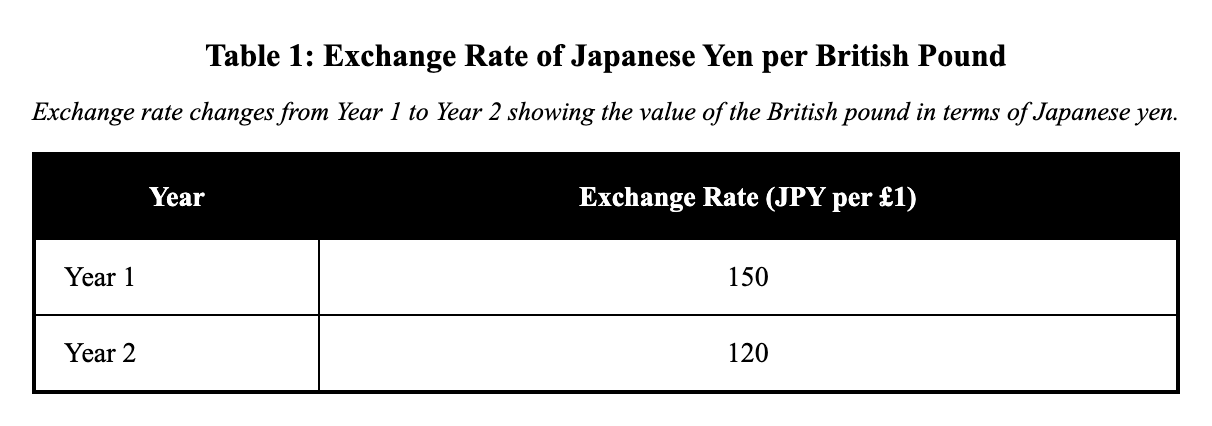
Based on the exchange rate shown in the table (quoted as Japanese yen per 1 British pound), which statement correctly describes what happened to the pound and the purchasing power of UK residents traveling to Japan?
Exchange Rate: JPY per £1 (GBP)
- Year 1: 150 JPY per £1
- Year 2: 120 JPY per £1
The pound appreciated, and UK residents could buy fewer yen per pound when traveling to Japan.
The pound appreciated, and UK residents could buy more yen per pound when traveling to Japan.
The pound depreciated, and UK residents could buy fewer yen per pound when traveling to Japan.
The pound depreciated because Japan’s price level increased by 20 percent.
The pound depreciated, and UK residents could buy more yen per pound when traveling to Japan.
Explanation
An exchange rate represents the value of one currency against another, in this scenario quoted as Japanese yen per British pound, showing how many yen one pound can acquire. Appreciation of a currency means it strengthens, buying more of the foreign currency, whereas depreciation weakens it, buying less. The data indicates the rate dropped from 150 JPY per £1 to 120 JPY per £1, meaning the pound depreciated as it now purchases fewer yen. Consequently, UK residents traveling to Japan receive fewer yen per pound, reducing their purchasing power there. One frequent misconception is assuming a lower exchange rate number always benefits the domestic currency, but here it signals depreciation for the pound. A useful strategy is to identify the currency in question first (e.g., the pound) and then specify the direction of change (depreciated) to better understand effects on international transactions.
Based on the exchange rate shown (quoted as Canadian dollars per 1 euro), which statement correctly describes the change in the euro and its likely effect on euro-area exports to Canada?
Exchange Rate: CAD per €1 (EUR)
- Month 1: 1.50 CAD per €1
- Month 2: 1.60 CAD per €1
The euro appreciated because the euro-area real GDP increased by 10 percent.
The euro depreciated, and euro-area exports to Canada became cheaper in Canadian dollars.
The euro appreciated, and euro-area exports to Canada became cheaper in Canadian dollars.
The euro depreciated, and euro-area exports to Canada became more expensive in Canadian dollars.
The euro appreciated, and euro-area exports to Canada became more expensive in Canadian dollars.
Explanation
The exchange rate is defined as the rate at which one currency can be exchanged for another, here given as Canadian dollars per euro, reflecting how many CAD one euro can buy. When a currency appreciates, its value rises, enabling it to purchase more of another currency; depreciation occurs when it buys less. According to the stimulus, the rate increased from 1.50 CAD per €1 to 1.60 CAD per €1, indicating the euro appreciated by buying more CAD. This makes euro-area exports to Canada more expensive in Canadian dollars, as Canadians need more CAD to buy euros for those goods. A misconception often arises when people think appreciation always cheapens exports, but it actually raises their foreign price. Remember the transferable strategy: name the currency first (e.g., euro) and then the direction (appreciated) to systematically evaluate trade implications.
Based on the exchange rate shown, assume Australia is the domestic country and the exchange rate is quoted as U.S. dollars per A$1. The exchange rate changes from A$1 = $1 in Month 1 to A$1 = $2 in Month 2. Which statement correctly describes what happened to the Australian dollar and one likely implication for Australian exports to the United States (holding Australian prices constant in Australian dollars)?
The U.S. dollar appreciated, and Australian exports become more expensive for U.S. buyers.
The Australian dollar appreciated, and Australian exports become more expensive for U.S. buyers.
The Australian dollar depreciated, and Australian exports become more expensive for U.S. buyers.
The Australian dollar appreciated, and Australian exports become cheaper for U.S. buyers.
The Australian dollar appreciated, and export prices change only if Australian inflation changes.
Explanation
An exchange rate represents the relative value between two currencies. When the exchange rate changes from A$1 = $1 to A$1 = $2, one Australian dollar now buys more U.S. dollars, which means the Australian dollar has appreciated (strengthened) relative to the U.S. dollar. When the Australian dollar appreciates, Australian exports to the United States become more expensive for U.S. buyers because Americans need more U.S. dollars to purchase the same Australian goods priced in Australian dollars. A common misconception is thinking currency appreciation helps exporters—it actually makes their products less competitive abroad. The strategy is to identify the base currency (A$1), see if it commands more or less of the other currency, then trace the impact on export competitiveness.
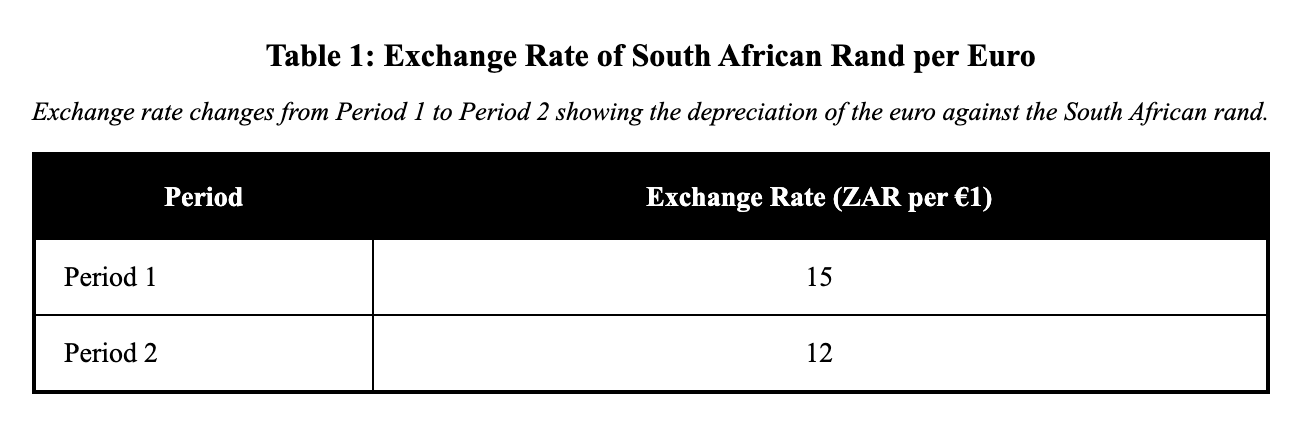
Based on the exchange rate shown in the table (quoted as South African rand per 1 euro), which statement correctly describes what happened to the euro and the likely effect on euro-area exports to South Africa?
Exchange Rate: ZAR per €1 (EUR)
- Period 1: 15 ZAR per €1
- Period 2: 12 ZAR per €1
The euro depreciated because South Africa’s inflation rate fell to zero.
The euro appreciated, and euro-area exports became cheaper in rand.
The euro appreciated, and euro-area exports became more expensive in rand.
The euro depreciated, and euro-area exports became more expensive in rand.
The euro depreciated, and euro-area exports became cheaper in rand.
Explanation
An exchange rate is the price at which currencies are traded, here shown as South African rand per euro, indicating rand per euro. Appreciation increases a currency's value, allowing more foreign currency per unit; depreciation decreases it, allowing less. The table displays a decrease from 15 ZAR per €1 to 12 ZAR per €1, meaning the euro depreciated as it now buys fewer rand. Consequently, euro-area exports to South Africa become cheaper in rand, requiring fewer rand for euro-priced goods. Some misconceive a lower rate as appreciation, but it signifies depreciation for the euro. A transferable approach is to state the currency first (e.g., euro) and then the direction (depreciated) to understand export competitiveness better.
Based on the exchange rate shown, assume the United States is the domestic economy and the exchange rate is quoted as Chinese yuan (CNY) per $1. The exchange rate changes from $1 = 6 CNY in Period 1 to $1 = 4 CNY in Period 2. Which statement correctly describes the change and the likely effect on U.S. exports to China (priced in dollars) from the perspective of Chinese buyers, holding other factors constant?
The yuan depreciated, and U.S. exports become cheaper in yuan.
The U.S. dollar depreciated, and U.S. exports become cheaper in yuan.
The U.S. dollar appreciated, and U.S. exports become more expensive in yuan.
The U.S. dollar depreciated, and U.S. exports become more expensive in yuan.
The U.S. dollar appreciated, and U.S. exports become cheaper in yuan.
Explanation
An exchange rate shows the price of one currency expressed in terms of another currency. When the exchange rate changes from $1 = 6 CNY to $1 = 4 CNY, each dollar now buys fewer yuan (4 instead of 6), which means the dollar has depreciated relative to the yuan. When the dollar depreciates, U.S. goods priced in dollars become cheaper for Chinese buyers because they need fewer yuan to purchase each dollar needed to buy U.S. exports. A common misconception is confusing the perspective - even though the U.S. is the domestic economy, we must consider how Chinese buyers view U.S. goods. The strategy is to state the domestic currency first (U.S. dollar), identify its direction (depreciated because it buys fewer CNY), then determine the effect on exports (cheaper in yuan for Chinese buyers).
Based on the exchange rate shown (quoted as Indian rupees per 1 Australian dollar), which statement correctly describes what happened to the Australian dollar and the likely effect on Australian imports from India (priced in rupees)?
Exchange Rate: INR per A$1 (AUD)
- Period 1: 50 INR per A$1
- Period 2: 60 INR per A$1
The Australian dollar appreciated, and Australian imports from India became cheaper in Australian dollars.
The Australian dollar appreciated because Australia’s price level increased relative to India’s price level.
The Australian dollar appreciated, and Australian imports from India became more expensive in Australian dollars.
The Australian dollar depreciated, and Australian imports from India became more expensive in Australian dollars.
The Australian dollar depreciated, and Australian imports from India became cheaper in Australian dollars.
Explanation
The exchange rate defines how much foreign currency one unit of domestic currency can purchase, quoted as Indian rupees per Australian dollar in this case. When a currency appreciates, it strengthens, buying more foreign currency; depreciation weakens it, buying less. The data indicates a rise from 50 INR per A$1 to 60 INR per A$1, showing the Australian dollar appreciated by obtaining more rupees. This makes Australian imports from India cheaper in Australian dollars, as fewer AUD are required for rupee-priced goods. A frequent misconception is that an increasing rate signals depreciation, but it denotes appreciation for the AUD here. Employ the strategy: identify the currency first (e.g., Australian dollar) and specify the direction (appreciated) to evaluate import affordability effectively.
Based on the exchange rate shown, assume the euro area is the domestic economy and the exchange rate is quoted as U.S. dollars per €1. The exchange rate changes from €1 = $2 in Quarter 1 to €1 = $1 in Quarter 2. Which statement correctly describes the change in the euro and the effect on the dollar price of euro-area exports to the United States (priced in euros), holding other factors constant?
The euro depreciated, and euro-area exports are unchanged in dollars because inflation determines exchange rates.
The euro depreciated, and euro-area exports become more expensive in dollars.
The euro appreciated, and euro-area exports become cheaper in dollars.
The euro appreciated, and euro-area exports become more expensive in dollars.
The euro depreciated, and euro-area exports become cheaper in dollars.
Explanation
An exchange rate indicates how many units of one currency equal one unit of another currency. When the exchange rate changes from €1 = $2 to €1 = $1, each euro now exchanges for fewer dollars (1 instead of 2), meaning the euro has depreciated relative to the dollar. When a currency depreciates, that country's exports become cheaper for foreign buyers because they need fewer of their own currency to purchase the depreciated currency. A common misconception is focusing only on the numbers without considering which currency is the base - here, the euro is the base currency and its value fell. The strategy is to identify the domestic currency (euro), determine its direction (depreciated because €1 buys fewer dollars), and then assess the effect on exports (cheaper in dollars for U.S. buyers).
Based on the exchange rate shown, assume Australia is the domestic economy and the exchange rate is quoted as Australian dollars (AUD) per $1. The exchange rate changes from $1 = 2 AUD in Period 1 to $1 = 1 AUD in Period 2. Which statement correctly describes the change in the AUD and the likely effect on Australia’s imports from the United States (priced in dollars), holding other factors constant?
The U.S. dollar appreciated, and U.S. imports into Australia become cheaper in AUD.
The AUD appreciated, and U.S. imports into Australia become more expensive in AUD.
The AUD depreciated, and U.S. imports into Australia become cheaper in AUD.
The AUD depreciated, and U.S. imports into Australia become more expensive in AUD.
The AUD appreciated, and U.S. imports into Australia become cheaper in AUD.
Explanation
An exchange rate represents the relative value between two currencies in the foreign exchange market. When the exchange rate changes from $1 = 2 AUD to $1 = 1 AUD, each dollar now buys fewer Australian dollars (1 instead of 2), which means the dollar has depreciated and the Australian dollar has appreciated. When the AUD appreciates against the dollar, U.S. goods priced in dollars become cheaper in AUD terms because Australians need fewer AUD to buy each dollar required for U.S. imports. A common misconception is thinking that a currency appreciation makes imports more expensive, but appreciation actually increases purchasing power over foreign goods. The strategy is to state the domestic currency first (AUD), identify the direction (appreciated because fewer AUD buy $1), then determine the effect on imports (U.S. goods become cheaper in AUD).
Based on the exchange rate shown, assume Switzerland is the domestic economy and the exchange rate is quoted as Swiss francs (CHF) per €1. The exchange rate changes from €1 = 2 CHF in Week 1 to €1 = 3 CHF in Week 2. Which statement correctly identifies the change in the Swiss franc and the effect on the franc price of euro-area imports into Switzerland (priced in euros), holding other factors constant?
The Swiss franc depreciated, and euro-area imports become more expensive in francs.
The Swiss franc appreciated, and euro-area imports become more expensive in francs.
The Swiss franc depreciated, and euro-area imports become cheaper in francs.
The Swiss franc appreciated, and euro-area imports become cheaper in francs.
The euro depreciated, and euro-area imports become more expensive in francs.
Explanation
An exchange rate indicates how many units of one currency can be exchanged for one unit of another currency. When the exchange rate changes from €1 = 2 CHF to €1 = 3 CHF, each euro now buys more Swiss francs (3 instead of 2), which means the euro has appreciated and the Swiss franc has depreciated. When the Swiss franc depreciates against the euro, European goods priced in euros become more expensive in franc terms because Swiss buyers need more francs to buy each euro. A common misconception is thinking that because the euro buys more francs, European goods become cheaper - but from Switzerland's perspective, they need more of their currency to buy foreign goods. The strategy is to identify the domestic currency (Swiss franc), determine its direction (depreciated because more CHF are needed per euro), and assess the effect on imports (euro-area goods become more expensive in francs).
Based on the exchange rate shown (quoted as Indian rupees per 1 U.S. dollar), which statement correctly describes what happened to the rupee and a purchasing power implication for an Indian household buying a U.S. good priced at $1?
Before: 1 USD = 50 INR
After: 1 USD = 60 INR
The exchange rate increase is domestic inflation, so the $1 good costs more rupees only because prices rose.
The dollar depreciated, and the $1 good costs more rupees than before.
The rupee appreciated, and the $1 good costs more rupees than before.
The rupee depreciated, and the $1 good costs fewer rupees than before.
The rupee depreciated, and the $1 good costs more rupees than before.
Explanation
An exchange rate defines how much foreign currency one unit of domestic currency can buy, here as Indian rupees per U.S. dollar. Depreciation occurs when a currency loses value, requiring more of it to buy the same foreign amount, while appreciation is gaining value. The rate rose from 50 to 60 INR per USD, indicating the rupee depreciated against the dollar, as more rupees are needed for one USD. Thus, a U.S. good priced at $1 now costs more rupees for an Indian household. One misconception is confusing exchange rate changes with inflation, but this is specifically about relative currency values. The strategy is to state the currency first, then direction, like 'rupee depreciated,' to evaluate purchasing power changes effectively.