System Equilibrium - AP Chemistry
Card 1 of 70
Which of the following accurately describes what occurs in reversible reactions?
Which of the following accurately describes what occurs in reversible reactions?
Tap to reveal answer
The definition of reversible reactions is that they are indeed reversible; in other words, they can proceed in the forward and reverse directions. Since the products can react as well to reform the reactants, these reactions usually do not proceed to completion and instead exist in a dynamic state.
The definition of reversible reactions is that they are indeed reversible; in other words, they can proceed in the forward and reverse directions. Since the products can react as well to reform the reactants, these reactions usually do not proceed to completion and instead exist in a dynamic state.
← Didn't Know|Knew It →
What is occuring when a mixture reaches a dynamic equilibrium state?
What is occuring when a mixture reaches a dynamic equilibrium state?
Tap to reveal answer
Dynamic equilibrium means that the forward and reverse reactions are occurring at the same rate so that there is no net change in the concentrations.
Dynamic equilibrium means that the forward and reverse reactions are occurring at the same rate so that there is no net change in the concentrations.
← Didn't Know|Knew It →
Consider the following reaction:
A+2Brightarrow2C
The equilibrium constant, $K_{eq}$, is 0.367.
In a reaction flask, you have a solution containing ![[A]=0.332\hspace{1 mm}M](https://vt-vtwa-assets.varsitytutors.com/vt-vtwa/uploads/formula_image/image/21576/gif.latex) ,
, ![[B]=0.0200\hspace{1 mm}M](https://vt-vtwa-assets.varsitytutors.com/vt-vtwa/uploads/formula_image/image/21577/gif.latex) , and
, and ![[C]=0.332\hspace{1 mm}M](https://vt-vtwa-assets.varsitytutors.com/vt-vtwa/uploads/formula_image/image/21578/gif.latex) . Will the reaction proceed forward (to the right), or backwards (to the left)?
. Will the reaction proceed forward (to the right), or backwards (to the left)?
Consider the following reaction:
A+2Brightarrow2C
The equilibrium constant, $K_{eq}$, is 0.367.
In a reaction flask, you have a solution containing
Tap to reveal answer
For the reaction:
A+2Brightarrow2C
The expression for the equilibrium constant is:
![K_${eq}=\frac{[C]^2$$}{[A][B]^2$}$](https://vt-vtwa-assets.varsitytutors.com/vt-vtwa/uploads/formula_image/image/21580/gif.latex)
The reaction quotient is:
$![Q=\frac{[C]^2$$}{[A][B]^2$$}$=\frac{[0.332]^2$$}{[0.332][0.0200]^2$}$=830\hspace{1 $mm}M^{-1}$](https://vt-vtwa-assets.varsitytutors.com/vt-vtwa/uploads/formula_image/image/21581/gif.latex)
The reaction quotient is much larger than the equilibrium constant, so the reaction will proceed to the left.
For the reaction:
A+2Brightarrow2C
The expression for the equilibrium constant is:
The reaction quotient is:
$
The reaction quotient is much larger than the equilibrium constant, so the reaction will proceed to the left.
← Didn't Know|Knew It →
Which of the following is not always true for the given arbitrary reaction in equilibrium?

Which of the following is not always true for the given arbitrary reaction in equilibrium?
Tap to reveal answer
The forward and reverse reaction rates are equal for reactions in equilibrium, however, the molar concentration of the reactants and products are usually not equal themselves. One can calculate the equilibrium constant using the equation below.
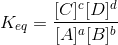
The forward and reverse reaction rates are equal for reactions in equilibrium, however, the molar concentration of the reactants and products are usually not equal themselves. One can calculate the equilibrium constant using the equation below.
← Didn't Know|Knew It →
Determine the equilibrium expression for the following reaction:

Determine the equilibrium expression for the following reaction:
Tap to reveal answer
Equilibrium expressions are a ratio of the concentration of products raised to the stoichiometric coefficient, divided by reactants raised to the stoichiometric coefficient. Solids are omitted from this expression.
For the generic example  , the equilibrium expression is
 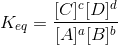 .
.
For our given reaction, we can find the equilibrium expression in a similar manner. Do not forget to omit the solid component of the reaction!

Equilibrium expressions are a ratio of the concentration of products raised to the stoichiometric coefficient, divided by reactants raised to the stoichiometric coefficient. Solids are omitted from this expression.
For the generic example
For our given reaction, we can find the equilibrium expression in a similar manner. Do not forget to omit the solid component of the reaction!
← Didn't Know|Knew It →
Which of the following accurately describes what occurs in reversible reactions?
Which of the following accurately describes what occurs in reversible reactions?
Tap to reveal answer
The definition of reversible reactions is that they are indeed reversible; in other words, they can proceed in the forward and reverse directions. Since the products can react as well to reform the reactants, these reactions usually do not proceed to completion and instead exist in a dynamic state.
The definition of reversible reactions is that they are indeed reversible; in other words, they can proceed in the forward and reverse directions. Since the products can react as well to reform the reactants, these reactions usually do not proceed to completion and instead exist in a dynamic state.
← Didn't Know|Knew It →
What is occuring when a mixture reaches a dynamic equilibrium state?
What is occuring when a mixture reaches a dynamic equilibrium state?
Tap to reveal answer
Dynamic equilibrium means that the forward and reverse reactions are occurring at the same rate so that there is no net change in the concentrations.
Dynamic equilibrium means that the forward and reverse reactions are occurring at the same rate so that there is no net change in the concentrations.
← Didn't Know|Knew It →
Consider the following reaction:
A+2Brightarrow2C
The equilibrium constant, $K_{eq}$, is 0.367.
In a reaction flask, you have a solution containing , , and . Will the reaction proceed forward (to the right), or backwards (to the left)?
Consider the following reaction:
A+2Brightarrow2C
The equilibrium constant, $K_{eq}$, is 0.367.
In a reaction flask, you have a solution containing
Tap to reveal answer
For the reaction:
A+2Brightarrow2C
The expression for the equilibrium constant is:
The reaction quotient is:
$
The reaction quotient is much larger than the equilibrium constant, so the reaction will proceed to the left.
For the reaction:
A+2Brightarrow2C
The expression for the equilibrium constant is:
The reaction quotient is:
$
The reaction quotient is much larger than the equilibrium constant, so the reaction will proceed to the left.
← Didn't Know|Knew It →
Which of the following is not always true for the given arbitrary reaction in equilibrium?
Which of the following is not always true for the given arbitrary reaction in equilibrium?
Tap to reveal answer
The forward and reverse reaction rates are equal for reactions in equilibrium, however, the molar concentration of the reactants and products are usually not equal themselves. One can calculate the equilibrium constant using the equation below.
The forward and reverse reaction rates are equal for reactions in equilibrium, however, the molar concentration of the reactants and products are usually not equal themselves. One can calculate the equilibrium constant using the equation below.
← Didn't Know|Knew It →
Determine the equilibrium expression for the following reaction:
Determine the equilibrium expression for the following reaction:
Tap to reveal answer
Equilibrium expressions are a ratio of the concentration of products raised to the stoichiometric coefficient, divided by reactants raised to the stoichiometric coefficient. Solids are omitted from this expression.
For the generic example , the equilibrium expression is .
For our given reaction, we can find the equilibrium expression in a similar manner. Do not forget to omit the solid component of the reaction!
Equilibrium expressions are a ratio of the concentration of products raised to the stoichiometric coefficient, divided by reactants raised to the stoichiometric coefficient. Solids are omitted from this expression.
For the generic example
For our given reaction, we can find the equilibrium expression in a similar manner. Do not forget to omit the solid component of the reaction!
← Didn't Know|Knew It →
Which of the following accurately describes what occurs in reversible reactions?
Which of the following accurately describes what occurs in reversible reactions?
Tap to reveal answer
The definition of reversible reactions is that they are indeed reversible; in other words, they can proceed in the forward and reverse directions. Since the products can react as well to reform the reactants, these reactions usually do not proceed to completion and instead exist in a dynamic state.
The definition of reversible reactions is that they are indeed reversible; in other words, they can proceed in the forward and reverse directions. Since the products can react as well to reform the reactants, these reactions usually do not proceed to completion and instead exist in a dynamic state.
← Didn't Know|Knew It →
What is occuring when a mixture reaches a dynamic equilibrium state?
What is occuring when a mixture reaches a dynamic equilibrium state?
Tap to reveal answer
Dynamic equilibrium means that the forward and reverse reactions are occurring at the same rate so that there is no net change in the concentrations.
Dynamic equilibrium means that the forward and reverse reactions are occurring at the same rate so that there is no net change in the concentrations.
← Didn't Know|Knew It →
Consider the following reaction:
A+2Brightarrow2C
The equilibrium constant, $K_{eq}$, is 0.367.
In a reaction flask, you have a solution containing , , and . Will the reaction proceed forward (to the right), or backwards (to the left)?
Consider the following reaction:
A+2Brightarrow2C
The equilibrium constant, $K_{eq}$, is 0.367.
In a reaction flask, you have a solution containing
Tap to reveal answer
For the reaction:
A+2Brightarrow2C
The expression for the equilibrium constant is:
The reaction quotient is:
$
The reaction quotient is much larger than the equilibrium constant, so the reaction will proceed to the left.
For the reaction:
A+2Brightarrow2C
The expression for the equilibrium constant is:
The reaction quotient is:
$
The reaction quotient is much larger than the equilibrium constant, so the reaction will proceed to the left.
← Didn't Know|Knew It →
Which of the following is not always true for the given arbitrary reaction in equilibrium?
Which of the following is not always true for the given arbitrary reaction in equilibrium?
Tap to reveal answer
The forward and reverse reaction rates are equal for reactions in equilibrium, however, the molar concentration of the reactants and products are usually not equal themselves. One can calculate the equilibrium constant using the equation below.
The forward and reverse reaction rates are equal for reactions in equilibrium, however, the molar concentration of the reactants and products are usually not equal themselves. One can calculate the equilibrium constant using the equation below.
← Didn't Know|Knew It →
Determine the equilibrium expression for the following reaction:
Determine the equilibrium expression for the following reaction:
Tap to reveal answer
Equilibrium expressions are a ratio of the concentration of products raised to the stoichiometric coefficient, divided by reactants raised to the stoichiometric coefficient. Solids are omitted from this expression.
For the generic example , the equilibrium expression is .
For our given reaction, we can find the equilibrium expression in a similar manner. Do not forget to omit the solid component of the reaction!
Equilibrium expressions are a ratio of the concentration of products raised to the stoichiometric coefficient, divided by reactants raised to the stoichiometric coefficient. Solids are omitted from this expression.
For the generic example
For our given reaction, we can find the equilibrium expression in a similar manner. Do not forget to omit the solid component of the reaction!
← Didn't Know|Knew It →
What is occuring when a mixture reaches a dynamic equilibrium state?
What is occuring when a mixture reaches a dynamic equilibrium state?
Tap to reveal answer
Dynamic equilibrium means that the forward and reverse reactions are occurring at the same rate so that there is no net change in the concentrations.
Dynamic equilibrium means that the forward and reverse reactions are occurring at the same rate so that there is no net change in the concentrations.
← Didn't Know|Knew It →
Which of the following accurately describes what occurs in reversible reactions?
Which of the following accurately describes what occurs in reversible reactions?
Tap to reveal answer
The definition of reversible reactions is that they are indeed reversible; in other words, they can proceed in the forward and reverse directions. Since the products can react as well to reform the reactants, these reactions usually do not proceed to completion and instead exist in a dynamic state.
The definition of reversible reactions is that they are indeed reversible; in other words, they can proceed in the forward and reverse directions. Since the products can react as well to reform the reactants, these reactions usually do not proceed to completion and instead exist in a dynamic state.
← Didn't Know|Knew It →
Consider the following reaction:
A+2Brightarrow2C
The equilibrium constant, $K_{eq}$, is 0.367.
In a reaction flask, you have a solution containing , , and . Will the reaction proceed forward (to the right), or backwards (to the left)?
Consider the following reaction:
A+2Brightarrow2C
The equilibrium constant, $K_{eq}$, is 0.367.
In a reaction flask, you have a solution containing
Tap to reveal answer
For the reaction:
A+2Brightarrow2C
The expression for the equilibrium constant is:
The reaction quotient is:
$
The reaction quotient is much larger than the equilibrium constant, so the reaction will proceed to the left.
For the reaction:
A+2Brightarrow2C
The expression for the equilibrium constant is:
The reaction quotient is:
$
The reaction quotient is much larger than the equilibrium constant, so the reaction will proceed to the left.
← Didn't Know|Knew It →
Which of the following is not always true for the given arbitrary reaction in equilibrium?
Which of the following is not always true for the given arbitrary reaction in equilibrium?
Tap to reveal answer
The forward and reverse reaction rates are equal for reactions in equilibrium, however, the molar concentration of the reactants and products are usually not equal themselves. One can calculate the equilibrium constant using the equation below.
The forward and reverse reaction rates are equal for reactions in equilibrium, however, the molar concentration of the reactants and products are usually not equal themselves. One can calculate the equilibrium constant using the equation below.
← Didn't Know|Knew It →
Determine the equilibrium expression for the following reaction:
Determine the equilibrium expression for the following reaction:
Tap to reveal answer
Equilibrium expressions are a ratio of the concentration of products raised to the stoichiometric coefficient, divided by reactants raised to the stoichiometric coefficient. Solids are omitted from this expression.
For the generic example , the equilibrium expression is .
For our given reaction, we can find the equilibrium expression in a similar manner. Do not forget to omit the solid component of the reaction!
Equilibrium expressions are a ratio of the concentration of products raised to the stoichiometric coefficient, divided by reactants raised to the stoichiometric coefficient. Solids are omitted from this expression.
For the generic example
For our given reaction, we can find the equilibrium expression in a similar manner. Do not forget to omit the solid component of the reaction!
← Didn't Know|Knew It →