Reaction Mechanisms - AP Chemistry
Card 1 of 65
Which of the following is true?
Which of the following is true?
Tap to reveal answer
All of the above describe elementary reactions and how they give an overall mechanism.
All of the above describe elementary reactions and how they give an overall mechanism.
← Didn't Know|Knew It →
A possible mechanism for the overall reaction Br2 (g) + 2 NO (g) -> 2 NOBr(g) is
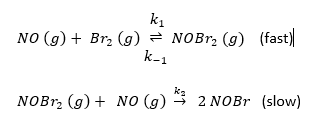
The rate law for the formation of NOBr based on this mechanism is rate = .
A possible mechanism for the overall reaction Br2 (g) + 2 NO (g) -> 2 NOBr(g) is
The rate law for the formation of NOBr based on this mechanism is rate = .
Tap to reveal answer
Based on the slowest step the rate law would be: Rate = k2 \[NOBr2\] \[NO\], but one cannot have a rate law in terms of an intermediate (NOBr2).
Because the first reaction is at equilibrium the rate in the forward direction is equal to that in the reverse, thus:
 and:
and: 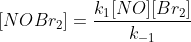
Substitution yields: 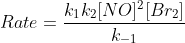
Based on the slowest step the rate law would be: Rate = k2 \[NOBr2\] \[NO\], but one cannot have a rate law in terms of an intermediate (NOBr2).
Because the first reaction is at equilibrium the rate in the forward direction is equal to that in the reverse, thus:
Substitution yields:
← Didn't Know|Knew It →
For the reaction NO2 (g) + CO (g) -> NO (g) + CO2 (g), the reaction was experimentally determined to be Rate = k\[NO2\]2. If the reaction has the following mechanism, what is the rate limiting step, and why?
Step 1: 2 NO2 -> NO3 + NO (slow)
Step 2: NO3 + CO -> NO2 + CO2 (fast)
For the reaction NO2 (g) + CO (g) -> NO (g) + CO2 (g), the reaction was experimentally determined to be Rate = k\[NO2\]2. If the reaction has the following mechanism, what is the rate limiting step, and why?
Step 1: 2 NO2 -> NO3 + NO (slow)
Step 2: NO3 + CO -> NO2 + CO2 (fast)
Tap to reveal answer
The reaction can never go faster than its slowest step.
The reaction can never go faster than its slowest step.
← Didn't Know|Knew It →
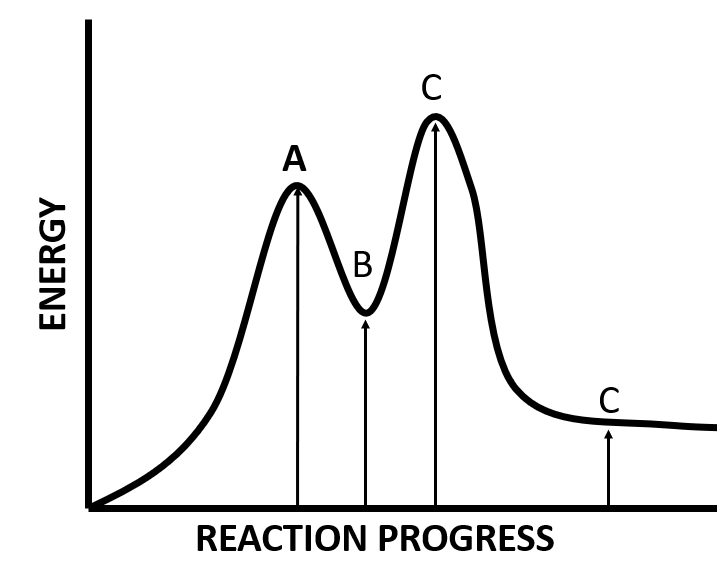
Based on the figure above, what arrows corresponds to the activation energy of the rate limiting step and the energy of reaction? Is the reaction endo- or exothermic?
Based on the figure above, what arrows corresponds to the activation energy of the rate limiting step and the energy of reaction? Is the reaction endo- or exothermic?
Tap to reveal answer
Since the products are higher in energy than the reactions, the reaction is endothermic.
Since the products are higher in energy than the reactions, the reaction is endothermic.
← Didn't Know|Knew It →
Consider the following mechanism:
A + B -> R + C (slow)
A + R -> C (fast)
Consider the following mechanism:
A + B -> R + C (slow)
A + R -> C (fast)
Tap to reveal answer
R is the intermediate. It is formed in Step 1 and consumed in Step 2.
R is the intermediate. It is formed in Step 1 and consumed in Step 2.
← Didn't Know|Knew It →
Which of the following is true?
Which of the following is true?
Tap to reveal answer
All of the above describe elementary reactions and how they give an overall mechanism.
All of the above describe elementary reactions and how they give an overall mechanism.
← Didn't Know|Knew It →
A possible mechanism for the overall reaction Br2 (g) + 2 NO (g) -> 2 NOBr(g) is
The rate law for the formation of NOBr based on this mechanism is rate = .
A possible mechanism for the overall reaction Br2 (g) + 2 NO (g) -> 2 NOBr(g) is
The rate law for the formation of NOBr based on this mechanism is rate = .
Tap to reveal answer
Based on the slowest step the rate law would be: Rate = k2 \[NOBr2\] \[NO\], but one cannot have a rate law in terms of an intermediate (NOBr2).
Because the first reaction is at equilibrium the rate in the forward direction is equal to that in the reverse, thus:
and:
Substitution yields:
Based on the slowest step the rate law would be: Rate = k2 \[NOBr2\] \[NO\], but one cannot have a rate law in terms of an intermediate (NOBr2).
Because the first reaction is at equilibrium the rate in the forward direction is equal to that in the reverse, thus:
Substitution yields:
← Didn't Know|Knew It →
For the reaction NO2 (g) + CO (g) -> NO (g) + CO2 (g), the reaction was experimentally determined to be Rate = k\[NO2\]2. If the reaction has the following mechanism, what is the rate limiting step, and why?
Step 1: 2 NO2 -> NO3 + NO (slow)
Step 2: NO3 + CO -> NO2 + CO2 (fast)
For the reaction NO2 (g) + CO (g) -> NO (g) + CO2 (g), the reaction was experimentally determined to be Rate = k\[NO2\]2. If the reaction has the following mechanism, what is the rate limiting step, and why?
Step 1: 2 NO2 -> NO3 + NO (slow)
Step 2: NO3 + CO -> NO2 + CO2 (fast)
Tap to reveal answer
The reaction can never go faster than its slowest step.
The reaction can never go faster than its slowest step.
← Didn't Know|Knew It →
Based on the figure above, what arrows corresponds to the activation energy of the rate limiting step and the energy of reaction? Is the reaction endo- or exothermic?
Based on the figure above, what arrows corresponds to the activation energy of the rate limiting step and the energy of reaction? Is the reaction endo- or exothermic?
Tap to reveal answer
Since the products are higher in energy than the reactions, the reaction is endothermic.
Since the products are higher in energy than the reactions, the reaction is endothermic.
← Didn't Know|Knew It →
Consider the following mechanism:
A + B -> R + C (slow)
A + R -> C (fast)
Consider the following mechanism:
A + B -> R + C (slow)
A + R -> C (fast)
Tap to reveal answer
R is the intermediate. It is formed in Step 1 and consumed in Step 2.
R is the intermediate. It is formed in Step 1 and consumed in Step 2.
← Didn't Know|Knew It →
Which of the following is true?
Which of the following is true?
Tap to reveal answer
All of the above describe elementary reactions and how they give an overall mechanism.
All of the above describe elementary reactions and how they give an overall mechanism.
← Didn't Know|Knew It →
A possible mechanism for the overall reaction Br2 (g) + 2 NO (g) -> 2 NOBr(g) is
The rate law for the formation of NOBr based on this mechanism is rate = .
A possible mechanism for the overall reaction Br2 (g) + 2 NO (g) -> 2 NOBr(g) is
The rate law for the formation of NOBr based on this mechanism is rate = .
Tap to reveal answer
Based on the slowest step the rate law would be: Rate = k2 \[NOBr2\] \[NO\], but one cannot have a rate law in terms of an intermediate (NOBr2).
Because the first reaction is at equilibrium the rate in the forward direction is equal to that in the reverse, thus:
and:
Substitution yields:
Based on the slowest step the rate law would be: Rate = k2 \[NOBr2\] \[NO\], but one cannot have a rate law in terms of an intermediate (NOBr2).
Because the first reaction is at equilibrium the rate in the forward direction is equal to that in the reverse, thus:
Substitution yields:
← Didn't Know|Knew It →
For the reaction NO2 (g) + CO (g) -> NO (g) + CO2 (g), the reaction was experimentally determined to be Rate = k\[NO2\]2. If the reaction has the following mechanism, what is the rate limiting step, and why?
Step 1: 2 NO2 -> NO3 + NO (slow)
Step 2: NO3 + CO -> NO2 + CO2 (fast)
For the reaction NO2 (g) + CO (g) -> NO (g) + CO2 (g), the reaction was experimentally determined to be Rate = k\[NO2\]2. If the reaction has the following mechanism, what is the rate limiting step, and why?
Step 1: 2 NO2 -> NO3 + NO (slow)
Step 2: NO3 + CO -> NO2 + CO2 (fast)
Tap to reveal answer
The reaction can never go faster than its slowest step.
The reaction can never go faster than its slowest step.
← Didn't Know|Knew It →
Based on the figure above, what arrows corresponds to the activation energy of the rate limiting step and the energy of reaction? Is the reaction endo- or exothermic?
Based on the figure above, what arrows corresponds to the activation energy of the rate limiting step and the energy of reaction? Is the reaction endo- or exothermic?
Tap to reveal answer
Since the products are higher in energy than the reactions, the reaction is endothermic.
Since the products are higher in energy than the reactions, the reaction is endothermic.
← Didn't Know|Knew It →
Consider the following mechanism:
A + B -> R + C (slow)
A + R -> C (fast)
Consider the following mechanism:
A + B -> R + C (slow)
A + R -> C (fast)
Tap to reveal answer
R is the intermediate. It is formed in Step 1 and consumed in Step 2.
R is the intermediate. It is formed in Step 1 and consumed in Step 2.
← Didn't Know|Knew It →
Which of the following is true?
Which of the following is true?
Tap to reveal answer
All of the above describe elementary reactions and how they give an overall mechanism.
All of the above describe elementary reactions and how they give an overall mechanism.
← Didn't Know|Knew It →
A possible mechanism for the overall reaction Br2 (g) + 2 NO (g) -> 2 NOBr(g) is
The rate law for the formation of NOBr based on this mechanism is rate = .
A possible mechanism for the overall reaction Br2 (g) + 2 NO (g) -> 2 NOBr(g) is
The rate law for the formation of NOBr based on this mechanism is rate = .
Tap to reveal answer
Based on the slowest step the rate law would be: Rate = k2 \[NOBr2\] \[NO\], but one cannot have a rate law in terms of an intermediate (NOBr2).
Because the first reaction is at equilibrium the rate in the forward direction is equal to that in the reverse, thus:
and:
Substitution yields:
Based on the slowest step the rate law would be: Rate = k2 \[NOBr2\] \[NO\], but one cannot have a rate law in terms of an intermediate (NOBr2).
Because the first reaction is at equilibrium the rate in the forward direction is equal to that in the reverse, thus:
Substitution yields:
← Didn't Know|Knew It →
For the reaction NO2 (g) + CO (g) -> NO (g) + CO2 (g), the reaction was experimentally determined to be Rate = k\[NO2\]2. If the reaction has the following mechanism, what is the rate limiting step, and why?
Step 1: 2 NO2 -> NO3 + NO (slow)
Step 2: NO3 + CO -> NO2 + CO2 (fast)
For the reaction NO2 (g) + CO (g) -> NO (g) + CO2 (g), the reaction was experimentally determined to be Rate = k\[NO2\]2. If the reaction has the following mechanism, what is the rate limiting step, and why?
Step 1: 2 NO2 -> NO3 + NO (slow)
Step 2: NO3 + CO -> NO2 + CO2 (fast)
Tap to reveal answer
The reaction can never go faster than its slowest step.
The reaction can never go faster than its slowest step.
← Didn't Know|Knew It →
Based on the figure above, what arrows corresponds to the activation energy of the rate limiting step and the energy of reaction? Is the reaction endo- or exothermic?
Based on the figure above, what arrows corresponds to the activation energy of the rate limiting step and the energy of reaction? Is the reaction endo- or exothermic?
Tap to reveal answer
Since the products are higher in energy than the reactions, the reaction is endothermic.
Since the products are higher in energy than the reactions, the reaction is endothermic.
← Didn't Know|Knew It →
Consider the following mechanism:
A + B -> R + C (slow)
A + R -> C (fast)
Consider the following mechanism:
A + B -> R + C (slow)
A + R -> C (fast)
Tap to reveal answer
R is the intermediate. It is formed in Step 1 and consumed in Step 2.
R is the intermediate. It is formed in Step 1 and consumed in Step 2.
← Didn't Know|Knew It →