pH - AP Chemistry
Card 1 of 504
What is the pH of a solution that has \[OH-\] 1 X 10⁻⁴ M?
What is the pH of a solution that has \[OH-\] 1 X 10⁻⁴ M?
Tap to reveal answer
pOH would be 4 (use –log \[OH–\]) and pH would be 14–pOH = 14 – 4 = 10
pOH would be 4 (use –log \[OH–\]) and pH would be 14–pOH = 14 – 4 = 10
← Didn't Know|Knew It →
What is the pH of a solution with \[OH-\] = 4 X 10⁻⁶
What is the pH of a solution with \[OH-\] = 4 X 10⁻⁶
Tap to reveal answer
\[OH-\] = 4 X 10⁻⁶
pOH = 5.4 — use –log \[OH–\] to find pOH
pH = 14– pOH = 8.6
\[OH-\] = 4 X 10⁻⁶
pOH = 5.4 — use –log \[OH–\] to find pOH
pH = 14– pOH = 8.6
← Didn't Know|Knew It →
Which of the following will produce the solution with the lowest pH?
Which of the following will produce the solution with the lowest pH?
Tap to reveal answer
NaOH is a base, so that won't produce an acidic solution. Of the remaining acids, HCl and HI are strong acids, and HF is weak. HI is at a higher molarity, so it will produce the most acidic solution.
NaOH is a base, so that won't produce an acidic solution. Of the remaining acids, HCl and HI are strong acids, and HF is weak. HI is at a higher molarity, so it will produce the most acidic solution.
← Didn't Know|Knew It →
What is the pH of a soution containing .0001 M HCl?
What is the pH of a soution containing .0001 M HCl?
Tap to reveal answer
The pH of a solution is determined by taking the negative log of the concentration of hydrogen ions in solution. HCl is strong acid so it completely dissociates in solution. So adding .0001 M HCl is the same as saying that 1 *10-4 moles of H+ ions have been added to solution. The -log\[.0001\] =4, so the pH of the solution =4.
The pH of a solution is determined by taking the negative log of the concentration of hydrogen ions in solution. HCl is strong acid so it completely dissociates in solution. So adding .0001 M HCl is the same as saying that 1 *10-4 moles of H+ ions have been added to solution. The -log\[.0001\] =4, so the pH of the solution =4.
← Didn't Know|Knew It →
What is the pOH of a solution that has a \[H+\] = 3.2 X 10⁻⁷ mol?
What is the pOH of a solution that has a \[H+\] = 3.2 X 10⁻⁷ mol?
Tap to reveal answer
\[H+\] = 3.2 X 10⁻⁷ mol
pH = -log \[H+\]
= 7 - log 3.2
= 7 -.505
=6.495
pOH = 14 - pH
= 7.5
\[H+\] = 3.2 X 10⁻⁷ mol
pH = -log \[H+\]
= 7 - log 3.2
= 7 -.505
=6.495
pOH = 14 - pH
= 7.5
← Didn't Know|Knew It →
Which of the following solutions contains the greatest number of H+ ions?
Which of the following solutions contains the greatest number of H+ ions?
Tap to reveal answer
This question asks for the solution with the greatest number H+ ions, we can also approach this problem as if we are looking for the solution with the lowest pH. HCl is strong acid, therefore it will dissociate completely in solution. So the solution containing 0.010 mL of HCL contains 0.010 mL of H+ ions in solution, in addition to the H+ ions that are already in solution due to the auto-ionization of water. The only other solution that could have a pH less than 7 would be the one with 0.010 mL of CH3OH in excess water, becasue CH3OH is very slightly acidic. But since it is compared with an equal volume of HCl which is strong acid, it can be said that the most H+ ions will be found in the solution containing a small amount of strong acid, HCl.
This question asks for the solution with the greatest number H+ ions, we can also approach this problem as if we are looking for the solution with the lowest pH. HCl is strong acid, therefore it will dissociate completely in solution. So the solution containing 0.010 mL of HCL contains 0.010 mL of H+ ions in solution, in addition to the H+ ions that are already in solution due to the auto-ionization of water. The only other solution that could have a pH less than 7 would be the one with 0.010 mL of CH3OH in excess water, becasue CH3OH is very slightly acidic. But since it is compared with an equal volume of HCl which is strong acid, it can be said that the most H+ ions will be found in the solution containing a small amount of strong acid, HCl.
← Didn't Know|Knew It →
What is the approximate pH of a 1.0 M solution of soluble CaCO3?
What is the approximate pH of a 1.0 M solution of soluble CaCO3?
Tap to reveal answer
Calcium carbonate is a base since it's the salt of a strong base (NaOH) and a weak acid (carbonic acid). The only basic pH on the list is 8, making it the correct answer.
Calcium carbonate is a base since it's the salt of a strong base (NaOH) and a weak acid (carbonic acid). The only basic pH on the list is 8, making it the correct answer.
← Didn't Know|Knew It →
What is the pH of a 1 * 10–3M solution of H2CO3 acid? (pKa is 6.4)
What is the pH of a 1 * 10–3M solution of H2CO3 acid? (pKa is 6.4)
Tap to reveal answer
The –log of the pKa will give you the Ka, so take the –log (6.4), which gives you approximately 4 * 10–7. The Ka expression is set up with products over reactants (hydrogen carbonate ion * hydrogen ion/carbonic acid). The undissociated carbonic acid is 0.001M, and you should use the variable 'x' to account for how much it dissociates and how many of the ions are produced. Ka = 4 * 10–7 = x2/0.001 ends up being your Ka expression, if you assume x is negligible compared to the original concentration of 0.001. Solving for x, you get 2 * 10–5. This is the hydrogen ion concentration. pH = –log (hydrogen ion concentration), so pH = –long(2 * 10–5), which is approximately 4.7.
The –log of the pKa will give you the Ka, so take the –log (6.4), which gives you approximately 4 * 10–7. The Ka expression is set up with products over reactants (hydrogen carbonate ion * hydrogen ion/carbonic acid). The undissociated carbonic acid is 0.001M, and you should use the variable 'x' to account for how much it dissociates and how many of the ions are produced. Ka = 4 * 10–7 = x2/0.001 ends up being your Ka expression, if you assume x is negligible compared to the original concentration of 0.001. Solving for x, you get 2 * 10–5. This is the hydrogen ion concentration. pH = –log (hydrogen ion concentration), so pH = –long(2 * 10–5), which is approximately 4.7.
← Didn't Know|Knew It →
If the Ksp of Mg(OH)2 is 1.2 * 10–11 and the magnesium ion concentration is 1.2 * 10–5M, at what pH does the Mg(OH)2 compound begin to precipitate?
If the Ksp of Mg(OH)2 is 1.2 * 10–11 and the magnesium ion concentration is 1.2 * 10–5M, at what pH does the Mg(OH)2 compound begin to precipitate?
Tap to reveal answer
The expression for Ksp is Ksp = \[Mg2+\]\[OH–\]2.
Thus, \[OH–\] = √(1.2 * 10–11)/(1.2 * 10–5)
\[OH–\] = 1 * 10–3
Thus, pH = –log(1 X 10⁻³) = 3
pH = 14 – 3 = 11
The expression for Ksp is Ksp = \[Mg2+\]\[OH–\]2.
Thus, \[OH–\] = √(1.2 * 10–11)/(1.2 * 10–5)
\[OH–\] = 1 * 10–3
Thus, pH = –log(1 X 10⁻³) = 3
pH = 14 – 3 = 11
← Didn't Know|Knew It →
What is the range of possible hydrogen ion concentrations in acidic solution?
What is the range of possible hydrogen ion concentrations in acidic solution?
Tap to reveal answer
For a solution to be acidic, it must have a pH between 1 and 6.99, since 7 is neutral; pH is –log(hydrogen ion concentration), the range of possible values is between 10–1 and 10–6.999.
For a solution to be acidic, it must have a pH between 1 and 6.99, since 7 is neutral; pH is –log(hydrogen ion concentration), the range of possible values is between 10–1 and 10–6.999.
← Didn't Know|Knew It →
What is the range of possible hydrogen ion concentrations in basic solution?
What is the range of possible hydrogen ion concentrations in basic solution?
Tap to reveal answer
For a solution to be basic, it must have a pH between 8 and 14, since 7 is neutral; pH is –log(hydrogen ion concentration); the range of possible values is between 10–13 and 10–7.001.
For a solution to be basic, it must have a pH between 8 and 14, since 7 is neutral; pH is –log(hydrogen ion concentration); the range of possible values is between 10–13 and 10–7.001.
← Didn't Know|Knew It →
What is the pH of a 0.05M solution of hydroflouric acid?
What is the pH of a 0.05M solution of hydroflouric acid?
Tap to reveal answer
The Ka = \[H+\]\[F–\]/\[HF\]. The beginning concentration of HF is given as 0.05, and we can use x as the variable that accounts for how much of the HF is lost, along with how much of the H+ and F– are formed.
Thus, Ka = _x_2/.05 if you use the approximation that x is negligible compared to the starting concentration of HF.
Solving for x, x = 1 * 10–3. This is the H+ ion concentration.
pH = –log(H+) = –log(1.0 * 10–3)) = 3
The Ka = \[H+\]\[F–\]/\[HF\]. The beginning concentration of HF is given as 0.05, and we can use x as the variable that accounts for how much of the HF is lost, along with how much of the H+ and F– are formed.
Thus, Ka = _x_2/.05 if you use the approximation that x is negligible compared to the starting concentration of HF.
Solving for x, x = 1 * 10–3. This is the H+ ion concentration.
pH = –log(H+) = –log(1.0 * 10–3)) = 3
← Didn't Know|Knew It →
A chemist adds 625g of solid NaOH to 500mL of 16M H_2SO_4. What is the pH of the solution after it reaches equilibrium?
A chemist adds 625g of solid NaOH to 500mL of 16M H_2SO_4. What is the pH of the solution after it reaches equilibrium?
Tap to reveal answer
Consider the reaction of NaOH and H_2SO_4:
2NaOH+H_2SO_4rightarrow Na_2SO_4hspace{1 mm}+2H_2O
Now we will calculate the moles of H_2SO_4 in the solution prior to adding base.
500hspace{1 mm}mLtimes$\frac{1hspace{1 mm}$L}{1000hspace{1 mm}mL}times$\frac{16hspace{1 mm}$moleshspace{1 mm}H_2SO_4}{1hspace{1 mm}L}=8.00hspace{1 mm}moleshspace{1 mm}H_2SO_4
We will then calculate the amount of moles of H_2SO_4 that react with the base.
625hspace{1 mm}ghspace{1 mm}NaOHtimes$\frac{1hspace{1 mm}$molehspace{1 mm}NaOH}{40hspace{1 mm}ghspace{1 mm}NaOH}times$\frac{1hspace{1 mm}$molehspace{1 mm}H_2SO_4}{2hspace{1 mm}moleshspace{1 mm}NaOH}=7.81hspace{1 mm}moleshspace{1 mm}H_2SO_4
We will then calculate the remaining moles of H_2SO_4:
8.00hspace{1 mm}moleshspace{1 mm}H_2SO_4 -hspace{1 mm}7.81hspace{1 mm}moleshspace{1 mm}H_2SO_4=0.19hspace{1 mm}moleshspace{1 mm}H_2SO_4
We will then calculate the new concentration of sulfuric acid:
$\frac{0.19hspace{1 mm}$moleshspace{1 mm}H_2SO_4}{0.5hspace{1 mm}L}=0.38hspace{1 mm}M
Sulfuric acid is a diprotic acid, so the hydrogen ion concentration is 0.76 M.
$![pH=-log[H^{+}$]=-log(0.76)=0.12](https://vt-vtwa-assets.varsitytutors.com/vt-vtwa/uploads/formula_image/image/20061/gif.latex)
Consider the reaction of NaOH and H_2SO_4:
2NaOH+H_2SO_4rightarrow Na_2SO_4hspace{1 mm}+2H_2O
Now we will calculate the moles of H_2SO_4 in the solution prior to adding base.
500hspace{1 mm}mLtimes$\frac{1hspace{1 mm}$L}{1000hspace{1 mm}mL}times$\frac{16hspace{1 mm}$moleshspace{1 mm}H_2SO_4}{1hspace{1 mm}L}=8.00hspace{1 mm}moleshspace{1 mm}H_2SO_4
We will then calculate the amount of moles of H_2SO_4 that react with the base.
625hspace{1 mm}ghspace{1 mm}NaOHtimes$\frac{1hspace{1 mm}$molehspace{1 mm}NaOH}{40hspace{1 mm}ghspace{1 mm}NaOH}times$\frac{1hspace{1 mm}$molehspace{1 mm}H_2SO_4}{2hspace{1 mm}moleshspace{1 mm}NaOH}=7.81hspace{1 mm}moleshspace{1 mm}H_2SO_4
We will then calculate the remaining moles of H_2SO_4:
8.00hspace{1 mm}moleshspace{1 mm}H_2SO_4 -hspace{1 mm}7.81hspace{1 mm}moleshspace{1 mm}H_2SO_4=0.19hspace{1 mm}moleshspace{1 mm}H_2SO_4
We will then calculate the new concentration of sulfuric acid:
$\frac{0.19hspace{1 mm}$moleshspace{1 mm}H_2SO_4}{0.5hspace{1 mm}L}=0.38hspace{1 mm}M
Sulfuric acid is a diprotic acid, so the hydrogen ion concentration is 0.76 M.
$
← Didn't Know|Knew It →
A chemist adds 4.2hspace{1 mm}ghspace{1 mm}KOH to  mL of water. What is the pH of the solution?
A chemist adds 4.2hspace{1 mm}ghspace{1 mm}KOH to 
Tap to reveal answer
First, we will calculate ![[KOH]](https://vt-vtwa-assets.varsitytutors.com/vt-vtwa/uploads/formula_image/image/21614/gif.latex) as follows:
as follows:
$\frac{4.2hspace{1 mm}$ghspace{1 mm}KOH}{500hspace{1 mm}mL}times$\frac{1000hspace{1 mm}$mL}{1hspace{1 mm}L}times$\frac{1hspace{1 mm}$molehspace{1 mm}KOH}{56.1hspace{1 mm}ghspace{1 $mm}KOH}=1.497times10^{-1}$hspace{1 mm}M
Now we will calculate the pOH:
![pOH=-log[OH^-]](https://vt-vtwa-assets.varsitytutors.com/vt-vtwa/uploads/formula_image/image/21616/gif.latex)
In solution $KOH_{(s)}$rightarrow $K^{+}$${(aq)}+OH^${-}${(aq)}$, so ![[KOH]=[OH^-]](https://vt-vtwa-assets.varsitytutors.com/vt-vtwa/uploads/formula_image/image/21618/gif.latex) .
.
![pOH=-log[1.497\times $10^{-1}$]=8.248\times $10^{-1}$](https://vt-vtwa-assets.varsitytutors.com/vt-vtwa/uploads/formula_image/image/21619/gif.latex)
pH=14-pOH=14-0.8248=13.18
First, we will calculate
$\frac{4.2hspace{1 mm}$ghspace{1 mm}KOH}{500hspace{1 mm}mL}times$\frac{1000hspace{1 mm}$mL}{1hspace{1 mm}L}times$\frac{1hspace{1 mm}$molehspace{1 mm}KOH}{56.1hspace{1 mm}ghspace{1 $mm}KOH}=1.497times10^{-1}$hspace{1 mm}M
Now we will calculate the pOH:
In solution $KOH_{(s)}$rightarrow $K^{+}$${(aq)}+OH^${-}${(aq)}$, so
pH=14-pOH=14-0.8248=13.18
← Didn't Know|Knew It →
A chemist boils off the water from 627 mL of a solution with a pH of 10.2. The only dissolved compound in the solution is NaOH. How much solid remains?
A chemist boils off the water from 627 mL of a solution with a pH of 10.2. The only dissolved compound in the solution is NaOH. How much solid remains?
Tap to reveal answer
The pH of the solution is 10.2, and we know:
pHhspace{1 mm}+hspace{1 mm}pOH=14
pOH=14-pH=14-10.2=3.8
![pOH=-log[OH^-]](https://vt-vtwa-assets.varsitytutors.com/vt-vtwa/uploads/formula_image/image/21966/gif.latex)
![3.8=-log[OH^-]](https://vt-vtwa-assets.varsitytutors.com/vt-vtwa/uploads/formula_image/image/21967/gif.latex)
![-3.8=log[OH^-]](https://vt-vtwa-assets.varsitytutors.com/vt-vtwa/uploads/formula_image/image/21968/gif.latex)
![[OH^$-]=10^{-3.8}$=1.58\times $10^{-4}$](https://vt-vtwa-assets.varsitytutors.com/vt-vtwa/uploads/formula_image/image/21969/gif.latex)
And since $NaOH_{(s)}$rightarrow Na^$+{(aq)}$+OH^$-{(aq)}$, ![[NaOH]=1.58\times $10^{-4}$](https://vt-vtwa-assets.varsitytutors.com/vt-vtwa/uploads/formula_image/image/21971/gif.latex) .
.
627hspace{1 mm}mLtimes$\frac{1hspace{1 mm}$L}{1000hspace{1 mm}mL}times$\frac{1.58times $10^{-4}$$hspace{1 mm}moleshspace{1 mm}NaOH}{1hspace{1 mm}L}times$\frac{40hspace{1 mm}$ghspace{1 mm}NaOH}{1hspace{1 mm}molehspace{1 mm}NaOH}=4.03times $10^{-3}$hspace{1 mm}ghspace{1 mm}NaOH
The pH of the solution is 10.2, and we know:
pHhspace{1 mm}+hspace{1 mm}pOH=14
pOH=14-pH=14-10.2=3.8
And since $NaOH_{(s)}$rightarrow Na^$+{(aq)}$+OH^$-{(aq)}$,
627hspace{1 mm}mLtimes$\frac{1hspace{1 mm}$L}{1000hspace{1 mm}mL}times$\frac{1.58times $10^{-4}$$hspace{1 mm}moleshspace{1 mm}NaOH}{1hspace{1 mm}L}times$\frac{40hspace{1 mm}$ghspace{1 mm}NaOH}{1hspace{1 mm}molehspace{1 mm}NaOH}=4.03times $10^{-3}$hspace{1 mm}ghspace{1 mm}NaOH
← Didn't Know|Knew It →
A chemist adds 10mL of a solution with a pH of 3.00 to 50mL of water. What is the pH of the new solution?
A chemist adds 10mL of a solution with a pH of 3.00 to 50mL of water. What is the pH of the new solution?
Tap to reveal answer
First, we will determine the amount of hydronium ions in the first solution. This allows us to measure the moles of hydronium ion that are transferred to water.




Now we can calculate the hydronium ion concentration in the new solution, using the amount transferred and the volume of water, and can solve for pH.


First, we will determine the amount of hydronium ions in the first solution. This allows us to measure the moles of hydronium ion that are transferred to water.
Now we can calculate the hydronium ion concentration in the new solution, using the amount transferred and the volume of water, and can solve for pH.
← Didn't Know|Knew It →
A chemist mixes  of a
of a  solution with
  of a
of a  solution. Assuming the two solutions are additive, what is the pH of the resulting solution?
A chemist mixes
Tap to reveal answer
To find the pH of the solution after mixing the individual components, one first has to determine the final hydroxide concentration, \[-OH\].

 (Remember that 1 mole of Ba(OH)2 will give 2 moles of \[-OH\]).


To find the pH of the solution after mixing the individual components, one first has to determine the final hydroxide concentration, \[-OH\].
← Didn't Know|Knew It →
Which two solutions, when combined in equal amounts, will produce the lowest pH?
Which two solutions, when combined in equal amounts, will produce the lowest pH?
Tap to reveal answer
HCl is a strong acid, while NaCl is a salt. Mixing these two will result in a pH < 1.
As for the other choices, mixing 2.0M HCl and 2.0M KOH will result in the formation of KCl and H2O, resulting in a neutral pH. Acetic acid (pKa= 4.76) is a weak acid, so it will have a pH less than 7 but greater than 1. Finally, NH3 and NH4+ is a buffer system between a weak base and weak acid, and if equal amounts are present, the pH will be the same as the pKa of NH4+, which is around 9.
HCl is a strong acid, while NaCl is a salt. Mixing these two will result in a pH < 1.
As for the other choices, mixing 2.0M HCl and 2.0M KOH will result in the formation of KCl and H2O, resulting in a neutral pH. Acetic acid (pKa= 4.76) is a weak acid, so it will have a pH less than 7 but greater than 1. Finally, NH3 and NH4+ is a buffer system between a weak base and weak acid, and if equal amounts are present, the pH will be the same as the pKa of NH4+, which is around 9.
← Didn't Know|Knew It →
1mol of hydrobromic acid (HBr) is added to water, resulting in 1L of solution. Worried that the acid is too strong, a professor adds more water, increasing the volume of solution to 2L.
What was the pH of the solution before adding water? What was the pH after adding the water?
1mol of hydrobromic acid (HBr) is added to water, resulting in 1L of solution. Worried that the acid is too strong, a professor adds more water, increasing the volume of solution to 2L.
What was the pH of the solution before adding water? What was the pH after adding the water?
Tap to reveal answer
The pH of a solution is given by the equation  .
.
- We can assume that hydrobromic acid, as a strong acid, will dissociate completely. As a result, there will be 1mol of protons in the initial solution. Molarity is a method of measuring the concentration of an agent in a solution and is defined by the equation below.
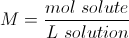
Since we have 1mol of protons and 1L of solution, the molarity of protons is simply 1M in the initial solution (1mol/1L). We can plug this into the pH equation and solve.

- After the dilution with water, the concentration of protons will change. Since the volume of the solution has doubled, the concentration of protons has been halved.
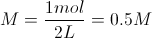

* Key points to remember!
-
The lower the pH, the more acidic the solution. This is why the diluted solution was 0.3 and the original, more acidic solution was 0.
-
pH is a logarithmic scale. As a result, a pH of 2 is ten times more acidic than a pH of 3. This is why halving the concentration DID NOT halve the pH.
The pH of a solution is given by the equation
- We can assume that hydrobromic acid, as a strong acid, will dissociate completely. As a result, there will be 1mol of protons in the initial solution. Molarity is a method of measuring the concentration of an agent in a solution and is defined by the equation below.
Since we have 1mol of protons and 1L of solution, the molarity of protons is simply 1M in the initial solution (1mol/1L). We can plug this into the pH equation and solve.
- After the dilution with water, the concentration of protons will change. Since the volume of the solution has doubled, the concentration of protons has been halved.
* Key points to remember!
-
The lower the pH, the more acidic the solution. This is why the diluted solution was 0.3 and the original, more acidic solution was 0.
-
pH is a logarithmic scale. As a result, a pH of 2 is ten times more acidic than a pH of 3. This is why halving the concentration DID NOT halve the pH.
← Didn't Know|Knew It →
What is the pH of a solution if you dilute 10mL of a 0.56M NaOH solution into 100mL of water?
What is the pH of a solution if you dilute 10mL of a 0.56M NaOH solution into 100mL of water?
Tap to reveal answer
We first need to calculate the moles of NaOH in 10mL of a 0.56M solution.

Now, in the new volume, the concentration is equal to this same number of moles divided by the new volume. The new volume is the sum of the two solutes together, so the sum of 10mL of solution and 100mL of water.

Now we need to calculate pH. Since NaOH will dissociate one hydroxide ion for every molecule of NaOH in solution, the concentration of hydroxide is equal to the concentration of NaOH.


Knowing the pH allows us to solve for the pH.


We first need to calculate the moles of NaOH in 10mL of a 0.56M solution.
Now, in the new volume, the concentration is equal to this same number of moles divided by the new volume. The new volume is the sum of the two solutes together, so the sum of 10mL of solution and 100mL of water.
Now we need to calculate pH. Since NaOH will dissociate one hydroxide ion for every molecule of NaOH in solution, the concentration of hydroxide is equal to the concentration of NaOH.
Knowing the pH allows us to solve for the pH.
← Didn't Know|Knew It →